
AI Licenses: The Hidden Profit Lever for Major Corporates
Large corporates are shifting from free AI tools to multi-year licensing contracts, with AI spending budgeted at 1.7% of revenue for 2026 against 0.8% in 2025 (BCG AI Radar 2026). The meaningful investor signal has shifted from AI buzz to the share of contracted recurring AI revenue and operating margin gains.

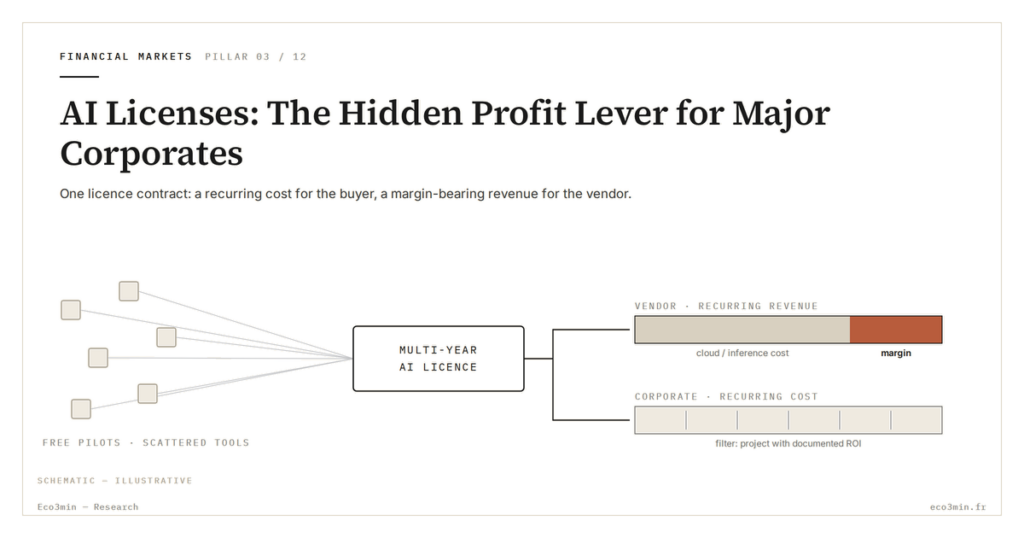
With AI models worth billions, the battle is shifting toward “AI licenses” and their recurring revenue streams.
TL;DR
Multi-year AI licensing contracts are replacing free pilots: several S&P 500 groups signed 3-to-5-year deals in November–December 2025, turning AI into a recurring P&L line with locked-in budget visibility.
- Corporate AI budgets are doubling year over year from a low base: 0.8% of revenue in 2025, 1.7% budgeted for 2026 (BCG AI Radar 2026), with financials at 2.0% and technology at 2.1%.
- Corporates are consolidating from 6–8 AI pilot tools to 2–3 strategic platforms, and the spend behind that consolidation is concentrated: professional services budget $3,470 per employee for 2026 against $672 in manufacturing (Atlanta Fed).
- Where vendors convert 25–30% of customers to add-on AI packs, average revenue per user can rise 20–40% within 12–18 months on low marginal cost.
In brief:
- Large corporates are shifting from free AI tools to multi-year AI licensing contracts.
- US firms spent $1,358 per employee on AI in 2025 and budget $2,068 for 2026 (Atlanta Fed, March 2026 survey), but more than half plan to stay under $200.
- Software vendors’ margins can rise by +5 to +10 points through these recurring licenses.
- The fed funds target stood at 3.50–3.75% in December 2025, after three cuts that year: above the 2015–2021 regime, no longer at the cycle peak.
- For investors, the meaningful signal is no longer AI buzz but the share of contracted recurring AI revenue.
What stands out this week
- Multi-year AI contracts: several S&P 500 groups announced 3-to-5-year AI agreements in November–December 2025, with minimum commitments in the tens of millions. Signal: IT budgets are being locked in, with high revenue visibility.
- Rising “cost of AI per employee”: US firms report $1,358 per employee spent on AI in 2025 and $2,068 budgeted for 2026, a 50% rise (Atlanta Fed, March 2026). Risk: margin pressure if productivity gains lag.
- AI integration into ERP/CRM: AI features are shipping inside existing ERP and CRM suites rather than as separate products, which is what turns them into a renewable line rather than a project. Impact: AI becomes a standard P&L line item rather than an innovation project.
- Vendor consolidation: many corporates are narrowing from 6–8 AI pilot tools to 2–3 strategic platforms. Winners: vendors able to sell group-wide licensing at scale.
What the news reveals on closer inspection
Since early 2024, most companies have experimented with generative AI through free tools or a few individual “pro” licenses. In 2025, the dynamic shifts: CFOs demand quantified ROI and structured contracts. BCG’s AI Radar 2026, run on 2,360 executives across 16 markets in January 2026, puts expected AI spending at 1.7% of revenue for 2026 against 0.8% in 2025: a doubling, from a base small enough that each line is still defended budget by budget. A related market angle — how markets turn selective on earnings — is set out in our analysis of earnings surprises and performance dispersion.
This shift unfolds against a still-elevated cost of capital: a fed funds target of 3.50–3.75% in the United States at end-2025, after three cuts that year, and an ECB deposit rate of 2.00% held since June 2025, both above the 2015–2021 period and both raised again in September 2026. The result: only AI projects with tangible return on investment (such as a 15% reduction in case-handling time or a −20% drop in support costs) secure multi-year budgets. AI is professionalizing, and AI licensing contracts increasingly resemble those of ERP or CRM ten years ago, with higher average ticket sizes. Related series: the equity risk premium series.
For software vendors, the shift is massive. A SaaS company that converts 25–30% of its customers to add-on “AI packs” can lift average revenue per user (ARPU) by 20–40% within 12–18 months. With low marginal costs (cloud costs persist, but software replicates), operating margins in the software sector could gain 5 to 10 points between 2023 and 2027, provided infrastructure bills and model costs stay under control.
This rise of AI licensing reflects a broader transformation in corporate economic structures, where software innovation has become a central lever for margins, pricing power and sector differentiation — a mechanism examined more broadly in the pillar dedicated to corporate and sector dynamics.
Implications across investor and corporate profiles
For equity investors:
- Companies that clearly disclose recurring AI revenue have stood out — particularly those where AI license revenue exceeds 10% of total revenue and grows by more than 3 points per year.
- Disclosure practice varies widely: some vendors break out AI-attributed bookings, others fold them into existing product lines, which makes any cross-vendor comparison of “AI revenue” unreliable without reading the definition each company uses.
- Sector dispersion, not the average, carries the information: the Atlanta Fed’s March 2026 survey puts professional and business services at $3,470 per employee for 2026, against $672 in manufacturing.
For corporate users:
- AI spending stood near 0.8% of revenue in 2025 and is budgeted at 1.7% for 2026 (BCG AI Radar 2026); only technology (2.1%) and financial institutions (2.0%) reach the level that 2025 commentary treated as general.
- AI licensing contracts have increasingly included annual review clauses tied to KPIs: when productivity gains stay below 5%, price reductions or expanded feature sets have become standard outcomes.
- The dominant pattern has been tool consolidation: one horizontal AI platform (office/productivity) plus one business-vertical platform (e.g., AI for customer relations or supply chain).
For individuals and independent professionals: the published surveys measure firms, not sole traders, and no comparable series tracks independent professionals’ AI spending. What the firm-level data does show is that the median employer stays under $200 per employee per year, an order of magnitude below the employment-weighted average of $2,068.
Weak signals to watch closely
- “AI seats” share in SaaS contracts: when a vendor reports that more than 30% of active users have adopted AI modules, the revenue model shifts.
- Internal productivity KPIs: tickets handled per agent, average response time, cases closed per week. Stable gains exceeding 15% across three consecutive quarters have historically marked AI license scale-up phases.
- Cloud-cost-to-AI-revenue ratio: when this ratio exceeds 35–40%, forward margins come under threat and models become fragile in pricing-down scenarios.
- Average AI contract duration: a move from 1-year “pilots” to a 3-year standard signals that AI has become structural within the organization.
What may unfold over the next 3 to 12 months
Scenario 1 — Profitable normalization (≈50% probability)
Global growth holds near 2.5–3% in 2026, rates ease modestly without collapsing. AI budgets grow 15–20% per year, but heavily concentrated on a few vendors. Valuation multiples for AI software vendors stabilize around 18–22x 2026 earnings. Key indicator: quarterly recurring AI revenue growth above 5%.
Scenario 2 — AI spending pullback (≈30% probability)
A marked slowdown in 2026 forces CFOs to cut projects without direct profitability. AI license renewals drop, growth rates fall below 10%. Unprofitable AI names correct by 30–50%. Key indicator: announcements of major cost-savings plans combined with tech hiring freezes.
Scenario 3 — Explosive outperformance by a few leaders (≈20% probability)
A small number of players succeed in standardizing AI licensing globally (an enforced “office + AI” model). Their revenue per user climbs 40–60% over three years, with operating margins above 35%. Key indicator: global AI contract signings covering more than 100,000 seats per agreement.
Conclusion
AI is leaving experimentation behind to become a structural revenue — and cost — line. The point is no longer to “do AI” but to lock in profitable, measurable, scalable AI licensing. For investors and executives alike, the central question has become the capacity to convert technological buzz into visible recurring flows. The coming quarters will separate costly illusions from genuine cash-flow pools, with allocation and contract reviews preceding the next budget arbitration cycle. Where those pools already exist, they show up as the residual left after capital spending, tracked in quarterly free cash flow for six large US tech firms since 2017.
- Large corporate AI budgets doubled between 2023 and 2025, but only projects with measured gains above 10% are likely to survive in a high-rate environment.
- The AI budget line is doubling from a low base (0.8% to 1.7% of revenue, BCG 2026) while the median employer stays under $200 per employee: the aggregate and the typical company tell different stories.
- Profitable AI shows up in the contracts: durations beyond 3 years, more than 30% of users converted to AI modules, and operating margins lifting 5 to 10 points.
Last updated — 22 September 2026
Disclaimer – Financial and Legal Information: The analyses, commentary, and content published on eco3min.fr are provided for informational and educational purposes only. They do not constitute investment advice or a solicitation to buy or sell financial instruments. Past performance is not indicative of future results. All investment decisions involve risk and are the sole responsibility of the reader. Data, charts and calculated series are provided as is and may contain errors or lag behind their source: check any figure against the primary source cited before relying on it. Content describing laws, regulations or contracts reflects the law as of its publication date and does not constitute legal or tax advice; applying it to a specific situation requires a qualified legal or tax professional.
Read next
Full pillar →Earnings Surprises and Performance Dispersion: Why Markets Turn Selective Before Indices
Earnings surprises reveal growing performance dispersion well before any broad correction. A structural signal of an equity market…
Nasdaq 100: The True Risk Barometer of the Cycle
The Nasdaq 100 is no longer just a tech index but the gravity centre of global equity risk,…
Global Equity ETFs: When the US Weight Outruns the US Economy
US issuers made up 61.4% of a fund tracking the MSCI ACWI in July 2026, against 48.8% of…