
Holding-Period Lock-In and Sequencing Risk: When the Tax Clock Meets a Drawdown

An equity plan’s five-year tax break fixes a date, but an equity market does not know where it will be on that date: the fiscal clock and the market calendar can collide at the moment of withdrawal.
Sold as a simple advantage, the five-year clock also carries a rarely named risk. This analysis frames it as sequencing risk applied to the wrapper, and prescribes no date.
After five years, gains in a French equity plan escape income tax; but if the withdrawal lands in a drawdown, the tax date and the market date collide.
- The five-year exemption covers income tax only: social levies remain due on gains, at 18.6% since 1 January 2026.
- A fiscal clock fixes a date; the market’s valuation level on that date depends on the entry point in the cycle, measurable for instance through the CAPE.
- The risk is not the average return but the dispersion of outcomes by exit date: sequencing risk, applied to the wrapper rather than to a withdrawal-rate rule.
A tax-advantaged equity plan rewards patience with a fiscal window: hold past a threshold and gains escape income tax. That clock is sold as an advantage. It is also a rarely named risk. A fiscal clock fixes a date; an equity market does not know where it will be on that date. When a goal’s deadline, and therefore the withdrawal, lands during a drawdown, the tax calendar and the market calendar collide. This is sequencing risk applied to the wrapper itself, not to a withdrawal-rate rule. Using the French PEA’s five-year clock as a working case, and Eco3min’s CAPE/regime series, this piece reads how likely that collision is depending on the entry point in the valuation cycle. It prescribes no date. It makes visible a mechanic that “gains are tax-free after five years” hides completely. In the same vein: our analysis of reducing taxable income.
The five-year clock, what it opens and what it does not close
The base mechanic is simple to state. As long as the money stays inside the plan, dividends and capital gains compound untaxed. After five years of holding, a withdrawal no longer triggers income tax on the gains. The advantage is therefore conditional on duration: it rewards a five-year commitment, not the mere opening of the plan.
Two qualifications change the common reading. First, the exemption covers only one tier. Since 1 January 2026, social levies remain due, at 18.6% on gains, up from 17.2% before. “Tax-free” here means “free of income tax,” not “free of every levy.” Second, crossing the five-year threshold freezes no outcome. The plan merely becomes free of income tax; the value of the holdings at the moment of withdrawal depends entirely on the market. The clock opens a tax door; it does not guarantee the value that will pass through it. That distinction between container and content extends directly the reading of wrappers as mechanics, not a ranking: the wrapper sets a tax regime, not a return. A closer look: the vehicles matched to their regime.
This clock must be distinguished from its pre-five-year symmetry. An early withdrawal triggers, in principle, the closure of the plan and the taxation of gains realised since opening; that is a separate tax mechanic. This article does not address the exit rule but the timing risk that weighs even when the clock is honoured: the risk of withdrawing after five years, within the rules, but at the wrong point of the cycle. For the wider question of whether to hold equities in a sheltered or a taxed wrapper at all, see the sheltered-versus-taxable choice.
Why a fixed date collides with a market that is not fixed
The heart of the problem is an asymmetry of nature between two calendars. The tax calendar is deterministic: the five-year date is known from the opening, and a goal’s deadline (the down payment for a purchase, the funding of a need) often fixes a withdrawal window too. The market calendar is stochastic: no one knows where the index will be on a given date. When a fixed date meets an uncertain path, the net result depends on the exact point where the two cross. A deferred loss works on the same crossing, since the deduction only lands when a later sale is made, which is the mechanism behind the wash sale rule and its effect on tax loss strategies.
In practice, two savers following the same strategy, with the same holding period and the same tax advantage, can obtain very different net results depending on whether their withdrawal window falls after a rally or during a correction. The tax advantage is identical for both; the valuation at exit is not. That is precisely what “tax-free after five years” hides: it describes the tax tier and ignores the market tier, which often weighs more on the final amount actually received.
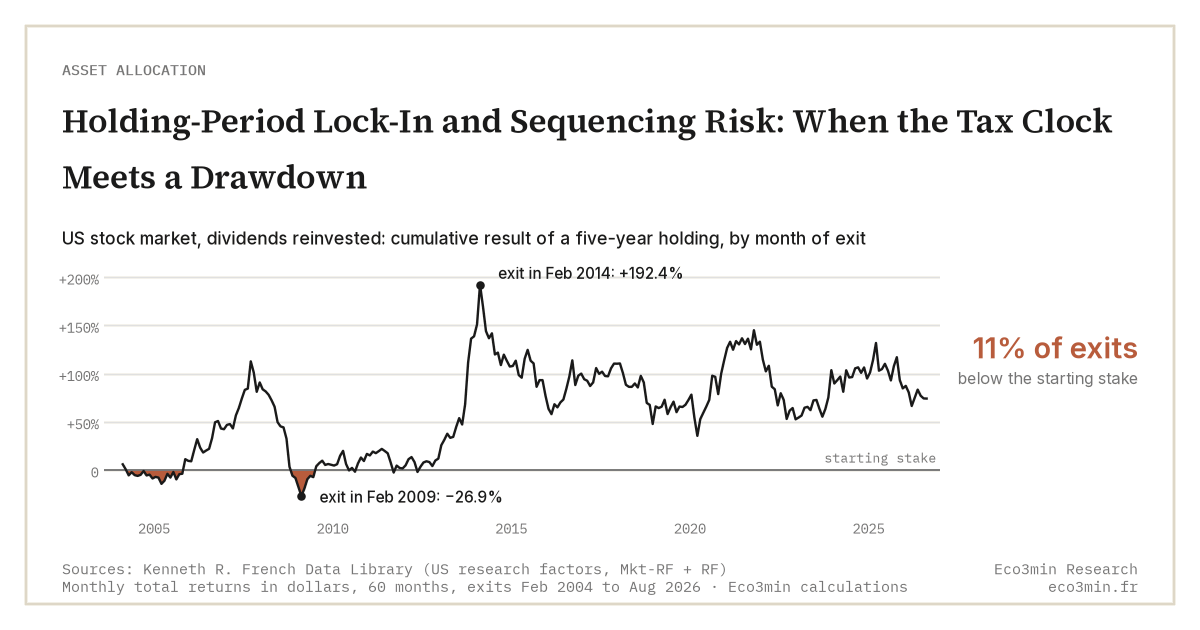
The order of magnitude makes the hierarchy clear. The advantage carried by the clock is bounded: it removes income tax, 12.8% of gains under the flat regime, with social levies still due. A market move, by contrast, has no comparable bound: between a high and a trough, an equity index can fall by tens of percent. On the US stock market with dividends reinvested (Kenneth R. French Data Library), a five-year holding returned anywhere from −26.9% (exit in February 2009) to +192.4% (exit in February 2014) depending on the month of exit, and 11% of exits between February 2004 and August 2026 landed below the starting stake. When the potential amplitude of the market tier so clearly exceeds that of the tax tier, it is the timing of exit, not the exemption, that drives most of the net result. The fiscal clock optimises a second-order variable while the first-order variable, valuation at maturity, stays fully exposed to the cycle.
This mechanic has a name in portfolio analysis: sequencing risk. It is usually invoked for scheduled retirement withdrawals, where the order of returns matters as much as their average. Applied to the wrapper, it takes a particular form: it is not a regular withdrawal rate meeting a sequence of returns, but a single exit window, partly constrained by a tax deadline or a goal, meeting a given market level. The risk sits not in the long-term average but in the date. More on this: our study of pre-tax retirement wrappers.
Reading the probability of collision through the entry point
If the exit date is partly constrained, the only remaining analytical lever is the entry point. And the entry point reads through the valuation level at the moment of exposure. A cycle-adjusted valuation ratio, such as the CAPE (the price-earnings ratio smoothed over ten years of inflation-adjusted earnings), measures the terrain on which the clock will run.
The logic is probabilistic, not deterministic. Entering at a high valuation level does not imply a certain decline; it shifts the distribution of possible outcomes downward and raises the probability that the five-year clock opens onto a market lower than at entry. Entering after a correction does the opposite. The valuation level at entry does not predict the date of the next trough; it informs the margin of safety with which one approaches the deadline. The series that tracks that level over time, namely the CAPE level at entry, lets an exposure point be placed against its own history.
The macro regime adds a layer. The same CAPE level does not carry the same weight across regimes: low real rates mechanically justify higher valuations, high real rates compress them. Reading the entry point therefore means crossing the valuation level with the rate regime that underpins it, not looking at the CAPE in isolation. That reading by cycle extends the approach of the sub-pillar devoted to choosing investments by regime.
“Gains are tax-free after five years” is accurate on income tax and misleading on the result. The phrase describes the tax tier and stays silent on the market tier: a withdrawal can be perfectly free of income tax and still bear on capital cut down by a drawdown. The exemption removes a levy; it does not neutralise sequencing risk on the value withdrawn.
What the clock does not say
The mechanic described here is neutral: it recommends no entry or exit date, and does not say one should avoid the equity plan or defer its use. It makes visible a variable that the dominant tax reading leaves in shadow. The exposure decision depends on variables specific to each situation, the real horizon of the goal, the tolerance for seeing value fluctuate as the deadline nears, the ability or not to postpone the withdrawal, that this article does not know and does not arbitrate.
It is worth being explicit about what “neutral” rules out. The analysis does not claim valuations are too high or a correction is due; it claims only that the net result of a five-year hold depends on the entry level and the exit timing, both of which the headline tax framing ignores. A saver entering after a deep correction faces a different distribution of outcomes than one entering near a cyclical peak, even with the same wrapper and the same five-year discipline. Naming that difference is description, not a forecast and not a signal.
The PEA’s timing risk is not isolated. Life insurance carries a second, longer clock whose reach also depends on the cycle, and the choice between a sheltered wrapper and a taxable one, which conditions the very existence of the clock, sits upstream of this question. Sequencing risk applied to the wrapper replaces none of those analyses: it adds the time dimension that taxation, on its own, does not capture.
One reading this article makes possible without settling it remains: at a given valuation level and rate regime, what margin of safety does a saver judge sufficient as the deadline approaches? The mechanic can be described; the answer belongs to each situation, and it is precisely because it depends on the entry point and the regime that it does not reduce to “tax-free after five years.”
Last updated — 8 October 2026
Disclaimer – Financial and Legal Information: The analyses, commentary, and content published on eco3min.fr are provided for informational and educational purposes only. They do not constitute investment advice or a solicitation to buy or sell financial instruments. Past performance is not indicative of future results. All investment decisions involve risk and are the sole responsibility of the reader. Data, charts and calculated series are provided as is and may contain errors or lag behind their source: check any figure against the primary source cited before relying on it. Content describing laws, regulations or contracts reflects the law as of its publication date and does not constitute legal or tax advice; applying it to a specific situation requires a qualified legal or tax professional.
Read next
Full pillar →Investment Wrappers Are Mechanics, Not Rankings
A tax-advantaged equity plan, a taxable brokerage account and a life-insurance wrapper do not fire the same mechanics…
Target-Date Funds vs Self-Directed Portfolios: The Mechanics of a Delegated Glide Path
A target-date fund is sold as a simple, set-and-forget win. It is first something narrower: a delegated glide…
What Guaranteed Savings Products Have Paid: Fixed Annuity and Stable Value Yields Through the Rate Cycle
US guaranteed savings products credit a rate that trails the bond market rather than tracking it. Through the…