
Understanding Economic Cycles: The Eco3min Analytical Framework
Why do economic analyses so often get cycles wrong?
Because they confuse events, cycles, and structural constraints. Markets react to news; economic cycles, however, respond to slower dynamics: real interest rates, credit, energy, demographics, liquidity — and to the way monetary policy transmits through the economy, shaping financial conditions over time.
Understanding a cycle does not mean predicting the next crisis. It means identifying the durable forces that shape economic and financial regimes.
This page presents the methodological framework used by Eco3min to analyze these dynamics.
The concept of an economic cycle is based on a precise definition:
What is an economic cycle?
An economic cycle is the alternation of expansion and slowdown phases in growth and activity, influenced by credit, interest rates, and investment dynamics. It reflects a durable macroeconomic dynamic, not a simple crisis episode.
What is a financial cycle?
It is important to distinguish the economic cycle from the financial cycle:
A financial cycle corresponds to phases of expansion and contraction in credit, liquidity, and asset prices. It directly influences the magnitude and duration of the economic cycle.
How should economic cycles be analyzed?
Analyzing an economic cycle relies on four steps:
- Identify structural constraints (debt, demographics, energy).
- Assess the position within the credit and interest rate cycle.
- Measure liquidity conditions and the cost of capital.
- Distinguish temporary events from regime shifts.
What deciphering economic cycles does not mean
- Predicting market turning points
- Anticipating the exact dates of crises or recoveries
- Producing actionable short-term scenarios
- Reacting to news as an autonomous signal
Prediction remains a chimera in economics. Cyclical analysis aims to minimize major interpretation errors, not eliminate uncertainty.
The foundation of the approach: mapping constraints before opportunities
Any economic or financial dynamic unfolds within a constrained environment: interest rates, liquidity, cost of capital, energy, demographics, geopolitics, and value chain architecture.
Apparent opportunities never emerge ex nihilo. They are systematically conditioned by a specific macroeconomic regime.
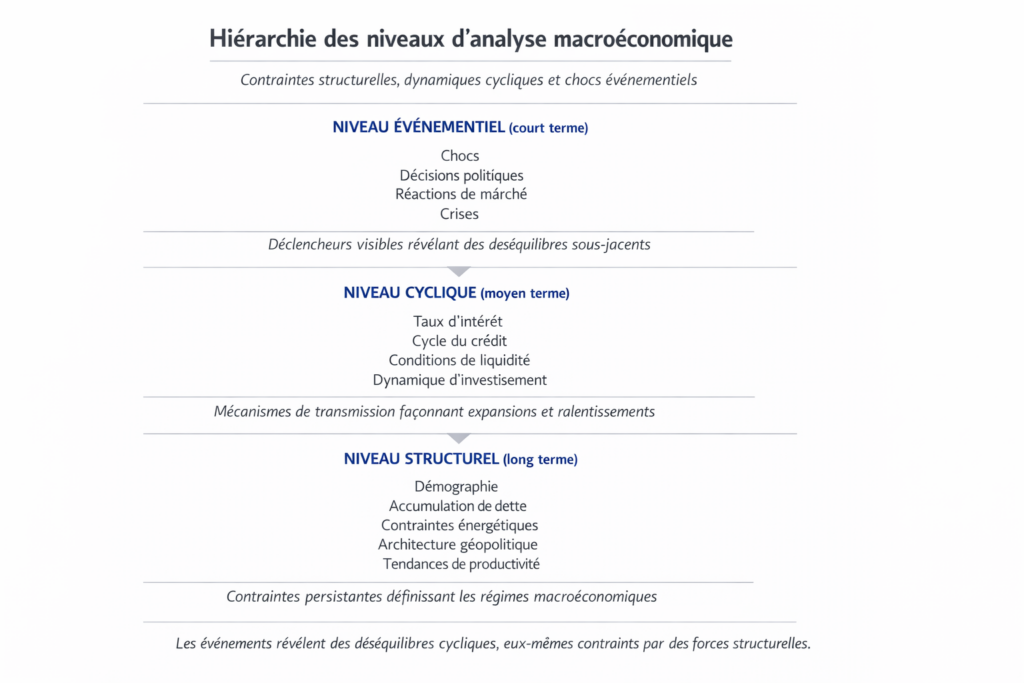
What is the difference between structural, cyclical, and event-driven factors?
Structural refers to durable constraints, cyclical to economic phases, and event-driven to temporary shocks.
The distinction between these three levels of analysis is essential:
- Structural: durable constraints such as demographics, debt, or energy.
- Cyclical: phases linked to interest rates, credit, and liquidity.
- Event-driven: temporary shocks revealing an existing imbalance.
Common mistakes in economic cycle analysis
Several recurring confusions distort economic cycle analysis:
- Confusing market rises with structural improvement.
- Interpreting an isolated shock as a lasting change.
- Ignoring the role of real rates and credit.
- Extrapolating short term into long term.
Understanding transmission mechanisms
Economic cycles spread through successive layers: from macroeconomic forces to the financial sphere, before reaching the productive fabric and the real economy.
This propagation logic underpins all analyses published on Eco3min through its various thematic pillars.
Eco3min pillars as specialized analytical frameworks
- Macroeconomics & Geopolitics : global structural constraints
- Monetary policy & rates : the price of time and capital
- Commodities : physical supply and real cycles
- Financial markets : reactions to macroeconomic regimes
- Investment strategies : consistency over time
- Stocks & ETFs : valuation and cycle arbitrage
- Real estate & cycles : credit, rates, and real asset pricing
- Crypto assets : hybrid assets and liquidity
- Financial education : durable decision frameworks
A transparent methodology
The analytical approach of Eco3min is detailed here: Macroeconomic analysis methodology.
It is grounded in a rigorous editorial charter: Editorial charter, ensuring an informative, analytical, and non-prescriptive approach.
This methodological framework ensures analytical consistency across content, a clear distinction between facts, analysis, and hypotheses, and adherence to rigorous economic information free of sensationalism and any form of solicitation.
The editorial identity of Eco3min
Eco3min is neither a real-time news outlet nor an investment advisory service.
Its mission is to shed light on the forces that shape the economy and financial markets, enabling greater perspective amid pervasive uncertainty.
Learn more: About Eco3min.
In summary
Deciphering economic and financial cycles means identifying the persistent constraints that shape regimes, not precisely forecasting events.
This page represents Eco3min’s methodological foundation. It sets out the analytical principles used across all articles, reports, and tools published on the site, providing an economic perspective that is coherent, contextualized, and grounded in the long term.