
Geopolitics and Macroeconomics: Structural Transmission to Markets and Economic Regimes
Trade tensions, energy constraints, and fragmented value chains: how persistent geopolitical forces transmit into macroeconomic cycles and financial markets.
— Geopolitics is no longer a temporary risk. It is a structural constraint reshaping economic regimes.
This page is an analytical subset of the pillar Macroeconomics & Geopolitics. It provides a cross-disciplinary framework to understand how persistent geopolitical constraints transmit into macroeconomic and financial regimes.
Geopolitics is no longer a simple episodic risk factor, but a structural constraint that durably shapes macroeconomic cycles, value chains, trade flows, and investment decisions. Between 2018 and 2024, geopolitical shocks were cited as the primary risk factor in World Economic Forum surveys of global executives — ahead of inflation, climate change, and cybersecurity. The cumulative economic cost of geopolitical disruptions since 2020 — pandemic, war in Ukraine, Red Sea crisis, sanctions, trade war — is measured in trillions of dollars and in lost points of global growth.
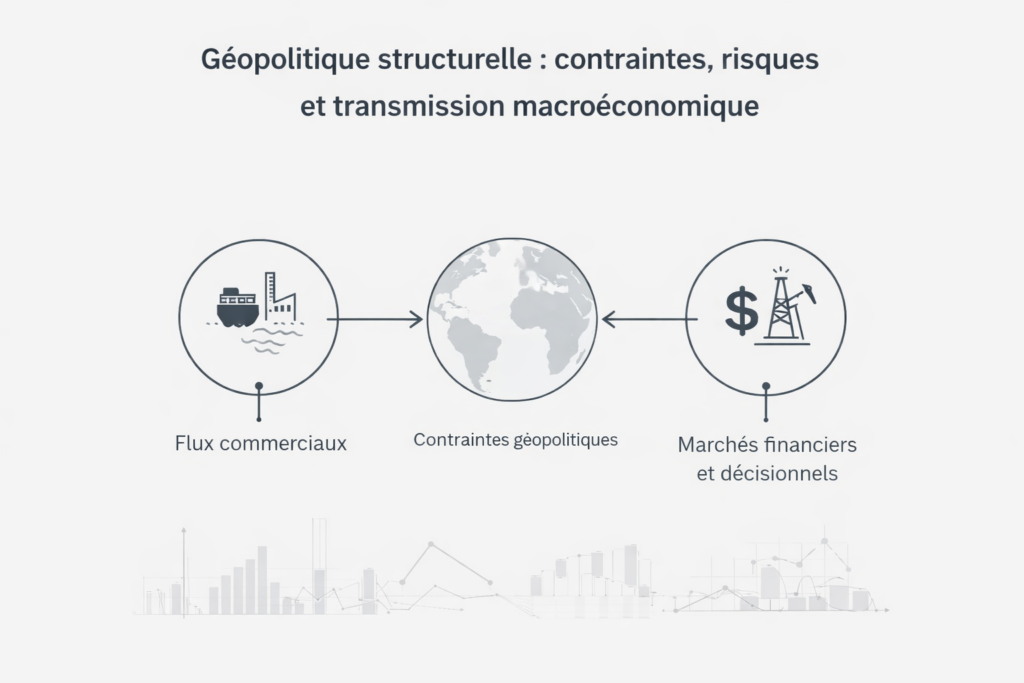
This page structures the analysis of how geopolitical constraints transmit to the real economy and financial markets. The objective is not to predict the next geopolitical event — an exercise whose reliability is close to zero — but to understand the transmission channels through which a geopolitical event alters macroeconomic parameters: energy prices, transportation costs, capital flows, risk premia, and value-chain reallocation.
Geopolitical risk in numbers: a measurable reality
Geopolitics is often perceived as qualitative and difficult to quantify. In reality, its effects are measurable through concrete indicators whose recent evolution documents a regime shift.
Trade restrictions. The number of restrictive measures on global trade rose from 600 per year in 2017 to more than 3,000 in 2024 (Global Trade Alert) — a fivefold increase in seven years. Average tariffs on Chinese imports to the United States rose from 3.1% to around 19% (Peterson Institute for International Economics). The WTO estimates that trade restrictions now affect more than $2.5 trillion in annual trade flows.
Military spending. Global military expenditures reached $2.443 trillion in 2023 (SIPRI), a historic real-term record. Within NATO, the number of members meeting the 2% of GDP target increased from 3 in 2014 to 11 in 2024. China’s official military budget exceeded $230 billion in 2024, with annual growth above 7% for a decade (Western estimates place the real figure closer to $400 billion). This rising militarization diverts budgetary resources that would otherwise fund productive investment.
Economic sanctions. The number of active sanctions programs has surged since 2014. As of late 2024, the United States maintained sanctions against more than 12,000 entities across over 30 countries (OFAC, Treasury). The freezing of Russian central bank assets — roughly $300 billion immobilized in February 2022 (ECB, Federal Reserve) — marked a historic precedent whose implications for the international monetary system are analyzed in the Dollar sub-pillar.
Estimated economic cost. The IMF estimates that geoeconomic fragmentation could reduce global GDP by 1% to 7% in the long run depending on the extent of decoupling (World Economic Outlook, 2023). The war in Ukraine imposed more than €200 billion in additional energy costs on the European economy in 2022 (Bruegel). Pandemic-related supply chain disruptions added 2–3 percentage points to goods inflation in advanced economies (BIS, 2022).
Three geopolitical regimes since 1990: from the peace dividend to fragmentation
The relationship between geopolitics and macroeconomics has passed through three distinct phases since the end of the Cold War, each defined by a different regime of risk and transmission.
1990–2008: the peace dividend and hyper-globalization
The collapse of the Soviet bloc (1989–1991) opened a historically exceptional period of low perceived geopolitical risk. Global military spending fell from 4.7% of world GDP in 1988 to 2.3% in 1999 (SIPRI) — a “peace dividend” reinvested into consumption, investment, and deficit reduction. Global trade quadrupled (WTO). China’s accession to the WTO (December 2001) integrated 1.3 billion people into the global market economy.
Geopolitical shocks during this period — Gulf War 1990–91, September 11 attacks, Iraq War 2003 — produced violent but temporary market effects. The S&P 500 fell 12% in the five days after September 11, 2001, but fully recovered within two months. Oil briefly reached $147 per barrel in July 2008 (ICE), but the primary driver was financial speculation rather than supply disruption. Geopolitical risk premia remained temporary and absorbable.
2014–2020: early signs of fragmentation
Russia’s annexation of Crimea in March 2014 marked the return of power politics in Europe. However, the structural inflection point came with the U.S.–China trade war launched in March 2018. For the first time since the 1930s, the world’s two largest economies entered deliberate tariff escalation. The Trade Policy Uncertainty Index surged to unprecedented levels (Federal Reserve Bank of St. Louis).
Market impact was measurable. U.S. business investment growth slowed from 5.9% to 1.4% annually between 2018 and 2019 (BEA) as firms delayed capex decisions amid trade uncertainty. Global manufacturing PMI remained below the contraction threshold of 50 for eight consecutive months between 2019 and 2020 (JPMorgan/S&P Global). MSCI Emerging Markets underperformed MSCI World by 15 points between 2018 and 2019, absorbing the shock of trade fragmentation.
2022–?: geopolitics as a permanent constraint
Russia’s invasion of Ukraine in February 2022 shifted geopolitics from episodic risk to permanent structural constraint. For the first time since 1945, a high-intensity conventional war involved a permanent UN Security Council member on European soil. Western sanctions against Russia — the most extensive ever imposed on a major economy — rapidly reconfigured global energy, financial, and trade flows.
The macroeconomic impact was immediate and lasting. European natural gas (TTF) reached €340/MWh in August 2022 versus a €20 average over the prior decade (ICE) — a seventeen-fold increase. Wheat prices surged 60% in two weeks, with Russia and Ukraine accounting for 28% of global exports (FAO). Germany — Europe’s largest economy — saw its industrial model challenged by the loss of cheap Russian energy: GDP stagnated in 2023 (+0.0%) and contracted in 2024 (−0.1%) according to Destatis, an unprecedented outcome for an economy built on cheap Russian energy plus exports to China.
This period also saw new geopolitical fronts with direct economic implications: the Red Sea crisis (late 2023), intensified U.S.–China tech rivalry (semiconductor restrictions of October 2022 and 2023), and rising tensions in the Taiwan Strait — all turning geopolitics into a structural parameter of macroeconomic analysis.
Five geopolitical transmission channels
Geopolitics transmits to the economy and markets through identifiable and measurable channels. Understanding these channels — rather than reacting to events — is central to structural analysis.
Channel 1: energy and commodities
Energy is the most immediate and powerful geopolitical transmission channel. Every major geopolitical crisis since 1973 has produced a measurable energy shock. The 1973 oil embargo quadrupled crude prices. The 1979 Iranian revolution doubled them. Iraq’s invasion of Kuwait in 1990 caused a temporary doubling. The 2022 war in Ukraine multiplied European gas prices by seventeen.
The macroeconomic transmission mechanism is direct: higher energy costs act as a tax on overall economic activity, compress corporate margins, reduce household purchasing power, and generate imported inflation. The ECB estimates that the 2022 energy shock added 2.5 percentage points to euro-area inflation (ECB, Economic Bulletin). Middle East energy risks are detailed in our regional energy risk analysis.
Channel 2: supply chains and trade
Value-chain fragmentation — analyzed in depth in the Deglobalization sub-pillar — is the second structural channel. Trade restrictions multiplied fivefold since 2017, U.S.–China tech decoupling, and maritime route reconfiguration durably reshape production costs and relative competitiveness. The New York Fed’s Global Supply Chain Pressure Index reached 4.3 standard deviations above average in December 2021 — an unprecedented stress level.
Channel 3: capital flows and the dollar
Geopolitical crises trigger massive capital reallocations toward perceived safe assets — U.S. Treasuries, the dollar, gold, Swiss franc. In 2022, the DXY index reached 114 (+16% year-over-year), tightening global financial conditions via the dollar channel analyzed in the Dollar sub-pillar. Capital outflows from emerging markets reached $100 billion between March and October 2022 (IIF). Gold hit record highs above $2,400/oz in 2024 (LBMA), supported by record central bank purchases — 1,037 tons in 2023 (World Gold Council) — reflecting post-sanctions reserve diversification.
Channel 4: public budgets and industrial policy
The return of geopolitics massively redirects public spending toward defense and industrial policy. NATO military budgets increased by more than $300 billion annually between 2014 and 2024 (SIPRI). The CHIPS Act ($53B), IRA ($369B), European Chips Act (€43B), and Germany’s rearmament plan (€100B) represent major fiscal reallocations that reshape public spending structures and sector dynamics — while widening deficits at a time when debt sustainability is already under strain.
Channel 5: risk premia and volatility
Geopolitical risk transmits to financial markets through risk premia. The Caldara-Iacoviello Geopolitical Risk Index (Federal Reserve Board) reached its highest level since the Iraq War in 2022. Empirically, major geopolitical shocks raise the VIX by 10–30 points on average (CBOE), widen credit spreads by 50–150 bps, and lead to 5–15% underperformance of risky assets in subsequent weeks.
The most significant phenomenon, however, is persistence. Unlike 1990–2014 when geopolitical premia faded within weeks, markets now embed a structural geopolitical risk premium — visible in persistently elevated gold prices, a positive long-term Treasury term premium, and valuation premia for firms less exposed to geopolitical risks. The return of volatility is analyzed in our dedicated report.
Four structuring geopolitical hotspots
Without claiming exhaustiveness, four geopolitical hotspots concentrate most macroeconomic risks over the coming decade.
U.S.–China rivalry is the matrix of global fragmentation. It extends far beyond trade into technology (semiconductors, AI, quantum), finance (de-dollarization, SWIFT vs CIPS), space, and military capabilities. The semiconductor war, analyzed in our dedicated report, shows how an industrial issue becomes a major macroeconomic factor. Taiwan risk — with CSIS simulations estimating blockade costs above $2 trillion in year one — remains the primary tail scenario for markets. Tech-financial fragmentation is examined in our dedicated study.
The broader Middle East remains the main energy risk hotspot. The Strait of Hormuz, through which 21% of global oil flows, is a critical chokepoint. The Red Sea crisis (late 2023–2024) showed how a non-state actor (Houthis) could disrupt 12–15% of global maritime trade, cutting Suez Canal traffic by 50% (Suez Canal Authority). Detailed impacts are covered in our Red Sea corridor analysis.
Russia and the post-Soviet space — the war in Ukraine reshaped European energy flows, drove historic NATO enlargement (Finland, Sweden), and triggered the largest sanctions package ever. Escalation risk — including nuclear — remains a tail scenario imperfectly priced by markets.
Strategic minerals are an expanding geopolitical front. China controls 60% of rare earth production, 70% of cobalt refining, and 80% of graphite processing (USGS, IEA). In December 2023, China imposed export restrictions on germanium and gallium — key materials for semiconductors and defense — demonstrating how critical minerals become foreign-policy tools, as documented in our dedicated analysis.
How to read geopolitics as a macro analyst: the eco3min method
The eco3min analytical method follows one guiding principle: every geopolitical analysis must connect an observable event to a measurable economic constraint. A geopolitical event that transmits through none of the macro channels — energy, trade, capital, budgets, risk premia — has no relevance for economic and financial analysis, regardless of its human or diplomatic gravity.
This analytical discipline rests on three pillars. First, identify the transmission channel: a Middle East conflict transmits through energy prices, a Taiwan crisis through semiconductors, sanctions escalation through capital flows. Second, distinguish temporary shocks from structural constraints: the Red Sea crisis is temporary (reroutable via the Cape of Good Hope); U.S.–China tech decoupling is structural (irreversible in the foreseeable horizon). Third, quantify macro impact rather than speculate on political scenarios: the macro analyst does not predict whether China will invade Taiwan — they model the GDP, inflation, and supply-chain costs of a blockade.
This method informs all site pillars — Monetary Policy & Rates, Financial Markets, Equities & ETFs, Investment Strategies — grounded in the conviction that geopolitics is now a structural parameter of macro analysis, not background noise.
Treating every geopolitical event as an unpredictable “black swan.” In reality, most recent geopolitical shocks — Ukraine war, Red Sea crisis, tech restrictions on China — followed long-identifiable trajectories. The error is not failing to predict the event, but refusing to price the trajectory before the event materializes.
Implications for markets and allocation
The shift from episodic geopolitical risk to structural constraint has measurable implications for markets and asset allocation.
Structural risk premium. Markets now embed a permanent geopolitical component in risk premia. The U.S. Treasury term premium — extra compensation for holding duration — has turned significantly positive after a decade of compression, partly due to geopolitical risk (Adrian, Crump & Moench, Fed NY Term Premium Model). Gold — the quintessential safe haven — reached successive record highs in 2024, incorporating a geopolitical premium not fully explained by traditional real-rate models.
Sectoral reconfiguration. Defense and cybersecurity sectors directly benefit from rising tensions — the S&P Aerospace & Defense Index outperformed the S&P 500 by more than 30 points between 2022 and 2024 (S&P Global). Critical materials producers (lithium, copper, uranium, rare earths) carry rising strategic valuation premia. Conversely, firms most exposed to fragmentation — reliant on single-country sourcing, vulnerable to sanctions, exposed to risky maritime corridors — face geopolitical risk discounts.
Stronger home bias. Amid geopolitical uncertainty, institutional investors overweight domestic assets and reduce exposure to geopolitically vulnerable markets. This reinforced home bias, documented by the IMF (Global Financial Stability Report, 2023), reduces cross-border flows and contributes to financial fragmentation alongside trade fragmentation.
Structural economic analysis neither eliminates uncertainty nor geopolitical risk. It contains them by identifying transmission channels, quantifying potential impacts, and separating structural signals from noise. This framework informs the Investment Strategies and Real Estate & Cycles pillars, where geopolitical constraints translate into concrete allocation decisions.
Geopolitics has changed status in macroeconomic analysis. It has shifted from a tail risk — unlikely and episodic — to a structural constraint durably reshaping global economic parameters: energy costs, value-chain configuration, public-budget allocation, risk premia, and capital flows. The relevant diagnosis is not “what will the next shock be?” but “which transmission channels are active, how persistent are they, and how do they reshape the macroeconomic regimes in which markets and firms operate?”
← Back to pillar page Macroeconomics and Geopolitics