
Equity ETF Flows in 2026: A Leading Indicator of Market Risk

Equity ETF flows are an early barometer of investor positioning and the gradual return to risk.
After a phase of balancing between equities and bonds, recent reallocations point to a renewed appetite for risky assets — but not in an indiscriminate way. The trend remains concentrated in certain regions and management styles. Reading these flows helps anticipate allocation rotations before they become visible in the indices.
TL;DR: 5 key takeaways
- Net flows into global equity ETFs have resumed after a period of more balanced arbitrage with bonds.
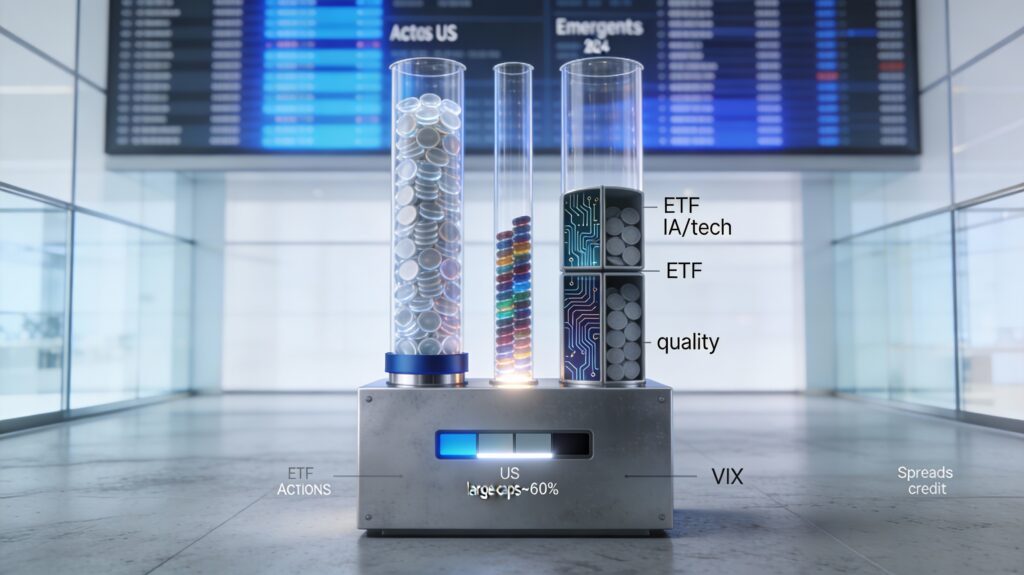
- U.S. large-cap equity ETFs still attract the majority of inflows, but Europe and emerging markets are gradually becoming more attractive again.
- Technology exposures remain dominant, while “quality,” “value,” and dividend strategies are drawing steady inflows.
- Index concentration remains high, increasing the sensitivity of capitalization-weighted ETFs to mega-caps.
- Tracking ETF flows alongside implied volatility and credit spreads provides an early signal of market rotations.
Main trends to note this week
- Sustained flows into U.S. equity ETFs: several consecutive weeks of net inflows, with a large share going to S&P 500 and Nasdaq-tracking ETFs. Signal: risk appetite, but still concentrated.
- Emerging market flows stabilize: after a long stretch of outflows in 2024–2025, emerging market ETFs are recording modest net inflows. Implication: gradual geographic diversification.
- Slower flows into long-duration bond ETFs: flows are shifting back toward intermediate maturities, signaling a reassessment of rate expectations.
- Visible sector rotation: industrials, financials, and energy are attracting positive flows alongside tech. Message: a bet on moderate growth rather than a binary scenario.
- Higher volumes in hedging ETFs: inverse and low-volatility ETFs are seeing higher volumes, suggesting hedging strategies rather than one-way optimism.
Deep dive: what the current setup reveals
After a second half of 2025 marked by bond-friendly arbitrage, early 2026 reflects a more balanced reallocation phase. The partial easing in long rates and the stabilization of inflation expectations have made the equity/bond trade-off less asymmetrical.
ETF flows show that the return to equities is not indiscriminate. “Quality” and “value” strategies continue to attract capital alongside technology ETFs. This reflects a cautious positioning style, favoring strong balance sheets and visible cash flows.
This reading makes even more sense when placed within the broader framework of equity markets and ETFs, where index concentration and factor arbitrage change the real impact of observed flows.
Immediate implications for your allocations
1. Adjust the equity/bond mix
- For a balanced profile with a horizon of more than 5 years: a structure close to 55% equities / 35% bonds / 10% cash.
- Increase equity exposure primarily through global ETFs, with geographic diversification including 2–4% emerging markets.
2. Reduce concentration risk
- Limit capitalization-weighted S&P 500 ETFs to around 25–30% of total portfolio exposure.
- Complement with 10–15% in equal-weight or factor ETFs (quality/value) to reduce dependence on mega-caps.
3. Use inverse ETFs with discipline
- Short ETFs can be used as a tactical hedge on 5–10% of the equity allocation, for a limited period.
- Avoid excessive exposure to leveraged ETFs, which amplify volatility in both directions.
Weekly KPI: net equity ETF flows / bond ETF flows ratio. A ratio consistently above 1.5 may indicate a late-stage optimism phase worth monitoring.
Weak signals that will matter next
- Acceleration in small-cap ETF flows: several weeks of meaningful inflows would signal stronger domestic risk appetite.
- Thematic diversification: rising flows into healthcare, infrastructure, or cybersecurity beyond AI.
- Equal-weight vs cap-weight relative performance: sustained outperformance of equal-weight would indicate a broadening market.
- ETF volume as a share of total market volume: a ratio above 35–40% would increase the impact of systematic flows on prices.
Outlook: 3–12 months
Scenario 1 – Moderate growth and positive flows (≈50%)
ETF equity flows remain positive but become more geographically diversified. Equity allocation stays around 55–60%, with gradual additions on intermediate pullbacks.
Scenario 2 – Cyclical slowdown (≈30%)
Flows return toward sovereign bond ETFs and investment-grade credit. Allocation shifts toward 45–50% equities, with greater emphasis on quality and dividend strategies.
Scenario 3 – Inflation rebound (≈20%)
Long rates rise, putting pressure on valuations. Relative advantage shifts to value ETFs, financials, and commodities; caution is warranted on long bond duration.
Pivot indicator: the 2-year / 10-year U.S. spread. A durable normalization of the curve (meaningfully positive spread) would support equity flows.
Conclusion
ETF flows are an early barometer of broad positioning. In 2026, they point to a measured return to risk, driven more by selectivity than by euphoria. Tracking ETF flows, the yield curve, and volatility on a regular basis helps adjust exposure before rotations become visible in the indices.
Main keyword: equity ETF flows
Suggested slug: /equity-etf-flows-risk-barometer-2026
Meta description: Equity ETF flows in 2026: how to interpret reallocations and adjust your portfolio using simple indicators.
Meta title: Equity ETF Flows: A Risk Barometer for 2026
- Equity ETF flows signal a gradual reallocation toward risk in early 2026.
- Diversifying beyond cap-weighted ETFs reduces dependence on mega-caps.
- Tracking weekly ETF / bond flows and the yield curve helps anticipate major rotations.
Last updated — 2 April 2026
This article provides economic and financial analysis for informational purposes only. It does not constitute investment advice or a personalized recommendation. Any investment decision remains the sole responsibility of the reader.