Beyond ETFs: What Passive Investing Really Changes in Financial Markets
Passive investing has overtaken active management in the United States. Beneath the apparent simplicity of the ETF, three market variables are being reshaped: index concentration, intra-market correlations, and stress liquidity.

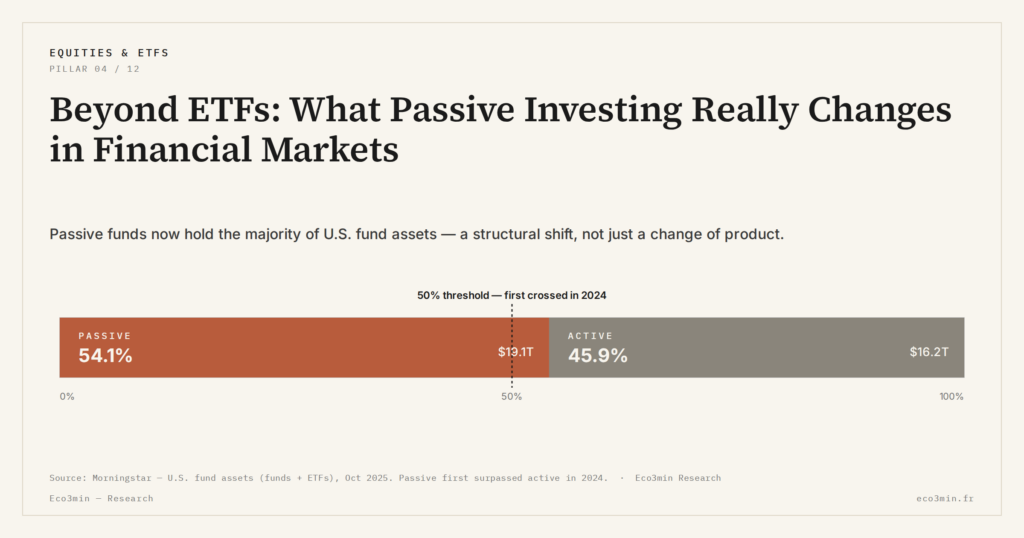
Passive investing, which now captures more than half of U.S. equity flows, does not merely replicate indices: it alters price formation, amplifies concentration and distorts correlations — with structural consequences that the product’s apparent simplicity does not reveal.
TL;DR
An index ETF buys a stock because it sits in the index, signalling nothing about the company; as passive investing surpasses half of U.S. equity flows, price discovery erodes. Further detail: comparing active management and passive management across regimes.
- The ten largest S&P 500 companies now exceed 35% of the index, an unprecedented level, through a self-reinforcing loop: a rising stock gains weight, forcing trackers to buy more and lift it further.
- ETF liquidity deteriorates non-linearly under stress, as seen in March 2020 and autumn 2022: it works well until it suddenly does not, and the tipping point is hard to anticipate.
When an investor buys an ETF, the gesture feels simple. The mechanics it triggers behind the scenes are increasingly complex — and systemic in ways that are still poorly measured.
The ETF is probably the most democratising financial innovation of the last thirty years. It has made diversified investing accessible, transparent and inexpensive: an individual can, with one click, buy a basket of 1,500 global stocks for a few basis points in fees. The progress is real, but it masks a deeper transformation of markets unfolding beneath the surface. Related work: the false assumptions investors make about ETFs and passive investing.
When 50% of equity investment flows go through products that mechanically buy the same securities, in the same proportions, with no fundamental analysis whatsoever, something changes in the way prices are formed. The observation is not theoretical: it is measurable in the data on index concentration, stock correlations and stress liquidity. Reading the passive revolution and index investing is reading a structural shift whose effects are still unfolding.
How an ETF works: the creation-redemption mechanism
An ETF is not a traditional fund listed on an exchange. Its functioning rests on a specific mechanism — creation and redemption of shares — that involves a key actor: the authorised participant (AP).
When demand for an ETF rises, the AP buys the underlying stocks in the market, delivers them to the ETF manager and receives new shares in return. When investors sell ETF shares in size, the mechanism reverses: the AP redeems the shares, exchanges them for the underlying stocks and sells those stocks in the market. The arbitrage process keeps the ETF price aligned with the value of its underlying assets.
Under normal conditions, the mechanism works smoothly. The price formation and liquidity process in ETFs is efficient as long as the underlying securities are themselves liquid and APs retain an economic incentive to keep arbitraging. Neither condition is always met — and that is where the risks lie.
An ETF is never more liquid than its underlying assets. An ETF tracking high-yield bonds may trade on-exchange within seconds, but the bonds it holds may take days to sell in the over-the-counter market. Under stress, APs reduce their arbitrage activity, the ETF price disconnects from its net asset value and meaningful premiums or discounts appear. The phenomenon, observed in March 2020, contradicts the idea that ETF liquidity is intrinsic to the product.
What passive investing changes in price formation
When an active manager buys a stock, it is because they believe it is undervalued. Their purchase is an informational signal: it embeds an analysis of fundamentals into the price. When an index ETF buys a stock, it does so because the stock is in the index, period. The purchase contains no information about the quality of the company, the strength of its earnings or the relevance of its valuation.
In theory, the effect is not a problem as long as active managers remain numerous enough to ensure “price discovery” — the process by which prices reflect fundamental information. In practice, the share of active management in total flows keeps shrinking year after year. According to Morningstar data, passive funds now hold more assets than active funds in the United States, and flows continue to move massively into passive products.
The consequences for market microstructure are documented without being fully understood. Academic research identifies three convergent effects: higher correlations among stocks within the same index (passive flows buy and sell all names together); reduced informational efficiency in individual stock prices (a stock’s price is increasingly determined by ETF flows rather than company analysis); and amplified market moves when large flows go in one direction or the other.
Index concentration: a mechanical risk
Passive investing has a structural side effect: it amplifies the concentration of capitalisation-weighted indices.
The mechanism is self-reinforcing. A company whose stock rises sees its weight in the index increase. ETFs that track the index must buy more of that company’s shares to maintain the weight — which pushes the price up further, which lifts the weight again, and so on. Virtuous circle for large caps, vicious circle for diversification: the ten largest companies in the S&P 500 now account for more than 35% of the index, an unprecedented level of concentration. Related material: the criteria behind picking an ETF.
For an investor who thinks they own a “diversified” portfolio through an S&P 500 ETF, the concentration means performance depends disproportionately on a handful of names. The examination of valuations and profit dynamics in these mega-caps shows that their multiples are significantly above the index average — making them mechanically more vulnerable to an earnings disappointment or a shift in the rate regime.
The correlation dynamics within markets confirm the shift. In a regime dominated by passive flows, intra-index correlations rise during directional phases (broad rallies or sell-offs) and collapse sharply during sector rotations — when the market moves from a “everything rises together” regime to a selection regime.
Stress liquidity risk: when everyone sells the same product
The most discussed — and perhaps most underestimated — risk concerns stress episodes. If a shock triggers massive ETF selling, the creation-redemption mechanism works in reverse: APs must sell the underlying stocks. If millions of investors sell the same S&P 500 ETF at the same time, APs must sell the same 500 stocks at the same time — in a market where everyone is selling.
The liquidity of ETFs during market drawdowns has become a growing research topic since the episodes of March 2020 and the autumn of 2022. The empirical conclusion is that liquidity deteriorates non-linearly: it works well until the moment it does not, and the tipping point is hard to anticipate.
The illusion of ETF liquidity continuity relative to the underlying market is especially pronounced in less liquid segments: corporate bonds, emerging markets, listed real estate. In these segments, the ETF’s daily trading volume can far exceed that of its underlying assets — a structurally unstable configuration when selling pressure intensifies.
The weakening of ETF liquidity in high-rate regimes adds another layer. When rates are high, the carrying cost of market-making positions rises. APs have less economic incentive to maintain tight quotes. The result is a structural deterioration in liquidity quality — invisible in trading volumes but measurable in spreads and order-book depth — that makes the system more fragile in the face of a shock.
Thematic ETFs and AI: the newest layer of risk
Thematic ETFs — especially those focused on artificial intelligence — are the newest and most concentrated extension of passive investing. An AI thematic ETF may hold 30 to 50 securities, with 5 to 10 accounting for more than 60% of the weight. Diversification is minimal. Sector exposure is maximal. And the link to a narrative (“AI is going to transform the world”) creates a self-referential flow risk: investors buy the ETF because the theme is rising, the theme rises because ETF flows push prices higher, the loop feeds itself — until it reverses.
The review of sector and thematic dynamics shows that this type of thematic concentration has historically produced episodes of spectacular outperformance followed by equally sharp corrections. ETFs focused on renewable energy, blockchain or cannabis followed that pattern. AI may not escape it — not because the technology is not real, but because passive-flow mechanisms amplify the disconnect between prices and fundamentals.
What to take away for portfolio construction
ETFs remain a remarkable tool for their transparency, low cost and accessibility. Nothing in this analysis suggests they should be abandoned. But treating them as “simple” products whose internal mechanics can be ignored means underestimating the structural risks they carry.
The questions raised by this analysis are concrete for portfolio risk management. What is the true concentration level of a portfolio built around an S&P 500 ETF? What is the real liquidity of the ETFs held in a stress event? Does the allocation reflect convictions, or merely the current market capitalisation of companies — which itself mechanically embeds passive flows?
For readers beginning with ETFs, these considerations do not undermine the product’s usefulness. They invite a fuller understanding — of its strengths and its limits. The ETF is a vehicle, not a destination. And like any vehicle, it is most useful when its characteristics are known, including those that do not appear in the brochure.
Last updated — 20 September 2026
Disclaimer – Financial Information: The analyses, commentary, and content published on eco3min.fr are provided for informational and educational purposes only. They do not constitute investment advice or a solicitation to buy or sell financial instruments. Past performance is not indicative of future results. All investment decisions involve risk and are the sole responsibility of the reader.
Read next
Full pillar →Reading Earnings Surprises: Cash Flow, Margins, Guidance
How to analyze an earnings surprise beyond the simple beat or miss: cash flow, margins, guidance, and weak…
Equal-Weight ETFs: The Quiet Signal Behind Rising Indices
Equal-weight ETFs reveal the true health of the equity market behind mega-cap-driven indices. Their gap with cap-weighted ETFs…
Smart Beta ETFs: The Hidden Risk Behind Factor Performance
Smart beta ETFs now hold ~15-20% of global equity ETF assets. Stacking factor exposures often rebuilds hidden concentration…