Market Volatility in 2026: A New Regime for Stocks, Bonds, and Crypto

Since the beginning of December 2026, volatility has remained elevated across equity and bond markets, after a year marked by periods of calm followed by violent swings. Between shifts in rate expectations, persistent geopolitical tensions, and rapid sector rotations around tech and AI, the market regime has undergone a lasting transformation.
TL;DR
Volatility has settled into a higher regime in 2026, trading above its 2021–2024 average across equities and bonds, with +2%/−3% intraday swings common again even in large caps. On this point: our analysis of the 4%-of-GDP oil-burden threshold.
- Duration is again a structural risk factor: with markets pricing positive real rates for longer, long-dated bonds have grown more sensitive to even modest inflation or fiscal surprises.
- Major cryptocurrencies now track global liquidity and risk-on/risk-off moves, weakening the decoupling case, while speculative altcoins and thematic tokens correct faster than traditional assets in stress.
- Indices sit near highs while internal rotation is violent, with AI mega-cap consolidation alongside selective catch-up in cyclical and value segments, so a passive index looks resilient as winner-loser dispersion widens.
This context is crucial: it comes after a long bullish stretch that began in late 2024 and continued through 2025, drawing retail investors back in massively through ETFs, crypto, and derivatives. The issue is no longer simply how to “benefit from the rally,” but how to adapt to an environment where intraday moves of +2% / -3% are once again common, including in large-cap stocks.
This regime shift shows why current volatility cannot be understood without a structured economic and financial analysis capable of connecting monetary policy, asset valuations, and market behavior rather than treating each move as an isolated shock.

The key dynamics currently observed in markets
1. Volatility settling at a higher level
Equity and bond volatility indexes, after reaching relative lows earlier in the year, are now trading above their 2021–2024 average. The preceding stretch of compressed volatility that this shift unwinds is documented in our analysis of the anomalous 2023–2026 low-volatility regime. The increase is visible simultaneously in large caps, small caps, and certain bond maturities. Translation: the market no longer believes in a perfectly linear scenario of disinflation and monetary easing.
2. Fast rotation within indices
Major indices may remain near all-time highs, but the internal moves are violent: consolidation in some AI-linked mega caps, selective catch-up in cyclical or undervalued sectors, renewed interest in “value” depending on rate phases. For a passive investor, the index looks resilient; in reality, dispersion between winners and losers is widening. This widening dispersion beneath a calm headline index opens the boundary where a diversifier stops diversifying.
3. Bonds: duration is once again a central issue
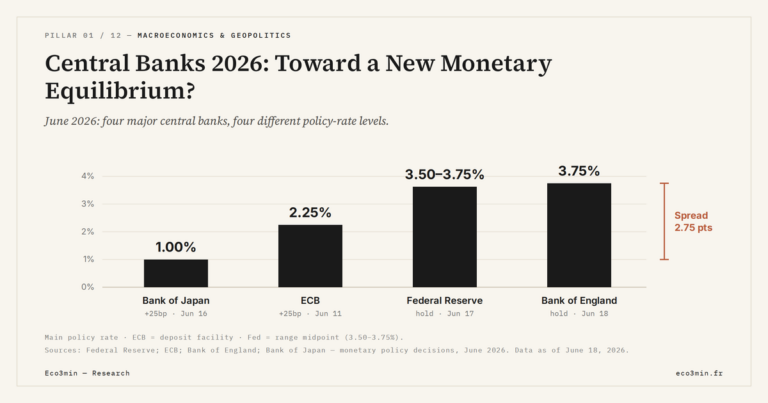
After the strong bond performance seen when rate cuts were expected, long-duration segments are now more sensitive to even modest inflation or fiscal surprises. The market is pricing in the idea that central banks can keep real rates positive for longer than expected. “Risk-free” is no longer neutral: duration has become a structural risk factor again. For more detail: when an economy turns strategically stable yet inefficient.
4. Crypto: greater integration into the global cycle
Major cryptocurrencies now react closely to global liquidity dynamics and to risk-on / risk-off moves. The case for lasting decoupling has weakened. In periods of stress, the most speculative segments (altcoins, thematic tokens) often correct faster than traditional assets.
Macro reading: what this regime really reveals
Structural adjustment rather than an isolated accident
The current sequence looks less like a crash than a regime adjustment: the market is shifting from an environment dominated by multiple expansion and rapid expectations of rate cuts toward a context where:
- central banks prioritize flexibility and anti-inflation credibility
- some valuations already embed optimistic growth assumptions
- political and geopolitical risk is once again a central variable
Microeconomics: margin pressure
Several companies are reporting stabilizing or even eroding margins: still-elevated wage costs, demand normalization in some segments, and tighter commercial negotiations. In a demanding market, any disappointment — even a modest one — is quickly punished, especially in stocks trading at elevated multiples.
Sector view: the end of broad-based upside
- Tech and AI are moving from an almost automatic “buy the dip” pattern to more selective stock picking between profitable models and distant promises of profitability.
- Financials benefit from positive rates, but remain exposed to credit risk if growth slows.
- Defensive stocks are regaining a relative buffering role, without becoming systematically cheap again.
Direct implications for economic and financial actors
1. For listed companies
- Financial discipline matters again: cash flow, cost structure, and shareholder returns are being scrutinized more closely.
- Purely narrative IPOs are facing a tougher backdrop: the path to profitability is decisive.
2. For individual investors
- Do not stop at the index level: sector dispersion can create large performance gaps.
- Truly diversify performance drivers and avoid hidden concentration through ETFs overweighted in mega caps.
- Limit leverage and aggressive options strategies in a more erratic environment.
3. Practical positioning (without personalized advice)
- Rebalance portfolios periodically after strong outperformance by any single segment.
- Mix bond maturities to reduce dependence on one rate scenario.
- In crypto, distinguish a core of liquid, established assets from more speculative positions.
Leading indicators to watch closely
1. Small-cap volatility
Persistent underperformance of small caps despite lower valuations would be a cautionary signal about confidence in the cycle.
2. Quality of earnings reports
Beyond beats and misses versus consensus, monitor:
- margin trends
- visibility on order books
- productive investment decisions
3. Hedging dynamics
Rising put option volumes and renewed interest in minimum-volatility or low-beta strategies suggest a gradual repositioning toward a more unstable environment. Reading that repositioning as a directional call is the step where most interpretations break, and it is the one weighed in what options markets do and do not say about stock direction.
Macro outlook: prospects for the coming months
Base case: volatility structurally above the 2021–2024 period
Between less predictable monetary policy, fiscal constraints, and rapid technological transitions, a higher-volatility regime looks plausible. This does not necessarily imply a prolonged bear market, but rather a more selective and demanding one.
For diversified portfolios
- Factor-based approaches (quality, value, low volatility) may regain relative appeal.
- The balance between global equities, multi-maturity bonds, and real/alternative assets helps absorb shocks.
Key indicators to follow
- Rate expectations in futures markets.
- Credit spreads, especially high yield.
- Analyst earnings revisions and sector dispersion.
The key in 2026 is to treat volatility as a structural component of the current macro-financial regime. Robust, diversified, and disciplined strategies will be better suited to this environment than approaches built on a single scenario. Worth watching closely, session after session. Companion study: our reading of the present regime.
Last updated — 29 August 2026
Disclaimer – Financial Information: The analyses, commentary, and content published on eco3min.fr are provided for informational and educational purposes only. They do not constitute investment advice or a solicitation to buy or sell financial instruments. Past performance is not indicative of future results. All investment decisions involve risk and are the sole responsibility of the reader.
Read next
Full pillar →Monetary Tightening: How Central Banks Are Reshaping Financial Markets
After more than a decade of ultra-accommodative policy, monetary tightening has reintroduced the real cost of capital as…
Hidden Unemployment: Reading the Real Labor Market in 2026
Headline unemployment is stabilizing while broad underemployment still runs above pre-2020 levels. Reading the gap between official rates…
2026 Economic Outlook: Key Trade-Offs After the End of Cheap Money
2026 ushers in a more constrained macro regime where real rates stay positive, fiscal space narrows and geoeconomic…