Why Monthly Economic Data Mislead More Than They Inform

Monthly data often provide a misleading picture of the economy due to volatility, statistical noise, and frequent revisions.
TL;DR
Monthly releases are unstable by construction, since noise, imperfect seasonal adjustment and later revisions can reverse the first reading, leaving a trend legible only across three to six months.
- U.S. nonfarm payrolls ranged from +100,000 to +330,000 across 2025 (BLS) around a standard deviation near 70,000 jobs, so a monthly move signals a shift only when it clearly clears that margin.
- Euro-area industrial production swung between −1.8% and +1.2% in 2025 (Eurostat), short-term noise that only a three-month moving average filters out.
- The BLS cut cumulative 2024 job creation by 818,000 in its February 2025 benchmark revision, almost 30% of the initially reported flow, leaving any interim diagnosis on fragile ground.
Monthly data releases drive economic news flow and capture market attention. Their frequency gives them a level of importance that is often disproportionate to their reliability. These figures are subject to significant volatility, imperfect seasonal adjustments, and statistical noise. A single month may show a sharp increase followed by an equally sharp correction, without any change in the underlying trend. Subsequent revisions can materially alter the initial assessment. Interpreting them in isolation—without context or perspective—leads to excessive reactions and unstable diagnoses.
The mistake is not in following monthly data—it is in treating them as verdicts. Each release triggers an immediate wave of interpretation, even though the data itself will be revised, sometimes substantially, in the weeks that follow. The issue is not the data, but how it is used.
Volatility that exceeds the signal
Monthly data are inherently more volatile than quarterly or annual figures. The BLS (Bureau of Labor Statistics) publishes monthly U.S. nonfarm payrolls—a figure that fluctuated between +100,000 and +330,000 throughout 2025, without the underlying trend shifting to the same extent. The standard deviation of monthly job creation is around 70,000 jobs, meaning that month-to-month changes only constitute a reliable signal when they significantly exceed this margin. Part of that noise is calendar noise: the date a number lands rarely matches the period it describes, a gap catalogued in the index of US release times, rate reset dates and index-linked formulas.
The same issue applies to industrial production, retail sales, and price indices. In the euro area, Eurostat reported monthly industrial production changes ranging from −1.8% to +1.2% in 2025—a level of short-term noise that only a three-month moving average can effectively filter out. The real economic cycle unfolds over much longer horizons than what these monthly releases can capture.
Revisions that alter the diagnosis ex post
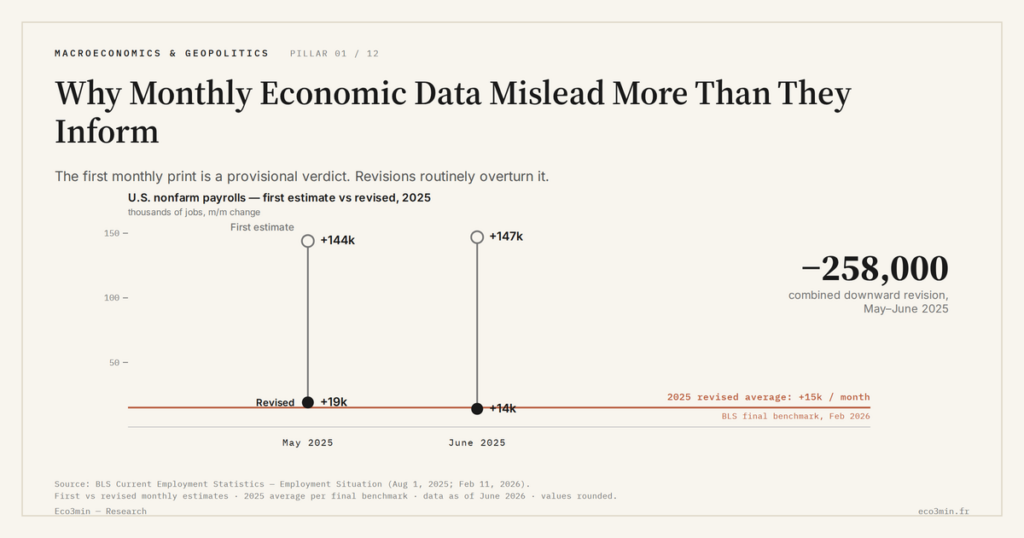
Monthly figures are initially released as preliminary estimates and are then revised—sometimes multiple times. How far that revision travels has been measured on the recent record, in the 30 US monthly payroll figures revised between January 2024 and June 2026. The BLS revised down cumulative job creation for 2024 by 818,000 jobs in its annual benchmark revision (published in February 2025)—a correction of nearly 30% relative to the initially reported flow. This type of revision highlights how decisions based on initial releases rest on fragile foundations.
The inherent time lag in macroeconomic indicators is compounded by the limited reliability of early estimates. A monthly figure revised upward three months later does not correct the flawed diagnosis made in the interim. The amplification of fluctuations through inventory adjustments illustrates this trap: inventory changes can artificially inflate or compress a monthly production figure without reflecting underlying demand trends.
Comparing two consecutive months to infer a trend. A rebound after a weak month is often just statistical mean reversion, not a sign of recovery. Likewise, a decline after a strong month does not necessarily indicate a reversal. Only a three- to six-month moving average allows for a meaningful interpretation of the trend.
Monthly data still retain value: they help detect abrupt breaks—such as a collapse in confidence following a geopolitical shock or a sudden halt in activity during a health crisis—that smoothed averages would capture too late. Economic cycle frameworks recommend using them as a complement, never as a standalone basis for diagnosis. Their value lies in identifying anomalies, not confirming trends.
Last updated — 29 August 2026
Disclaimer – Financial Information: The analyses, commentary, and content published on eco3min.fr are provided for informational and educational purposes only. They do not constitute investment advice or a solicitation to buy or sell financial instruments. Past performance is not indicative of future results. All investment decisions involve risk and are the sole responsibility of the reader.
Read next
Full pillar →Monetary Tightening: How Central Banks Are Reshaping Financial Markets
After more than a decade of ultra-accommodative policy, monetary tightening has reintroduced the real cost of capital as…
Hidden Unemployment: Reading the Real Labor Market in 2026
Headline unemployment is stabilizing while broad underemployment still runs above pre-2020 levels. Reading the gap between official rates…
2026 Economic Outlook: Key Trade-Offs After the End of Cheap Money
2026 ushers in a more constrained macro regime where real rates stay positive, fiscal space narrows and geoeconomic…