Barbell Strategy: Rethinking Risk Allocation in a High-Rate Environment

The so-called “barbell” logic offers a polarized reading of risk allocation in an environment of persistently high rates, sustained volatility, and fragmented market performance.
TL;DR
Barbell logic frames a portfolio as two poles, resilience and optionality, with a deliberately thin middle: a reading tool for testing how an allocation holds up against asymmetric shocks.
- Positive real rates on intermediate-maturity US and European sovereign bonds, higher sustained equity volatility, and a shift toward remunerated cash are reshaping the old hierarchy between defensive and risky assets.
- The framework reads four gauges: the cash-versus-intermediate-duration yield differential, index concentration, the gap between valuations and earnings trajectories, and the share of non-remunerated cash holdings.
Rising capital costs, constraining public debt, and concentrated valuations are reshaping the traditional balance of portfolios. In this context, overly homogeneous allocations become more vulnerable to asymmetric shocks. Barbell logic is not a ready-made operational method, but an analytical framework for examining how risk is distributed between resilience poles and pockets of optionality in an unstable macroeconomic regime. Related discussion: What ’Placing’ Money Reveals About Risk Perception.
This framework is part of a broader effort to understand financial mechanisms, developed in our dedicated financial education page, which aims to clarify economic trade-offs without ever prescribing investment decisions. A close neighbour in this cluster: Investment Horizon: Why It Is the First Question, Not the Last.
Structuring macroeconomic dynamics visible at the end of 2025
- Positive real rates on intermediate-maturity U.S. and European sovereign bonds, reshaping the traditional hierarchy between defensive and risky assets, in line with the broader developments analyzed in the general framework for monetary policy and rates.
- Sustained higher equity volatility, signaling a market regime that is less linear than the one observed in the early 2020s.
- Progressive reallocation toward remunerated cash, reflecting a stronger preference for financial flexibility in an uncertain environment.
- Strong performance concentration in a small number of segments, widening the gap between aggregate indices and the true dispersion of returns.
What this context reveals about portfolio structure
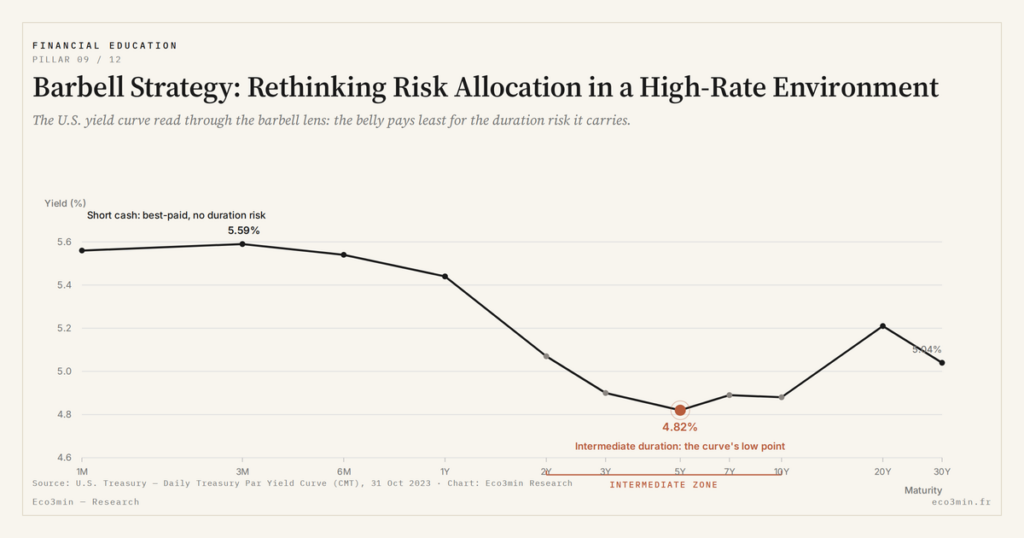
The sustained rise in rates profoundly changes the cost of waiting: money market and short-dated bond instruments now offer a meaningful real return, which alters how risk and time are assessed in portfolio construction.
At the same time, equity markets remain driven by a narrow core of large-cap stocks, while a broad portion of the market lags behind. This phenomenon, repeatedly observed throughout the history of financial markets, increases the vulnerability of undifferentiated allocations.
Barbell logic highlights this tension: it sets out clearly identifiable poles — resilience on one side, optionality on the other — against intermediate zones whose economic readability has weakened as the cost of capital has risen.
Barbell logic as an analytical framework
Historically, barbell logic refers to a polarized structure between low-volatility assets and higher-risk segments, with deliberately limited exposure to the middle ground. It is a reading tool, not a normative or prescriptive model.
In the current environment, this framework makes it possible to question:
- the actual ability of intermediate-risk assets to compensate for the risk taken;
- the resilience of defensive allocations in the face of persistent macro shocks;
- the asymmetry between the risk borne and the upside potential of certain speculative segments.
Reading indicators to assess this polarization
- Yield differential between cash and intermediate duration, a key indicator of the temporal trade-off in risk.
- Level of index concentration, revealing an underlying structural fragility.
- Gap between valuations and earnings trajectories in high-growth segments.
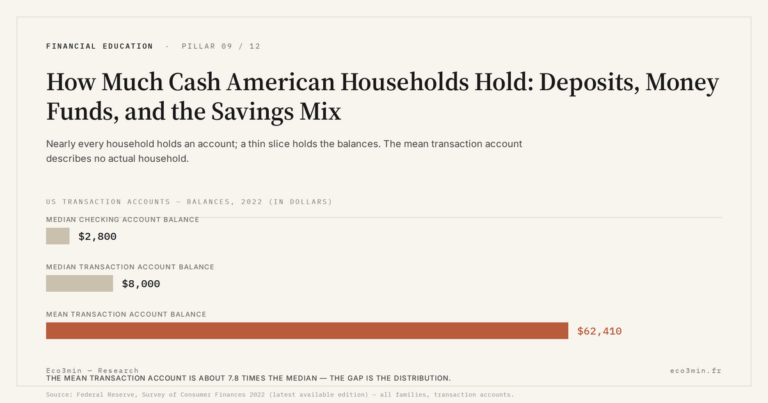
- Share of non-remunerated cash holdings, often a sign of inefficiency rather than an intentional strategy.
Plausible macroeconomic paths over a 6–12 month horizon
Orderly slowdown: moderate growth, gradual disinflation, and relative financial stability. This scenario favors structures capable of absorbing modest but steady performance.
Persistent inflationary pressures: rates remain elevated, margins are squeezed, and volatility rises, increasing performance dispersion.
Sharper slowdown: profits decline and financial conditions tighten, but inflation eases quickly, making liquidity and flexibility central. The wider pattern is charted in our framework on saving, investing and placing across risk and time.
In each case, barbell logic does not provide a single answer, but rather a useful lens for assessing how robust an allocation is to asymmetric shocks. The gap between the common account and the evidence is the focus of the false assumptions investors make about asset allocation.
This article provides economic and financial analysis for strictly informational and educational purposes. The underlying detail is gathered in Eco3min’s analysis of macro-conditioned household tradeoffs. It does not constitute investment advice or a personalized recommendation. Any decision remains the judgment and responsibility of the reader.
Last updated — 24 July 2026
Disclaimer – Financial Information: The analyses, commentary, and content published on eco3min.fr are provided for informational and educational purposes only. They do not constitute investment advice or a solicitation to buy or sell financial instruments. Past performance is not indicative of future results. All investment decisions involve risk and are the sole responsibility of the reader.
Read next
Full pillar →Series I and EE Savings Bonds: Locked Formulas in a Moving Rate World
US savings bonds lock a rate formula at the moment you buy them, for the life of the…
Where the Livret A’s Money Goes: The Caisse des Dépôts Circuit and Social-Housing Finance
The savings held on Livret A accounts do not sit idle. A regulation-set share is centralised at the…
France’s LEP vs the Livret A: A Means-Tested Higher Rate, Explained
France’s Livret d’épargne populaire is often described as "the Livret A, only better". The description misleads: the LEP…