
Commodities and the Business Cycle: A Leading Indicator of Economic Regimes

Commodities are not mere goods: they act as revealers of economic regimes, at the intersection of investment cycles, monetary arbitrage, and emerging geopolitical fault lines. Their signals consistently precede those of traditional macroeconomic indicators.
How Commodities Anticipate Macroeconomic Turning Points
Commodities do not follow the business cycle — they reveal it in advance through the investment channel and supply constraints.
Commodity markets function as a primary macroeconomic transmission channel: pressures on supply capacity, extractive investment cycles, and supply‑chain fragmentation emit early signals about the inflation path, the sustainability of economic policies, and the phase of the real cycle — often several quarters before conventional indicators capture them.
Understanding these mechanisms changes how commodities are interpreted: not as vehicles for directional speculation, but as diagnostic tools for the real economic cycle. For asset allocators, public‑policy decision‑makers, and industrial executives, signals from commodity markets are an essential complement to traditional macro indicators. This article analyzes the mechanisms through which commodities signal shifts in economic regimes and their implications for the current cycle.
Financial markets underestimate a structural reality: commodity prices do more than record a balance between physical supply and demand. They capture capacity constraints, investment dead ends, and value‑chain dislocations long before those tensions materialize in statistical aggregates — GDP, inflation, industrial production. This informational lead is documented by the BIS (Annual Report 2025) and the IMF (World Economic Outlook, October 2025), which show that commodity price indices are significant leading indicators of inflation and production cycles, with a lead time of 3 to 6 months.
This perspective fits within the broader framework of the global dynamics of commodities in the world economy and connects with the analysis of the indirect transmission of economic policy through commodities.
- Commodities signal macro regime shifts 3 to 6 months before conventional indicators
- The decisive cycle is the investment cycle (5–12 years), not short‑term price movements
- Geopolitical fragmentation turns commodities into strategic variables whose signals extend beyond physical supply and demand
Commodities do not follow the business cycle — they reveal it in advance. Their informational value rests on three transmission channels: the extractive investment cycle (whose 5–12 year inertia anticipates future supply constraints), the monetary channel (real rates and the dollar, which jointly determine extractive capital costs and commodity valuations), and the geopolitical channel (value‑chain fragmentation creating persistent cross‑regional price asymmetries). This triple leading‑signal function is documented by the BIS, IMF, and IEA. The current configuration — cumulative underinvestment, positive real rates, rising fragmentation — points to a constrained regime in which commodities continue to signal imbalances that conventional macro indicators have yet to capture.
The Core Mechanism: Three Channels Through Which Commodities Signal the Macro Regime
The ability of commodities to anticipate regime turning points rests on a three‑channel causal chain that operates simultaneously and reinforces itself.
Supply‑capacity constraints (investment cycle) + Monetary pressure (real rates, dollar) + Geopolitical fragmentation (regionalization of flows) → Stress signals in prices and market structures (contango/backwardation, inventories, regional spreads) → Materialization in macro indicators (inflation, production, employment) with a 3–6 month lag
Channel 1: The investment cycle as a leading signal. The fundamental cycle in commodities is not price — it is investment. Between exploration of a deposit and the start of production, the lag is measured in years: 7 years for conventional oil, 10 years for copper, 12 years for lithium (IEA, World Energy Outlook, 2025). This inertia means that today’s investment decisions (or lack thereof) determine supply constraints for the next decade. When extractive capex declines — as has been the case since 2014, with oil exploration‑production spending still 25% below its peak despite comparable prices (IEA, World Energy Investment, 2025) — the signal is clear: future supply will be constrained, regardless of short‑term price movements. This signal precedes its macroeconomic materialization by years, giving extractive capex data greater diagnostic value than spot prices. The analysis of price formation through supply‑demand time asymmetry details the mechanism through which supply inertia translates into price volatility.
Channel 2: Monetary transmission through real rates and the dollar. Commodities are a domain where monetary policy effects materialize with particular intensity and speed. Real rates operate through two simultaneous paths: on the supply side, higher real rates raise the cost of capital for extractive projects (whose return horizons span decades), slowing investment and prolonging capacity constraints. On the pricing side, the dollar — in which most commodities are priced — acts as a distortion filter: a strong dollar compresses real prices for non‑dollar buyers. The BIS (Annual Report 2025) formalizes this dual transmission, showing a significant negative correlation between real rates and extractive capex (2–3 year lag) and between the DXY index and real non‑energy commodity prices (-0.5 over 2000–2025, World Bank data). This mechanism makes commodities the first arena where monetary policy “bites,” often before effects appear in credit or employment. The framework of the role of real rates and global financial conditions provides the analytical foundation for this interpretation.
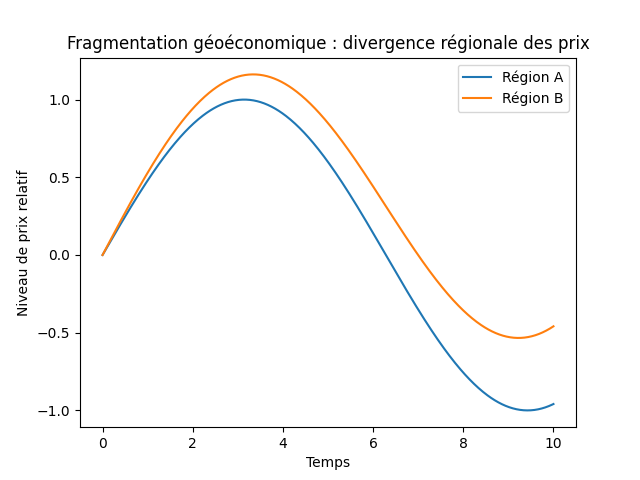
Channel 3: Geopolitical fragmentation as a new structural rigidity. The paradigm of a fluid and unified global commodity market is fracturing. The proliferation of trade tensions, sanctions regimes, and supply‑security policies is driving increasing regionalization of flows, documented by the IMF (World Economic Outlook, October 2025) and the OECD in their geo‑economic fragmentation reports. Value chains are splintering: two regions can now display radically different prices for the same commodity, with no possibility of immediate arbitrage. Security premia rise not because demand is surging, but because access to certain resources depends on political alliances or dedicated infrastructure. This fragmentation adds an additional layer of structural rigidity to supply — beyond geological and capital constraints — amplifying the signaling value of regional price spreads. The new geopolitical front of critical minerals is the most advanced illustration of this dynamic. The role of producer countries in price cycles shows why fiscal trade‑offs and rent strategies among exporting states prolong tensions beyond initial financial signals.
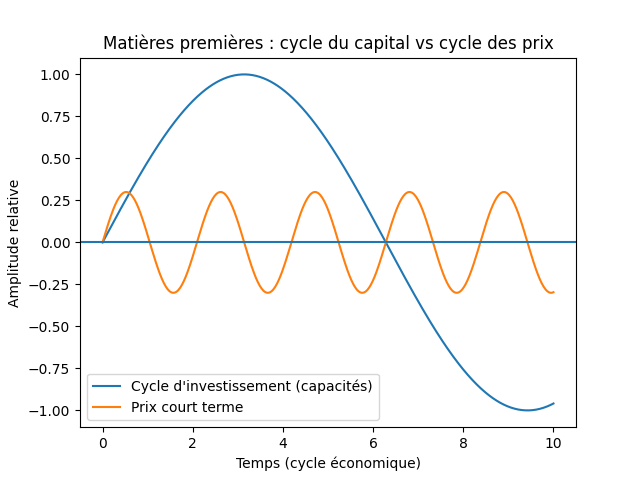
- Lead on inflation: commodity price indices lead CPI inflation by 3 to 6 months in advanced economies. Source: BIS, IMF WEO.
- Extractive capex: -25% vs the 2014 peak in oil exploration & production, despite comparable price levels. Source: IEA, World Energy Investment, 2025.
- Capex/real rates correlation: negative, with a 2–3 year lag — today’s underinvestment will translate into supply constraints by 2027–2030. Source: BIS, 2025.
- DXY/non-energy commodities correlation: -0.5 over 2000–2025. Source: World Bank, Commodity Markets Outlook.
- Fragmentation: persistent regional price differentials for the same commodity, widening since 2022. Sources: IMF, OECD.
Declining extractive capex + positive real rates (investment headwind) + commercial inventories below averages + rising fragmentation of trade flows → commodities are signaling a constrained regime that conventional macro indicators (GDP, inflation) do not yet fully reflect.
What the Consensus Gets Right — and the Structural Signal It Misses
The dominant view, promoted by commodities desks and reflected in major institutional outlooks, assumes a normalization scenario: prices stabilize, supply gradually adapts to past price signals, and substitution effects (technological innovation, source diversification) ease structural tensions. This diagnosis is not unfounded — previous cycles did show a supply response with a 3–5 year lag.
Its limitation lies in conflating price stabilization with the resolution of underlying constraints. Apparently stable prices can coexist with persistent underinvestment, declining inventories, and increasing supply-chain fragmentation. The consensus treats commodities as price assets (that go up or down) whereas they function as regime assets (that signal structural configurations). This distinction is fundamental: the relevant signal is not the price level but the combination of declining capex, falling inventories, and widening regional differentials — a configuration that signals a constrained regime even when prices appear contained.
The most costly consensus mistake is interpreting stable prices as a return to equilibrium. Price stability may reflect a constrained market where quantities — not prices — bear most of the adjustment: fewer transactions, shrinking inventories, and supply that no longer responds to price signals because the cost of capital and regulatory uncertainty block investment. The role of inventories in price formation and the analysis of marginal cost of production shed light on these mechanisms.
Interpreting stable prices as a return to equilibrium. Price stability can mask a constrained regime where adjustment occurs through quantities (declining inventories, fewer transactions, stalled investment) rather than prices. The relevant signal is not the spot price but the capex / inventories / regional differentials combination — three variables that reveal the true state of the supply cycle. Another mistake: treating commodities as a homogeneous set. The distinction between financial-cycle commodities (precious metals, highly financialized products) and real-cycle commodities (energy, industrial metals, agriculture) is analytically decisive.
| “Back to Normal” View | Regime-Signal View | |
|---|---|---|
| Focus | Spot prices and quarterly physical supply/demand balance | Extractive capex, inventories, regional differentials, marginal cost |
| Implicit assumption | Price signals are sufficient to restart investment | Real rates + regulatory uncertainty + fragmentation block the response |
| Time horizon | 1–4 quarters | Full cycle (5–12 years for supply) |
| Stable prices = | Equilibrium restored | Possible constrained regime (adjustment via quantities, not prices) |
| Key variable | Spot price, forecast consensus | Sector capex, term structure (contango/backwardation), regional spreads |
Two Speeds, Two Logics: Financial-Cycle Commodities vs Real-Cycle Commodities
The most widespread mistake is treating commodities as a uniform asset class. In reality, a fundamental analytical distinction is required between two categories with radically different behaviors, and understanding this distinction determines the quality of regime diagnosis.
Financial-cycle commodities. Some commodities primarily follow capital-flow dynamics. Their valuations fluctuate with liquidity conditions, portfolio allocation strategies, and interest-rate and inflation expectations. Gold and silver, precious metals in general, and highly financialized commodities (where non-commercial CFTC positions dominate volumes) fall into this category. Their signal is essentially a financial-conditions signal — not a physical-constraint signal. Gold at record highs in 2024–2025 signals risk aversion and central-bank buying (World Gold Council data), not metal scarcity.
Real-cycle commodities. Real-cycle commodities — energy, industrial metals, agricultural products — primarily respond to physical constraints: extraction capacity, infrastructure conditions, climate shocks, logistical bottlenecks. Their evolution depends less on short-term capital flows than on investment decisions made years earlier. This category gives commodities their role as leading indicators of the real economic cycle. Tensions in the copper market — often called “Dr. Copper” for its ability to diagnose industrial health — or in the natural gas market typically reflect industrial or energy constraints already forming well before inflation or industrial production data register them. Palladium illustrates an extreme case of this logic: extreme geographic concentration of production, structurally rigid demand, and near-zero short-term adjustment capacity.
The interaction between the two logics. Analytical complexity arises from the interaction between these categories. Monetary tightening weighs on financial-cycle commodity prices (via the dollar and real rates) while amplifying supply constraints for real-cycle commodities (via the cost of capital that slows investment). The result is a blurred short-term signal — falling prices despite rising supply constraints — but a powerful cycle-horizon signal: underinvestment accumulated under high real rates will materialize as supply tensions when demand recovers. This interaction lies at the core of the analysis of price formation through time asymmetry.
Implications for Reading the Current Cycle
For macro diagnosis. Real-cycle commodities are sending an ambivalent signal at end-2025: spot prices remain contained under pressure from a strong dollar and positive real rates, but structural indicators (declining capex, inventories below averages, rising fragmentation) signal a constrained regime. This configuration is consistent with a cyclical slowdown diagnosis (financial pressure on prices) combined with accumulating structural supply constraints (underinvestment). The gap between the two — low prices today, supply tensions tomorrow — is the most informative signal for the upcoming cycle. The structural lags of macroeconomic indicators make commodities even more valuable as leading signals.
For the inflation outlook. If the investment-cycle framework holds, commodity prices embed a latent inflation signal that current inflation measures do not capture. Cumulative underinvestment, supply-chain fragmentation, and inventory erosion create the conditions for a potential supply shock at the cycle horizon — a second-round inflation risk that demand- and expectations-centered models overlook. The inflation trajectory will depend on the interaction between this latent supply signal and global demand dynamics, themselves conditioned by the lagged transmission of restrictive monetary policy.
For asset allocation and industrial strategy. Commodities provide a richer macro-regime lens than short-term performance signals alone. They help contextualize inflation dynamics, assess monetary-policy sustainability, and gauge supply-chain disruption risks. For corporations, understanding real supply cycles helps anticipate input-cost pressures and availability constraints — regardless of immediate price fluctuations. This reading fits within the broader framework of financial market functioning mechanisms.
Invalidation condition. This analytical framework loses relevance if a major negative demand shock (deep global recession) eliminates structural supply tensions, if a rapid and sustained decline in real rates massively revives extractive investment, or if geopolitical de-escalation reduces fragmentation premia and restores fluid global trade flows. A major technological breakthrough in extraction or substitution could also change the outlook. Conversely, geopolitical escalation, an energy shock, or an acceleration of the energy transition would amplify constraint signals and strengthen the diagnostic value of commodities.
Three Time Horizons for Interpreting Commodity Signals
Short term (0–6 months): financial conditions dominate price signals. Indicators to monitor: real rates, DXY, CFTC positioning, commercial inventory levels (EIA, IEA), and the term structure (contango vs backwardation). Persistent backwardation in certain segments (oil, industrial metals) signals physical tightness that spot prices alone fail to capture. The short-term risk is a widening disconnect between the financial signal (contained prices) and the physical signal (declining inventories, capacity under strain).
Cycle horizon (1–3 years): cumulative underinvestment begins to materialize as supply constraints. The key variable is the trajectory of global physical demand — conditioned by the phase of the real economic cycle — and its capacity to reveal accumulated supply tensions. If demand accelerates (global recovery, faster energy transition) amid constrained capacity, real-cycle commodities will signal a regime shift ahead of macro indicators. The World Bank (Commodity Markets Outlook, 2025) estimates that investment in transition metals must triple by 2030 to meet climate objectives — an unprecedented pace.
Structural horizon (5+ years): the energy transition is reshaping commodity demand structure. Transition metals (copper, lithium, cobalt, nickel) are entering a structurally rising demand cycle while hydrocarbons approach a plateau (IEA central scenario). Geopolitical fragmentation creates parallel supply chains and permanent security premia. This reconfiguration turns commodities from economic inputs into geostrategic variables whose signals inform cycle analysis far beyond their traditional role. Regular monitoring of the weekly macro dashboard integrates these dynamics.
Commodities do not follow the economic cycle — they reveal it in advance through investment dynamics, monetary transmission, and geopolitical fragmentation. The decisive cycle is not the price cycle (which reflects the interaction between financial demand and monetary conditions) but the investment and supply-capacity cycle (whose signals precede macro-indicator materialization by years). The current configuration — cumulative underinvestment, positive real rates, rising fragmentation — signals a constrained regime that short-term prices, under financial pressure, do not yet reflect. The most informative signal is not the price level but the capex / inventories / regional differentials combination, which provides the best available diagnosis of the true state of the supply cycle.
Robust: The leading-indicator role of commodities for inflation and the production cycle (3–6 month lead) is documented by the BIS and IMF. Extractive supply inelasticity over horizons below five years is a structural fact. Cumulative underinvestment since 2014 is measurable in capex data. Dual transmission via real rates (extractive cost of capital) and the dollar (real commodity prices) is formalized. Geopolitical fragmentation of value chains is observable through regional price differentials.
Uncertain: The precise timing of supply-constraint materialization depends on the trajectory of global demand, itself conditioned by the economic cycle. The scale of acceleration in transition-metal demand (dependent on the pace of the energy transition) is subject to widely dispersed estimates. The ability of prices to remain sustainably above or below marginal cost — and the speed of correction once thresholds are crossed — varies across cycles. The possibility of a deep global recession temporarily erasing supply constraints remains an open scenario.
Reading commodities as regime indicators — rather than directional price signals — provides a more robust analytical framework for diagnosing the phase of the economic cycle, anticipating structural inflation pressures, and assessing vulnerabilities in global supply chains.
- Commodities do not follow the cycle — they reveal it in advance through investment (5–12 years), monetary transmission (real rates, dollar), and geopolitical fragmentation.
- The decisive cycle is investment and supply capacity, not short-term prices. Extractive capex down 25% since 2014 signals future supply constraints that current prices do not reflect.
- The distinction between financial-cycle commodities (gold, precious metals) and real-cycle commodities (energy, industrial metals) is analytically fundamental — they do not send the same signal.
- Stable prices do not mean equilibrium: the combination of declining capex + falling inventories + widening regional spreads signals a constrained regime where adjustment occurs via quantities, not prices.
- This framework is invalidated if a negative demand shock removes supply tensions, if falling real rates revive investment, or if a technological breakthrough shortens supply-adjustment timelines.
Mis à jour : 20 March 2026
This article provides economic and financial analysis for informational purposes only. It does not constitute investment advice or a personalized recommendation. Any investment decision remains the sole responsibility of the reader.