
How a Credit Crunch Unfolds and Why Its Effects Are Asymmetric
A credit crunch marks a sudden contraction in credit supply, decoupled from borrower fundamentals. Its macroeconomic effects propagate unevenly, hitting bank-dependent agents far harder than those with market access.

Analysis of credit crunches, the breakdown in credit supply and their asymmetric macroeconomic consequences.
TL;DR
A credit crunch contracts loan supply independently of demand, and the constraint falls hardest on borrowers dependent on banks rather than bond markets.
- In the first half of 2009, 60% of euro area SMEs that applied for a bank loan obtained it in full, against 72% of large firms, which keep bond-market access (ECB SAFE survey).
- The contraction is abrupt because banks react simultaneously to a common shock and regulatory thresholds force disproportionate cuts as prudential limits approach.
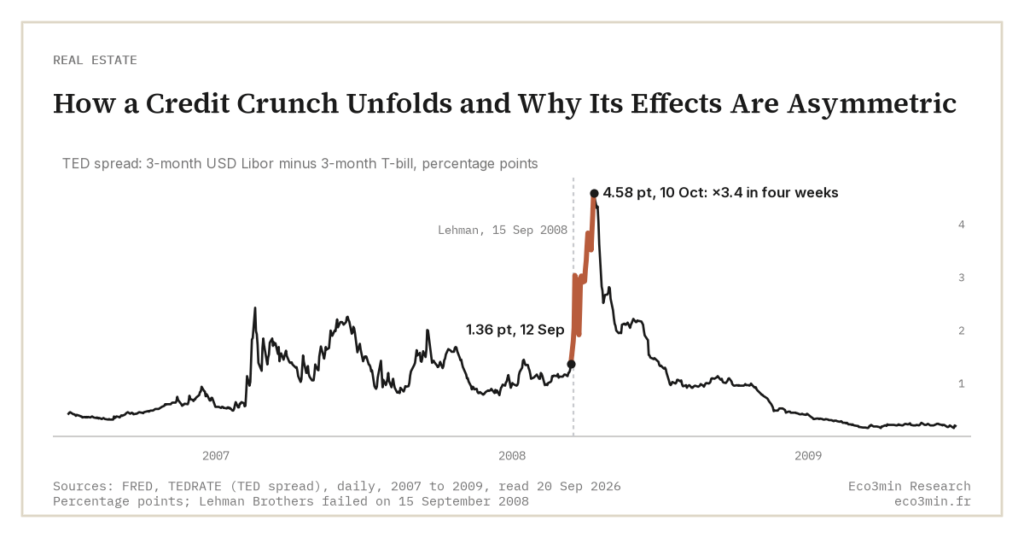
- The spread between the interbank rate and the policy rate leads liquidity frictions, as in the interbank freeze that followed Lehman's September 2008 failure.
How a Credit Crunch Unfolds and Why Its Effects Are Asymmetric
A credit crunch marks a sudden break in financing dynamics. Credit supply contracts independently of existing demand. The evidence is brought together in our reading of housing price inertia in the face of rate moves. The discontinuity affects some agents faster than others. Macroeconomic effects propagate unevenly. This asymmetry is often poorly understood. Yet it constitutes an essential feature of the cycle’s extreme phases.
A credit crunch is not simply a slowdown in credit. It refers to a sudden, involuntary contraction in supply, decoupled from borrower fundamentals.
The Triggering Mechanisms
Several configurations can trigger a credit crunch. The most common involves a sharp deterioration in bank balance sheets. As loan losses accumulate, bank capital erodes. Prudential ratios tighten. Institutions reduce their exposures to restore solvency margins.
This mechanism played out during the 2008 crisis. Subprime-related losses forced US then European banks to drastically cut their commitments. Bank lending to euro area non-financial corporations, still growing 15.0% year on year in April 2008, was down 2.2% in December 2009 and 2.7% in January 2010 (ECB monetary statistics).
A second configuration involves an interbank liquidity crisis. When banks stop lending to each other out of mutual mistrust, the refinancing system seizes up. Even solvent institutions may then reduce their credit supply for lack of resources.
The failure of Lehman Brothers in September 2008 illustrates this dynamic. The interbank market froze within days. In the United States, the TED spread jumped from 1.36 points on 12 September to 4.58 on 10 October. In the euro area, the gap between three-month Euribor and Eonia rose from a monthly average of 75 basis points in September to 129 in October, the highest since the euro was created (ECB).
Why the Contraction Is Abrupt
A credit crunch is distinguished by its suddenness. Unlike a gradual tightening of conditions, it occurs discontinuously. This abruptness is explained by several factors.
Banks react simultaneously to the same signals. A common shock (deterioration in an asset class, default by a major counterparty) triggers synchronised defensive behaviour. Implicit coordination amplifies the move.
Regulatory thresholds create cliff effects. As a bank approaches its prudential limits, it has to reduce its exposures disproportionately to restore its ratios.
Contractual and market thresholds work the same way. A borrower whose leverage ratio exceeds a covenant may face an immediate repayment demand. A downgrade from investment grade to high yield forces selling by institutional investors bound by their mandates, and margin calls on leveraged positions turn a marginal deterioration into a discontinuous adjustment.
Lending surveys show how lopsided the turn is. In the ECB Bank Lending Survey, the net share of banks tightening standards on business loans rose from −3% in the third quarter of 2007 to 65% in the fourth quarter of 2008. Net easing has never exceeded 16% (third quarter of 2005) since the survey began in 2003. For mortgages, net tightening reached 41% in early 2009, against net easing of 12% at most (2018).
The snap is sharpest on corporate lending. Euro-area household credit growth peaked at 9.7% in April 2006 and only turned negative in May 2009, after three years of deceleration (ECB data). The corporate reversal described above took less than two years.
The assessment of the credit cycle and its turning points shows that this abruptness stems from the very logic of bank financing.
The Asymmetry of Sectoral Effects
A credit crunch does not affect all agents in the same way. Companies dependent on short-term financing face an immediate impact. Those with confirmed credit lines or cash reserves get through the acute phase better.
SMEs suffer more than large corporates. Their access to bond markets is limited. They depend almost exclusively on bank credit.
ECB data for 2009 document the gap: new loans of up to EUR 1 million, the usual proxy for SMEs, fell 13% over the year, against 10% for larger amounts.
Second-Round Effects
The initial credit contraction triggers propagation effects. Rationed companies cut their investments and orders. Defaults rise, further degrading bank balance sheets.
Our analysis of the non-linear nature of turning points details this feedback loop.
Employment acts as a lagged but significant adjustment variable. In the euro area, it fell for nine consecutive quarters after its Q1 2008 peak, through Q2 2010, a loss of 4.3 million jobs, or 2.7% of the workforce (Eurostat).
Conflating a credit crunch with a simple slowdown in credit. A credit crunch refers to a break in supply, independent of demand.
What Consensus Underestimates
Standard macroeconomic models struggle to capture the discontinuities specific to credit crunches.
Growth projections tend to underestimate the magnitude of contractions during periods of financial stress. In September 2008, ECB staff projected 2009 growth of between 0.6% and 1.8%, revised to between −1.0% and 0.0% in December. Euro area GDP eventually contracted by 4.5% (Eurostat).
Variables That Modify the Amplitude
Banks’ initial capitalisation and central bank intervention influence the severity of a credit crunch.
Accumulated leverage, the concentration of exposures and market liquidity set the rest. Concentration often means property. In the euro area, loans for house purchase made up 36% of bank lending to the private sector in August 2026 (€5,531 billion out of €15,334 billion, ECB monetary statistics), before counting loans to developers and commercial property. Spanish and Irish banks before 2008, Nordic banks in the 1990s and US savings and loan institutions in the 1980s show how often banking crises have been tied to real estate reversals.
Policy can dampen the snap without removing it. Liquidity injections and asset purchases, deployed at scale since 2008, can break a downward spiral: in March 2020, liquidity in the US Treasury market deteriorated within a few sessions to the point of requiring massive Fed intervention. Regulatory moratoria used during the 2020 shock bought time without resolving the underlying imbalances. Economies where firms can tap bond markets as well as bank credit absorb a contraction better, since the failure of one channel does not close access to capital.
Indicator to Watch
The spread between the interbank rate and the policy rate acts as a leading indicator of liquidity frictions within the banking system.
Cross-referenced with the analysis of financing and credit dynamics, this signal helps identify ahead of time the phases of stress likely to transmit to the real economy.
What This Asymmetry Reveals
A credit crunch is an abrupt and asymmetric phenomenon, with disproportionate consequences for the agents most dependent on bank credit.
Last updated — 20 October 2026
Disclaimer – Financial and Legal Information: The analyses, commentary, and content published on eco3min.fr are provided for informational and educational purposes only. They do not constitute investment advice or a solicitation to buy or sell financial instruments. Past performance is not indicative of future results. All investment decisions involve risk and are the sole responsibility of the reader. Data, charts and calculated series are provided as is and may contain errors or lag behind their source: check any figure against the primary source cited before relying on it. Content describing laws, regulations or contracts reflects the law as of its publication date and does not constitute legal or tax advice; applying it to a specific situation requires a qualified legal or tax professional.
Read next
Full pillar →Real Rates and Property Valuation: Why Inflation Alone Does Not Protect Prices
A property’s value is its net income capitalized at a rate the market sets, and that rate is…
Rent Pass-Through: How Lease Structure Decides If Inflation Reaches the Landlord
US rents adjust to inflation only when a lease resets, not continuously. Fixed terms, renewal smoothing and survey…
US Rental Property Real Yield: What Cap Rate and NOI Actually Leave You
A rental listing leads with a yield. Divide the annual rent by the price and the number looks…