
What Are Real Interest Rates? How Inflation Shapes Returns, Debt, and Markets

The real cost of money — the nominal rate minus inflation — shapes investment, saving, and borrowing decisions far more directly than central bank announcements do.
Public debate tends to focus on policy rates, but that misses the variable that truly drives economic behavior and market valuations.
Real interest rates shape economic trade-offs, credit cycles, and financial markets. Here is a breakdown of this overlooked variable.
The real cost of money — what an investment actually earns or what a loan actually costs once inflation is taken into account — determines most major economic decisions. Real rates simultaneously influence households’ trade-offs between consumption and saving, companies’ investment choices, and the terms on which governments borrow. Yet public debate focuses almost exclusively on nominal rates and monetary policy announcements, obscuring the variable that truly structures cycles. That confusion leads to persistent diagnostic errors: a rising policy rate can coexist with accommodative financial conditions, and vice versa.
What nominal rates do not tell you
As of early 2026, the ECB policy rate stands at 2.75%, after several successive cuts from the 4% peak reached in mid-2023. This move is usually interpreted as monetary easing. That reading is incomplete. According to Eurostat data (January 2026), inflation in the euro area is around 2.4%. The real policy rate — about 0.35% — remains positive, which means monetary conditions are still tighter than during the entire 2012–2021 decade, when real rates were persistently negative.
A saver earning 3% while inflation runs at 4% is losing purchasing power despite an apparently attractive nominal return. Conversely, a borrowing rate of 1% with inflation at 0.5% implies a real cost that is higher than the headline number suggests. Confusing the distinction between nominal and real rates is like navigating without a compass in a complex monetary environment.
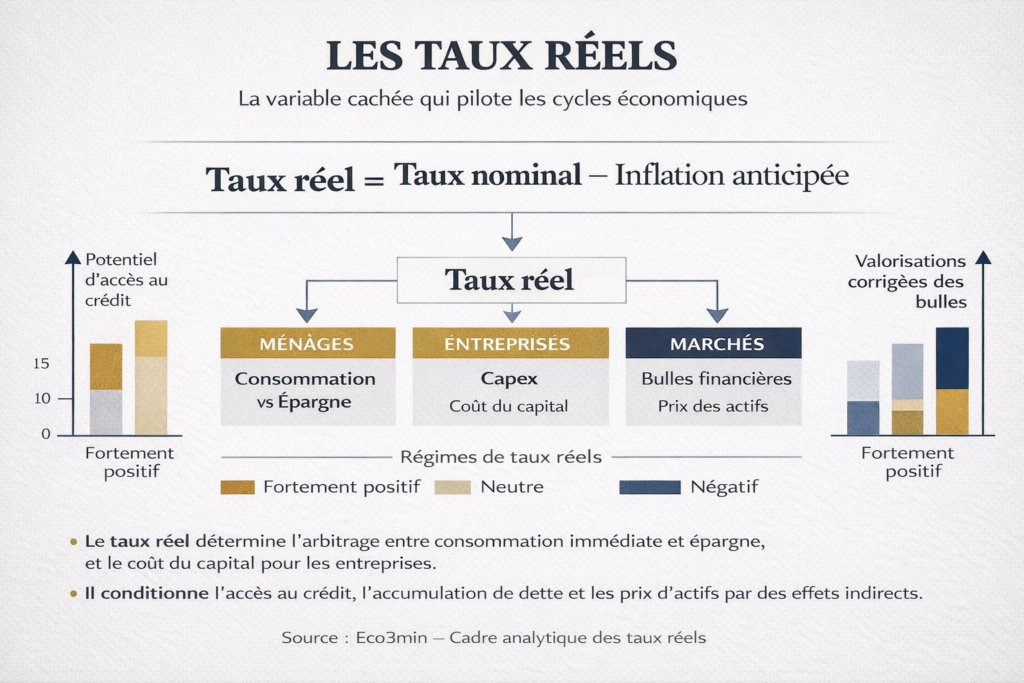
The filter of economic trade-offs
Consume or save? Invest or wait? Each of these decisions depends on the level of real rates. When the real return on savings is meaningfully positive, the preference for the future strengthens: households save more, and companies demand higher-return projects. When it is negative, fundamental trade-offs between consumption and saving shift in favor of immediate spending and borrowing.
According to the ECB’s Bank Lending Survey (Q4 2025), euro area firms factor real rates into their capex decisions, not just the headline nominal rate. Long-run BRI series show that periods of low real rates historically coincide with faster capital accumulation but lower-quality capital — a dilemma made visible by the transmission mechanism to investment.
Monetary policy: the gap between intent and effect
Central banks set nominal rates. The economy responds to real rates. The Federal Reserve raised its policy rate by 525 basis points between March 2022 and July 2023. Yet the expected recession did not materialize. Elevated inflation limited the rise in real rates during part of the cycle, softening the real transmission of monetary decisions.
As early as the 1960s, Milton Friedman identified “long and variable” lags in transmission, estimated at 12 to 24 months. Recent BRI work confirms that estimate while also emphasizing that transmission runs through multiple channels — credit, valuations, exchange rates — all converging on one intermediate variable: the real rate perceived by market participants. The central scenario favored by most observers assumes that nominal cuts automatically pass through to the real economy. But the most common mistakes in interpreting rates are precisely what lead to underestimating those lags.
Equating a cut in the policy rate with real easing is the most widespread error. If inflation falls at the same time — and faster than the nominal rate — real conditions can tighten precisely as official communication signals a loosening. The relevant diagnosis always compares the movement in the nominal rate with that of expected inflation.
Real rates at the core of financial cycles
Periods of financial expansion line up with low or negative real-rate regimes, which reduce the cost of leverage and push asset prices away from fundamentals. Between 2012 and 2021, real rates in the euro area remained negative almost continuously — a configuration that fueled gains in bond, real estate, and equity markets without real growth fully justifying those valuations.
The turning point comes when real rates rise: debt service becomes more expensive, risk premiums reprice, and financial cycle dynamics reverse. According to the IMF’s Global Financial Stability Report (October 2025), the rise in real rates across advanced economies compressed risk-adjusted valuations to levels not seen since 2007. According to U.S. TIPS, 10-year real rates stand around 2% in early 2026, versus -1% at the end of 2021.
The variables that could change the picture
A rapid disinflation shock — driven by a slowdown in China or an energy reversal — would push real rates higher even without additional monetary tightening. Conversely, a return of inflation linked to trade tensions could keep real rates below what nominal rates would suggest. Uncertainty also surrounds equilibrium real rates, whose estimation remains fragile, as the Federal Reserve minutes (December 2025) reminded readers.
The debate over policy rates overlooks the only variable that truly conditions cycles: the real rate adjusted for inflation expectations.
A compass, not a thermometer
Real rates are not just one indicator among many. They are the filter through which investment decisions, sovereign financing conditions, and market valuations pass. For institutional investors, the real-rate regime determines risk-adjusted returns across all asset classes. For companies, it sets the viability threshold for long-term projects. For households, it determines the real value of savings and the effective cost of debt.
Putting real rates back at the center of analysis changes how we understand the liquidity and financial conditions in which economic agents operate. The path over the next few quarters will depend less on monetary announcements than on the actual evolution of inflation and the expectations attached to it.
- Real rates — nominal rates adjusted for inflation — determine the economic cost of time and shape the fundamental trade-offs faced by economic agents.
- A cut in nominal rates is not necessarily real easing if inflation falls at the same time.
- Expansionary and contractionary financial cycles are structurally linked to the real-rate regime, not to policy rates alone.
Mis à jour : 20 March 2026
This article provides economic and financial analysis for informational purposes only. It does not constitute investment advice or a personalized recommendation. Any investment decision remains the sole responsibility of the reader.