Monetary Policy Lags: Why Rate Decisions Take Time to Bite
Central bank moves do not flow instantly through the economy. The 12-to-24-month lag between rate decisions and real-activity effects reflects a chain of frictions across banks, balance sheets, and expectations.

Why monetary policy decisions take time to affect the real economy: indirect channels, financial frictions, and lagged transmission.
Monetary policy operates with a structural lag. Between a central bank decision and the observable adjustment of activity, inflation, or investment, the economy travels through a chain of intermediate mechanisms shaped by financial and contractual frictions.
TL;DR
From a rate decision to its effect on activity runs 12 to 24 months, because banks, contracts and expectations each filter the impulse on their own clock.
- Friedman's 1960s “long and variable lags” still describe it: market rates react within days, while the bank lending channel takes several quarters to move consumption or investment.
- The ECB Bank Lending Survey (Q4 2025) and the Fed's Senior Loan Officer Opinion Survey (January 2026) both show banks holding corporate lending standards restrictive even as the 2024 rate cuts began.
- Effects are asymmetric: euro-area core inflation took nearly 18 months to start declining after the July 2022 tightening (Eurostat), and cuts do not unwind hikes symmetrically because of fixed-rate contracts and nominal rigidities.
- BIS data (2025) put the advanced-economy credit-to-GDP ratio about 15 points above its 2019 level, altering how sensitive the economy now is to each monetary impulse.
Understanding that timing keeps slowness from being mistaken for inefficiency. Transmission channels are neither synchronous nor automatic: they depend on private balance sheets, financing structures, and the expectations of agents. The macroeconomic response reflects a sequential propagation, not an instantaneous effect.
Monetary policy decisions are routinely judged on their immediate effects, even though they propagate through a deeply frictional economic system. Between the moment a central bank moves and the moment activity, inflation, or investment respond, multiple intermediate mechanisms intervene. Those transmission channels are not synchronous and not automatic: they hinge on balance sheets, financing structures, and the expectations of economic agents.
That reality fuels a recurring misreading, where the absence of a fast response is interpreted as inefficiency. Restoring the economic logic behind these delays and asymmetries clarifies the actual macro-financial timing of monetary policy. The data cited below comes from ECB, Federal Reserve, Bank for International Settlements, and national statistical institution publications.
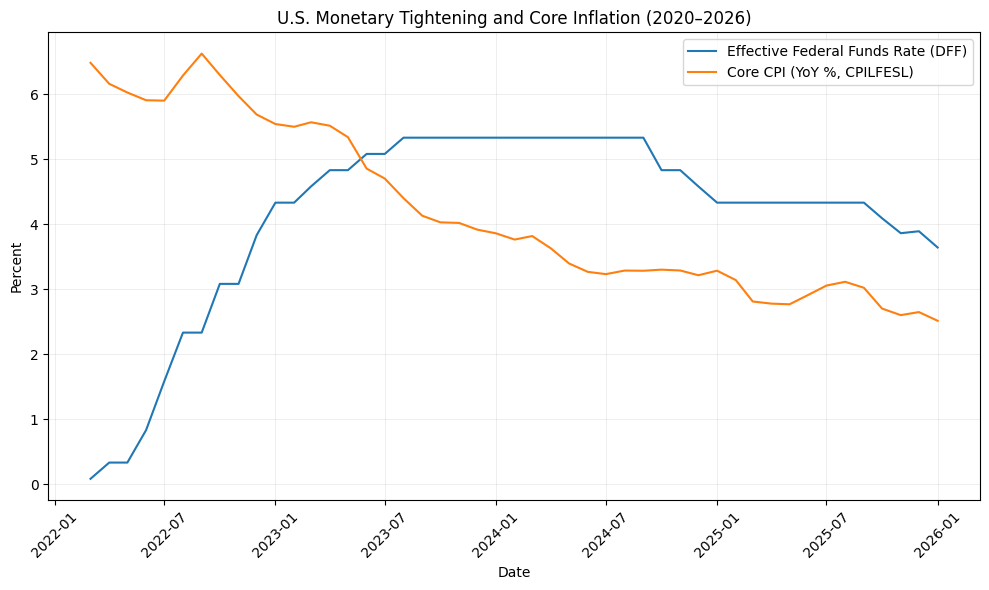
What makes this topic more consequential than it appears is the widening gap between the speed of monetary announcements and the slow pace of real adjustments. In an environment where rate cuts started in 2024 are already fuelling expectations of recovery, the effective transmission timing becomes critical to reading the cycle correctly.
A fragmented transmission architecture
Monetary policy does not run through a single channel. A detailed mapping of the monetary transmission channels explains why observed effects are spread over time. The policy rates set by a central bank first influence interbank conditions, then propagate to bond yields, credit conditions, asset prices, and exchange rates. Each of those vectors runs on its own clock. Market rate channels react within days. The bank lending channel takes several quarters to produce tangible effects on consumption or investment.
That observation goes back to Milton Friedman’s 1960s work on “long and variable lags.” The pattern was particularly visible during the recent cycle of rate hikes and their delayed effects, where the impact on real activity materialised well after the peak in policy rates. The average lag between a monetary move and its observable impact on real activity sits between 12 and 24 months — an order of magnitude that recent cycles have not materially compressed. Mapping the different transmission channels explains why those timelines do not stack linearly.
The role of liquidity and financial conditions in the transmission sequence is decisive: they form the first observable link in the chain, well ahead of any adjustment in the real economy. liquidity as the fuel of asset prices maps out its implications.
The credit and bank balance sheet filter
Monetary transmission operates largely through the banking system, as detailed in the analysis of transmission through bank lending. Yet banks do not mechanically pass through changes in policy rates. Their lending decisions hinge on balance sheet strength, regulatory constraints (Basel III, leverage ratios), and their perception of default risk.
According to the ECB’s Bank Lending Survey (Q4 2025), euro area banks kept restrictive lending standards in place for corporate loans, even as the rate-cutting cycle began. The Fed’s Senior Loan Officer Opinion Survey (January 2026) confirms a similar dynamic: monetary easing does not translate automatically into looser credit conditions.
Equating lower policy rates with an actual easing of credit. A central bank cuts a benchmark rate, but commercial banks calibrate lending conditions on their own balance sheet constraints. The gap between the two creates a blind spot where monetary policy appears ineffective, when in fact it has simply not yet reached the productive economy.
That reality weighs primarily on non-listed companies dependent on bank financing, whose investment capacity is tied to the effective supply of credit. The banking channel therefore structurally shapes the real effectiveness of monetary policy by filtering the impulse coming from policy rates.
Expectations and the forward-looking dimension
Monetary policy operates as much through its signals as through its decisions, particularly via the role of expectations in monetary transmission. When a central bank communicates its future path — forward guidance — markets immediately adjust asset prices and yield curves, well ahead of any real-economy move. Agent expectations can shift transmission effectiveness, at times more powerfully than the instruments themselves.
The baseline scenario adopted by many market participants in early 2026 assumes a soft landing, where monetary easing gradually restores financing conditions. That view rests on the assumption of a smooth and steady transmission. Yet Atlanta Fed President Raphael Bostic noted in November 2022 that it could take “18 months to two years or more” for rate hikes to fully take effect. If the same framework applies during easing phases, the rate cuts started by the ECB and the Fed in 2024 may only reach their full impact on credit and investment by 2026–2027. Liquidity and financial conditions unpacks the underlying machinery.
Asymmetries and lagged effects on prices
Transmission lags are not only long — they are asymmetric. The contractual and financial mechanisms that delay the impact of rate hikes do not reverse symmetrically during rate cuts. Fixed-rate contracts, multi-year investment commitments, and wage adjustments generate frictions that slow any change of direction.
The asymmetry is particularly visible in price dynamics. Inflation responds to monetary decisions with a lag, as analysed in the study on the delayed response of inflation to monetary policy, owing to nominal rigidities, indexation mechanisms, and cost-chain inertia. According to Eurostat data, euro area core inflation took nearly 18 months to begin a meaningful decline after the tightening that started in July 2022.
Transmission also varies across regions. Financial fragmentation within the euro area produces uneven transmission within a single monetary zone: the same ECB decision generates different effects depending on national banking structures and debt levels.
Monetary transmission is not a technical delay. It is a structural filter that redistributes effects according to balance sheet positions and financial structures.
- The average lag between a rate decision and its impact on real activity ranges between 12 and 24 months, depending on the channels involved.
- Commercial banks filter transmission through their balance sheets and regulatory constraints, not just through the level of policy rates.
- Effects are asymmetric: rate cuts do not mirror rate hikes because of contractual and nominal rigidities.
Several paths remain plausible. If transmission channels normalise gradually, monetary easing could support activity over the medium term. If bank balance sheets remain constrained or if inflation expectations become unanchored, the lags could lengthen further. According to BIS data (2025), the credit-to-GDP ratio in advanced economies sits roughly 15 points above its 2019 level, structurally altering the economy’s sensitivity to monetary impulses. Higher leverage is one reason the time lags of monetary policy transmission to the real economy have to be re-estimated in every cycle.
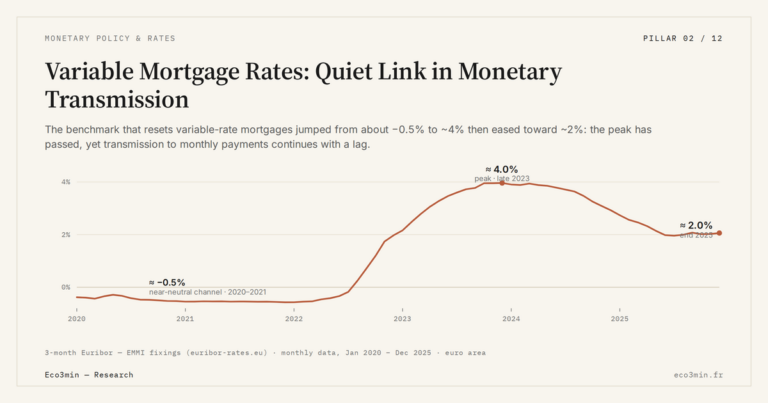
The effective cost of corporate financing does not decline at the pace of announcements. Bond yield curves embed transmission assumptions that reality can contradict. Mortgage and consumer credit conditions evolve with a delay that blurs the cyclical signal on the household side. The ability of central banks to calibrate policy is measured less by the initial decision than by the depth and duration of its diffusion into the real economy. Eco3min breaks this down in the rate-to-yield transmission delay.
Last updated — 18 September 2026
Disclaimer – Financial Information: The analyses, commentary, and content published on eco3min.fr are provided for informational and educational purposes only. They do not constitute investment advice or a solicitation to buy or sell financial instruments. Past performance is not indicative of future results. All investment decisions involve risk and are the sole responsibility of the reader.
Read next
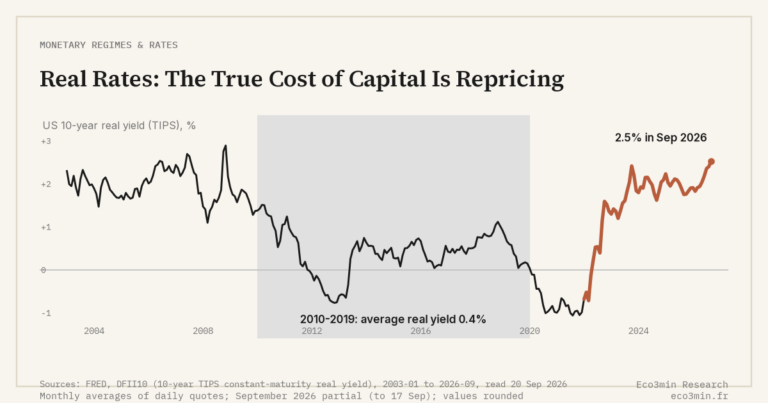
Full pillar →Real Rates: The True Cost of Capital Is Repricing
Why real rates are reasserting themselves as markets' anchor and how to recalibrate investment and financing decisions facing…
Real Interest Rates: The Quiet Signal Reshaping Markets
Real interest rates: why their persistence in positive territory in 2026 is reshaping the rules for bonds, equities,…
OAT-Bund Spread: A Quiet Gauge of French Sovereign Risk
OAT-Bund spread: how this yield gap has become a key signal on French sovereign risk, fiscal policy and…