
Liquidity and Financial Conditions: Monetary Plumbing, QT Cycles, and Market Impact
The value of a financial asset does not depend solely on its economic fundamentals, but on the ability of market participants to mobilize capital to acquire it. That ability depends on a central and often underestimated factor: liquidity. Since 2008, changes in global liquidity have explained a growing share of market movements — at times more than macroeconomic data themselves.
When liquidity is abundant, prices can rise even without visible improvement in the real economy. When liquidity contracts, adjustments can be brutal, even in the absence of a major macroeconomic shock. Understanding this mechanism provides an analytical framework that clarifies the recurring disconnect between macro signals and market behavior.
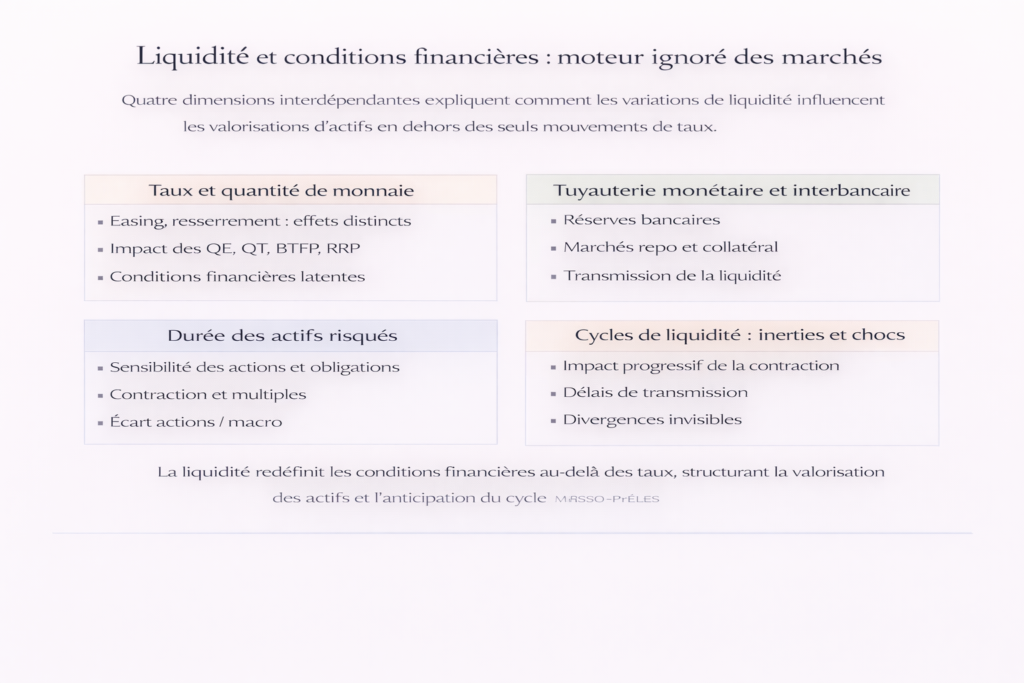
What is liquidity in macroeconomics?
Liquidity refers to the ease with which economic agents can access funding and trade assets without causing significant price movements. It operates at several levels that do not necessarily overlap: central bank liquidity (bank reserves, balance sheet size), market liquidity (order book depth, bid-ask spreads), and funding liquidity (credit access, repo conditions).
The distinction is crucial. In March 2020, bank reserves were abundant but market liquidity evaporated within days — bid-ask spreads on US Treasuries reached levels unseen since 2008, and even the most liquid market in the world stopped functioning normally for several sessions (Federal Reserve Bank of New York, March 2020). This paradox — abundant central bank liquidity coexisting with a shortage of market liquidity — highlights the complexity of transmission channels.
How Eco3min analyzes liquidity
Eco3min’s analyses approach liquidity as a structural driver of financial conditions, distinct from policy rates and often more decisive for market trajectories. This sub-pillar integrates into the broader framework of monetary policy and interest rates, providing its quantitative dimension — the one policy rates alone fail to capture.
Five episodes that redefined global liquidity
Global liquidity does not evolve linearly. It moves through expansion and contraction phases whose transitions are often abrupt and whose market consequences appear with variable lags. Five key episodes since 2008 structure the understanding of the current regime.
2008–2014: the birth of QE and the era of abundant liquidity
The collapse of Lehman Brothers in September 2008 triggered a sudden freeze in interbank liquidity. The TED spread — the gap between 3-month Libor and the 3-month Treasury yield, a classic indicator of money market stress — jumped from 100 to over 450 basis points within weeks (Federal Reserve). Repo markets stopped functioning for entire segments of collateral.
To prevent the financial system from collapsing, the Fed deployed quantitative easing on an unprecedented scale. QE1 (November 2008 – March 2010) injected $1.75 trillion through MBS and Treasury purchases. QE2 (November 2010 – June 2011) added $600 billion. QE3, launched in September 2012 as an open-ended $85 billion per month program, continued until October 2014 (Federal Reserve). The Fed’s balance sheet expanded from $900 billion at end-2007 to $4.5 trillion at end-2014 — a fivefold increase in six years.
The ECB followed a different but converging path. After the 2011–2012 LTRO programs, European QE launched in March 2015 reached a peak purchase pace of €80 billion per month (ECB). The Bank of Japan pushed the logic further with QQE (Quantitative and Qualitative Easing), becoming the world’s largest buyer of equity ETFs — holdings exceeding ¥50 trillion, roughly 7% of Japan’s market capitalization (BoJ, 2023).
2013: the taper tantrum, or the fragility of liquidity-driven markets
In May 2013, Ben Bernanke’s mere suggestion of a future slowdown in asset purchases — not tightening, just a deceleration in liquidity injections — triggered a disproportionate market shock. The 10-year Treasury yield jumped from 1.63% to 2.99% in four months (Federal Reserve), a 136-basis-point increase. Emerging markets suffered massive capital outflows — the MSCI Emerging Markets index fell 15% between May and August 2013.
The episode revealed an uncomfortable reality: markets had become structurally dependent on liquidity flows, to the point where a verbal shift in future pace alone caused violent adjustments. The “Fed put” — the perception that the Fed would always step in to support markets — had morphed into a “liquidity put,” a dependence on liquidity injections themselves.
September 2019: the repo crisis that caught everyone off guard
On September 17, 2019, the overnight repo rate — normally nearly identical to the Fed Funds rate — surged from 2% to 10% within hours (Federal Reserve Bank of New York). This seemingly technical malfunction exposed a structural fragility: quantitative tightening initiated in 2017 had reduced bank reserves from $2.2 trillion to about $1.4 trillion, approaching a critical threshold below which money markets no longer functioned smoothly.
The Fed was forced to intervene urgently, injecting tens of billions of dollars daily into repo markets and relaunching Treasury bill purchases at $60 billion per month starting October 2019 — a “QE that was not QE” in official language, but one that mechanically re-expanded the balance sheet. The episode showed that the post-2008 financial system, saturated with reserves for a decade, could not tolerate their withdrawal without serious dysfunction.
March 2020: unlimited QE and the new liquidity ceiling
The arrival of Covid triggered the fastest liquidity crisis in financial history. Within two weeks in March 2020, the VIX volatility index hit 82.7 — above the 2008 peak (CBOE). Credit markets froze, money funds faced massive redemptions, and even Treasuries — the quintessential “risk-free” asset — saw bid-ask spreads explode.
The Fed’s response was unprecedented: unlimited Treasury and MBS purchases announced on March 23, 2020, then expansion to corporate bonds — including high yield — via emergency credit facilities. In two years, the Fed’s balance sheet expanded by over $4.7 trillion, from $4.2 trillion in early March 2020 to a peak of $8.965 trillion in April 2022 (Federal Reserve). The ECB added its €1.85 trillion Pandemic Emergency Purchase Programme (PEPP). Combined balance sheets of the four major central banks (Fed, ECB, BoJ, BoE) exceeded $28 trillion in early 2022 (BIS).
This injection created an environment of excess liquidity that compressed risk premia to historic lows — the US high-yield spread fell to 303 basis points in June 2021 (ICE BofA), among the lowest levels ever recorded — and fueled speculative bubbles across entire market segments: cryptocurrencies, SPACs, unprofitable equities, NFTs.
2022–2025: coordinated QT and progressive drainage
Quantitative tightening (QT) initiated by the Fed in June 2022 — balance sheet reduction at an initial pace of $95 billion per month, reduced to $60 billion starting June 2024 (Federal Reserve) — marked the beginning of a coordinated contraction in global liquidity. The ECB began its own QT in March 2023, ending reinvestments under APP and later PEPP.
The impact was asymmetric and lagged. Bond markets absorbed the shock first: 2022 was the worst year for bonds in a century, with long Treasuries down 31% (ICE BofA 20+ index). Equity markets corrected, but performance concentration in a handful of tech giants — the “Magnificent 7” accounted for over 60% of S&P 500 gains in 2023 (S&P Global) — masked broader liquidity tightening across the rest of the market.
By end-2024, the Fed’s balance sheet had declined to around $6.8 trillion (Federal Reserve), more than $2.1 trillion below its peak — yet still seven times larger than its pre-2008 level. The equilibrium level of bank reserves remains a subject of intense debate: the 2019 repo crisis showed the system’s comfort threshold is far higher than pre-QE models suggested.
Real rates do not only determine asset valuations, but also the sustainability dynamics of public debt. When real rates durably exceed real growth, fiscal adjustment becomes arithmetically constrained: Real rates and public debt sustainability .
Liquidity: what interest rates alone don’t tell you
Reducing monetary policy to policy rate movements is a common misreading. Financial conditions depend just as much — and sometimes more — on the quantity of liquidity circulating within the banking and financial system. The Goldman Sachs Financial Conditions Index, which aggregates rates, credit spreads, equity valuations and the dollar, provides a useful composite indicator: it eased significantly between October 2023 and end-2024 even though the Fed only began cutting rates in September 2024 — illustrating the gap between rate policy and actual financial conditions.
This analysis remains incomplete if one does not distinguish between nominal rates and real rates. Financial conditions are primarily transmitted through the real cost of capital, that is, returns adjusted for inflation — the true decision variable for investor allocation. This core mechanism is detailed in the pillar article: Real rates: the central variable of the economy and financial markets .
Quantitative easing expanded central bank balance sheets, multiplying bank reserves and compressing risk premia. Conversely, quantitative tightening gradually withdraws liquidity, tightening financial conditions without necessarily raising nominal rates. The Fed can keep rates stable while effectively tightening through QT alone — a subtlety routinely missed by commentary focused solely on rate decisions.
Focusing on headline rates leads to a classic mistake: reasoning in nominal terms rather than in purchasing-power-adjusted capital returns. This confusion, known as money illusion, distorts the interpretation of financial cycles and investment decisions: Nominal rates, inflation and money illusion .
Liquidity contraction does not affect all agents uniformly. The asymmetric effects of monetary policy show some sectors and actors experience tightening well before others, creating divergences invisible in aggregate data. Small businesses reliant on bank financing are hit first; large caps with cash buffers or direct bond-market access feel the effects with significant delay.
Financial conditions are never globally uniform. Real rate differentials across monetary areas reshape capital flows, exchange rates, and the relative performance hierarchy of asset classes: Differences in real rates across economic zones .
This dynamic is analyzed in depth in the study on delayed effects of monetary tightening.
Confusing rate policy with overall monetary policy. A seemingly stable policy stance can become restrictive through simple liquidity contraction. Conversely, high rates can remain accommodative if liquidity stays abundant — a configuration observed in late 2024 when the S&P 500 hit record highs despite Fed Funds at 4.50%.
This confusion between headline rates and real financial conditions fuels many misinterpretations of monetary policy, especially when markets prematurely price a policy pivot.
The yield curve provides the clearest synthesis of overall financial conditions. It aggregates expectations for growth, liquidity and monetary policy into a single signal. The inversion of the 2Y–10Y spread, which persisted from July 2022 to September 2024 — the longest inversion since the 1980s (Federal Reserve) — simultaneously reflected recession expectations and perceptions of sustained liquidity tightening.
→ Read the flagship article: The yield curve: compass of financial markets
→ Reference analysis: Complete history of 2Y–10Y spread inversions since 1976
Bank reserves, repo markets and monetary plumbing
Liquidity transmission operates through infrastructure often invisible to non-specialists: repo markets, collateral flows, bank reserves and standing facilities. Bank reserves held at the Fed — about $3.2 trillion in early 2025 (Federal Reserve) — form the foundation of this architecture. They serve as settlement money between major financial institutions and determine the smooth functioning of the payments system.
The repo market (repurchase agreements) is the most critical operational link. Its daily volume exceeds $4 trillion in the United States (SIFMA, 2024). It functions through collateral exchange — mainly Treasuries — for short-term cash. When high-quality collateral becomes scarce or bank reserves fall below a critical threshold, this market malfunctions, triggering cascading effects across the financial system — as demonstrated in September 2019.
The Fed’s Reverse Repo Facility (RRP) has become a key indicator of excess liquidity. At its peak in December 2022, it absorbed over $2.5 trillion of surplus cash from money market funds (Federal Reserve Bank of New York). Its gradual decline to below $200 billion by end-2024 signaled a drainage of excess liquidity — an indicator now watched as closely as policy rates.
When these channels clog, monetary transmission turns into a liquidity crisis. Our analysis of monetary transmission during crises shows how technical dysfunctions can abruptly amplify financial shocks. Tensions in these markets explain why some crises emerge without prior macro warning, as illustrated in the analysis of delayed effects of economic decisions.
This financial infrastructure constitutes the operational channel through which monetary policy influences the real economy. Transmission does not occur solely through policy rates, but through their impact on real rates relevant for investment and credit decisions: Monetary policy transmission through real rates .
Liquidity and valuation of risk assets
Long-duration financial assets — growth equities, real estate, long bonds — are particularly sensitive to liquidity shifts. The relationship is mechanical: liquidity contraction raises the cost of capital and compresses valuation multiples, even without an immediate recession. Between January and October 2022, the S&P 500 forward P/E fell from 21.5x to 15.5x (FactSet), a 28% compression largely attributable to tighter financial conditions rather than profit deterioration.
Beyond the valuation channel alone, real rates also function as a synthetic signal of macro-financial expectations: future growth, monetary credibility, and risk premia. They act as a cross-market barometer of financial regimes: Real rates as a signal for financial markets .
The link between liquidity and risk premia is especially visible in credit markets. The US high-yield spread acts as a liquidity barometer: it widened from 303 basis points (June 2021) to 583 basis points (July 2022) during tightening, then compressed again below 300 basis points by end-2024 amid easing expectations (ICE BofA). Such moves often precede real-economy turning points by several months.
The central question then becomes: who is truly affected by rising rates? Effects vary significantly depending on debt structure, asset duration and reliance on external financing. This mechanism sheds light on the decoupling between equity markets and traditional macro signals — a structural feature of the post-2008 regime that only a liquidity-based framework can explain.
Why liquidity acts with a lag
Like interest rates, liquidity operates with long and variable lags — but through distinct channels. Excess liquidity accumulated during accommodative phases continues supporting prices long after tightening begins. The liquidity stock matters as much as the flow: even after 18 months of QT, the Fed’s balance sheet still exceeded $7.5 trillion at end-2023 (Federal Reserve), roughly three times its pre-QE 2008 level.
This persistence explains why equity markets reached new highs in 2024 despite positive real rates and ongoing QT. The “liquidity wall” built between 2020 and 2022 had not yet fully unwound, providing a cushion that softened tightening effects — a lag consistent with monetary transmission delays documented in the literature.
This delay creates an analytical trap. Observers conclude too quickly that tightening “isn’t working” because markets remain resilient, then are surprised when effects materialize abruptly — often through an event that appears isolated (bank failure, fund freeze, sector crisis) but actually reflects accumulated tensions from liquidity drainage.
Markets react less to the level of rates than to changes in overall financial conditions. Liquidity is the primary — and most underestimated — driver. The relevant diagnosis is not “are rates high or low?” but “is net liquidity contracting or expanding, and at what pace?”. Since 2022, coordinated QT by central banks has initiated a progressive liquidity drain whose effects are not yet fully transmitted — a temporal asymmetry that remains one of the most mispriced risks in markets.
Financial markets do not react solely to the absolute level of liquidity, but to expectations of its future trajectory. This dynamic explains why markets and the economy react differently to monetary decisions, depending on the prevailing regime.
← Back to the pillar page Monetary policy and rates