
EUR/USD Exchange Rate History: Dollars per Euro Since 1999
EUR/USD exchange rate history (dollars per euro) — Federal Reserve H.10 via FRED, daily since the euro's 1999 launch. Covers the 2008 high and 2022 parity. CSV and Excel, free.
EUR/USD is the world’s most-traded currency pair, the central axis of the global FX market. This dataset tracks the Federal Reserve H.10 noon rate, expressed as US dollars per euro, distributed via FRED under the code DEXUSEU, with daily coverage since the euro’s launch in 1999. A higher number means a stronger euro; a lower number means a stronger dollar.
Dataset: EUR/USD Exchange Rate (1999–2026) · Updated 2026-09-11
Loading FRED data…
Source: Federal Reserve Board · H.10 Foreign Exchange Rates (via FRED)
Macro Takeaway
As the most-traded pair, EUR/USD is effectively the inverse of broad dollar strength and the cleanest read on the ECB-versus-Fed policy gap. It dominates the broad trade-weighted dollar.
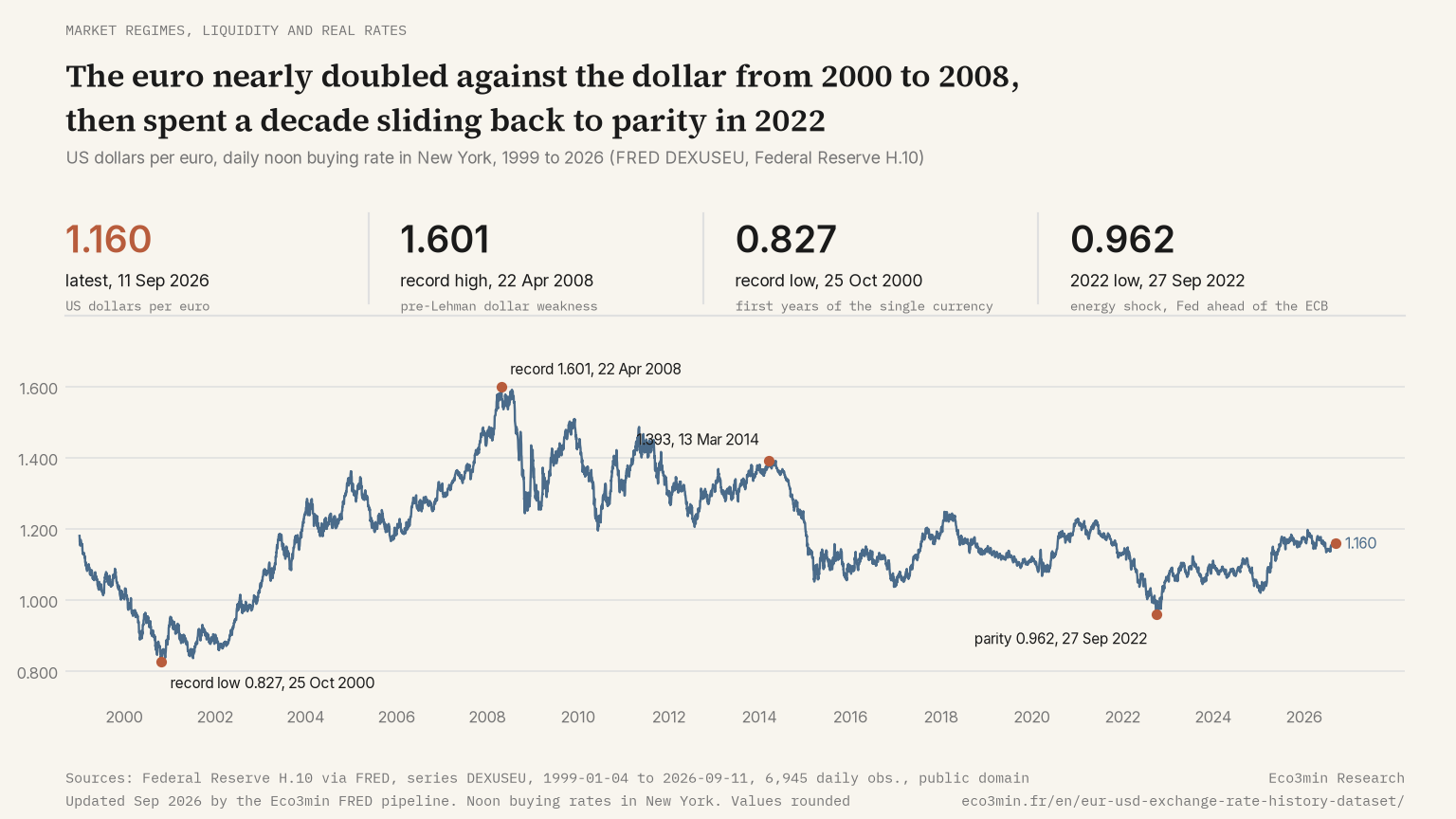
The arc spans the euro’s life: a weak launch to a record low near 0.83 in 2000-2001, an all-time high near 1.60 in 2008, the 2010-2012 sovereign-debt crisis, and a drop below parity in 2022 for the first time in two decades, driven by the energy shock and aggressive Fed tightening. It trades alongside GBP/USD and USD/JPY.
Dataset Overview
| Indicator | EUR/USD Exchange Rate (1999–2026) |
|---|---|
| Quotation | USD per EUR — US dollars per euro; a higher value means a stronger euro |
| Geography | Euro area / United States |
| Frequency | Daily (business days) |
| Period | 1999–2026 |
| Variables | Date, exchange rate (USD per EUR) |
| Format | CSV, Excel (XLSX) |
| Sources | Federal Reserve Board — H.10 Foreign Exchange Rates (FRED series DEXUSEU) |
| Last updated | — |
Dataset Variables
The CSV and Excel files contain the following columns. Each row represents one business day.
| Column | Type | Description |
|---|---|---|
date | Date (YYYY-MM-DD) | Observation date (business day) |
eur_usd | Float | EUR/USD exchange rate, USD per EUR |
Column names match the CSV headers exactly.
Where the Latest Rate Sits in the Distribution
A rate near 1.16 is unremarkable against the full record and can be high or low against the last five years. This tool places the latest EUR/USD fixing inside the distribution of every trading day in the window you select, and reports its percentile rank, the window median and the dated extremes.
At 1.160 on 11 September 2026 the euro sits at the 48th percentile of the 6,945 trading days since January 1999, whose median is 1.168, but at the 82nd percentile of the last five years, median 1.093. The record high is 1.601 on 22 April 2008, the low 0.827 on 25 October 2000; the 2022 trough was 0.962 on 27 September.
Download the Complete Dataset
The full dataset is available in CSV and Excel formats — daily observations spanning 1999–2026.
FRED Direct CSV Access
The underlying data is published in the Federal Reserve Economic Data (FRED) database under the series code DEXUSEU, sourced from the Federal Reserve Board’s H.10 release:
https://fred.stlouisfed.org/graph/fredgraph.csv?id=DEXUSEU
The Eco3min dataset mirrors the same daily series, packaged in a stable, versionable CSV with consistent column names — designed for direct ingestion in Python, R, or any data pipeline. The URL never changes, making it suitable for automated scripts.
Direct CSV Access — Eco3min Structured Dataset
https://eco3min.fr/dataset/eur-usd-exchange-rate.csv
This URL returns the complete dataset in CSV format. It can be used directly in pandas, R, curl, or any data tool.
Using the Dataset in Python
import pandas as pd

url = "https://eco3min.fr/dataset/eur-usd-exchange-rate.csv"
df = pd.read_csv(url, parse_dates=["date"])

print(df.head())
print(df["eur_usd"].describe())

df.plot(x="date", y="eur_usd", title="EUR/USD Exchange Rate", legend=False)
Using the Dataset in R
library(readr)

url <- "https://eco3min.fr/dataset/eur-usd-exchange-rate.csv"
df <- read_csv(url)

head(df)
summary(df$eur_usd)
Both examples load the dataset directly from the URL — no download or API key required.
Methodology
The Federal Reserve reports the US dollars per euro noon buying rate in New York, in its H.10 release; the series begins with the euro’s launch in 1999. The forces behind this rate are set out in the euro-versus-dollar exchange dynamic.
The Federal Reserve publishes these rates daily in its H.10 release. Values are indicative noon or end-of-day rates, not transactable quotes, and there are no observations on weekends or US holidays. The series begins in 1999.
This dataset is updated via an automated pull from the FRED API (series DEXUSEU) by an Eco3min pipeline running on GitHub Actions, which regenerates the cleaned CSV and Excel files and refreshes the page metadata.
Data Quality & Provider Notes
The Federal Reserve H.10 rates are a standard, widely cited reference for bilateral exchange rates. A few provider-specific points matter when using this series.
- Indicative, not transactable. H.10 rates are reference rates collected at a set time of day. They will differ from the bid/ask a trader actually deals on, and from other fixings (ECB, WM/Refinitiv 4pm London).
- Gaps on non-business days. There are no observations on weekends or US public holidays, so the series is not strictly continuous in calendar time.
- Bilateral, not trade-weighted. This is a single currency pair. It is not the broad, trade-weighted dollar index, which aggregates many bilateral rates.
- Discontinued or restated quotes. The Federal Reserve has occasionally changed how a rate is reported; treat very long histories as broadly consistent rather than methodologically identical throughout.
Common Pitfalls When Using This Series
- Reading the quotation direction backwards. This series is US dollars per euro (the market convention), so the number rises when the euro strengthens and falls when the dollar strengthens. The series only begins in 1999, when the euro launched. Getting the direction wrong inverts every move and every regime described below.
- Treating gaps as missing data. Weekends and holidays have no H.10 observation; this is by design, not a data error. Resample carefully before computing returns.
- Confusing a bilateral rate with the dollar’s overall strength. One pair can move on currency-specific news while the broad, trade-weighted dollar barely moves, and vice versa.
Historical Regimes
1999–2002 — Weak launch. The euro launched in 1999 and fell to a record low near 0.83 in 2000-2001 amid scepticism.
2003–2008 — Strong euro. Dollar weakness drove the euro to an all-time high near 1.60 in 2008.
2010–2012 — Sovereign-debt crisis. The euro-area debt crisis pressured the euro as break-up fears rose.
2014–2021 — ECB easing. Negative ECB rates and quantitative easing kept the euro in a 1.05-1.25 range.
2022 — Parity. The energy crisis and aggressive Fed tightening pushed the euro below parity with the dollar for the first time in two decades.
2023–2026 — Recovery. The euro recovered modestly as the energy shock faded.
Related Macroeconomic Datasets
- USD/JPY (Yen) — the dollar-yen pair, a pure Fed-BoJ policy read
- GBP/USD (Pound) — sterling, or ‘cable’
- USD/CHF (Franc) — the Swiss franc, a classic safe haven
- USD/CAD (Loonie) — the oil-linked Canadian dollar
- AUD/USD (Aussie) — the commodity-linked Australian dollar
Developed Markets (ex-US) Hub
This dataset is part of the Eco3min repository of exchange rates, government bond yields, and policy rates for the major developed economies outside the United States, all sourced from the Federal Reserve and the OECD via FRED.
Explore the Developed Markets (ex-US) Hub
Sources
- Federal Reserve Board — H.10 Foreign Exchange Rates, EUR/USD
- Federal Reserve Bank of St. Louis — FRED database, series DEXUSEU
- Federal Reserve H.10 noon buying rate, New York — basis underlying the FRED series
Dataset Reference
Last updated — 21 September 2026
Disclaimer – Financial Information: The analyses, commentary, and content published on eco3min.fr are provided for informational and educational purposes only. They do not constitute investment advice or a solicitation to buy or sell financial instruments. Past performance is not indicative of future results. All investment decisions involve risk and are the sole responsibility of the reader.