
Understanding Economic Cycles: The Eco3min Analytical Framework
Economic analyses rarely fail on the numbers. They almost always fail on the level of analysis, by conflating events, cycles, and structural constraints. This page lays out the Eco3min reading framework.
Conceptual framework mobilized across all publications on the site. Articulates the three levels of macroeconomic analysis and the durable forces shaping economic and financial regimes.
- 1. Why so many analyses get cycles wrong
- 2. Distinguishing economic, financial, and credit cycles
- 3. The analytical hierarchy: structural, cyclical, event-driven
- 4. The forces that shape economic regimes
- 5. Transmission mechanisms
- 6. What reading cycles does not mean
- 7. Common interpretation mistakes
- 8. How Eco3min applies this framework
- 9. Further reading
1. Why so many analyses get cycles wrong
Markets react to news. Economic cycles respond to slower dynamics: real interest rates, credit expansion, liquidity conditions, working-age demographics, the cost of energy. Conflating these two timescales is the most widespread analytical error, because news is visible and loud while cyclical dynamics are silent and stretched over years. A related perspective: our analysis of how markets form expectations and price risk.
A second, deeper confusion operates between three levels that share neither duration, mechanism, nor implications: the temporary event (a surprising monthly CPI print, an FOMC decision, a sovereign default), the cycle phase (a rate hike cycle, a credit expansion, a property market downturn), and the structural constraint (the public debt trajectory, demographic ageing, value chain deglobalization). The same fact may simultaneously belong to all three levels, and analysis must say which one carries the most weight in the reading proposed.
Understanding a cycle does not mean predicting the next crisis. It means identifying the durable forces shaping economic and financial regimes, and placing a given event within a broader trajectory. Markets and the real economy do not move in sync: this temporal gap between financial signals and economic reality is precisely what distorts most real-time interpretations.
2. Distinguishing economic, financial, and credit cycles
The economics literature distinguishes three types of cycles that overlap without merging. Conflating them mixes heterogeneous timescales and mechanisms.
2.1 The economic cycle
The economic cycle refers to the alternation of expansion and contraction phases in real activity (GDP, employment, industrial production, consumption, investment). In the United States, its peaks and troughs are dated retrospectively by the NBER Business Cycle Dating Committee. Average duration since 1945 ranges from 5 to 7 years, with significant variability (10-year expansions such as 2009–2020, short contractions such as 2020).
This is the most visible and most commented cycle. It remains, however, the shortest of the three and the most exposed to exogenous shocks (pandemic, conflict, sanctions).
2.2 The financial cycle
The financial cycle, whose modern formalization is largely attributed to Bank for International Settlements (BIS) research — notably the work of Claudio Borio — refers to the alternation of expansion and contraction phases in credit, liquidity, and asset prices (real estate, equities, fixed income). Its typical duration is 15 to 20 years, roughly twice that of an economic cycle.
Structuring feature: a financial cycle of expansion may encompass several economic cycles. Financial downturn phases (deleveraging, credit contraction, property correction, bank lending squeeze) are systematically associated with the deepest and longest recessions, as Schularick and Taylor have documented across two centuries of data for 14 advanced economies.
2.3 The credit cycle
The credit cycle refers more specifically to the dynamics of supply and demand for bank financing: lending standards, collateral requirements, margins, risk premia. It is tracked monthly via central bank surveys (Senior Loan Officer Opinion Survey in the United States, Bank Lending Survey in the euro area). Related question: Our note on the credit cycle.
The credit cycle is shorter than the broader financial cycle and more responsive to monetary policy decisions. It constitutes one of the fastest transmission channels between central bank action and the real economy, with a typical lag of 3 to 6 quarters between a tightening of lending standards and its measurable impact on investment and employment.
2.4 Why this distinction matters
The three cycles do not move in phase. An economy may simultaneously sit at the end of an economic cycle (peak activity, full employment), mid-financial cycle (still-expansive credit, elevated valuations), and at the start of a credit cycle reversal (tightening bank lending standards). This asynchrony is precisely what makes real-time cyclical reading difficult, and turning-point prediction nearly impossible.
3. The analytical hierarchy: structural, cyclical, event-driven
The distinction between three levels of analysis is the foundation of the Eco3min reading framework. Any economic or financial event can be read at these three levels, and the quality of an analysis is measured first by its ability to identify which one dominates.
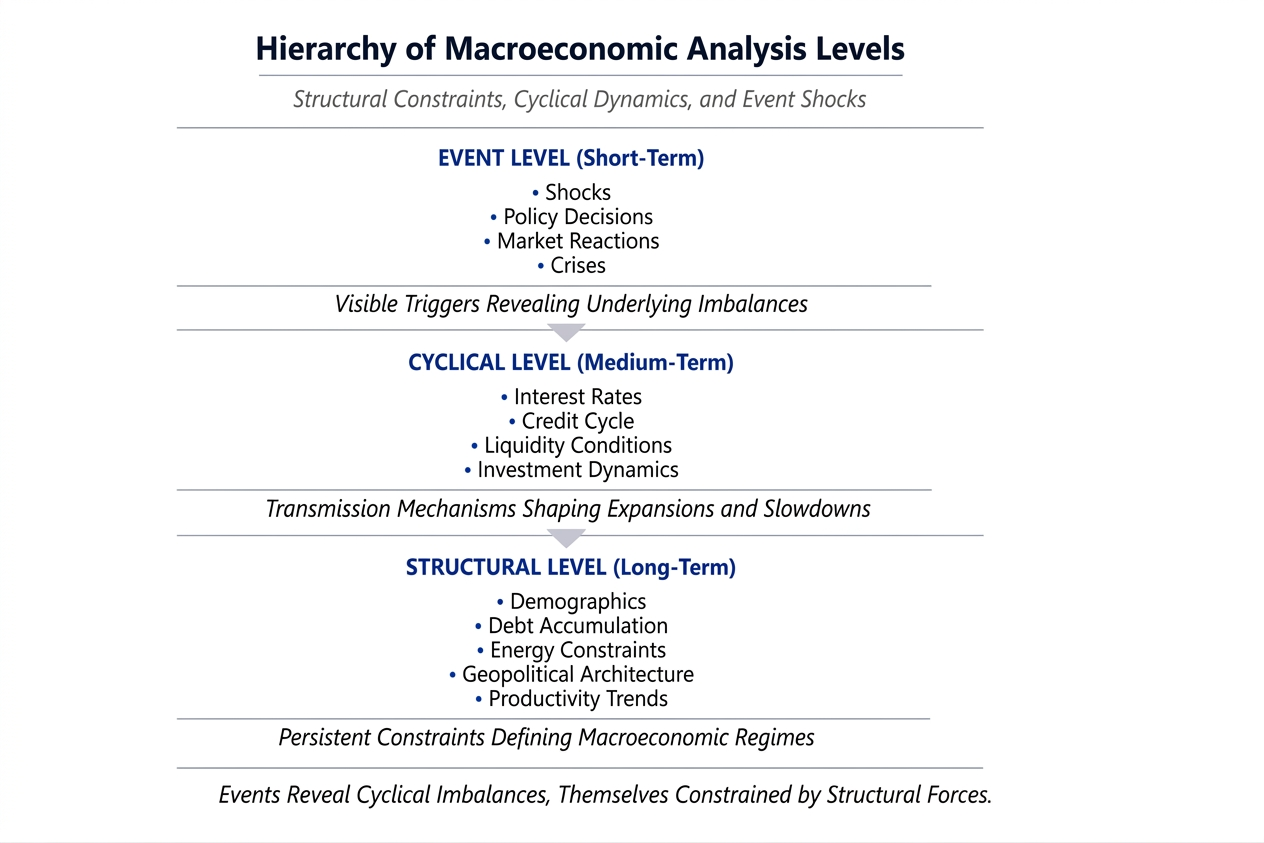
- Structural level — durable constraints measured in decades: public debt trajectory, working-age demographics, energy dependence, geopolitical architecture of value chains, trend productivity. These forces are not modified by short-term policy decisions and condition the space of possibilities of the two other levels.
- Cyclical level — phases measured in years: policy rate cycle, credit cycle, global liquidity cycle, profit cycle, property cycle. The cyclical unfolds within the envelope set by the structural.
- Event-driven level — temporary shocks measured in days or weeks: central bank decisions, monthly macro releases, geopolitical tensions, corporate defaults, market panics. An event often reveals a pre-existing cyclical imbalance, but rarely creates one on its own.
The reading rule is constant: an event only carries analytical weight to the extent that it reveals or modifies a cyclical or structural dynamic. Otherwise, it is noise. Conversely, attributing to an event the responsibility for a cyclical reversal conflates trigger and cause.
An event only carries analytical weight to the extent that it reveals or modifies a cyclical or structural dynamic. Otherwise, it is noise.
4. The forces that shape economic regimes
Any economic or financial dynamic unfolds within a constrained environment. Apparent opportunities never emerge ex nihilo: they are systematically conditioned by a specific macroeconomic regime. Six main forces structure contemporary regimes.
- Real interest rates (nominal rates adjusted for expected inflation). The price of time. Determines the present value of future cash flows, the trade-off between saving and consumption, and the cost of capital for productive investment.
- The credit cycle. The leverage variable. Determines the capacity for balance-sheet expansion or contraction of private agents (households, corporations, banks).
- Global liquidity conditions. The availability variable. Central bank aggregate balance sheets, dollar swap lines, offshore funding conditions. A variable that propagates internationally and conditions the resilience of the financial system to shocks.
- The cost and availability of energy. The primary input variable. Conditions productivity, underlying inflation, the current account balance of net-importing countries, and the trade-off between growth and transition.
- Working-age demographics. The slow variable. Conditions potential growth, the active-to-inactive ratio, net savings flows, and the sustainability of pension and healthcare systems.
- Geopolitical architecture and value chains. The organizational variable. Conditions production costs, trade flows, supply diversification, and relative sovereign risk premia.
These six forces do not add mechanically: they interact. A regime of high real rates produces a different effect depending on agent leverage, global liquidity availability, and energy costs. It is this interaction that defines a regime, more than each force taken in isolation.
5. Transmission mechanisms
Economic cycles propagate through successive layers. A shock or regime change does not simultaneously hit all spheres of the economy: it propagates along a transmission chain involving lags and asymmetries.
The typical sequence in a modern financialized economy is as follows:
- Central bank action (policy rate change, balance sheet operations, forward guidance adjustment).
- Market reaction (yield curve, credit spreads, dollar, equities). Lag: near-instantaneous to a few days.
- Transmission to financing conditions (mortgage rates, corporate lending terms, high yield market access). Lag: weeks to months.
- Impact on agent decisions (corporate investment, household home purchases, hiring). Lag: 6 to 12 months.
- Effect on real activity (GDP, employment, inflation). Lag: 12 to 18 months on average.
This cumulative 12-to-18-month lag between a monetary decision and its full effect on the real economy is documented by abundant empirical literature. It explains why central banks must act on expectations, and why a rate hike cycle may continue exerting its recessionary effect several quarters after the hikes have ended.
The same propagation logic applies in reverse: monetary easing produces no immediate effect on the real economy, and the transmission phase constitutes a period of particularly difficult-to-read uncertainty.
6. What reading cycles does not mean
Cyclical analysis is regularly confused with a forecasting exercise. This confusion is the main source of misuse of the Eco3min framework. For clarity:
- Reading cycles does not mean predicting market turning points. No methodology can date a stock index peak or trough in advance. Cyclical analysis can identify regimes of elevated risk, not inflection points.
- Reading cycles does not mean anticipating recession dates. Even the most advanced probabilistic models (yield curve, Sahm Rule, GDPNow) produce signals whose time horizon remains wide (6 to 18 months) and whose historical false positives are numerous.
- Reading cycles does not mean producing actionable short-term scenarios. Scenarios built on this framework aim to organize reflection on the range of plausible futures, not to provide dated portfolio decisions.
- Reading cycles does not mean reacting to news as an autonomous signal. A monthly print, an FOMC decision, a corporate default take their meaning within a longer trajectory. Taken in isolation, they support no cyclical inference.
Prediction remains a chimera in economics. Cyclical analysis aims to minimize major interpretation errors, not to eliminate uncertainty. Its added value is defensive: avoid confusing an event with a regime change, avoid overweighting an isolated signal, avoid projecting the present onto the future.
7. Common interpretation mistakes
Several recurring confusions distort cyclical analysis. Identifying them helps avoid them in one’s own reading.
- Confusing equity rallies with structural improvement. A stock rally may reflect risk premium compression, valuation bubbles, or fundamental improvement. Without distinction, the analysis misses what matters.
- Interpreting an isolated shock as a lasting change. An inflation spike driven by a supply shock is not equivalent to inflation sustained by a wage-price cycle. The nature of the shock conditions its persistence.
- Ignoring the role of real rates and credit. Many analyses focus on nominal rates and neglect the real (inflation-adjusted) dimension, which is nevertheless decisive for investment and asset valuation.
- Extrapolating short term into long term. One strong quarter does not establish a trend. Neither does one weak quarter. The statistical density of a cycle requires several quarters of coherent observation.
- Underestimating transmission lags. Concluding that monetary policy “has no effect” 6 months after tightening overlooks the documented 12-to-18-month lag.
- Over-interpreting historical correlations. A regularity observed across a few cycles does not constitute a law. The contemporary regime may differ from previous ones enough to invalidate the extrapolation.
Confusing a trigger (the event that reveals an imbalance) with a cause (the cyclical or structural dynamic that built it). A bank failure that reveals a systemic banking crisis is not the cause of that crisis.
8. How Eco3min applies this framework
The framework laid out here constitutes the conceptual foundation mobilized across all Eco3min publications. Three operational extensions complete this theoretical page.
The macroeconomic analysis methodology documents how this framework is applied in practice: data sources used, data pipeline, processing methodology, distinction between facts, mechanisms, hypotheses, and interpretations, and citation conventions.
The Eco3min macroeconomic analysis tools formalize three reading frameworks derived from this approach: interest rate cycle decoding, macro cycle diagnosis, and anatomy of a misleading indicator. These tools are mobilized selectively in articles when a specific point of reasoning calls for them.
The site’s thematic pillars apply this framework by domain:
- Macroeconomics & Geopolitics — global structural constraints.
- Monetary policy & rates — the price of time and capital.
- Commodities — physical supply and real cycles.
- Financial markets — reactions to macroeconomic regimes.
- Investment strategies — consistency over time.
- Stocks & ETFs — valuation and cycle arbitrage.
- Real estate & cycles — credit, rates, and real asset pricing.
- Crypto assets — hybrid assets and liquidity.
- Financial education — mechanisms before investing.
- Three levels of analysis coexist in any economic fact: structural (decades), cyclical (years), event-driven (days–weeks). The quality of an analysis depends first on its ability to identify which one carries the most weight.
- Three distinct cycles overlap without merging: economic cycle (5–7 years), financial cycle (15–20 years), credit cycle (responsive to monetary policy). Their asynchrony is constitutive.
- The transmission lag between a monetary decision and its full effect on the real economy is typically 12 to 18 months. Concluding too early that a policy is ineffective is a common error.
- Reading cycles is not about predicting turning points, but about minimizing interpretation errors and placing each event within a broader trajectory.
9. Further reading
- Eco3min macroeconomic analysis methodology — data sources, pipeline, citation conventions.
- Eco3min macroeconomic analysis tools — the three operational frameworks.
- Macro Q&A — application of the framework to concrete situations.
- Investing for beginners — for readers new to these concepts.
Last updated — 12 July 2026
Disclaimer – Financial Information: The analyses, commentary, and content published on eco3min.fr are provided for informational and educational purposes only. They do not constitute investment advice or a solicitation to buy or sell financial instruments. Past performance is not indicative of future results. All investment decisions involve risk and are the sole responsibility of the reader.