
Fuel Burden Calculator: Your Fuel as a Share of Income
When oil prices climb, public debate fixes on the national recession risk. At the household level the question is more direct: what share of your income goes into the tank, and how much does it move when the pump price changes? That is an individual measure, distinct from the aggregate oil burden expressed as a share of GDP.
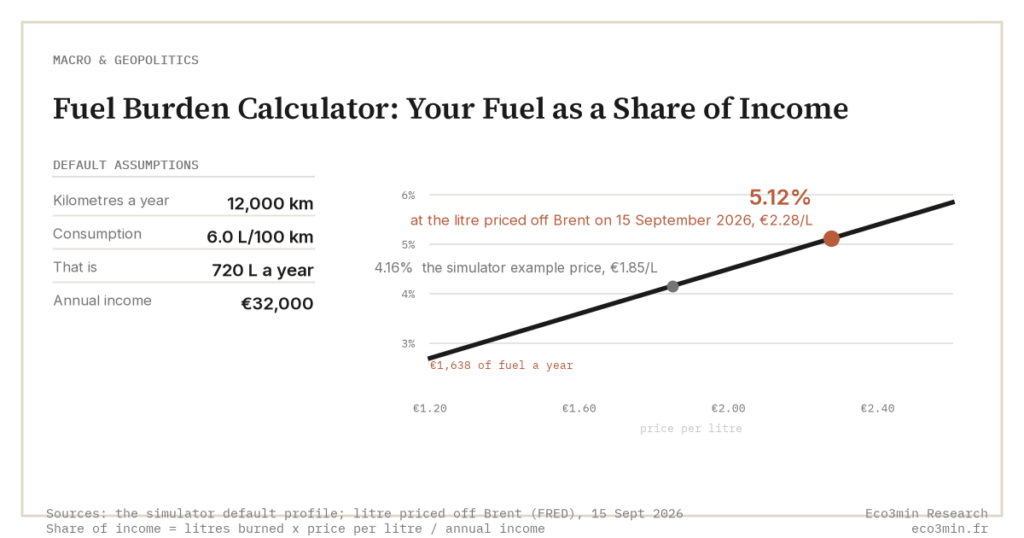
The calculator below works out your annual fuel spend from your mileage and consumption, then expresses it as a share of net income. The curve carries the point: at a given mileage, it is the price — far more than your consumption — that moves the burden, and a price shock shows up on it immediately.
What an oil price spike actually costs your household
Enter your mileage, consumption and net income. The tool shows your fuel as a share of income — and how that share moves with the pump price. It is your personal burden, a different measure from the national oil-burden threshold.
Conditional arithmetic, non-predictive · assumptions entered by the user · personal fuel/income share, a different measure from the national oil-burden/GDP threshold · Eco3min — educational tool, neither advice nor a recommendation.
How to read your fuel burden
The spend is the product of three factors: distance driven, vehicle consumption (litres per 100 km) and the price per litre. Divided by net income, it yields a share — in percent — measuring the fraction of your purchasing power absorbed by fuel. A household driving 12,000 km a year at 6 L/100 spends roughly €1,300 at an indicative €1.85/L; set against a net income near the French median standard of living — about €26,000 a year for a single person, per INSEE — that spend is a few percent of income.
The value of the tool is not the single figure but the slope: the curve plots your burden across price levels. The steeper it is, the more exposed your budget is to a rise. The “+30%” marker shows what a price shock of that size would produce, at the same mileage — a way to see the risk asymmetry without forecasting where prices go next.
Why price weighs more than consumption
In the short run a household does not change its vehicle or its commute overnight: mileage and consumption are relatively rigid. The pump price, by contrast, can swing 20 or 30% within months during a geopolitical shock to the oil market. Price therefore dominates the short-run variation in the burden — which the slope of the curve makes visible. That rigidity in consumption is also why an oil shock compresses household disposable income: constrained spending rises while the volume consumed cannot adjust quickly. Related data: the US retail gasoline price dataset.
An individual measure, distinct from the macro threshold
This personal burden should not be confused with the national oil burden, which divides aggregate US petroleum spending by GDP. Historically, US oil shocks that exceeded roughly 4% of GDP were followed by a recession — but that empirical regularity concerns a macroeconomic measure, computed differently and subject to exceptions and statistical uncertainty. Your fuel/income share and that national threshold are not comparable: one describes a household, the other an entire economy. The mechanism — a price squeezing a budget — is the same; the scale is not.
For the mechanism at the national scale and the 4%-of-GDP threshold, see our study Oil Shocks and US Recessions: The 4%-of-GDP Burden Threshold. To place oil within commodity cycles, see the pillar Commodities: macroeconomic regime signals, cycles and transmission.
Last updated — 6 October 2026
Disclaimer – Financial and Legal Information: The analyses, commentary, and content published on eco3min.fr are provided for informational and educational purposes only. They do not constitute investment advice or a solicitation to buy or sell financial instruments. Past performance is not indicative of future results. All investment decisions involve risk and are the sole responsibility of the reader. Data, charts and calculated series are provided as is and may contain errors or lag behind their source: check any figure against the primary source cited before relying on it. Content describing laws, regulations or contracts reflects the law as of its publication date and does not constitute legal or tax advice; applying it to a specific situation requires a qualified legal or tax professional.