
GOLDPMGBD228NLBM: Gold Price USD — Monthly Long-Run Reference (1960–2026, World Bank Pink Sheet)
GOLDPMGBD228NLBM is the FRED tag for the daily LBMA Gold PM Fix in USD. Eco3min provides the complementary World Bank Pink Sheet monthly long-run gold price series since 1960.
GOLDPMGBD228NLBM is the Federal Reserve Bank of St. Louis (FRED) identifier for the London Bullion Market Association (LBMA) Gold Price PM Fix in USD per troy ounce, a daily benchmark published since April 1968. The Eco3min series provides the monthly World Bank Pink Sheet aggregation of London gold market prices since January 1960 — a longer historical reference than the daily GOLDPMGBD228NLBM series, sourced from the same underlying London gold market. For users requiring the daily FRED resolution, the raw GOLDPMGBD228NLBM series is available directly via FRED; the Eco3min file complements it with a deeper historical window suitable for long-cycle and regime analysis.
Dataset: Gold Price — Monthly Average, USD (1960–2026) · Updated 2026-08-01
Loading dataset…
Source: World Bank Commodity Price Data (Pink Sheet) — monthly historical gold price archive
Macro Takeaway
GOLDPMGBD228NLBM and its monthly World Bank equivalent function as the canonical USD-denominated reference for the London gold market — the deepest pool of physical gold trading globally. Nominal prices in this series compound currency-of-denomination effects with real gold demand, which is why the CPI-adjusted real gold price and the US dollar index are typically read alongside GOLDPMGBD228NLBM for cycle analysis.
The series captures three structurally distinct regimes since 1960: the Bretton Woods fixed-price era (1960–1971), the post-1971 fiat-era repricing, and the post-2000 secular cycle. Comparisons against the 10-year real interest rate reveal the inverse relationship between the nominal level of GOLDPMGBD228NLBM and the real opportunity cost of holding a non-yielding asset.
Dataset Overview
| Indicator | Gold Price — Monthly Average, USD (1960–2026) |
|---|---|
| Geography | Global (USD per troy ounce) |
| Frequency | Monthly |
| Period | 1960–2026 |
| Variables | date, gold_price_usd |
| Format | CSV, Excel (XLSX) |
| Sources | World Bank Commodity Price Data (Pink Sheet); FRED reference series GOLDPMGBD228NLBM (daily, since 1968) |
| Last updated | — |
Dataset Variables
The CSV and Excel files contain the following columns.
| Column | Type | Description |
|---|---|---|
date | Date (YYYY-MM-DD) | First day of month |
gold_price_usd | Float | Monthly average gold price (USD per troy ounce) |
Column names match the CSV headers exactly.
Rolling Change in the Gold Price by Horizon
A log-scale chart flattens the violence of gold’s moves. This tool computes the percentage change of the monthly gold price over the horizon you select, one month to five years, for every month since 1960, and reports the latest change, the largest rise and fall with their dates, and the share of windows in which the price rose.
The twelve months to August 2026 show a rise of 31.0 percent. The largest twelve-month rise on record is +197.4 percent to January 1980, the largest fall −36.4 percent to July 1981; gold rose in 55.5 percent of the 788 twelve-month windows since January 1961 and last posted a twelve-month decline in March 2023.
Download the Complete Dataset
The full dataset is available in CSV and Excel formats.
FRED Direct CSV Access
The daily FRED series GOLDPMGBD228NLBM is available directly:
https://fred.stlouisfed.org/graph/fredgraph.csv?id=GOLDPMGBD228NLBM
The Eco3min version provides the longer-horizon monthly World Bank Pink Sheet series (1960–2026) in a clean, analysis-ready format with consistent column names and both CSV and Excel downloads. The two are complementary: GOLDPMGBD228NLBM for daily resolution since 1968, the Eco3min monthly file for long-run cycle and regime analysis since 1960.
Direct CSV Access — Eco3min Structured Dataset
https://eco3min.fr/dataset/gold-price.csv
This URL returns the complete dataset in CSV format. It can be used directly in pandas, R, curl, or any data tool.
Using the Dataset in Python
import pandas as pd

url = "https://eco3min.fr/dataset/gold-price.csv"
df = pd.read_csv(url, parse_dates=["date"])

print(df.head())
print(df.describe())
Using the Dataset in R
library(readr)

url <- "https://eco3min.fr/dataset/gold-price.csv"
df <- read_csv(url)

head(df)
summary(df)
Both examples load the dataset directly from the URL — no download or API key required.
Methodology
The Eco3min series mirrors the World Bank Commodity Markets Outlook (CMO) historical data, which compiles monthly average gold prices in USD per troy ounce from London Bullion Market quotations. Pre-1968 values rely on broker-reported London prices; from 1968 onwards they align with the LBMA Gold PM Fix that FRED publishes as GOLDPMGBD228NLBM. What that daily benchmark actually measures, and how the spot quotation is set, is unpacked in our explainer on the gold spot price and the London fix. The Pink Sheet historical archive is public-domain data updated monthly by the World Bank with no licensing restriction.
This dataset is updated automatically via the Eco3min data pipeline.
Data Quality & Provider Notes
The World Bank Pink Sheet is one of the most institutionally stable commodity price archives, used by the IMF, central banks, and academic researchers for long-run cycle studies. Its monthly cadence and 1960 start date make it the standard long-history reference for gold pricing in USD; FRED GOLDPMGBD228NLBM is the standard daily-frequency reference from 1968. A broader view: the routes to gold, from bullion to miners.
- Release latency. The World Bank publishes the Pink Sheet monthly, typically within the first two weeks of the following month. The Eco3min pipeline mirrors this monthly cadence. For higher-frequency users, the FRED GOLDPMGBD228NLBM daily series updates with the previous-business-day London PM Fix.
- Revisions policy. Historical monthly gold prices are not revised once published. Methodological updates are documented in successive Pink Sheet editions but do not retroactively alter historical values.
- Alternative sources. The LBMA publishes the daily Gold AM and PM Fix directly via lbma.org.uk. The World Gold Council aggregates monthly and quarterly gold price series in multiple currencies. Bloomberg (XAU Curncy), Refinitiv/LSEG, and ICE Benchmark Administration provide institutional feeds of the same underlying London market.
- Known gaps. None for the monthly Eco3min series. The daily FRED GOLDPMGBD228NLBM has gaps on weekends and London bank holidays, which can shift the apparent month-end value depending on when the fix occurs.
For long-horizon studies prior to 1968, the Pink Sheet series should be read as an average of broker-reported London quotations rather than as a single canonical fix.
Common Pitfalls When Using GOLDPMGBD228NLBM
GOLDPMGBD228NLBM is widely cited as the USD gold reference, but several recurring interpretation errors distort the signal — particularly when users switch between this daily FRED tag and longer-history monthly aggregates.
- Cadence and start-date confusion. GOLDPMGBD228NLBM is a daily series starting in April 1968. The Eco3min file mirrors the monthly World Bank Pink Sheet series since January 1960. Studies that mix the two without aligning frequency and start date introduce structural breaks that look like regime shifts but are methodological artefacts.
- Nominal vs real gold price. Reading GOLDPMGBD228NLBM in nominal USD across decades conflates real gold demand with USD purchasing-power erosion. For multi-decade comparisons, the CPI-adjusted real gold price is the appropriate reference; nominal levels alone overstate post-2000 gold strength relative to the 1980 peak.
- USD-denomination vs local-currency gold. A rising GOLDPMGBD228NLBM driven by USD weakness against major currencies is not the same signal as a rising gold price across all currencies. Cross-checking against the US dollar index separates the dollar component from the underlying gold demand signal.
- Spot fix vs futures vs ETF. The LBMA PM Fix that GOLDPMGBD228NLBM captures is one of several gold reference prices. COMEX gold futures (GC1 front-month) and the SPDR Gold Shares ETF (GLD net asset value) typically track the fix within a few basis points during normal trading but can diverge during stress episodes, end-of-quarter rolls, or physical-delivery squeezes.
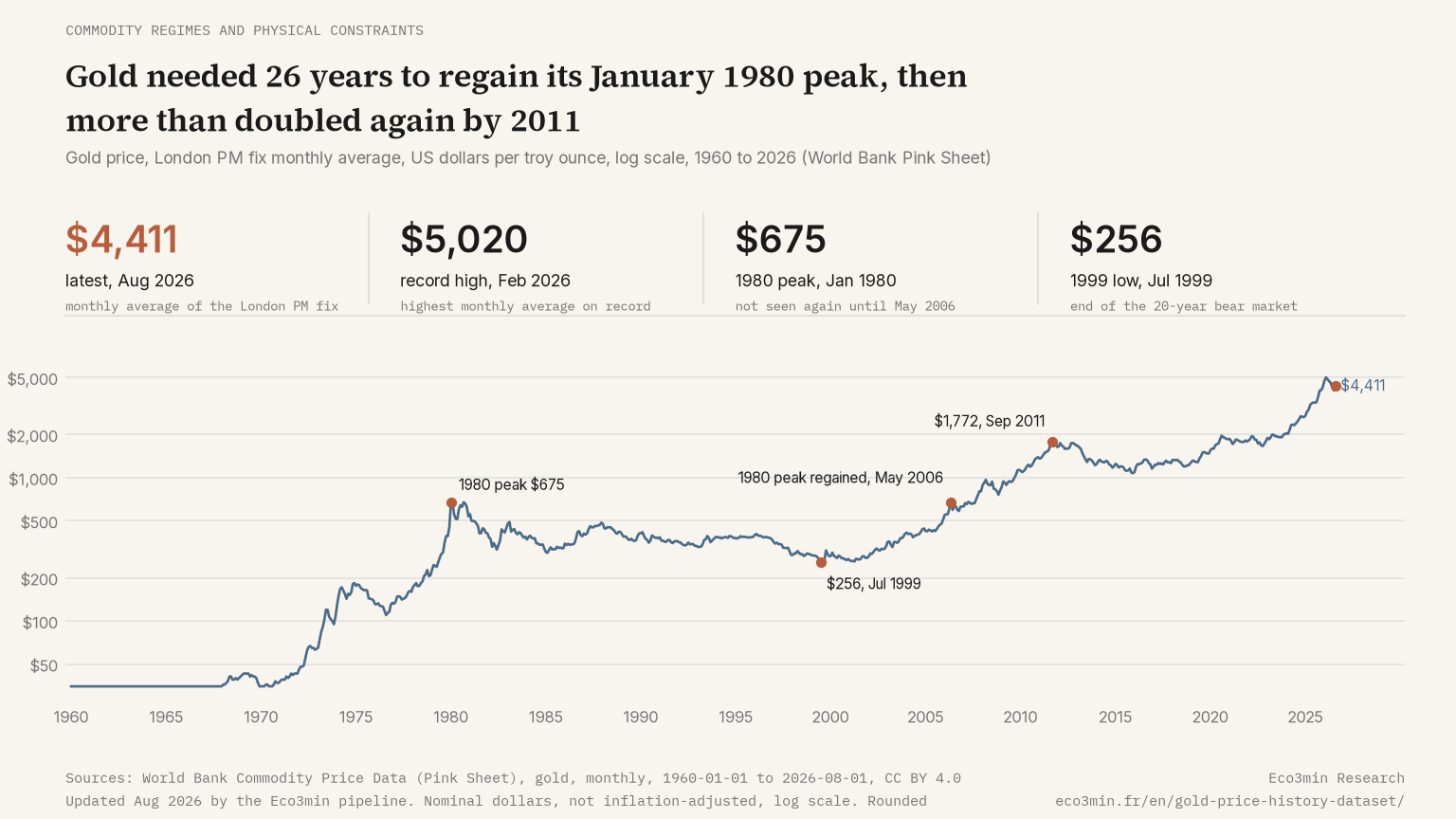
Historical Regimes
1960–1971 — Bretton Woods fixed parity. GOLDPMGBD228NLBM (and its monthly equivalent) traded near $35/oz, the official US Treasury convertibility price, with the London market quoting marginally above. The collapse of the London Gold Pool in 1968 and Nixon’s closure of the gold window in August 1971 ended this regime.
1971–1980 — Fiat-era repricing. Gold rose from $35 to over $850 by January 1980 (+24× nominal) as stagflation, oil shocks, and US dollar weakness converged. This is the steepest sustained gold appreciation in the GOLDPMGBD228NLBM record.
1980–2000 — Secular bear. Volcker disinflation, the reassertion of US monetary credibility, and rising real interest rates drove gold from $850 to under $260 by 1999 — a –70% nominal drawdown. The series traded sideways below $400 for most of the 1990s.
2000–2011 — Secular bull cycle. A combination of dollar weakness, the 2008 financial crisis, and post-crisis quantitative easing drove GOLDPMGBD228NLBM from $260 to $1,900 by September 2011 (+7×), a cycle visible alongside the collapse in 10-year real interest rates.
2011–2018 — Consolidation. Real-rate normalization and US dollar strength compressed gold to a $1,050–1,400 range through 2018, a multi-year base that resolved upward with the 2019 Fed pivot.
2018–2024 — Monetary expansion era. COVID-era balance-sheet expansion, 2022 inflation, and 2023–2024 central bank reserve accumulation drove GOLDPMGBD228NLBM from $1,300 to over $2,700 — a new nominal regime above the 2011 high.
2024–2026 — Reserve-accumulation cycle. Continued central bank and emerging-market sovereign buying, alongside an elevated geopolitical risk premium, sustained GOLDPMGBD228NLBM above historical averages. The structural question is whether this represents a durable repricing or a cyclical extension of the post-2018 trend.
Related Macroeconomic Datasets
GOLDPMGBD228NLBM is best analysed alongside related real-rate, dollar, and commodity series that drive its cycle.
- Real Gold Price (CPI-Adjusted) — Removes USD purchasing-power erosion for multi-decade comparisons
- Silver Price History — Companion precious metal; the gold/silver ratio is a classic regime indicator
- US Dollar Index (DTWEXBGS) — Inverse driver of USD-denominated gold
- 10-Year Real Interest Rate — Opportunity cost of holding non-yielding gold
- WTI Crude Oil Price — The gold/oil ratio captures monetary vs energy regimes
- Brent Crude Oil Price — Global energy benchmark for commodity-pair analysis
Deep analytical framework
Gold as a Monetary Signal: Real Yields, the Dollar and Central Bank Buying →
Macroeconomic Dataset Hub
This dataset is part of the Eco3min macro-financial data repository.
Explore the Eco3min Dataset Hub
Sources
- World Bank Commodity Price Data (Pink Sheet) — monthly historical gold price archive
- Federal Reserve Bank of St. Louis (FRED) — reference series GOLDPMGBD228NLBM (daily, since 1968)
Dataset Reference
Last updated — 21 September 2026
Disclaimer – Financial Information: The analyses, commentary, and content published on eco3min.fr are provided for informational and educational purposes only. They do not constitute investment advice or a solicitation to buy or sell financial instruments. Past performance is not indicative of future results. All investment decisions involve risk and are the sole responsibility of the reader.