Gold as a Monetary Signal: Real Yields, the Dollar and Central Bank Buying

Gold prices do not track inflation: they track the monetary opportunity cost of holding, itself driven by real yields, the dollar and — since 2022 — a long-dormant driver, record central bank buying.
TL;DR
Since Nixon ended dollar-gold convertibility in 1971, four cycles carried gold from $35 to the $3,000 mark crossed in March 2025 — driven by real yields, the dollar, now official buying.
- The 1971-1980 cycle ran from $35 to $850, a 24-fold rise on accelerating CPI (13.5% in 1980), before the mirror 1980-2001 collapse to a $252 floor in August 1999, the so-called Brown Bottom.
- Holding gold means forgoing a real yield, so the dollar matters too: the 12-month gold-dollar correlation has averaged about -0.6 over twenty years (FRED DTWEXBGS).
- Central bank buying near 2,100 tonnes across 2022-2023 — about a quarter of demand — alongside a dollar reserve share down to 57.1% by Q1 2026 (IMF COFER) marks the post-2022 structural shift.
Reading gold today requires combining three distinct mechanics rather than invoking a single narrative. This framing commands the analytical grid of this cluster. More context: The S&P 500 in Gold: How Many Ounces the Index Buys.
As of May 18, 2026, the LBMA spot gold price (the reference PM Fix since 1968, carried as a monthly average by the World Bank Pink Sheet since FRED withdrew the series) trades in a regime unprecedented since the crossing of the $3,000 per troy ounce threshold in March 2025. The most widely diffused reading in general-interest media collapses this level into a single frame: gold as inflation hedge. That reading is empirically weak, and it masks three distinct mechanics that together — and only together — illuminate modern price formation: monetary opportunity cost measured by TIPS real yields, the international arbitrage induced by dollar fluctuations, and the assumed return of central banks as structural buyers after a decade of near-effacement. On this three-axis grid, the current regime is not a single signal but a bundle of signals whose respective contributions remain contested. A distinction that matters: Physical Commodity Markets: Oil, Gas, Copper, Critical Minerals, and Structural Signals. The mechanical determinants of gold prices have been documented elsewhere on the site as a generic framework; the present article serves a different purpose: it reads, in the macro regime of 2026, how those determinants compose — and where the dominant narrative fails. Further on this: why gold hedges monetary instability rather than inflation.
1. Why Gold Is Not, Empirically, an Inflation Hedge
The received idea that gold mechanically protects against inflation collapses the moment it confronts historical series. The rolling 12-month correlation between the change in nominal gold prices (LBMA PM fix, monthly series from the World Bank Pink Sheet) and the change in U.S. CPI (FRED CPIAUCSL) has oscillated since 1971 between -0.6 and +0.8 depending on the window, around 0.1 on average, with considerable dispersion. On longer sub-periods, the observation is even sharper: between January 1980 and August 1999, U.S. CPI rose roughly 115% cumulatively while nominal gold prices lost nearly 70% of their value. Over that window, gold did not protect against inflation — it accompanied a destruction of purchasing power of more than 80% in real terms for holders. A broader view: commodity prices adjusted for inflation.
The reverse reading fares no better. Between 2010 and 2020, U.S. inflation remained structurally low — the average annual CPI hovered around 1.8% (BLS historical series) — yet gold prices ran two opposite moves: a climb to the September 2011 nominal peak at $1,923 per ounce, followed by a drop to $1,050 in December 2015. If gold responded mechanically to inflation, those two moves would be unintelligible. The inflation hedge myth dismantled on Eco3min from the empirical angle leaves the present question open: if gold is not an inflation hedge, then what is it, and how should it be read?
The answer rests on a distinction: gold does not respond to inflation taken as a stand-alone variable, but to the monetary opportunity cost of holding it. That cost is a function of the real yield obtainable on a risk-free alternative — typically 10-year TIPS. When inflation rises while nominal rates fail to follow, real yields drop and gold appreciates; when inflation rises and nominal rates more than follow, real yields rise and gold retreats. That is the frame that makes sense, not the naïve frame of “high inflation = high gold.” See also: the historical co-movement of copper-gold and Treasury yields.
2. Opportunity Cost as the Reading Grid: Real Yields and the Dollar as Two Faces of the Same Mechanic
Gold is an asset that distributes nothing: no coupon, no dividend, no rent. Holding it carries a cost that is not accounting but real — the yield the holder renounces by immobilizing capital in a sterile asset. The modern proxy for that renounced yield is the 10-year Treasury Inflation-Protected Securities yield (FRED DFII10), a FRED series available since January 2003 (TIPS themselves date from 1997) that directly measures the bond yield adjusted for expected inflation. The theoretical relationship is clean: higher real yields mean higher opportunity cost, which means downward pressure on gold — and conversely. Related framing: our bitcoin-versus-gold comparison.
The empirical reading confirms this relationship over nearly three decades. From 2003 to 2020, the rolling 12-month correlation between gold and the 10-year TIPS yield ran at -0.7 at the median (Eco3min calculations on the LBMA PM fix, monthly series from the World Bank Pink Sheet and FRED DFII10), with occasional positive windows, trending around -0.7 in calm periods and deepening to -0.85 during stress windows such as 2008-2011. That strong correlation is not accidental: it reflects the opportunity cost mechanic. But this relationship broke down between 2022 and 2024 — a topic to be treated in an empirical read of gold and real yields, where the decorrelation and its origin will be unpacked.
The dollar plays a parallel role, and for analogous reasons. Gold is quoted in dollars globally; for any buyer outside the dollar zone — whether an Asian central bank, a European investor, or a Middle Eastern refiner — the local-currency cost of acquiring gold depends mechanically on the exchange rate. A weaker dollar lowers the cost of gold for the rest of the world, supports foreign demand, and pushes the dollar gold price higher. Conversely, a stronger dollar makes gold more expensive abroad and exerts downward pressure on the dollar price. This international arbitrage mechanic is robust: the rolling 12-month correlation between gold and the trade-weighted dollar (FRED DTWEXBGS) has oscillated for twenty years widely since 2006, averaging around -0.4. See also, on the dollar’s long-run backdrop: the US external balance near zero.
Real yields and the dollar are not two distinct drivers but two expressions of the same underlying mechanic: the monetary opportunity cost of holding gold. The real yield measures this cost in domestic terms for the dollar investor; the dollar measures it for the rest of the world. This is why both variables tend to co-move during clean monetary phases: a Fed tightening cycle simultaneously raises real yields and strengthens the dollar, and gold retreats on both channels at once. The gold-dollar arbitrage mechanic deserves a dedicated treatment — provided within this cluster — because the regime exceptions are as instructive as the mechanic itself.
Observing phases of divergence illuminates the mechanic better than any theory. Between August 2011 and December 2015, the trade-weighted dollar index gained about 30% while gold lost nearly 45% from its peak; the 10-year TIPS yield moved from roughly -0.5% to +0.7% over the same window. The three variables co-moved perfectly along the theoretical grid. Conversely, between March 2008 and August 2011, gold rose by more than 80% while the dollar index remained broadly stable and the 10-year TIPS yield fell back from a peak above 3% (November 2008) to negative levels (August 2011) under the combined effect of the GFC and three rounds of QE. The strength of the real-yield factor masked the dollar effect — that kind of superposition is what one must learn to read. A parallel read: Gold Beyond the Dollar: A Dollar Record Is Not a Record Everywhere.
3. The Underestimated Structural Driver: Record Central Bank Buying Since 2022
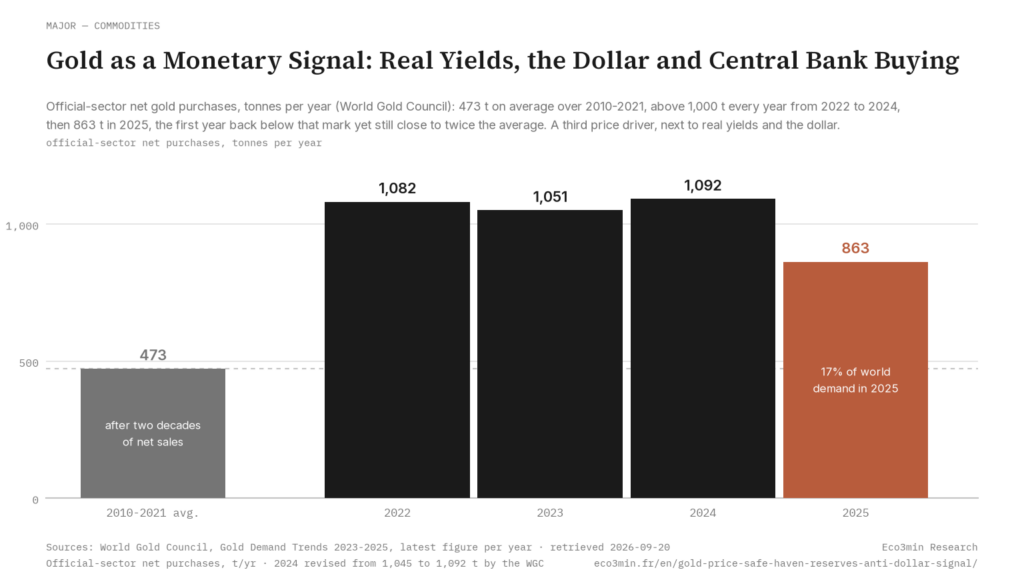
A two-variable grid — real yields and dollar — correctly covered the formation of gold prices from the 1990s through the early 2020s. But that grid became insufficient starting in 2022. The reason is the emergence of a third structural driver: the assumed return of central banks as massive net buyers of gold, after three decades of opposite behavior. According to World Gold Council data (Gold Demand Trends annual reports, reference series), central banks bought 1,082 tonnes of gold in 2022, 1,051 tonnes in 2023 and 1,092 tonnes in 2024 (figures revised in later editions), then 863 tonnes in 2025, the first year below 1,000 tonnes since 2021; before the revision the projection for 2024 sat near 1,100 tonnes. Those volumes represent nearly a quarter of total global gold demand over those years — and constitute an unprecedented structural floor on the market. Related reading: The inflation-adjusted gold price record.
To grasp the magnitude of the shift, the long sequence is worth recalling. From 1990 to 2009, central banks were net sellers of gold: annual sales oscillated between 400 and 600 tonnes for two decades, governed by the 1999 and 2004 Washington Agreements that capped European central bank disposals to avoid market destabilization. The turning point comes in 2009-2010, in the immediate wake of the global financial crisis: the official sector posts its first net buyer balance since 1988, and never reverts. From 2010 to 2021, average annual net purchases settle around 480 tonnes (WGC) — substantial, but within historical norms of the pre-1990 era. The quantitative break arrives in 2022, with a near-instantaneous doubling of annual volumes. Gold is the one commodity whose cycle answers to monetary rather than physical constraints — the outlier of the long view of commodity regimes.
Buyers are concentrated within an identifiable core. Over 2022-2024, the People’s Bank of China, the Central Bank of the Republic of Turkey, the Reserve Bank of India, the National Bank of Poland, the Monetary Authority of Singapore, the Czech National Bank, the Central Bank of Uzbekistan and — in 2023 — the Qatar Central Bank rank among the largest reported buyers. The WGC publishes monthly country-level data in its regular statistical releases. A portion of the buying, however, goes undeclared publicly — notably some Chinese operations whose estimated volumes by WGC analysts sometimes substantially exceed the volumes officially reported to the IMF under International Financial Statistics.
Stated or inferred motivation crosses three logics. First logic: reserve diversification, in the context of growing awareness of dollar concentration in reserve assets. Second logic: response to financial sanctions — the sequence following the 2014 annexation of Crimea, and especially the early-2022 freezing of Russian dollar and euro reserves (roughly $300 billion immobilized), signaled to non-Western central banks that reserve assets denominated in adversarial-jurisdiction currencies carry tangible geopolitical risk, no longer merely theoretical. Third logic: expectations regarding the dollar’s structural role in the international monetary system on decadal horizons. The record central bank buying wave and its breakdown by buyer is the subject of a dedicated satellite in this cluster. Further reading: what the gold/silver ratio signals about relative precious-metals valuation.
The movement fits into a broader macro frame: the slow de-dollarization of global reserves. According to IMF COFER (Composition of Official Foreign Exchange Reserves), published quarterly, the dollar share of identified global FX reserves has declined from 71% in 1999 (first COFER datapoint) to 57.1% in Q1 2026, an erosion of about 7 percentage points over twenty-seven years. This de-dollarization is slow but cumulatively significant; and although the euro, yuan, yen and pound have absorbed only a fraction of the decline, the residual balance has been directed in part toward gold, which does not appear in COFER but constitutes a distinct component of official reserves. Related analysis: Dollarization versus de-dollarization, by the data.
4. Reading by Superposition: No Single Driver Suffices
The principal contribution of a three-driver grid — real yields, dollar, official-sector flows — is not to replace the two-variable grid, but to deploy its exceptions. The 2022-2024 sequence provides the most instructive illustration. Over that window, 10-year TIPS yields climbed from negative territory (around -1% in March 2022 under the post-Covid shock) to clearly positive levels (up to +2.5% in late 2023, the highest since 2008). On the classical grid, gold prices should have collapsed. Instead they did the opposite: they moved from a $1,948 monthly average in March 2022 to $2,026 in December 2023, a 4% rise while opportunity cost was rising sharply. On the same theme: The Gold/Oil Ratio: How Many Barrels an Ounce Buys.
Three competing readings partially illuminate this decorrelation. First reading: structural override from central bank buying — a buying flow of 1,082 + 1,051 = more than 2,100 tonnes over 2022-2023 constitutes by itself a massive price support, independent of the opportunity cost channel, and numerically sufficient to offset the downward pressure from rising real yields. Second reading: expectations regarding the dollar’s role — marginal buyers price in a scenario in which the dollar loses its structural position, a scenario that does not show up in current real yields but does in official flows. Third reading: perceived monetary debasement — the idea that beyond measured CPI, persistent U.S. fiscal stance (deficits around 6% of GDP per CBO 2024) and anticipated future pressures on the Fed balance sheet degrade the long-run real value of the dollar. Related dataset: the Fed balance-sheet data.
These three readings are not mutually exclusive — they all function simultaneously, to varying degrees across sub-periods. And none lends itself to operational prescription: they are three interpretive grids that retrospectively illuminate the observed trajectory, without permitting direct prediction of what follows. An empirical read of gold and real yields proposes a decomposition of respective contributions by time window.
The gold price tracks the monetary opportunity cost — real yields, the dollar, official-sector flows — never inflation taken as a stand-alone variable.
5. What the 1971-2026 Cycles Teach
The modern history of gold prices begins on August 15, 1971, the date Richard Nixon unilaterally suspended the dollar-gold convertibility at $35 per ounce that had structured the Bretton Woods system since 1944. From that date forward, gold becomes a free asset, with its price determined on markets without institutional floor. Four complete cycles unfold since this rupture, each carrying a distinct macro reading.
The 1971-1980 cycle rises from $35 to $850 per ounce, a 24-fold multiplication in nine years. Three drivers are at work: accelerating U.S. inflation (CPI at 12.3% in December 1974, 13.5% in 1980), the two oil shocks (1973-1974 and 1979-1980), and growing distrust of the dollar in the wake of inconvertibility. The peak is reached in January 1980, against a backdrop of maximum stagflation and Paul Volcker’s accession to the Fed chairmanship. Related question: Our rundown of stagflation.
The 1980-2001 cycle is the mirror image: collapse to around $250-300 per ounce, a loss of roughly 70% in nominal terms and more than 80% in real terms. Three antagonistic drivers: Volcker tightening (policy rates pushed to 19% in 1981) that crushes inflation expectations, the structural disinflation that settles over the 1980s, and the strong-dollar reign initiated in the 1990s with the ideological victory of Reagan and Greenspan. The floor is reached in August 1999, at $252 — the so-called Brown Bottom, named after British Chancellor Gordon Brown who sold half of the Bank of England’s gold reserves that year at prices close to the cyclical minimum.
The 2001-2011 cycle brings the price to $1,923 per ounce in September 2011, a 7.6-fold multiplication in ten years. Drivers: a sequence of successive bubbles (dot-com 2000, housing 2007), the GFC of 2008, the first Fed QE rounds from 2008 onward, the continuous degradation of the U.S. sovereign rating (loss of AAA at S&P in August 2011). The September 2011 peak closely coincides with the entry into the eurozone sovereign debt crisis and systemic doubt over European public bonds.
The 2011-2015 bear cycle takes gold back down to roughly $1,050 in December 2015, a loss of around 45%. Taken from the LBMA gold price benchmark. The primary driver is the anticipated then effective Fed normalization: QE3 tapering announced in May 2013, end of QE3 in October 2014, first rate hike since 2006 in December 2015. The 10-year TIPS yield mechanically climbs, the dollar strengthens, and gold retreats along the classical two-variable grid.
The current cycle opens in December 2015 and is not yet complete in 2026. Its trajectory is markedly shaped by massive central bank buying from 2022 onward and by the crossing of the $3,000 per ounce threshold in March 2025. Gold’s major cycles since Bretton Woods and their detailed reading by macro regime form the subject of a dedicated article within this cluster.
A peculiarity of the current cycle deserves to be flagged: in real terms (CPI-adjusted), gold prices in 2025 exceeded their historical peak of January 1980 — something that had not occurred in forty-five years. To situate the order of magnitude, the $850 nominal peak of January 1980 equated to roughly $3,460 in December 2024 dollars (CPI-U). The crossing of that level on a monthly-average basis in September 2025, and then the clear surpassing ($5,020 in February 2026), makes the current cycle the first post-1971 bull cycle to erase the Volcker peak in both real and nominal terms. The macro significance of that crossing is one of the central topics of the satellite dedicated to the $3,000+ regime. In the same vein: gold’s place in a regime-aware portfolio.
6. The $3,000+ Regime Since March 2025: Three Plausible Readings, No Prescription
Crossing the $3,000 per ounce threshold in March 2025 marks a media inflection point but raises a more demanding analytical question: what does this level correspond to, and what does it say about the underlying macro regime? Three plausible readings coexist. None imposes itself to the exclusion of the others, and none lends itself to operational prescription.
First reading: structural override from central bank buying. If one assumes that official-sector purchases hold around 1,000-1,100 tonnes per year for another five to ten years, this buying flow constitutes a mechanical price floor on the market — not because central banks set a price, but because they absorb a substantial fraction of annual mine output (3,650 tonnes in 2024 and 3,672 tonnes in 2025 per the WGC) at levels that prevent the formation of a classical bear cycle. This reading would justify treating the $3,000 threshold less as a peak than as a new regime floor, conditional on the maintenance of official-sector buying flow.
Second reading: accelerating de-dollarization expectations. This reading invokes the scenario of a progressive shift of the international monetary system toward a multipolar configuration, in which the dollar’s role as sole reserve currency would erode in favor of a heterogeneous basket — euro, yuan, gold, and perhaps eventually institutional digital assets. This reading is consistent with the COFER trajectory (57.1% in Q1 2026 versus 71% in 1999) but also with the clear acceleration of that trend observed since 2022. The difficulty of this reading lies in its horizon: it says little about the next three to five years, but anchors the current price in a very long-term trajectory.
Third reading: perceived monetary debasement. This reading invokes a less quantifiable but documentable mechanism: the idea that beyond measured CPI, the aggregate of U.S. public liabilities, the fiscal trajectory (federal deficit around 6% of GDP per CBO 2024-2025), and anticipated future pressures on the Fed balance sheet degrade the long-run real value of the dollar as a unit of account. Under this reading, the nominal gold price captures not observed inflation but latent inflation — the gap between the current fiscal and monetary trajectory and the trajectory consistent with long-run monetary stability.
These three readings coexist simultaneously in the formation of the observed price. None is falsifiable in the short term — each makes predictions on different horizons, on different variables. For the careful reader, the task is not to choose a reading but to hold the three in parallel and observe empirically how their respective weights evolve. Reading the post-March 2025 $3,000+ regime and the signals to monitor in order to adjust weightings across these three readings is the subject of the cautionary satellite of this cluster.
Reading the March 2025 nominal record as proof that gold “works” as an inflation hedge over-interprets a coincidence and neglects the actual mechanic. The 1980 nominal record was followed by twenty years of decline while cumulative inflation reached 115%. The mechanism to observe is the relative weight of the three drivers — real yields, dollar, official flows — in the formation of the observed price, not inflation taken as a stand-alone variable.
Update, September 2026: gold peaked at a $5,020 monthly average in February 2026 before easing to $4,411 in August (Pink Sheet), while the 10-year TIPS yield climbed from 1.8% in February to 2.5% in September (FRED DFII10, 2.61% on 17 September). Central bank purchases fell back to 863 tonnes in 2025, 17% of total demand of 4,999 tonnes (World Gold Council), below the 22-25% range of the three prior years; the dollar’s share of COFER reserves stood at 57.1% in Q1 2026. All three drivers remain readable, but their relative weights have already shifted.
7. Reading Gold Today: a Three-Lens Framework, Never a Single One
The analysis presented in this article condenses into an operational three-axis grid, applicable in disciplined fashion to read every significant price move without falling into the mono-causal projection that characterizes dominant narratives.
First axis: monitor 10-year TIPS yields (FRED DFII10) and their derivative. A deceleration in real yields — whether absolute or anticipated — reduces the opportunity cost of holding and mechanically supports gold prices. An upward acceleration weighs, absent override from another channel. This axis is immediately observable and constitutes the most reliable channel on short-to-medium horizons. A closer look: dollar versus gold, by the data.
Second axis: monitor the dollar via the Trade-Weighted Dollar Index (FRED DTWEXBGS) or the market DXY. The direction of the dollar captures international arbitrage and complements the real-yield reading. A divergence between the two variables — for example a dollar appreciating while real yields stall — signals that another channel is at work (often official flows or structural expectations), and forces engagement with the third axis. More on this: physical commodity markets and their constraints.
Third axis: monitor World Gold Council quarterly flows broken down by buyer category — central banks, physical ETFs, jewelry, industrial demand, investment coins and bars. This point is put in perspective in the segmentation of gold demand by buyer category. The share of official-sector purchases in total demand, and the quarterly evolution of that share, is the most sensitive indicator to gauge whether the central bank structural driver maintains, accelerates or fades. An abrupt drop in that share — for example below 15% of quarterly demand after the 22-25% levels observed in 2022-2024 — would signal the end of the official-support regime and expose the price to correction along the classical real yields / dollar channels. For the wider frame, see also physical commodity markets across oil, gas and metals.
This three-axis grid does not eliminate uncertainty. It structures observation. It allows quick identification, in front of any given price move, of which axis dominates and which reading applies preferentially. It does not answer the question “how far?” — a legitimate question, but one outside the analytical perimeter of a non-prescriptive media outlet.
For readers who wish to descend into the technical detail of the quotation, what the London Fix actually quotes specifies the perimeter of the LBMA spot price, distinct from COMEX futures contracts and OTC transactions. To situate this analysis within the broader macro framework, the full inflation framework documents the inflation channel that we have precisely sought to de-naïvify here, and the oil burden recession threshold illuminates one of the commodity-side macro channels with which gold cycles often interact. The full FRED gold price series supports the empirical inspection of every claim made here. The page physical commodity markets aggregates connected thematic analyses — oil, gas, copper, critical minerals — sharing a common reading of physical constraints and structural macro signals.
- Gold prices have empirically never tracked inflation as a stand-alone variable: they respond to the monetary opportunity cost of holding, measured by TIPS real yields and the dollar.
- Since 2022, a third structural driver has joined that grid: massive and concentrated central bank purchases (1,082 t in 2022, 1,051 t in 2023, 1,092 t in 2024, 863 t in 2025 — World Gold Council), constituting an unprecedented demand floor.
- The $3,000+ regime initiated in March 2025 — the first cycle to erase the January 1980 real peak — admits three plausible, non-mutually-exclusive readings: official-flow override, accelerating de-dollarization expectations, perceived monetary debasement.
- The operational reading grid combines three simultaneous axes (TIPS DFII10, dollar DTWEXBGS, WGC flows by buyer category); none suffices in isolation, and their relative weights vary across sub-periods.
Last updated — 20 September 2026
Disclaimer – Financial Information: The analyses, commentary, and content published on eco3min.fr are provided for informational and educational purposes only. They do not constitute investment advice or a solicitation to buy or sell financial instruments. Past performance is not indicative of future results. All investment decisions involve risk and are the sole responsibility of the reader.
Read next
Full pillar →IMO 2020: the regulatory shock that rewrote product spreads
An environmental rule on marine sulfur can move a refining spread more than a swing in crude. IMO…
The 2022–2023 refining golden age: anatomy of an episode
In 2022, refined fuel prices climbed faster than crude. That gap, measured by the 3-2-1 crack spread, reached…
Diesel versus gasoline: why the two crack spreads diverge
The 3-2-1 crack blends gasoline and distillate into a single number, and that convenience hides something the market…