
Germany and the Weimar Trauma: Why the ECB Is Obsessed With Inflation
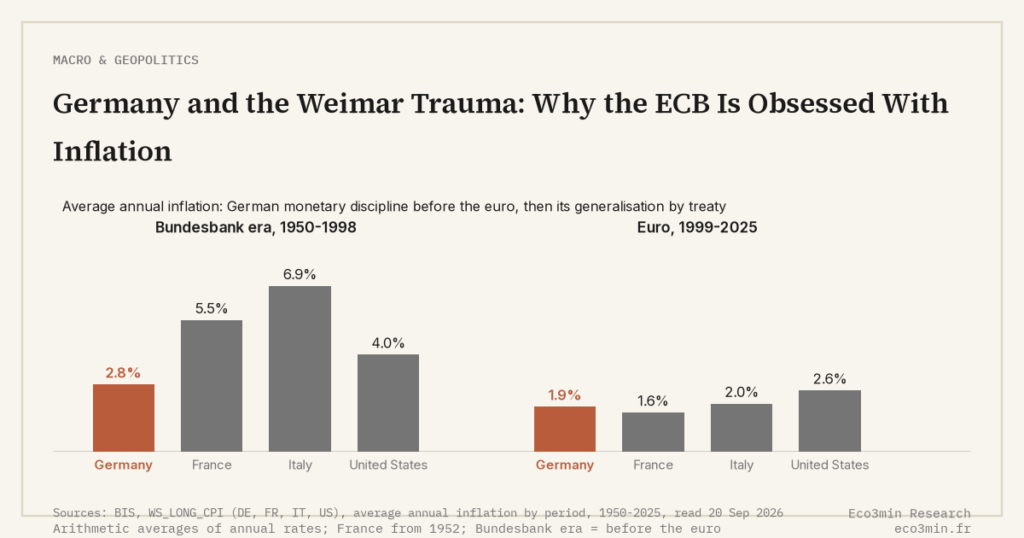
The “German fear of inflation” is real but its causal pathway is more institutional than psychological — it runs from Weimar 1921-1923 through the 1957 Bundesbank charter to Article 127 TFEU, embedding price stability into European treaty law.
Between June 1921 and November 1923, the German papiermark depreciated from 60 marks per dollar to 4.2 trillion marks per dollar. The institutional response over the following decades — Bundesbank independence, primary mandate of price stability, then the codification of that mandate at the European level — is traceable to the Weimar episode through documented continuity rather than collective memory alone.
Reading the European Central Bank’s hawkish bias as a “German cultural preference” misses the institutional architecture. The mandate is written into the treaties, the legal traditions of monetary policy run through the Bundesbank Act of 1957, and the analytical framework draws on Cagan 1956 and Sargent 1982 rather than on cultural sentiment. This article walks through the historical record, the transmission mechanism, and the codified European inheritance. On the same theme: the schedule of ECB rate decisions.
What happened: 1921-1923 chronologically
Cagan (1956, “The Monetary Dynamics of Hyperinflation”) provided the canonical model for the Weimar episode and six other twentieth-century hyperinflations. This is decomposed carefully in the inflation regime archive. The model centres on adaptive inflation expectations: agents update their expected inflation based on recent realised inflation, and money demand falls as expected inflation rises. When the central bank monetises ongoing fiscal deficits, the resulting price increase raises expected inflation, which lowers money demand, which forces further monetisation to maintain real government spending — a self-reinforcing loop. Cagan’s empirical estimation on the Weimar data identified a money-demand semi-elasticity to expected inflation of approximately -5 to -6, consistent with rapid demand collapse as inflation accelerated.
The chronology runs in three phases. Phase one (1919-1921): post-war reconstruction, Treaty of Versailles reparations, and a depreciating but not catastrophic exchange rate. The papiermark traded at roughly 60 per dollar in mid-1921, down from 4.2 per dollar at par in 1914 — a substantial but not yet hyperinflationary depreciation. Phase two (1921-1922): the London Schedule of Payments fixed reparations at 132 billion gold marks; failure to deliver led to the Ruhr occupation by France and Belgium in January 1923. The German government responded by financing passive resistance through monetary creation, and the papiermark broke through 17,000 per dollar by mid-1923. Phase three (mid-to-late 1923): hyperinflation properly defined, with monthly inflation rates exceeding 50% and the papiermark reaching 4.2 trillion per dollar by 15 November 1923. Only four episodes have ever run higher, according to the table of hyperinflations ranked by peak monthly rate. Bresciani-Turroni (1937, “The Economics of Inflation”) provided the most detailed contemporary documentation of the price-formation mechanics and the social consequences. For the larger frame, see our cross-regime inflation reference.
The episode ended on 15 November 1923 with the issuance of the Rentenmark, a transitional currency notionally backed by mortgages on industrial and agricultural assets. The exchange rate was fixed at 1 trillion papiermarks to 1 Rentenmark, which then traded at parity with pre-war gold mark levels. Fixed ratios of that kind became a standard instrument of monetary reform in the decades that followed, applied since 1960 by the thirty countries that have rebased their currency. Sargent (1982, “The Ends of Four Big Inflations”) attributed the abrupt stabilisation to a regime change in fiscal policy — the new Reichsmark issuance was bound by formal fiscal constraints, ending the implicit monetary financing arrangement. The episode’s resolution was therefore institutional, not technical.
The Bundesbank inheritance
The institutional continuity from Weimar to the postwar German monetary regime ran through the Bank deutscher Länder (founded 1948 in the western occupation zones) and the Deutsche Bundesbank Act of 1957. The 1957 Act made price stability the explicit primary objective of monetary policy and granted the Bundesbank operational independence from the federal government — provisions that drew explicitly on the Weimar lesson and on the parallel postwar concern about subordinating monetary policy to fiscal pressures. Garber (1982, in Hall’s “Inflation: Causes and Effects”) and Bordo-Eichengreen (2002) traced this institutional design lineage in detail.
The Bundesbank’s operational record from the 1960s through the 1990s reinforced its credibility. Inflation in West Germany averaged below the OECD median throughout the 1970s oil shocks, and the Bundesbank’s 1979 monetary-targeting framework — emphasising forward-looking restraint over short-run growth concerns — became a reference for international central banking practice. Issing (2008, “The Birth of the Euro”) documented the way Bundesbank traditions shaped the negotiations that produced the Maastricht framework in 1991-1992. The negotiating record is explicit: German participation in monetary union was conditioned on the future European central bank inheriting the Bundesbank’s operational independence, its primary mandate of price stability, and its prohibition on direct lending to fiscal authorities. The European institutional architecture inherited the German doctrine because the alternative — subordinating the future euro to political fiscal pressures — was not acceptable to Germany as a precondition for monetary union, and because no other major member state at the time of negotiation had a credible counter-doctrine to propose.
Article 127 TFEU: the codification
The European treaty framework codified the Bundesbank-style mandate at the European level. Article 127 of the Treaty on the Functioning of the European Union states that the primary objective of the European System of Central Banks “shall be to maintain price stability” — and only secondarily to support general economic policies of the Union, “without prejudice to the objective of price stability.” The hierarchy is explicit: price stability is not one objective among several but the binding primary target. Inflation divergences across the eurozone documents how this single mandate operates across heterogeneous national inflation conditions.
The “Germans fear inflation because of Weimar” framing is partially correct but underspecified. The institutional transmission runs through the Bundesbank Act of 1957 and Article 127 TFEU — both of which are legal documents, not cultural memes. The relevant continuity is doctrinal and procedural, not psychological. Treating the ECB’s reaction function as “German cultural preference” misses that the function was negotiated and written into the treaties as a precondition for euro adoption, with the legal text constraining future central bank behaviour beyond any individual generation’s memory.
The doctrinal continuity is visible in the speeches and writings of successive Bundesbank presidents and ECB Executive Board members of German background. Issing (Chief Economist of the ECB 1998-2006), Schnabel (Executive Board member since 2020) and others have repeatedly invoked the Weimar lesson in technical contexts — not as historical drama but as a reminder of the mechanism by which fiscal-monetary co-ordination failures produce inflation overshoots. Schnabel’s 2022 speech on inflation expectations during the eurozone inflation surge cited Cagan 1956 explicitly, framing the policy challenge as a defence of the expectations anchor. That defence took the form of ten consecutive hikes in 2022 and 2023, each dated and voted in the full record of ECB rate decisions since 1999.
What the legacy explains in 2020-2024
The ECB’s reaction during the 2021-2022 inflation surge can be partly read through this institutional lens. Despite hiking later than the Federal Reserve, the ECB delivered 450 basis points of tightening between July 2022 and September 2023 — the most rapid tightening cycle in eurozone history. The energy component that fed that surge is analysed in gas-driven inflation in the euro area. The forward guidance prioritised inflation expectations stability over growth concerns, consistent with the Bundesbank doctrine. The ECB’s communication explicitly invoked the credibility of the inflation anchor as the central policy objective. Inflation and savings traces the household-level transmission of these policy choices.
Critics have argued that the institutional inheritance produces an asymmetric reaction function — too hawkish during inflation overshoots, too slow during disinflations or deflation risks. The 2014-2019 episode, when eurozone inflation undershot the 2% target persistently, did produce sustained accommodation but also sustained criticism that the policy stance was insufficiently aggressive. The Weimar inheritance shapes the asymmetry, but does not fully determine it. Hyperinflation formalises the regime that the Bundesbank doctrine was designed to prevent.
Where this leaves the institutional reading
The Weimar episode is a documented historical event with measurable parameters (Cagan 1956 estimation, Bresciani-Turroni 1937 documentation, Sargent 1982 institutional analysis). The doctrinal inheritance ran through the Bundesbank Act 1957 and into the European treaties at Article 127. The legal text constrains the ECB’s reaction function regardless of any individual generation’s personal memory. Reading the ECB’s hawkish bias as cultural psychology misses the architecture; reading it as pure technocratic optimisation misses the historical anchor. The two readings are complements, not substitutes. Fiscal policy and inflation covers the fiscal-monetary co-ordination question that Article 127 is designed to insulate the ECB from.
- The Weimar hyperinflation (1921-1923) ended on 15 November 1923 with the Rentenmark; Cagan 1956 modelled the episode and Sargent 1982 documented the institutional regime change.
- The 1957 Bundesbank Act codified price stability as the primary mandate and granted operational independence — provisions explicitly informed by the Weimar lesson.
- Article 127 TFEU embeds the Bundesbank-style mandate at the European level: “the primary objective shall be to maintain price stability.”
- The institutional inheritance is doctrinal and procedural rather than purely cultural; the ECB’s reaction function reflects treaty constraints as much as collective memory.
The ECB’s price stability mandate is not a German cultural preference: it is institutional memory codified into treaty law, inherited from Weimar through the Bundesbank.
For the broader picture, see the complete inflation guide and the inflation regimes pillar. The empirical regime context is in the euro-area HICP core inflation dataset and core vs headline inflation. Negative real rates and their consequences documents the post-2008 regime that tested the Bundesbank doctrine within the eurozone framework.
Last updated — 22 September 2026
Disclaimer – Financial Information: The analyses, commentary, and content published on eco3min.fr are provided for informational and educational purposes only. They do not constitute investment advice or a solicitation to buy or sell financial instruments. Past performance is not indicative of future results. All investment decisions involve risk and are the sole responsibility of the reader.
Read next
Full pillar →Shelter Inflation: Why Housing Dominates the CPI
Shelter inflation: why a single component representing roughly one-third of the U.S. CPI basket dominates the headline number,…
Wage-Price Spirals: Mechanism and Historical Lessons
Wage-price spirals: the self-reinforcing loop that turns a one-off shock into persistent inflation — and why the 2022-2024…
Imported Inflation: Exchange Rates and External Shocks
Imported inflation: the channel through which exchange-rate moves and external supply shocks bypass domestic monetary control — and…