How Expensive Gas Fed European Inflation: From Wholesale Prices to the ECB

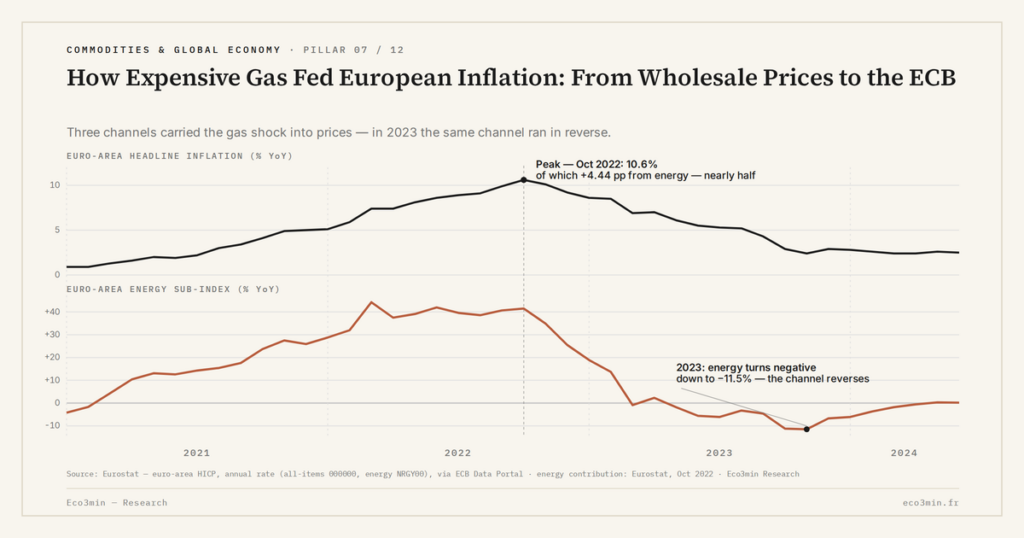
Wholesale gas prices fed through to European inflation along three channels — direct energy bills, marginal electricity pricing, industrial costs — to the point of accounting for nearly half of the 2022 inflation peak.
TL;DR
October 2022 marked the euro area's 10.6% inflation peak, with energy adding 4.44 points alone; as gas prices fell, the same channel reversed and pulled inflation down through 2023. For the schedule ahead, see the next Governing Council meeting dates.
- Energy ran at a 41.9% annual rate at the peak, on Eurostat data, with the European Central Bank treating October 2022 as the cycle high.
- Merit-order pricing is the widest channel: a gas plant often sets the marginal electricity price, lifting it even for the nuclear, hydro and renewable kWh paid for by consumers who burn no gas.
- Through 2023 the energy contribution turned negative, falling at double-digit annual rates and mechanically easing headline inflation, the same lagged channel running in reverse.
- For the ECB the shock was imported: raising rates does not lower the gas price, so policy acted on aggregate demand rather than the energy cause.
Tracing that path, from the wholesale market to the policy rate, shows why a regional commodity constrained a continent’s monetary policy. This piece breaks the transmission mechanism down.
The direct channel: gas in household bills
The first channel is the most visible. Gas enters household consumption directly, for space heating and hot water. When its wholesale price soars, the energy bill of gas-heated homes follows, with a lag that depends on contracts and national regulatory mechanisms. This component appears as such in the consumer price index, through the energy item. This channel is, however, only the first link in a broader mechanism, one that extends the cost of the fracture for Europe directly into the consumer-price sphere. A companion study: Did Expensive Gas Deindustrialize Europe? The Energy-Intensive Sectors at Risk.
This direct channel is powerful, but it does not by itself explain the scale of transmission seen in 2022. Its reach is limited by gas’s share of household budgets and by the price caps several states deployed to cushion the shock. Had transmission stopped there, the effect on inflation would have been real but contained. Most of the propagation ran through a second channel, less intuitive and far broader.
The electricity channel: marginal pricing
The second channel is the most decisive, and the least understood. On most European wholesale electricity markets, the price is set by merit order: for each hour, plants are called from cheapest to most expensive until demand is met, and it is the cost of the last plant called — the marginal plant — that sets the price paid to all the others. At hours of high demand, that marginal plant is often a gas plant.
The consequence is counterintuitive but central: when the gas price soars, it pulls the wholesale price of electricity with it, including for kilowatt-hours produced by nuclear, hydro or renewables. The production cost of those sources has not changed; it is the price-setting mechanism that transmits the gas shock to the entire electricity market. An economy that is largely decarbonized in its power generation could thus see its wholesale prices explode, simply because gas remained the marginal technology at critical moments.
This mechanism explains why the 2022 gas shock had such a broad grip on inflation. It did not only make gas dearer: it made electricity dearer for everyone, households and firms alike, regardless of their own supply source. Electricity being a universal input, that increase diffused through the entire price chain. It is through this channel that the price of a molecule set on a Dutch platform reached consumers who burned not a gram of gas. This dynamic extends the 2022 gas shock directly into the price sphere.
This mechanism has fueled a policy debate over decoupling gas prices from electricity prices. The idea is to reform price-setting so that the low costs of decarbonized sources are reflected more in the bill, rather than aligned on the marginal cost of gas. The debate goes beyond this analysis, but it reflects the stakes: as long as gas remains the marginal technology at peak hours, its price continues to govern part of the electricity price, and thus of inflation.
The indirect channel: industrial costs and second-round effects
The third channel operates with a longer delay. Industries that consume gas and electricity saw their production costs climb, and part of that increase passed through, with a lag, to the prices of goods and services. From fertilizer producers to food processors, through chemicals and materials, the rise in energy worked its way up value chains to consumer prices.
To this cost channel is added the risk central banks fear most: second-round effects. When an energy-driven price increase settles in, it can feed wage demands meant to protect purchasing power, then price increases meant to protect margins, in a self-sustaining dynamic. The initial, one-off shock then risks turning into persistent inflation, disconnected from its original energy cause. It is this shift from a temporary supply shock toward entrenched inflation that constitutes the real concern, more than the peak itself. The mechanics of these effects belong to imported inflation and external shocks, distinct from one-off shocks.
The numbers: what energy weighed
The data allow the scale of this transmission to be measured. According to Eurostat, euro-area inflation peaked at 10.6% in October 2022, a level the European Central Bank describes as the cycle peak. At that date, the energy component was running at an annual rate of 41.9% and contributed 4.44 percentage points on its own to total inflation — nearly half of the 10.6% recorded.
This figure deserves precise reading. The 4.44-point energy contribution captures only the direct effect of the energy item in the index: gas and electricity as they appear on the bill. It does not measure the indirect effect running through industrial costs, which diffuses into the other items of the index — food, goods, services — and is harder to isolate. The real footprint of the energy shock on inflation is therefore likely larger than the headline energy contribution alone, even if the surplus escapes simple accounting.
This distinction between measured direct effect and diffuse indirect effect is an important analytical point. Stating that energy “explained half” of inflation is accurate if one means the direct contribution of the energy item; it would understate its overall role to ignore the diffusion through costs. Rigor requires naming what the figure covers — and what it leaves out of frame. This propagation mechanism through imported prices is precisely the subject of how imported inflation transmits.
The reverse path is equally instructive. As gas prices receded from their 2022 peak, the energy contribution to inflation turned negative through 2023, mechanically pulling headline inflation down — energy fell at double-digit annual rates for much of that year. This symmetry confirms the diagnosis: a large share of the 2022 spike, and of the subsequent disinflation, was energy-driven. The same channel that propagated the shock upward also propagated its unwinding downward, with the same lag, which is why headline inflation eased faster than underlying price pressures. The American case separates the two ends of that channel, since the states where US electricity demand grew fastest are not the states where household bills rose most.
The ECB’s dilemma: an imported supply shock
For the European Central Bank, this type of shock poses a problem of a particular nature. The 2022 inflation was not domestic demand overheating, which monetary tightening is designed to cool. It was an imported supply shock: a rise in the price of a resource coming from outside, over which monetary policy has no direct hold. Raising rates does not lower the price of gas.
The dilemma is therefore acute. Doing nothing risks letting inflation expectations de-anchor and second-round effects set in, turning a temporary shock into durable inflation. Tightening acts not on the energy cause, but on aggregate demand, at the cost of slowing activity — a kind of double penalty for an economy already strained by its rising energy bill. The central bank finds itself arbitrating between two risks, without an instrument suited to the real cause of the shock. How the ECB settled that arbitration in 2022 and 2023 is legible, hike after hike, in every ECB rate decision since 1999, meeting by meeting.
This dilemma sheds light on why the euro area’s monetary framework found itself, in 2022 and 2023, partly determined by an external variable: the price of a regional commodity. The same mechanism recurs, in another form, with oil, where oil’s pass-through to inflation confronts central banks with a comparable trade-off. In both cases, a central bank must respond to inflation whose source escapes it — which belongs to physical markets and macro in their most direct articulation.
- Gas prices feed inflation through three channels: direct (household energy bills), electricity (gas often sets the marginal electricity price, pulling it up even for decarbonized kWh), and indirect (industrial costs passed through with a lag).
- The electricity channel is the broadest: through merit-order pricing, a gas shock makes electricity dearer for everyone, regardless of generation source, diffusing the shock well beyond gas consumers alone.
- According to Eurostat, energy contributed 4.44 points to the euro area’s 10.6% inflation peak in October 2022 (energy running at +41.9% year on year) — nearly half the total, before counting the indirect effect diffused into other items.
- For the ECB, an imported supply shock creates a dilemma: monetary tightening does not lower the gas price, but inaction risks second-round effects; monetary policy is then constrained by a variable it cannot directly reach.
The transmission of gas to inflation illustrates a general property of energy shocks: their capacity to work up the entire economic chain, from the wholesale market to the policy rate. What makes the 2022 gas case singular is the size of the initial shock and the amplifying role of the electricity mechanism, which turned a rise in a regional resource into a broad-based price increase. Understanding these channels says nothing about the future path of inflation; but it sheds light on why the price of a molecule, set on a market most consumers ignore, ended up weighing on the daily life of a continent — and why energy, long treated as a stable background cost, returned to the center of the inflation debate.
Last updated — 19 September 2026
Disclaimer – Financial Information: The analyses, commentary, and content published on eco3min.fr are provided for informational and educational purposes only. They do not constitute investment advice or a solicitation to buy or sell financial instruments. Past performance is not indicative of future results. All investment decisions involve risk and are the sole responsibility of the reader.
Read next
Full pillar →Reading the refinery utilisation rate: the threshold, the season, the turnarounds
A refinery runs full near ninety percent, not a hundred: the last slice of nameplate capacity is a…
IMO 2020: the regulatory shock that rewrote product spreads
An environmental rule on marine sulfur can move a refining spread more than a swing in crude. IMO…
The 2022–2023 refining golden age: anatomy of an episode
In 2022, refined fuel prices climbed faster than crude. That gap, measured by the 3-2-1 crack spread, reached…