
Inflation Expectations: How They Form and Why They Matter
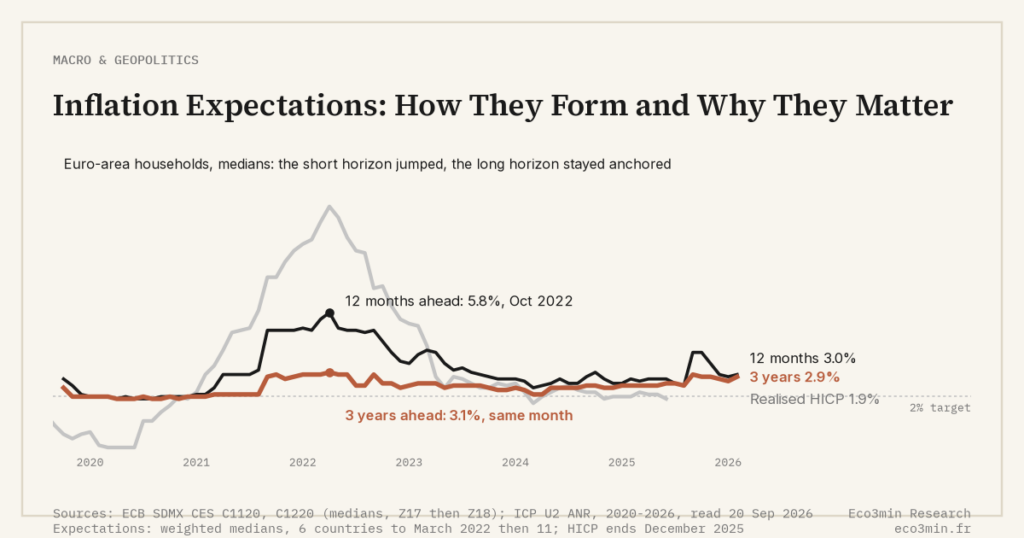
Inflation expectations: the forward-looking variable central banks watch most closely — because once they de-anchor, every other inflation diagnostic becomes secondary.
Inflation expectations are the bridge between today’s price shock and tomorrow’s price level. When households and firms believe future inflation will be high, they act in ways that make it so — and central-bank credibility is the load-bearing wall holding up the entire framework.
The Michigan Survey of Consumers, the ECB Consumer Expectations Survey (CES), and the New York Fed Survey of Consumer Expectations converged on the same 2022-2024 finding: short-run inflation expectations spiked sharply but long-run expectations remained anchored close to 2-3%. That divergence saved the disinflation campaign.
What inflation expectations actually are
Inflation expectations refer to the rate of price growth that economic agents — households, firms, financial-market participants — anticipate over a defined future horizon. The detail is worked through in the chronology of inflation regimes. The empirical detail can be found in Eco3min’s inflation primer. The variable matters not as a forecast of what will happen, but as an input into present-day decisions: wage demands, price setting, investment, savings allocation, financial-asset pricing. A household expecting 5% annual inflation behaves differently from one expecting 2%. A firm expecting persistent input-cost increases prices accordingly. A bond investor expecting higher inflation demands higher nominal yields. These behavioural responses are the channel through which expectations become self-fulfilling.
The diagnostic distinction that matters most is between short-run expectations (typically 12 months ahead) and long-run expectations (typically 5 to 10 years ahead). Short-run expectations track recent price experience closely and tend to be volatile around energy and food shocks. Long-run expectations are far more stable and reflect agents’ belief in the central bank’s ability to deliver its inflation target. The anchoring of long-run expectations is the empirical signature of central-bank credibility. Further reading: What Is Inflation? A Rigorous Definition and Why It Matters.
The three families of formation models
Modern macroeconomics offers three competing accounts of how expectations form. The adaptive framework (Cagan 1956) treats expectations as backward-looking: agents project recent inflation forward, with weights declining geometrically. This was the dominant framework through the 1960s and explains why a sustained inflation episode can become self-reinforcing under adaptive expectations. The historical survey of post-1948 U.S. inflation second waves documents when that self-reinforcement actually took hold. The rational expectations framework (Lucas 1972, Sargent 1973) replaced it: agents form expectations using all available information including the structure of monetary policy, and forecast errors are uncorrelated. This is the textbook framework underpinning inflation targeting since the 1990s. Related analysis: Bitcoin and Inflation: An Empirical Test of the Store-of-Value Narrative.
The sticky-information framework (Mankiw and Reis 2002) and its empirical extension rational inattention (Coibion and Gorodnichenko 2015) reconcile the two: agents are rational but acquire information at intervals, so their expectations adjust slowly to new conditions even when those conditions are publicly observable. This third framework matches the empirical patterns documented in consumer surveys far better than either pure adaptive or pure rational frameworks. The wage-price spiral mechanism operates through expectational channels: a spiral requires expectations to de-anchor, which in turn requires either persistent shocks that overwhelm the inattention buffer or a credibility loss that shifts the long-run anchor.
Why long-run anchoring matters more than short-run noise
The distinction between short-run and long-run expectations is the operational fulcrum of modern central banking. Short-run expectations naturally rise and fall with energy prices and food costs — Michigan one-year-ahead inflation expectations climbed from 3.0% in January 2021 to 5.4% in March 2022 (University of Michigan), tracking the surge in consumer prices. Long-run expectations, by contrast, are sticky in a way that reflects accumulated central-bank credibility. Michigan five-to-ten-year-ahead expectations stayed in a narrow 2.9%–3.2% band throughout 2022, despite headline CPI peaking at 9.1% (BLS). On the same theme: Argentina: 80 Years of Chronic Inflation, What History Teaches.
The asymmetry is the central banker’s friend. As long as long-run expectations remain anchored, the second-round effects required to convert a price-level shock into persistent inflation cannot fully activate. Wage demands moderate, price-setting behaviour stays consistent with the target, and the disinflation can arrive without requiring the magnitude of monetary tightening that the 1979-1982 Volcker episode demanded. Our coverage of how central banks calibrate rate hikes against inflation emphasises that the rate trajectory itself is partly a signal aimed at preserving this long-run anchoring. In the same vein: Commodities: Inflation Hedge or Amplifier?.
The 2022-2024 stress test: short-run spike, long-run anchor held
The post-pandemic episode provided the cleanest empirical test of the modern expectational framework. Across all three major surveys, the pattern was consistent. Michigan one-year inflation expectations peaked at 5.4% in March-April 2022 (University of Michigan), while the five-to-ten-year measure peaked at 3.2% in June 2022. The ECB Consumer Expectations Survey three-year-ahead measure reached 3.0% in October 2022 against eurozone HICP of 10.6% (Eurostat). The New York Fed Survey of Consumer Expectations showed a similar profile: one-year-ahead expectations spiked to 6.8% in June 2022, three-year-ahead remained near 3.2%, and five-year-ahead stayed below 3.0% (NY Fed SCE). A closer look: The Great Moderation (1990-2007): Why Inflation Disappeared.
Market-implied measures told a parallel story. The five-year, five-year forward inflation breakeven — the workhorse anchor measure for both the Fed and the ECB — stayed in the 2.0%-2.5% range throughout the 2022-2023 episode (FRED, T5YIFR series). The contrast with the 1970s is decisive: long-run expectations in 1979 had risen above 8% as measured by the Michigan Survey, signalling complete loss of monetary credibility. The 2022 episode never approached that threshold. Our breakdown of how to read breakeven inflation rates details the market-implied measurement framework.
The measurement problem: surveys, markets, and what they each capture
No single measure of inflation expectations is sufficient. Consumer surveys (Michigan, ECB CES, NY Fed SCE) capture household psychology and tend to overshoot when food and energy prices move, because households weight visible price changes heavily. Professional forecaster surveys (Survey of Professional Forecasters at Philadelphia Fed, ECB SPF) capture expert consensus and tend to be slower to move. Market-implied measures (TIPS breakevens, inflation swaps, five-year-five-year forward) capture the price at which inflation risk is hedged — but they embed inflation risk premia that distort the pure expectation signal. The 10-year breakeven (T10YIE) is the most-watched of these market-implied gauges — the T10YIE measure and what it captures about long-run expectations is documented separately.
The triangulation of these three sources is what central banks actually monitor. A short-run spike in one survey carries less weight if professional forecasts and market measures stay anchored. The reverse is true if all three move together: that signals a regime shift. The dataset on five-year breakeven inflation rates since 2003 shows the daily evolution of the market-implied measure across the 2008, 2015 and 2022 inflation cycles, and the relative stability of the five-year-five-year forward despite shorter-horizon volatility.
Anchored long-term inflation expectations are the single most valuable asset on a central bank’s balance sheet — they cost decades to build and a single cycle to destroy.
What anchored expectations earn central banks
The operational value of anchored long-run expectations is that they collapse the trade-off the Phillips curve frames. When agents trust the central bank to deliver its inflation target over the medium term, a temporary price shock does not require a deep recession to disinflate: the expectational anchor does most of the work, and monetary policy needs only to prevent visible de-anchoring. This is exactly what happened in 2022-2024. The Fed funds rate moved from 0.25% in March 2022 to 5.50% by July 2023 — aggressive but not Volcker-scale (Volcker took rates to 19%). Disinflation arrived without a major recession because the expectational anchor held. Our examination of the cost-push vs demand-pull diagnostic framework shows that the disinflation also benefited from the supply-side normalisation, but the expectational anchor allowed the Fed to “look through” the supply component without losing credibility. More on this: Inflation and the Value vs Growth Rotation: What the Literature Documents.
The credibility-anchor mechanism is also why the Fed adopted Flexible Average Inflation Targeting (FAIT) in August 2020, why the ECB completed its strategy review in July 2021, and why both institutions devote disproportionate communication resources to the inflation target itself. The institutional architecture exists to defend the anchor. Our examination of why the Fed targets 2% inflation specifically develops the rationale for the chosen anchor level.
Reading short-run survey expectations as evidence of de-anchoring. Michigan one-year-ahead inflation expectations climbed above 5% in 2022 and that was widely flagged as alarming — but the relevant measure for de-anchoring is the long-run series, which never breached 3.5%. Confusing the two led to repeated false alarms about a 1970s redux.
The fragility of the achievement
The post-2022 disinflation succeeded in keeping long-run expectations anchored, but the achievement is contingent. The breakdown is provided in our disinflationary regime analysis. Three vulnerabilities matter for the forward-looking analyst. First, the anchoring depends on continued central-bank credibility — a future episode of repeated inflation overshooting or political interference in monetary policy could erode the anchor. Second, the measurement infrastructure (Michigan, CES, breakevens) is itself imperfect, and an anchoring problem might be visible only after it has progressed. Third, the disinflationary structural backdrop of the 1990-2020 period (globalisation, demographic dividend, technology-driven price compression) is weakening, which raises the equilibrium pressure on the anchor and may force central banks to act earlier in future cycles. Stripped of that anchor entirely, an economy shifts into another regime altogether, the one assembled in the panorama of hyperinflations recorded since 1795.
The framework also leaves open the question of which agents’ expectations matter most. Wage-bargaining decisions are taken by workers and firms; price-setting decisions are taken by firms; financial-asset prices reflect investor expectations. Each set of agents may form expectations differently, and a regime where firm expectations de-anchor while household expectations remain stable produces a different inflation path than the reverse. The complete framework on inflation mechanisms, measurement, history and effects integrates these distinctions into the broader cluster.
- Inflation expectations matter because they shape present-day wage, pricing, and investment decisions — making the expected inflation rate partially self-fulfilling.
- The diagnostic distinction between short-run (1 year) and long-run (5-10 year) expectations is operational: short-run noise is normal, long-run de-anchoring is the regime-change signal.
- The 2022-2024 episode validated the modern framework: Michigan one-year expectations spiked to 5.4% while five-to-ten-year stayed near 3.0%; market-implied five-year-five-year forwards held in the 2.0%-2.5% range.
- Triangulating three measurement sources (consumer surveys, professional forecasters, market-implied breakevens) is what central banks actually monitor — no single measure is sufficient.
The diagnostic posture for the next cycle
For the analytically rigorous reader, the operational checklist is straightforward. Monitor the long-run series on each major survey alongside the five-year-five-year forward inflation breakeven. A drift in the long-run survey measures above 3.5% sustained over six months would be an early warning. A widening of the gap between professional forecaster and market-implied measures often signals a brewing reassessment. And a divergence between household and firm expectations in the regional surveys (Atlanta Fed business inflation expectations, ECB SAFE survey) often presages a regime shift before it shows up in the headline series. Background: Inflation and Demographics: The Invisible Pressure on Pensions.
The core vs headline inflation distinction matters here too: long-run expectations track core more closely than headline, because households gradually filter out the volatile components when forming durable beliefs. The infrastructure of inflation targeting — explicit numerical targets, regular communication, transparent decision frameworks — exists precisely to preserve the anchoring achievement. Its erosion would not be sudden; it would be visible in the data well before a 1970s-style regime emerged. The discipline is to watch the right series.
Last updated — 22 September 2026
Disclaimer – Financial Information: The analyses, commentary, and content published on eco3min.fr are provided for informational and educational purposes only. They do not constitute investment advice or a solicitation to buy or sell financial instruments. Past performance is not indicative of future results. All investment decisions involve risk and are the sole responsibility of the reader.
Read next
Full pillar →The Cantillon Effect: Who Benefits First From Money Creation
Cantillon effect: how new money never reaches the economy uniformly — the first beneficiaries capture real purchasing power…
The Phillips Curve: The Unemployment-Inflation Relationship and Its Limits
The Phillips curve: the most cited and most contested relationship in modern macroeconomics — alive enough to anchor…
Cost-Push vs Demand-Pull Inflation: The Two Foundational Logics
Cost-push and demand-pull inflation: the two foundational mechanisms behind every price-level surge — sharing one index but obeying…