
Inflation and Bonds: Why They Suffer First
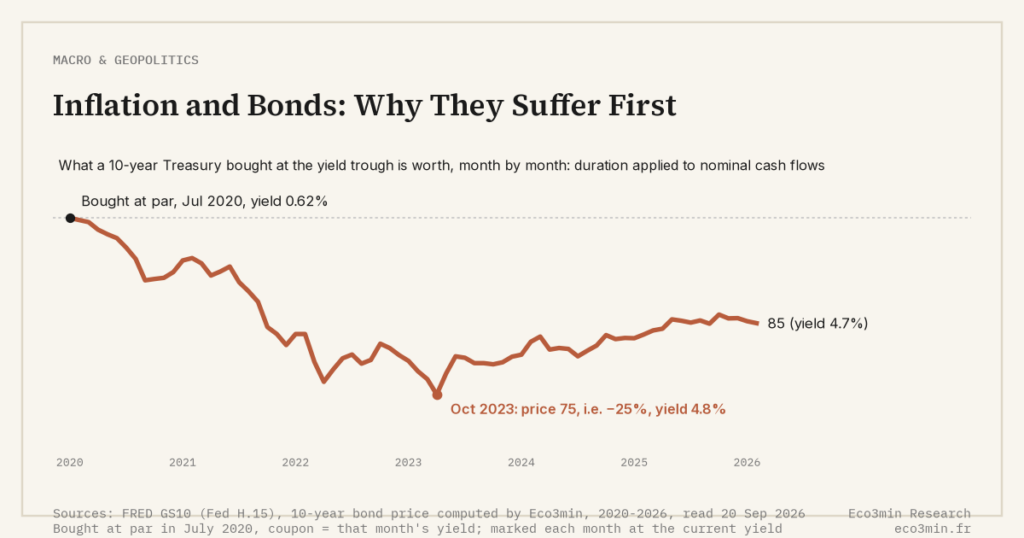
Bonds suffer first when inflation accelerates. The mechanism is purely arithmetic — duration risk applied to nominal cash flows whose real value is being eroded — and the 2022 episode produced the largest absolute fixed-income losses on record.
A nominal bond is a contract to receive fixed cash flows whose real value falls when realised inflation exceeds the rate priced at issuance. The longer the duration, the larger the price decline when expected inflation re-anchors higher.
The Fisher decomposition of nominal yields and the Macaulay duration framework together explain why the bond market repricing during 2022 was both predictable and unprecedented in modern data. This articulation appears in how duration governs a bond’s response to rates. The mechanism is older than the data archive; the magnitudes were a function of where yields started and how fast expectations adjusted.
The mechanical relationship: yields up, prices down
The price of an existing nominal bond moves inversely to changes in the yield required by the market. When inflation accelerates and inflation expectations re-anchor higher, the market demands a higher nominal yield on new bond issuance — and the price of existing lower-yielding bonds adjusts downward to bring their effective yield in line with the new market level. The mathematics is unforgiving: a 1 percentage point rise in the 10-year nominal yield produces approximately a 9% price decline on a 10-year zero-coupon bond, and approximately a 20% price decline on a 30-year zero-coupon bond. The same calculation applied to coupon bonds produces somewhat smaller declines, but the directional and magnitude logic holds.
The 2022 episode produced the largest single-year nominal bond losses on record across major fixed-income indices. The Bloomberg U.S. Aggregate Bond Index returned approximately -13% in 2022 — the worst year since the index began in 1976. Long-duration U.S. Treasuries returned approximately -29% (Bloomberg Long Treasury Index). European sovereign bond indices produced similar magnitudes of loss in 2022, with German Bund 10-year prices falling sharply as ECB policy tightened. The combination of starting yields near zero and rapid expectations re-anchoring produced an unusually severe repricing — but the directional mechanism was the same as in any prior inflation episode. Further on this: our walkthrough of duration.
The Fisher decomposition: why the loss is mechanical
The Fisher decomposition of nominal yields, formalised by Irving Fisher in 1930 and operationalised by modern fixed-income research, decomposes a nominal bond yield into three components: the real yield component, the expected inflation component, and the term premium (or inflation risk premium). When realised or expected inflation rises, all three components typically respond — real yields rise as central banks tighten, expected inflation rises in line with the regime, and the inflation risk premium expands as uncertainty rises. Boudoukh and Richardson (1993) extended the decomposition to the asset returns context, showing that the empirical correlation between nominal bond returns and inflation has been consistently negative at horizons relevant to most investors. Litterman and Iben (1991) provided the canonical term-structure framework for measuring how each component contributes to the curve, and Cochrane and Piazzesi (2005) refined the term-premium estimation that became the foundation of modern macro-finance work on inflation-bond dynamics.
The decomposition allows attribution of the 2022 repricing across components. Real yields rose by approximately 200-300 basis points across the U.S. Treasury curve as the Fed tightened from zero to a 4.5% policy rate. Expected inflation, measured by 10-year breakevens, rose by approximately 100 basis points before partially reversing as the Fed’s hawkish stance re-anchored expectations. Eco3min lays this out in Eco3min’s deep dive into price regimes. The term premium expanded by 50-150 basis points as inflation uncertainty rose. The combined nominal yield rise of approximately 300-450 basis points across the curve produced the price declines documented above, distributed by duration along the curve.
Duration as the structural risk variable
Duration measures the price sensitivity of a bond to changes in its yield. Macaulay duration corresponds approximately to the weighted-average time to receive cash flows; modified duration approximates the percent price change for a 1 percentage point yield change. A 30-year Treasury has a modified duration around 18-22; a 10-year Treasury around 8-9; a 2-year Treasury around 1.9; a money market instrument around 0.1. The 2022 yield rise produced price declines across the curve roughly proportional to these durations.
The portfolio-level implication is that fixed-income loss in any inflation surprise is dominated by the duration of the portfolio. The Bloomberg U.S. Aggregate Bond Index has an average duration of approximately 6 years; the long Treasury index closer to 18 years. The 2022 losses scaled accordingly. For investors holding floating-rate or short-duration nominal instruments, the repricing produced minimal capital loss but also limited the upside as nominal yields rose — a different exposure profile but consistent with the same Fisher decomposition.
Real bonds versus nominal bonds: the structural distinction
Inflation-linked bonds (TIPS in the U.S., OATi in France, gilts in the U.K., similar structures elsewhere) pay coupons and principal indexed to realised inflation. The Fisher decomposition for these instruments is simpler: the yield is a pure real yield, and the expected inflation component is automatically passed through. During the 2022 repricing, real yields rose sharply — the 10-year U.S. real yield moved from approximately -1.0% in late 2021 to approximately +1.8% by late 2022 — producing nominal price declines on TIPS that were substantial but smaller than nominal Treasury declines of equivalent maturity. The historical record across multiple inflation episodes confirms this pattern: linkers protect against unexpected inflation but not against rising real yields.
The 2022 episode added a wrinkle. Both nominal yields and real yields rose simultaneously, with expected inflation rising and then partially reversing. The relative performance of nominal Treasuries versus TIPS over the four-year window has been close, with TIPS modestly outperforming on a holding-period total-return basis after accounting for the inflation accruals. The breakeven inflation rate (nominal minus real yield) measured the market-implied inflation expectation throughout the episode, as documented in the breakeven inflation rate framework — a real-time observable of expectations that proved more reliable than survey-based measures during the surprise.
The historical pattern across inflation episodes
Bond returns during inflation episodes have followed a consistent pattern across the historical record. The 1970s U.S. produced cumulative bond returns substantially below realised inflation; nominal Treasury holders earned modest nominal returns while losing 30-50% of cumulative purchasing power across the decade. The 2021-2024 episode compressed a similar real loss into a much shorter window because of the rapid yield repricing — the magnitude of the cumulative real loss was comparable in some measures to the 1970s outcome despite the much shorter window.
Boudoukh and Richardson’s 1993 long-horizon analysis documented that nominal bonds have produced negative real returns in every U.S. high-inflation decade since 1900, with the magnitude scaling with the inflation-rate surprise. The inflation hedge property emerges only at very long holding periods (30+ years) where the natural maturation of the bond portfolio allows reinvestment at higher post-surprise yields. On the 1-10 year horizons that characterise most fixed-income portfolios, the negative real return signature has been remarkably consistent across episodes, regimes and countries — as documented in the long-run dataset on three-month T-bill real returns since 1962.
Why bonds suffer first in the cycle
The “suffer first” timing in the headline is not poetic. The bond market response to inflation surprise is the most immediate and most direct of any asset class because bond prices are an exact function of the discount factor applied to fixed nominal cash flows. Equity multiples respond with lag (the inflation-illusion mispricing documented in the analysis of equity returns across one hundred years of inflation regimes); real estate cap rates respond with quarters of lag; corporate margins respond with sectoral heterogeneity. Bonds reprice within days to weeks of any meaningful change in inflation expectations, with the magnitude scaling directly with duration.
The implication is that bond portfolios provide the cleanest real-time signal of how the market is repricing the inflation regime. Equity declines in 2022 lagged the bond decline; real estate price stagnation lagged both. The yield curve and the breakeven curve provided the early warning of the regime shift — observable months before the equity drawdown deepened. The empirical pattern recurs in every major inflation episode and is structural to the asset-class architecture: instruments with the most contractually fixed nominal cash flows have the most arithmetic exposure to changes in the discount factor.
“Bonds are safe assets that protect during downturns.” This statement is correct in deflationary or growth-shock recessions, but reverses in inflationary regimes. The thread is followed through in our analytical map of inflation regimes. The 2022 episode was the canonical case: bonds and equities declined simultaneously, breaking the negative correlation that had operated for two decades. The structural feature behind this is that the bond-equity correlation depends on whether the dominant macro shock is to growth (negative correlation, classic safe-haven) or to inflation (positive correlation, joint decline). The 2022 inflation surprise produced the latter regime and the largest joint bond-equity drawdown in modern data.
A nominal bond is a fixed-cash-flow contract whose real value collapses by exactly the inflation surprise — the only asset class with a closed-form mathematical exposure to the rate surprise.
The post-2024 environment and the question of mean reversion
Following the 2022 repricing, nominal yields settled at materially higher levels than the pre-2021 trend — 10-year U.S. Treasury yields in the 4.0-4.5% range during 2024, against the 0.5-2.5% range that prevailed for most of 2010-2021. The cumulative price recovery for bond holders depends on whether yields revert toward the lower pre-2021 trend (producing capital gains) or settle at the higher new equilibrium (producing only the coupon return). The empirical literature has not resolved which trajectory is most likely, with views diverging on whether the post-2008 zero-rate environment was anomalous or whether the 2022-2024 normalisation was overshooting.
The Bauer-Rudebusch 2017 framework on real-rate persistence suggests that real interest rates may have settled structurally higher than the 2010-2019 average — implying that the post-2022 nominal yields are closer to the new equilibrium than to a temporary overshoot. Under this view, fixed-income holders earn the new coupon income with limited prospect of substantial capital recovery from yield mean reversion. The alternative view — that demographic and savings-glut forces will return real rates to their pre-2021 trajectory — implies meaningful capital appreciation potential. The next several years will provide further data to discriminate between these structural readings.
- Bond prices fall mechanically when inflation expectations re-anchor higher; the 2022 episode produced the largest single-year nominal bond losses on record (Bloomberg U.S. Aggregate -13%, long Treasuries -29%).
- The Fisher decomposition allocates nominal yield changes across real yields, expected inflation and term premium; the 2022 repricing involved all three components moving simultaneously, producing the historic magnitude.
- Inflation-linked bonds (TIPS, OATi, linkers) protect against unexpected inflation but not against rising real yields; the 2022 episode produced material price declines on linkers despite their inflation indexation.
- The bond-equity correlation flips sign under inflation regimes — the 2022 joint drawdown of bonds and equities was the largest on record and reflects the structural difference between growth shocks and inflation shocks as drivers of cross-asset moves.
The bond asset-class observations sit inside the wider system mapped in the complete guide to inflation mechanics, measurement and effects. They sit alongside the equity asset-class observations analysed earlier in the cluster, and connect to the state-side fiscal benefit that bond holders structurally finance through real debt erosion. The market-implied measures relevant to the bond-inflation relationship are anchored by the real corporate bond yield series, by the long-run real interest rate history, and by the comparison of real returns across investment vehicles under different macro regimes. The household-level implications are anchored by the real return on savings framework, by the canonical real-versus-nominal returns framework, and by the long-run CPI-adjusted gold price dataset as a cross-asset reference. For the institutional context, the sub-pillar on the yield curve as financial decoder situates the bond-market repricing within the broader monetary-regime framework.
Last updated — 22 September 2026
Disclaimer – Financial Information: The analyses, commentary, and content published on eco3min.fr are provided for informational and educational purposes only. They do not constitute investment advice or a solicitation to buy or sell financial instruments. Past performance is not indicative of future results. All investment decisions involve risk and are the sole responsibility of the reader.
Read next
Full pillar →How INSEE Calculates Inflation: Basket, Weights, Methodology
The architecture of French inflation measurement: 200,000 prices, 27,000 outlets, 1,000 product categories, annual weight revisions, and a…
Inflation and Deglobalization: Why the Structural Regime Is Shifting
Deglobalization: how the structural disinflationary tailwind of 1990-2020 is reversing — and why the next inflation regime may…
Services vs Goods Inflation: The Great Post-2020 Divergence
The post-2020 services-versus-goods divergence: how a single inflation regime split into two sub-regimes operating on different timetables —…