
Duration: reading a bond’s sensitivity to interest rates

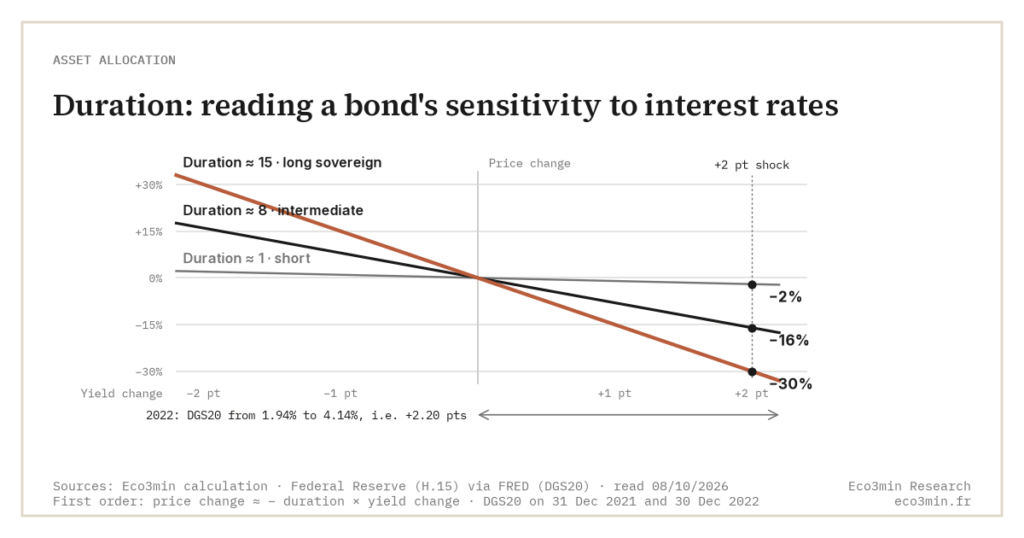
Duration measures, in years, how sensitive a bond’s price is to a change in rates. It is duration, not the headline yield, that determines the size of a bond fund’s reaction to a rate move.
TL;DR
A bond fund's duration is a sensitivity coefficient: it turns a rate move into a price move, and explains why two funds with identical yields can react in opposite directions.
- A duration of seven means a one-point rise in yields knocks roughly 7% off the price; the figure is the multiplier that converts any rate move into a price move.
- Convexity curves the price-yield relationship: on large moves the loss runs a little below what duration alone predicts and the gain a little above, but duration stays the first-order driver.
- Duration converts an unknowable question, where rates are heading, into a knowable one: how far a given fund moves once the rate move is known.
This founding concept underlies everything else: choosing a maturity, a wrapper or a category always amounts, implicitly, to choosing a duration. This page defines it and ties it to the real-rate regime.
Duration is the concept that separates a static view of a bond holding from a regime-based one. It measures, in years, how sensitive a bond’s price is to a change in rates: a duration of seven means a one-point rise in yields pushes the price down by roughly 7%, all else equal. This mechanics — set out long ago by Macaulay (1938) and Hicks (1939) — explains why two bond funds with the same running yield can move in opposite directions on the same rate shift. For anyone new to fixed income, it is also the first marker to acquire before any product choice, alongside the basics before investing. Everything else follows from it: choosing a short or long maturity is choosing a duration; weighing a fund against an ETF is weighing how much duration to carry. This page holds the conceptual depth the hub only points to, and ties it back to the prevailing real-rate regime.
What duration measures
Duration is not a bond’s lifespan but a measure of its sensitivity. More precisely, it quantifies how much a security’s price moves when rates shift by one point. A duration of seven indicates that a one-point rise in rates produces a price fall of roughly seven percent, and that a one-point fall would produce the reverse. The quantity is expressed in years because it derives from a present-value-weighted average of the maturities of a bond’s cash flows — coupons and principal repayment. But its useful reading is that of a sensitivity coefficient: it is the multiplier that turns a rate move into a price move.
The measure captures a simple intuition. A bond is a promise of future cash flows; its market value is the sum of those flows discounted at the prevailing rate. The more distant the flows, the more sensitive their present value is to the discount rate, because the effect of discounting compounds over time. A security redeeming in thirty years holds almost all its value in very distant flows, hence highly sensitive to rates; a security redeeming in one year has a value dominated by near flows, barely sensitive. Duration aggregates this structure into a single figure, comparable from one fund to another. A broader view: our framework for reading vehicles across regimes.
That is precisely what makes it the most structuring axis for reading a bond holding. Two funds can show the same yield at purchase yet react radically differently to the same rate shock, if their durations differ. The running yield describes what the security returns if held; duration describes what happens to its price if rates move before maturity. The two pieces of information are distinct, and conflating one with the other leads to mis-anticipating a fund’s behaviour.
The price-yield mechanics: why the direction inverts
The price of an already-issued bond moves inversely to rates. The logic rests on the comparison the market constantly makes between an old security’s fixed coupon and the terms of new issues. When rates rise, bonds issued since offer a higher coupon; to stay competitive, the price of the old security, whose coupon is fixed, has to fall until its effective yield matches the market’s. When rates fall, the move reverses: the old coupon becomes relatively attractive and the price rises. Duration measures the size of this readjustment.
The amplitude is not linear on large moves. The relationship between price and yield is slightly curved — that is convexity — which means the loss on a sharp rate rise is a little smaller than duration alone would predict, and the gain on a sharp fall a little larger. Convexity therefore works in the holder’s favour on large moves, but it does not overturn the hierarchy: duration remains the first-order determinant of the price move. For moderate variations, the linear approximation by duration is amply sufficient to anticipate the order of magnitude.
This mechanics has an often counter-intuitive consequence: a fund of the highest-rated sovereigns, free of any default risk, can fall heavily if its duration is long and rates rise. The issuer’s safety provides no protection against the price risk tied to rates. That is what happened in 2022, when long sovereigns posted one of their worst calendar-year declines in decades — not through any issuer default, but through the sheer revaluation of their distant flows at a higher discount rate.
Duration, maturity, running yield: three notions not to conflate
Maturity is the date the principal is repaid; duration accounts for that date but also for the coupon-payment profile. Two securities of the same maturity can have different durations depending on their coupon structure: a high-coupon security returns a larger share of its value early, which shortens its duration; a low- or zero-coupon security concentrates its value on the final repayment, which lengthens it. It is therefore duration, not raw maturity, that predicts the magnitude of the price reaction to a change in rates.
The running yield, for its part, measures the income a security provides, independently of its sensitivity. A fund can offer a high yield and a short duration, or a modest yield and a long duration. Reading a bond fund requires looking at both: yield informs on the expected carry if nothing moves, duration on what happens to capital if rates move. This distinction is what separates a fund’s behaviour in a plateau regime — where yield dominates — from its behaviour in a regime of moving rates — where duration dominates. Related framing: our study on bond ETFs across rate regimes.
Duration is often equated with a fund’s maturity, and low volatility with safety. But two funds of the same maturity can have very different durations, and a fund of long sovereigns, free of default risk, can fall further than a riskier-credit fund that is short in duration. A bond fund’s volatility comes first from its duration, not from the quality of its issuers.
This page stays deliberately on the concept and does not address the practical maturity choice, treated separately: the trade-off between short and long funds, and what maturity actually changes in an ETF’s behaviour, belongs to the page on short or long, a duration question. Likewise, the decomposition of the sovereign yield into its components — including the term premium — belongs to another analytical frame and is not the subject here: duration describes the price’s sensitivity, not the formation of the rate level.
Reading duration by the real-rate regime
Duration does not say which way rates will move; it says how violently a fund will react to the move, whatever it is. Its useful reading is therefore conditional on the prevailing real-rate regime. A few orders of magnitude help, walking the spectrum: on an intermediate fund with a duration near eight, a two-point rise in rates translates, to a first approximation, into a fall on the order of sixteen percent; on a long-sovereign fund, with a duration frequently between fifteen and eighteen years, the same shock drives a far steeper fall, on the order of thirty percent, as in 2022, when the 20-year US Treasury yield went from 1.94% to 4.14% (Federal Reserve, series DGS20); on a money-market fund with a duration below one, the same shock dents capital only marginally and is quickly offset by the rise in reinvested yield. That violence can be gauged against one’s own holdings in how exposed a bond position is to rate swings.
In a regime of rising real rates, long duration is therefore the dominant loss factor, and short duration cushions by capturing the rise as yield rather than capital loss. In a plateau regime, when real rates level off, the gap in behaviour between durations narrows: for lack of a new rate move, running yield becomes the main driver again, and duration stops penalising without delivering a gain. In an easing regime, when real rates recede, symmetry plays in favour of long duration, which becomes the most powerful appreciation factor. See also our note on bond duration.
One point deserves attention for inflation-linked securities: they carry a real duration, often high and invisible to whoever looks only at the “inflation protection” label. This dimension, which explains why a linked fund can fall in the middle of an inflationary surge, is developed on the page covering duration in inflation-linked bonds. It illustrates the reach of the concept: duration applies not only to nominal securities but to any asset whose value depends on discounted future flows.
This conditional reading is what makes duration a tool rather than a forecast. It does not require an investor to predict the next rate move — an exercise that defeats most who attempt it — only to recognise that whatever the move, a long-duration fund will register it amplified and a short-duration fund muted. The value of the measure lies precisely there: it converts an unknowable question, where rates are heading, into a knowable one, how a given fund would respond to a given move. A holder who has internalised the duration of their own exposure reads the same headline rate move with a calibrated expectation of its effect, instead of being surprised after the fact. A parallel read: our analysis of buying bonds.
By the end of this reading, duration emerges as the first-order grid for a bond holding: it does not predict rates, but it makes legible and even predictable the amplitude of a fund’s reaction once the move is known. It is this grid the hub draws on to choosing a bond ETF by regime, and it is what allows one to read a holding within the macro cycle rather than rely on a past performance that only photographs the elapsed regime.
Last updated — 8 October 2026
Disclaimer – Financial and Legal Information: The analyses, commentary, and content published on eco3min.fr are provided for informational and educational purposes only. They do not constitute investment advice or a solicitation to buy or sell financial instruments. Past performance is not indicative of future results. All investment decisions involve risk and are the sole responsibility of the reader. Data, charts and calculated series are provided as is and may contain errors or lag behind their source: check any figure against the primary source cited before relying on it. Content describing laws, regulations or contracts reflects the law as of its publication date and does not constitute legal or tax advice; applying it to a specific situation requires a qualified legal or tax professional.
Read next
Full pillar →Which bond ETF for the rate regime
A bond ETF has no fixed behaviour: the same exposure can cushion a portfolio or erase several years…
Target-Date Funds vs Self-Directed Portfolios: The Mechanics of a Delegated Glide Path
A target-date fund is sold as a simple, set-and-forget win. It is first something narrower: a delegated glide…
What Guaranteed Savings Products Have Paid: Fixed Annuity and Stable Value Yields Through the Rate Cycle
US guaranteed savings products credit a rate that trails the bond market rather than tracking it. Through the…