
Where Your Fuel Money Goes: The French Pump Price, Decomposed (2026)
In short
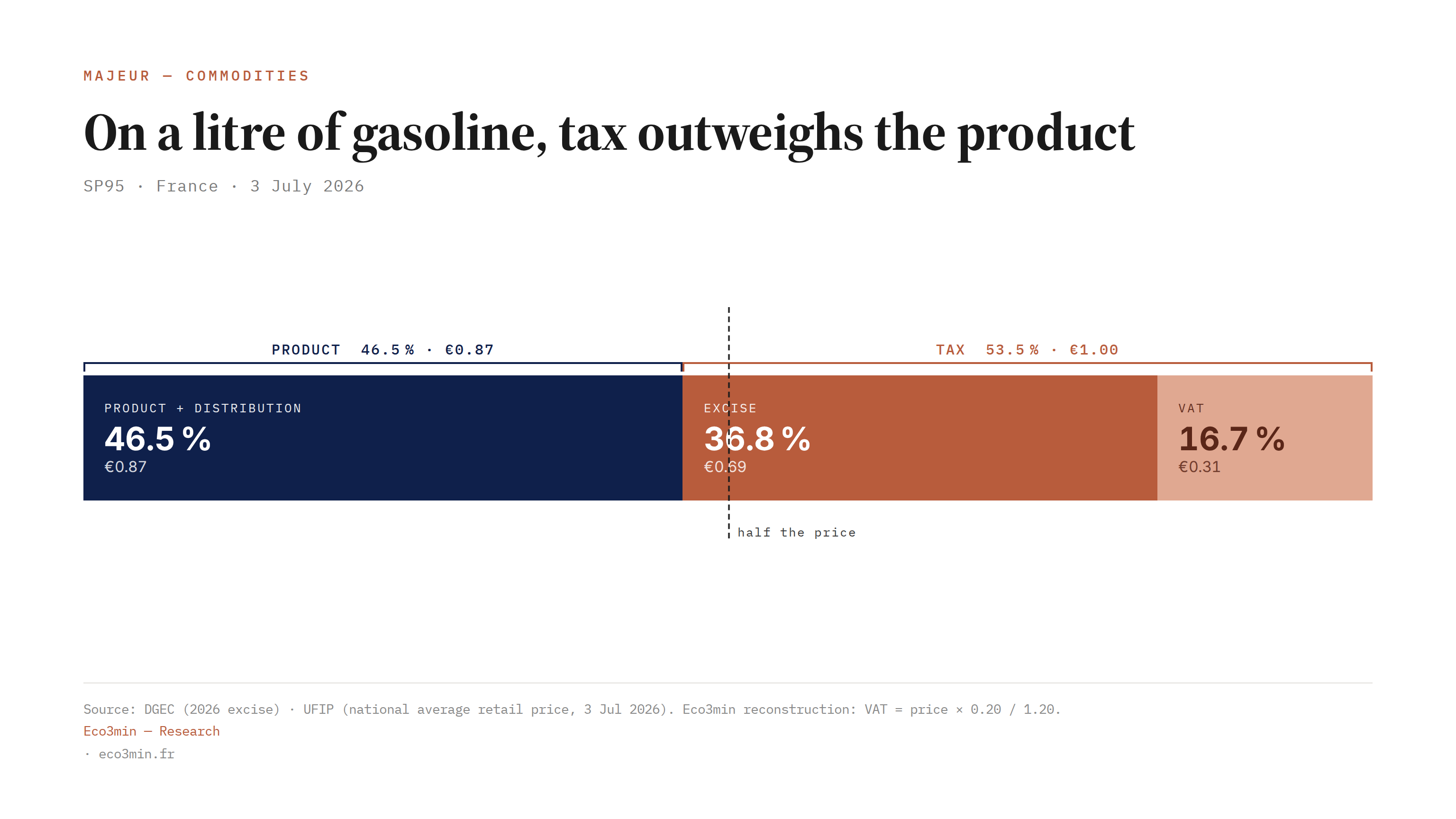
In France, over half the pump price is tax, largely fixed per litre; in the US, about 18% — the same barrel reaches drivers very differently. On a litre of French SP95 gasoline at €1.873 in early July 2026, the fixed excise (€0.690) and VAT (€0.312) make up 53.5% of the price; the refined product the retailer actually buys is less than half. Because the main tax is a fixed amount per litre, a fall in the barrel feeds through only to the “product” fraction of the price, never the whole.
When crude rises, the pump rises; when it falls, drivers wait for relief. The dominant narrative makes the oil price the near-exclusive driver of fuel prices, and media coverage reinforces it: a jump in Brent becomes, within days, a jump at the pump. That narrative is not wrong — the barrel matters — but it describes the most visible and smallest part of a price whose structure, in France, is largely fiscal and fixed.
The useful question is not “does the barrel move the pump?” (yes, at the margin) but “what is a litre of fuel actually made of?” The answer, measured against public sources, reorders the intuition completely: on a French litre, the component that moves with oil is a minority, and the component that dominates — taxation — does not move with the barrel at all.
What is inside a litre: the decomposition
Two taxes apply to road fuel in mainland France: the energy excise (formerly TICPE), a fixed amount per litre independent of the oil price, and VAT at 20%. In 2026, outside Corsica, the national excise rates are 60.75 c€/L for diesel, 67.02 c€/L for SP95-E10, and 69.02 c€/L for SP95-E5 and SP98 (sources: Directorate-General for Energy and Climate; the French energy-taxation guide, ecologie.gouv.fr). A technical point often missed: VAT applies both to the pre-tax price and to the excise itself — a tax on a tax (connaissancedesenergies.org, March 2026).
ON A LITRE OF SP95 AT €1.873 (3 JULY 2026)
| Refined product (Rotterdam quotation) + distribution | €0.871 · 46.5% |
|---|---|
| Excise (fixed amount per litre) | €0.690 · 36.8% |
| VAT (20% on product + excise) | €0.312 · 16.7% |
| Total tax (excise + VAT) | €1.002 · 53.5% |
Eco3min reconstruction from 2026 excise rates and the national average pump price (UFIP). VAT = price × 0.20/1.20; pre-tax + excise = price / 1.20.
The reconstruction reconciles with the shares published by UFIP on 6 March 2026: on that date, taxes accounted for roughly 48% of the diesel price and 54% of SP95-E10, the cost of oil (the Rotterdam quotation, i.e. the refined product at the refinery gate) for 35% and 28% respectively, and distribution — transport, retailer margin, the cost of energy-savings certificates and the biofuel-blending mandate — for about 17%. On diesel at €1.863 the same day, the same arithmetic yields €0.608 of excise, €0.311 of VAT and 49.3% tax, consistent with the UFIP figure.
One methodological point is needed to read these figures correctly: the “product” line is the quotation of the finished fuel at the refinery gate (Rotterdam), which already blends crude and refining. Crude alone and the refining margin are not published separately in a weekly series; the share attributable to Brent alone can only be inferred by removing the refining margin, which has no continuous official series.
Why the pump price does not track the barrel
The mechanism lies in the nature of the excise. It is a flat amount per litre: whether the barrel is worth $60 or $100, the state collects the same number of cents. This fixed layer acts as a floor that dampens variation: a 10% fall in Brent does not cut the price by 10%, because it applies only to the “product” fraction — a little under half — and leaves the excise untouched. Mechanically, the higher the tax share, the less sensitive the pump price is to the barrel. It is the opposite of a market where the final price would hug the oil price.
The regional modulation of the excise, which let regional councils raise the rate from 2011, was abolished on 1 August 2025 (Article 20 of the 2025 Finance Act); the surcharge was folded into the national rate, now single across the mainland apart from Corsica’s reduction. The French pump price has thus become a simple fiscal object to describe: a fixed national floor, plus a proportional VAT, on a product whose minority fraction alone follows world markets.
The reverse reading: what the barrel still does
Reducing the pump price to its fiscal component alone would be a symmetrical error. The “product” fraction — 28% to 35% depending on the fuel — remains fully exposed to Brent and to the euro-dollar exchange rate, and it explains most of the daily moves. In May 2026, amid Middle East tensions since March, SP95-E10 reached €2.034 and diesel €2.150 on national average, before easing below €1.88 in early July: those swings came from the product, not from taxes, which stayed identical. The fixed layer dampens; it does not immobilise.
A second point corrects a widespread intuition: when fuel prices rise, the state does not “gain” on the excise, since the excise is set per litre and not per price — a higher barrel, or even lower consumption, leaves excise revenue flat or falling. Only VAT on the product rises mechanically with the pre-tax price. The link between high prices and public revenue exists, but it runs through proportional VAT, not the flat excise — a distinction the public debate frequently conflates. See also our fuel-price breakdown simulator for France.
The same barrel, a price that behaves differently: the US comparison
France’s structure is not universal; it is a fiscal choice. In the United States, the retail gasoline price decomposition published by the Energy Information Administration in January 2026 breaks down as 51% crude, 20% refining, 11% distribution and marketing, and 18% taxes (federal, state and local). The federal gasoline tax is 18.4 cents per gallon, unchanged since 1993 and not indexed; adding the average of state taxes (33.3 cents) brings the total to about 52 cents per gallon — on the order of 13 cents per litre, roughly one-seventh of the French per-litre tax burden.
RETAIL GASOLINE PRICE — SHARE BY COMPONENT (JAN 2026)
| United States (EIA) | France (UFIP, SP95-E10) | |
|---|---|---|
| Crude oil | 51% | 28% (crude + refining, Rotterdam) |
| Refining | 20% | |
| Distribution & marketing | 11% | ~17% |
| Taxes | 18% | ~54% |
Sources: U.S. EIA (Jan 2026, via Congressional Research Service R48948); UFIP Énergies & Mobilités (6 Mar 2026). Shares shift with the price level: at higher prices the crude and refining shares rise and the tax share falls. On the same topic: our 21-year test of French rockets-and-feathers pricing.
The consequence is direct: the US price, more than 70% of which depends on crude and refining, tracks the barrel; the French price, more than half of which is a largely fixed tax, dampens it. The same barrel of oil, processed through two opposite fiscal architectures, produces two opposite price behaviours at the pump. The refined-product economics behind the crude-to-pump link are captured by the US 3-2-1 crack spread, the refining margin between products and crude.
Three common misreadings
- “Taxes rise when oil rises.” The excise does not move with the barrel; its share of the price rises when oil falls (the fixed floor weighs more) and falls when oil rises. It is a proportion effect, not a tax increase.
- “Crude is the bulk of the price.” In France, the “product” line (crude + refining) is a minority; in 2026 it even falls below the tax line for gasoline. In the US the opposite holds — hence the far stronger sensitivity to the barrel.
- “Cutting the excise would drop the price by the same amount.” A cut in the excise also reduces the VAT levied on it, but nothing guarantees full pass-through: the 2022 rebate showed that part can be absorbed by the distribution chain.
Frequently asked questions
Why does the pump price fall more slowly than it rises?
Two factors combine: a large share of the price (taxation) does not move, which dampens any variation; and the “product” fraction itself feeds through with a lag tied to stock turnover, often longer on the way down than up. This pass-through asymmetry is examined in a dedicated analysis.
No. In 2026 the excise is lower on diesel (60.75 c€/L) than on gasoline (67 to 69 c€/L), a legacy of historical diesel support; taxes therefore weigh slightly less on diesel (~48%) than on SP95-E10 (~54%). The Finance Act schedules a gradual convergence by 2030.
Is E85 cheaper because it is less taxed?
That is the dominant factor: the excise on E85 flex-fuel ethanol is far lower (around 12 c€/L), which explains a pump price near €0.85 in early July 2026, for compatible vehicles only. LPG road fuel also benefits from a reduced excise.
Do Corsica or the Paris region have different taxes?
Since the abolition of regional modulation on 1 August 2025, the excise rate is national and single across the mainland, apart from Corsica’s reduction. Price differences between regions therefore no longer come from the excise, but from distribution costs and competitive density (hypermarket stations run 5 to 15 cents lower).
How many distinct components are in a litre?
Four, in the official decomposition: the refined product (the Rotterdam quotation, which blends crude and refining), distribution costs (including energy-savings certificates and biofuel blending), the excise and VAT. Crude alone is not isolable in a public weekly series.
Go deeper
- Estimate your own exposure: fuel burden calculator.
- The refining economics behind the crude-to-pump link: US 3-2-1 crack spread · refining margins as the hidden driver of oil profits · what drives refining margins.
- The US pump-price components as datasets: US gasoline retail price · US diesel retail price.
- Framework: commodity price formation · commodity regimes and the energy transition.
Coming next: why the pump price climbs fast and eases slowly — the pass-through asymmetry, or the “rockets and feathers” effect.
Sources
- Directorate-General for Energy and Climate (DGEC) — 2026 excise rates and average fuel prices.
- French Ministry for Ecological Transition — energy-taxation guide.
- UFIP Énergies & Mobilités — decomposition of average diesel and SP95-E10 prices, 6 March 2026 (via connaissancedesenergies.org).
- U.S. Energy Information Administration — retail gasoline price decomposition, January 2026; federal and state fuel taxes (via Congressional Research Service R48948).
- FIPECO — fuel taxes (UFIP retail prices as of 3 July 2026).
Last updated — 13 July 2026
Disclaimer – Financial Information: The analyses, commentary, and content published on eco3min.fr are provided for informational and educational purposes only. They do not constitute investment advice or a solicitation to buy or sell financial instruments. Past performance is not indicative of future results. All investment decisions involve risk and are the sole responsibility of the reader.