
How the 2-Year Treasury Leads the Fed (1976–2026): 50 Years of Cycle Reversals
Eco3min Research · Study #6 · Rates
In 13 of the 15 Federal Reserve cycle reversals since 1976, the 2-Year Treasury was already moving in the Fed’s eventual direction before the FOMC acted.
Executive summary
- 15 Fed cycle reversals identified in monthly Fed Funds Effective Rate data from June 1976 to February 2026, using a pre-registered pivot definition (sign reversal in 12-month change of 3-month-smoothed series, ≥100 bp subsequent move within 24 months, ≥12 months separation from prior pivot).
- 13 of the 15 pivots were anticipated by the 2-Year Treasury moving more than 25 bp in the Fed’s eventual direction during the 6 months prior to the pivot date.
- 9 of the 15 pivots had a strict same-direction DGS2 major pivot within the prior 24 months. Across those 9 paired cases, the DGS2 led by a median of 3 months (range 1–7 months, mean 3.9 months).
- 2 cases did not follow the pattern. In January 1990 the Fed cut while DGS2 had risen 27 bp over the prior 6 months. In June 2021 the Fed pivoted to hiking while DGS2 had moved only +6 bp from its COVID floor — the Fed actually led the DGS2 by 1 month in this case.
- The spread itself encodes the lead-lag relationship in real time. When the spread (DGS2 − Fed Funds) sat below −100 bp (32 months in the sample), the Fed cut rates within 12 months in 84% of cases. When the spread sat above +25 bp (344 months combined), the Fed hiked within 12 months in 51% of cases — a much weaker, asymmetric signal.
- Current state (August 2026 monthly means, updated after the hike of 16 September 2026): DGS2 at 4.22%, Fed Funds at 3.63%, spread at +59 bp (POSITIVE regime). On daily closes the 2-year rose 129 bp between its 27 February low of 3.38% and 15 September (4.67%), the day before the FOMC raised its target range to 3.75–4.00%, its first hike since July 2023, while the effective funds rate held between 3.63% and 3.64% throughout. The episode is not yet a dated reversal under the pivot rule; see the section added in September 2026.
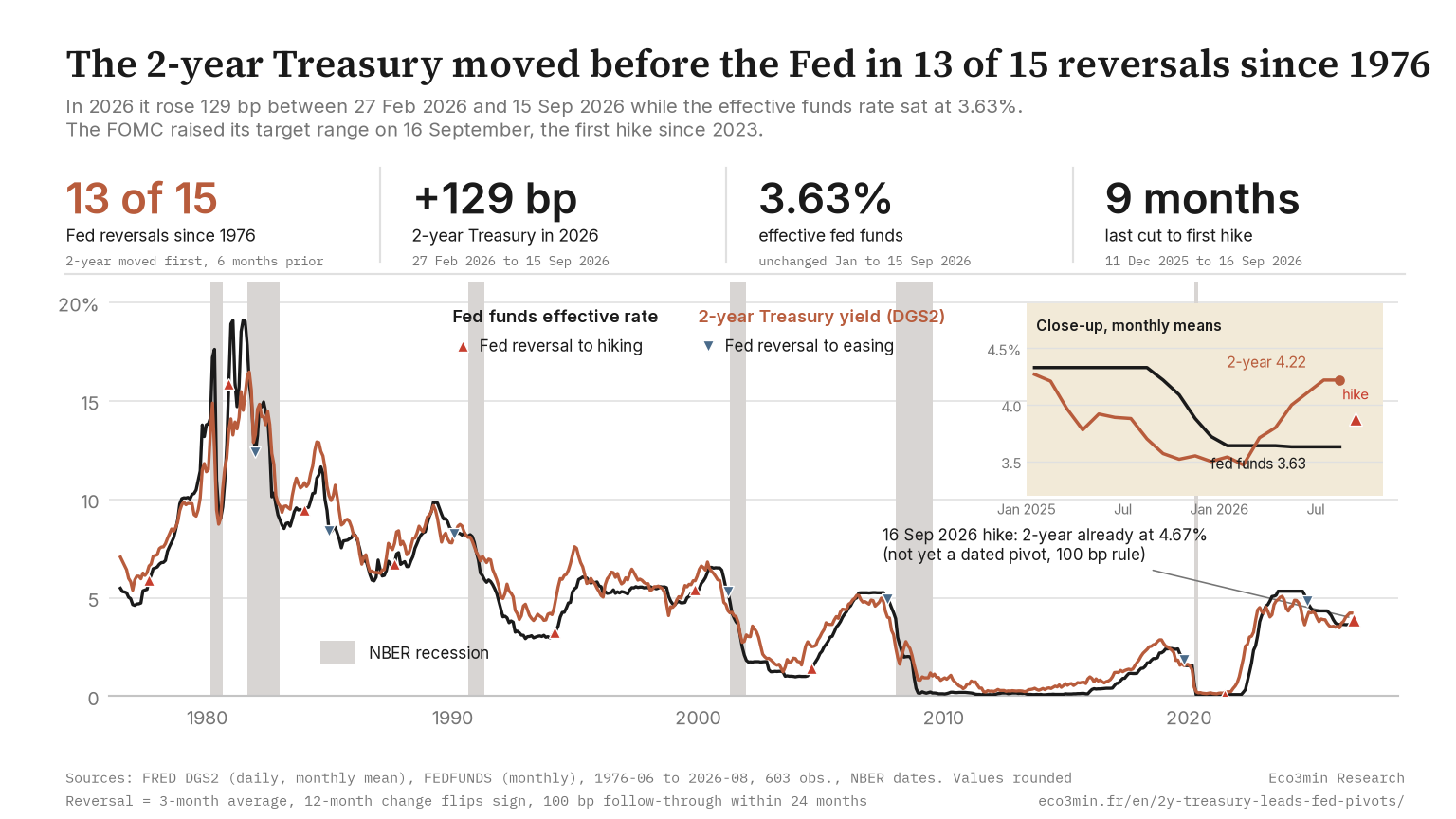
Sources: FRED (DGS2 daily aggregated to monthly average, FEDFUNDS monthly); NBER recession dates.
Why the 2-Year Leads: A Mechanical Explanation
The 2-Year Treasury yield is, by construction, a forward-looking instrument. Its current level reflects the market’s expectation of the average policy rate over the next 24 months, plus a term premium. The Fed Funds Effective Rate, by contrast, is a backward-looking summary of past FOMC decisions — the rate the Fed has already set. Read alongside: the relationship between Treasury issuance and gold demand.
This is the simplest version of the mechanical explanation: a forward-looking instrument tends to move before a backward-looking one whenever the policy path is expected to change. If a critic argues the lead is “trivial,” that is precisely the point — the lead is structural, not predictive in the sense of revealing private information. The 2-Year reflects publicly available information about the likely future path of policy, processed by market participants who collectively price the curve.
But “trivial” understates what the historical record allows us to test. Three observations make the relationship analytically interesting:
- The lead is variable, not constant. If the relationship were purely mechanical, one would expect the lead to track a stable horizon. Instead, the lead between a DGS2 major pivot and the Fed pivot ranges from 1 to 7 months across the 9 strictly paired cases. The longer leads captured by Chart 2 — out to 34 months in some cases — come from a different measure: the distance from the DGS2’s local peak or trough (within a 36-month window) to the Fed pivot, rather than from the DGS2’s own confirmed cycle reversal. Variability under both measures indicates that markets sometimes anticipate policy changes well in advance, and sometimes move only just before.
- The Fed sometimes acts against what the 2-Year had signalled. The December 1983 Fed hike pivot occurred one month after a DGS2 easing pivot — the market disagreed, and the Fed reversed course twelve months later in December 1984. This is documented in the table below.
- The signal asymmetry matters. Deep inversion of the spread (DGS2 well below Fed Funds) has historically been a more consistent leading indicator of Fed cuts than positive spreads have been of Fed hikes. This is documented in the section on the spread as a real-time signal.
The Full Record: 15 Fed Pivots Since 1976
The table below lists every Fed cycle reversal identified by the pivot algorithm, with three measures of DGS2 behavior in the run-up: the 6-month DGS2 change preceding the Fed pivot date, the date and value of the nearest DGS2 local extremum within a 36-month window (peak before an easing pivot, trough before a hiking pivot), and the strict-paired DGS2 major pivot date when one exists in the 24-month window prior.
| Fed pivot | Direction | Fed Funds at pivot | DGS2 6m prior change | Anticipated? | DGS2 local extremum (within 36m) | Lead time | DGS2 major pivot (within 24m, same direction) |
|---|---|---|---|---|---|---|---|
| 1977-08 | HIKE ▲ | 5.90% | +52 bp | Yes | 1976-12 trough at 5.38% | 8 m | None (1977-10, after pivot) |
| 1980-11 | HIKE ▲ | 15.85% | +406 bp | Yes | 1977-11 trough at 7.14% (≥36m censored) | ≥36 m | 1980-08 (3 m) |
| 1981-12 | EASE ▼ | 12.37% | −122 bp | Yes | 1981-09 peak at 16.46% | 3 m | None (1982-01, after pivot) |
| 1983-12 | HIKE ▲ | 9.47% | +66 bp | Yes | 1983-01 trough at 9.33% | 11 m | 1983-11 (1 m) |
| 1984-12 | EASE ▼ | 8.38% | −273 bp | Yes | 1982-02 peak at 14.82% | 34 m | None (1985-01, after pivot) |
| 1987-08 | HIKE ▲ | 6.73% | +135 bp | Yes | 1987-01 trough at 6.23% | 7 m | 1987-05 (3 m) |
| 1990-01 | EASE ▼ | 8.23% | +27 bp | No (opposite) | 1989-03 peak at 9.68% | 10 m | 1989-08 (5 m) |
| 1994-02 | HIKE ▲ | 3.25% | +47 bp | Yes | 1993-04 trough at 3.84%* | 10 m | None (1994-03, after pivot) |
| 1999-11 | HIKE ▲ | 5.42% | +61 bp | Yes | 1998-10 trough at 4.09% | 13 m | 1999-08 (3 m) |
| 2001-03 | EASE ▼ | 5.31% | −174 bp | Yes | 2000-05 peak at 6.81% | 10 m | 2000-12 (3 m) |
| 2004-08 | HIKE ▲ | 1.43% | +77 bp | Yes | 2003-06 trough at 1.23% | 14 m | 2004-01 (7 m) |
| 2007-09 | EASE ▼ | 4.94% | −56 bp | Yes | 2006-06 peak at 5.12% | 15 m | 2007-04 (5 m) |
| 2019-10 | EASE ▼ | 1.83% | −79 bp | Yes | 2018-10 peak at 2.86% | 12 m | 2019-05 (5 m) |
| 2021-06 | HIKE ▲ | 0.08% | +6 bp | Ambiguous | 2021-02 trough at 0.12% | 4 m | None (2021-07, after pivot) |
| 2024-10 | EASE ▼ | 4.83% | −90 bp | Yes | 2023-10 peak at 5.07% | 12 m | None within 24m |
* 1993-04 trough notation: the local minimum is 3.84% but DGS2 had been declining from a 1992 peak; the trough marks the start of the trend reversal toward the 1994 hike pivot. “Anticipated” = DGS2 6m prior change exceeds 25 bp in the Fed’s eventual direction. “Strict pair” = a same-direction DGS2 major pivot identified by the same algorithm applied to DGS2, within the 24-month window prior to the Fed pivot date.
Summary count. Across the 15 cases: 13 anticipated, 1 opposite (1990-01), 1 ambiguous (2021-06). Strict pairing identifies a same-direction DGS2 major pivot before the Fed pivot in 9 of 15 cases. The 6 unpaired cases break down as: 5 where the DGS2 major pivot occurred slightly after the Fed pivot (1977-08, 1981-12, 1984-12, 1994-02, 2021-06), and 1 where no DGS2 major pivot has yet formed at all (2024-10, where the DGS2 cycle was still developing).
Explore all 603 months
Point at any month for the 2-year, the funds rate, the spread and its regime; click a triangle to pin one of the 15 reversals; the last button zooms on the 2024 cuts and the 2026 hike.

Sources: FRED. Methodology: see methodology section.
Two Frameworks: Retrospective Lead Time vs Real-Time Signal
The lead times in Chart 2 are measured retrospectively. For each Fed pivot that has already happened, we look backward to find the DGS2 extremum or major pivot. This is useful for characterising the historical relationship but not for real-time use — at any given month, an observer does not know whether the current DGS2 move is a “peak” or “trough” until well after the fact.
A real-time framework is provided by the spread itself: DGS2 minus Fed Funds, observable each month. The spread does not require knowing whether a peak has formed; its level alone places the current observation in one of five historical regimes, each with its own distribution of subsequent Fed actions. This is the framework explored in the next section.
The two frameworks are complementary, not competing. Retrospective lead-time analysis answers “when DGS2 moved before each Fed pivot, by how much?”. Real-time spread analysis answers “given today’s spread, what has historically happened to the Fed Funds rate over the following 12 months?”. Both are needed to characterise the relationship fully.
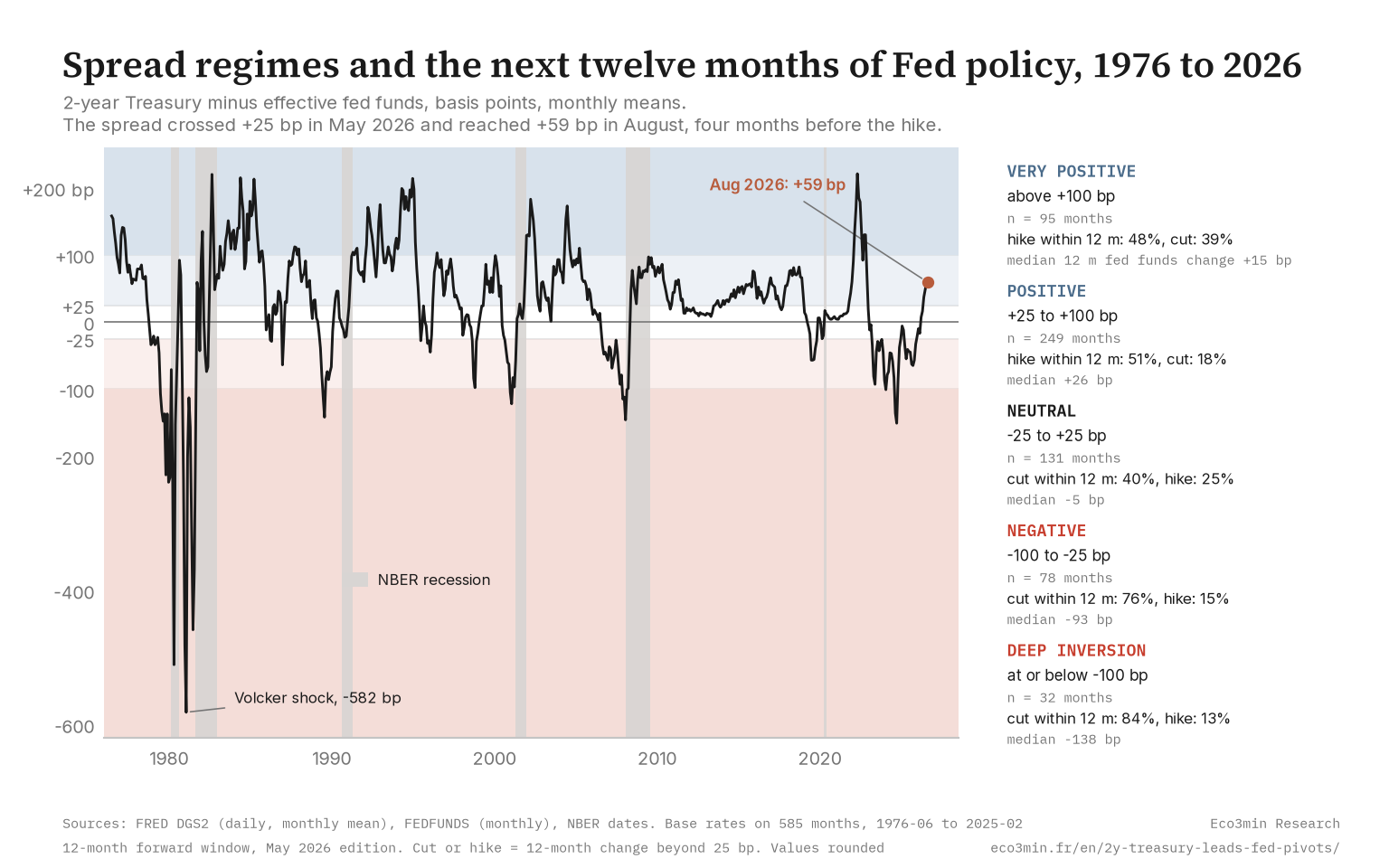
Sources: FRED, NBER. Regime thresholds (±25 bp, ±100 bp) chosen pre-data; sensitivity in methodology.
The Spread as Real-Time Signal: Five Regimes
The DGS2-minus-Fed Funds spread is observable at any moment and admits a direct interpretation: it is the market’s expected average Fed Funds rate over the next 24 months minus what the Fed has actually set, plus a small term premium. When the spread is sharply negative, market participants are collectively pricing a future Fed Funds rate below the current setting — that is, expecting cuts. For the complete series, see the 10-year term-premium data.
The historical record provides a rough base rate for each spread regime. The table below summarises forward 12-month Fed Funds behavior conditional on the spread regime at the observation date, computed over the 585 monthly observations (1976-06 to 2025-02) for which a 12-month forward window was available in the May 2026 edition. The base rates are kept as published; the September 2026 refresh adds observations, not a recomputation.
| Spread regime | Spread range | Months observed | Fed cut within 12m | Fed hike within 12m | Median forward FF change |
|---|---|---|---|---|---|
| Deep inversion | ≤ −100 bp | 32 | 84% | 13% | −138 bp |
| Negative | −100 to −25 bp | 78 | 76% | 15% | −93 bp |
| Neutral | −25 to +25 bp | 131 | 40% | 25% | −5 bp |
| Positive | +25 to +100 bp | 249 | 18% | 51% | +26 bp |
| Very positive | > +100 bp | 95 | 39% | 48% | +15 bp |
Asymmetry note. The signal is sharper on the negative side. Deep inversion (32 months, around 5% of sample) preceded a Fed cut within 12 months in 84% of cases. Positive spreads above +100 bp (95 months, 16% of sample) preceded a Fed hike in only 48% of cases, with 39% preceding a cut instead. Positive spreads frequently arise during late-cycle easing phases, when the market expects continued cuts despite already low Fed Funds — a configuration that has not historically preceded hikes.
The Pearson correlation between the spread and the subsequent 12-month change in Fed Funds is +0.34. This is a modest correlation, consistent with the spread being one informative signal among many rather than a deterministic predictor.
When the 2-Year Was Wrong
Any signal that worked in 13 of 15 cases did not anticipate the Fed in the other 2. Examining these two cases, together with the noisier paired-pivot record, identifies the boundary conditions of the relationship.
January 1990: the Fed cut while DGS2 was rising
In the 6 months leading to the Fed’s first easing pivot of 1990 (January 1990), the DGS2 had risen 27 basis points — moving against the Fed’s eventual direction. The longer-horizon picture is more nuanced: DGS2 had peaked at 9.68% in March 1989 and was 159 bp below that peak by January 1990, so the 12-month view shows DGS2 declining. The 6-month window simply caught a counter-trend bounce. The strict-paired DGS2 major pivot in August 1989 also identifies the cycle reversal 5 months before the Fed acted. So this case is best characterised as a true anticipation by DGS2, with a short-term move against the eventual direction in the final 6 months. A companion piece: the chronology of cuts into a bull market.
June 2021: the Fed led the 2-Year
The unique case where the Fed pivoted before DGS2 is the June 2021 shift from the pandemic floor. As reported in the Federal Reserve’s record of FOMC rate decisions. DGS2 had moved only +6 bp in the 6 months prior — barely off the all-time low of 0.12% reached in February 2021. The DGS2 major pivot, identified by the algorithm at July 2021, came one month after the Fed’s pivot. This is consistent with the unusual policy environment: the Fed was emerging from an explicit yield-curve-control-adjacent regime where short-rate forward guidance had suppressed front-end volatility. The 2-Year was anchored by guidance, not by market expectations — so it could not move first.
The exceptions cluster around regimes where front-end rates do not freely reflect market expectations — explicit forward guidance (2021) and short-term counter-trend bounces inside longer trends (1990). When the 2-Year is anchored by policy commitment rather than expectation, the lead-lag relationship breaks down. This is itself a useful diagnostic: when forward guidance is binding, the spread loses information value.
September 2026 in Real Time
The May 2026 edition of this study closed with the spread at −17 bp, in the NEUTRAL regime, and with both series drifting lower. What followed is the first out-of-sample test of the lead-lag record since publication.
The 2-year yield bottomed at 3.38% on 27 February 2026 and closed at 4.67% on 15 September, the day before the FOMC raised its target range to 3.75–4.00%, the first increase since July 2023 (Federal Reserve press release of 16 September 2026). Over the same period the effective federal funds rate did not move: 3.64% in January and February, 3.63% from May to the eve of the decision. On the monthly means used throughout this study, DGS2 rose from 3.47% in February to 4.22% in August, +75 bp over six months, three times the 25 bp threshold that defines an anticipated reversal in the table above. On 16 September itself the 2-year closed at 4.74%, its 2026 high, above the top of the new target range.
The spread told the same story in the five-regime framework. It left the NEUTRAL band in May (+37 bp), reached +59 bp in July and August, and stood near +88 bp on the partial September mean. The POSITIVE regime is, on the historical base rates, the least decisive of the five on the hiking side: a hike within twelve months followed 51% of its 249 months, a cut 18%. The regime alone was close to a coin flip. The direction was carried by the level of the 2-year, which had climbed above the funds rate by more than the FOMC’s usual 25 bp increment four months before the Committee moved.
Two cautions apply. First, the daily figure of +129 bp and the monthly figure of +75 bp measure different things, close-to-close extremes versus monthly means, and do not reconcile to each other. Second, the September 2026 hike is not yet a dated reversal under the pre-registered pivot rule: the rule requires a 100 bp follow-through within 24 months, which only the coming FOMC decisions can supply. Until then the 2026 episode is a real-time observation set beside the fifteen dated reversals, not a sixteenth row in the table. The six months added to the dataset in September 2026 carry no new pivot flag for that reason.
Current State and Levels to Watch
As of August 2026 (monthly means): DGS2 stands at 4.22%, the Fed Funds Effective Rate at 3.63%, and the spread at +59 basis points. This places the latest full-month observation in the POSITIVE regime (+25 to +100 bp), which historically preceded a Fed hike greater than 25 bp within 12 months in 51% of cases, a cut in 18%, with a median forward change of +26 bp. On 16 September 2026 the FOMC raised its target range to 3.75–4.00%; the 2-year closed at 4.74% that day and the partial September mean puts the spread near +88 bp, close to the +100 bp boundary of the VERY POSITIVE regime.
Levels to watch in this dataset
- Spread movement past +100 bp. If the September mean settles above +100 bp, the observation enters the VERY POSITIVE regime (n=95 historical months), the most mixed band of the five: 48% preceded a Fed hike within 12 months and 39% a cut, because such spreads have often appeared late in easing cycles rather than early in hiking ones.
- Spread movement back below +25 bp. A return to the NEUTRAL band (n=131 historical months) would mean the 2-year had converged on the new target range; that band carries the most evenly distributed forward outcomes (40% cut, 25% hike).
- DGS2 absolute level. At 4.74% on 16 September 2026 the 2-year sits 74 bp above the top of the 3.75–4.00% range, which reads as market pricing of an average funds rate above the new range over the next 24 months. A 25–50 bp move in either direction in the DGS2 would shift this implied path.
- Calendar. The next FOMC meetings decide whether the September 2026 hike becomes a dated reversal under the pivot rule, which needs a 100 bp follow-through within 24 months; the 12-month forward outcome of the August 2026 observation is known in August 2027.
These reference levels describe historical regime thresholds; they are not forecasts or recommendations. The POSITIVE spread regime of August 2026 has historically been followed by a hike within twelve months in about half of its months and by a cut in about one in five.
Methodology
Data
- DGS2. US Treasury Constant Maturity 2-Year, daily series from FRED, aggregated to monthly mean. Start: 1976-06.
- FEDFUNDS. Federal Funds Effective Rate, monthly series from FRED. Coverage to 2026-08 at the refresh of 18 September 2026 (2026-02 in the May 2026 edition).
- NBER recession dates. Standard NBER business cycle reference dates.
- Sample window. 1976-06 to 2026-08, the overlapping window of both series, n = 603 monthly observations. The pivot flags, the table of reversals and the regime base rates are those of the May 2026 edition; the six months added in September 2026 are observations, not new pivots.
Pivot algorithm (pre-registered)
A “major pivot” in either series is defined as the first month in which all three conditions hold:
- The 12-month change of the 3-month rolling average of the series reverses sign relative to the prior month.
- The series moves at least 100 basis points in the new direction within the following 24 months (confirms the reversal is not a short-lived wobble).
- At least 12 months have elapsed since the previous major pivot (prevents double-counting of two-sided wobbles inside a single cycle).
Applied to monthly Fed Funds, this identifies the 15 reversals listed. Applied to monthly DGS2 mean, it identifies 16 reversals. Sensitivity at the 75 bp and 125 bp thresholds yields 16 and 13 Fed reversals respectively, with the same core ordering. The 13/15 anticipation count is stable across these threshold variants.
“Anticipated” definition
A Fed pivot is classified as anticipated if the DGS2 monthly mean changed by more than 25 bp in the Fed’s eventual direction over the 6 months preceding the pivot date. At the ±10 bp sensitivity threshold the count remains 13/15 (the borderline 2021-06 case at +6 bp stays below the threshold); at ±50 bp it falls to 12/15 (the 1994-02 case at +47 bp falls out).
Spread regime thresholds
The five regimes are defined by spread thresholds at ±25 bp and ±100 bp, applied to the monthly DGS2 minus Fed Funds difference. These thresholds were chosen before computing forward-action statistics and correspond to commonly cited demarcations in the literature (e.g., the ±25 bp band is a typical FOMC inter-meeting move). Sensitivity at ±50 bp and ±150 bp shifts the regime counts but preserves the qualitative ranking of conditional cut/hike frequencies.
Forward Fed action measurement
For each observation date, the 12-month forward Fed Funds change is the difference between Fed Funds 12 months ahead and the current month’s Fed Funds. “Cut within 12 months” means this difference is less than −25 bp; “hike within 12 months” means greater than +25 bp. The 25 bp threshold is a standard FOMC move increment.
Limitations
- The window of 1976-06 to 2026-08 covers six recessions and multiple monetary regimes. Stationarity of the lead-lag relationship across regimes is not formally tested.
- The 36-month window for the local-extremum lead-time analysis caused censoring in one case (1980-11). A longer window would identify a longer lead in that case.
- Monthly aggregation of DGS2 smooths through intra-month volatility relevant to high-frequency analysis but does not affect cycle-level conclusions.
- The Fed Funds Effective Rate is itself a market-determined outcome of the Fed’s target range. In the post-2008 administered-rate regime, it tracks the IORB / ON-RRP corridor very closely and behaves as a policy rate; in earlier periods it could diverge slightly from the target.
- The relationship is partly endogenous: the Fed observes the 2-Year when setting communication. This does not invalidate the historical record but does limit how much one can attribute causation to either side.
Reproducibility
The full dataset, including the derived columns used in every figure in this study, is published as an open dataset under CC BY 4.0. See the dataset link below.
Frequently Asked Questions
Is the 2-Year Treasury a leading indicator of Fed policy?
The historical record shows that in 13 of 15 Fed cycle reversals since 1976, the DGS2 had already moved more than 25 bp in the Fed’s eventual direction during the prior 6 months. In 9 of those 15 cases, the DGS2 had its own major cycle reversal a median of 3 months before the Fed. Whether this constitutes “leading” depends on the framing: the 2-Year is, by construction, a forward-looking rate, so some lead is mechanical. The variability of the lead (1 to 7 months across paired cases) and the existence of exceptions (1990, 2021) indicate that the relationship is informative rather than tautological.
What did the 2-year Treasury signal before the September 2026 Fed hike?
On monthly means the 2-year rose from 3.47% in February 2026 to 4.22% in August, +75 bp, while the effective funds rate held at 3.63%. On daily closes it rose 129 bp from its 27 February low of 3.38% to 4.67% on 15 September, the day before the FOMC raised its target range to 3.75–4.00%. The spread crossed +25 bp in May and stood at +59 bp in August, in the POSITIVE regime, whose base rate is a hike within 12 months in 51% of months since 1976 and a cut in 18%. The episode is not yet a dated reversal under the pivot rule, which needs a 100 bp follow-through within 24 months.
Why use the Fed Funds Effective Rate rather than the target rate?
The Effective Rate is the realised market rate, available as a clean monthly series back to the late 1950s. The target rate (or target range, post-2008) is a discrete administrative variable that is harder to handle in continuous statistics. In the post-2008 administered-rate regime, the Effective Rate tracks the target range very closely, so the choice does not materially affect any of the pivot dates identified.
Why is the signal asymmetric? Negative spreads precede cuts more reliably than positive spreads precede hikes.
One interpretation: the easing phase of a cycle is more reliably triggered by deteriorating real conditions that the market reads earlier than the Fed. The hiking phase, by contrast, often follows recoveries whose strength the Fed gauges through extended data review, leading to longer and less synchronised positive-spread periods. Additionally, positive spreads above +100 bp frequently coincide with deep easing cycles where the market is pricing further cuts despite already low rates — a configuration that does not lead to hikes within 12 months.
Can this be used in real time?
The spread is directly observable in real time, while the local-extremum and pivot-pairing measures are retrospective. The five-regime table provides historical base rates conditional on the current spread observation. As with any base-rate signal, the appropriate use is as one input among many; the historical 84% cut frequency in the deep-inversion regime is informative but not a probability of a future event. The other inputs are, for the most part, the variables that locate any given month on the wider map of monetary regimes since 1990.
Why does the dataset start in 1976?
1976-06 is the first month for which the FRED DGS2 series is available. Extending further would require splicing alternative sources for short-rate Treasury yields, which would introduce inhomogeneity. The 50-year window from 1976 covers six US recessions and four major monetary regimes (late-Burns, Volcker, Greenspan, post-2008 administered-rate), which is sufficient for the descriptive claims made here.
Last updated — 18 September 2026
Disclaimer – Financial Information: The analyses, commentary, and content published on eco3min.fr are provided for informational and educational purposes only. They do not constitute investment advice or a solicitation to buy or sell financial instruments. Past performance is not indicative of future results. All investment decisions involve risk and are the sole responsibility of the reader.