
Gold and US Public Debt: The Fiscal Driver

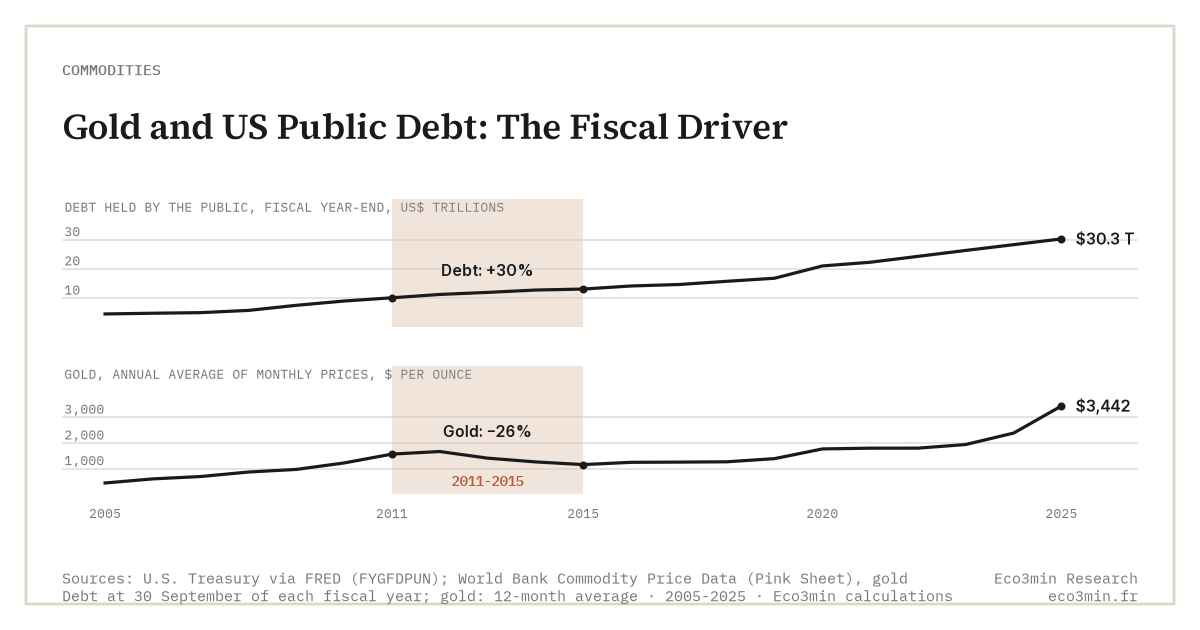
The US fiscal trajectory, debt at records and interest exceeding the defense budget, ranks among the structural drivers of gold demand: a liability-free asset, sought when a state’s debt looks less safe.
TL;DR
U.S. interest payments now exceed the entire defense budget, a fiscal backdrop whose support for gold runs through reserve flows and shifting expectations, slow and discontinuous channels.
- Per the CBO (February 2026), federal debt held by the public sits at 101% of GDP, while debt service near $1 trillion, about 3.3% of GDP, has doubled since 2022 and now tops all defense spending.
- Since 2022, central banks, mostly outside the Western world, have bought gold at a record pace, diversifying away from US Treasuries and absorbing a significant share of yearly mine output.
- The debt-gold tie is loose, not mechanical: across 2011-2015 gold fell sharply even as US debt and central-bank asset purchases both rose, with real rates and reserve flows doing the deciding.
The link is anything but mechanical, though: it runs through expectations and reserve flows, not through an equation tying the deficit to the metal’s price.
A trillion in interest, and debt at a record
The 2026 US fiscal figures frame the subject. According to the Congressional Budget Office (CBO, February 2026), federal debt held by the public reaches 101% of GDP this year and is projected to surpass, around 2030, the record of 106% set in 1946 after the Second World War. The deficit stands at $1.9 trillion, or 5.8% of GDP, at a time when unemployment nonetheless remains low, a historically unusual fiscal situation.
The line that worries most is interest. Debt service reaches about $1 trillion in 2026, or 3.3% of GDP, after roughly doubling since 2022. It now exceeds all defense spending and is the fastest-growing item in the budget. The CBO calls the trajectory «not sustainable», and several analyses flag a spiral risk should the rate paid on the debt come to exceed growth on a sustained basis.
The absolute scale sharpens the picture. Debt held by the public runs into tens of trillions of dollars, and CBO projections see it reaching about $56 trillion by 2036, as annual deficits near 6% of GDP accumulate. None of these figures implies a default: an issuer that borrows in its own currency can always meet its nominal obligations. But the sheer size of the amounts feeds a deeper question about the real value, over time, of those obligations. One way to put a number on that question is to divide the metal by the money stock, which is what the gold-to-M2 ratio since 1960 does.
The comparison with 1946 calls for a nuance. After the war, an equivalent debt had been worked down by strong growth and an inflation that eroded its real weight, in a rebuilding economy. The 2026 situation differs: the deficits are structural, not tied to a temporary war effort, and occur at near-full employment, which leaves less room for a reduction through growth. It is this difference in nature that makes the current trajectory more concerning than the mere crossing of a record suggests. A trajectory rather than a level is also what separates a cyclical deficit from the structural deficits embedded in advanced economies.
These orders of magnitude say nothing, in themselves, about gold’s price. But they sketch a backdrop: that of a sovereign issuer whose obligations accumulate faster than its economy, and whose signature, without being questioned, raises more questions than it did a decade ago.
The dollar’s position gives this trajectory a global reach. Other large economies carry high debt, but none issues the main reserve currency: US debt is held everywhere, and its evolution bears directly on the composition of the planet’s foreign-exchange reserves. That is what sets the US fiscal situation apart from an ordinary issuer’s.
Why debt feeds gold demand
The reasoning that links public debt to gold rests on a simple property of the metal: it is no one’s debt. A government bond is a promise of repayment; its value depends on the issuer’s ability and willingness to honour that promise, and on the currency in which it does so. Gold carries no counterparty risk: it can be neither over-issued nor devalued by political decision. On this point: physical constraints across the commodity spectrum.
When a large state’s fiscal trajectory looks hard to stabilise, part of investors and reserves seek assets outside the sovereign balance sheet. This is one of the springs of gold as a liability-free asset: not a bet on a default, unlikely for an issuer that borrows in its own currency, but a hedge against the slow erosion of that currency’s real value.
The distinction between nominal and real default is central here. A state that controls its currency does not default in the strict sense; it can, however, let inflation reduce the real value of its debt, which amounts, for the creditor, to a loss. Gold hedges precisely that second risk: it protects not against non-repayment, but against the depreciation of the unit in which repayment is made.
There is also the fear of «fiscal dominance»: the idea that high debt could, over time, constrain the central bank to keep real rates low to ease the burden, at the expense of fighting inflation. In such a regime, gold, which thrives when real rates are compressed, becomes a sought-after asset. The metal does not predict this scenario; it offers a hedge should the market begin to anticipate it. For more detail: gold’s portfolio role by regime.
The mechanism, moreover, carries an internal tension. Abundant debt and a growing supply of bonds tend to lift the term premium and the real yields the market demands; yet higher real yields are, in principle, a headwind for gold, a yield-free asset. See our term-premium record for the underlying data. Debt thus cuts both ways: it feeds the distrust that supports the metal, but can also push up real yields that penalise it. The net effect depends on the balance between these two forces.
Central banks vote with their reserves
The most concrete sign of this mechanism is found in official reserves. Since 2022, central banks, especially outside the Western world, have bought gold at a record pace, diversifying their holdings away from US Treasury bonds. This reallocation reflects as much caution toward the fiscal trajectory as a wish to reduce dependence on the dollar, sharpened by the use of financial sanctions.
This move is detailed in the analysis of central-bank gold buying, which gauges its scale and motives. It directly feeds structural demand for the metal and supports firm prices, independent of the business cycle or retail investor flows.
The weight of this official demand has changed scale. Where central banks were, in the 2000s and 2010s, net or marginal sellers, they have become structural buyers, absorbing a significant share of annual mine output. This shift explains why the metal could stay firm even as other supports, such as jewellery demand, softened.
The observation echoes that of gold measured beyond the dollar: distrust, when it surfaces, targets not just one currency, but the whole set of sovereign liabilities issued in currencies whose real value can erode. Gold then appears as the common vanishing point of these worries.
This reallocation has reshaped the hierarchy of reserves. In some countries, gold now represents a share of the reserve holding not seen for decades, at times level with or above certain currencies. This shift, slow but cumulative, installs an underlying demand that short-term moves in the price do not dissipate.
A real but loose link
It would be wrong, however, to infer a mechanical relationship between debt and the price of gold. US public debt has been high for years without the metal rising continuously: it stagnated, even fell, during long stretches of widening deficits. The link runs through expectations and reserve flows, two slow and discontinuous channels, not through an equation tying the budget balance directly to the metal’s price. Full series: the full federal debt series since 1966.
Recent history is a reminder. Between 2011 and 2015, while US debt kept rising and the central bank maintained massive asset purchases, gold lost 26% on an annual-average basis, from $1,569 to $1,161 an ounce according to the World Bank, while debt held by the public rose 30%, from $10.1 trillion to $13.1 trillion at fiscal year-end according to the US Treasury. Deficits alone did not support the metal: it was the combination of real rates, inflation expectations and reserve flows that decided.
The question of sustainability itself is subtler than a mere debt level. What matters is the relationship between the real interest rate paid on the debt and the economy’s growth rate: as long as growth exceeds the cost of debt, the ratio can stabilise despite deficits. This mechanics is at the heart of the sustainability of public debt, and it explains why a given debt level can be tenable or not depending on the rate and growth environment.
Placed within the geoeconomics of strategic resources, public debt is thus only one factor among others in gold demand, alongside real rates, monetary distrust and reserve dynamics. The metal responds to a bundle of signals, of which the fiscal one is only a strand.
The trajectory is all the more watched because it is hard to bend. Most US spending falls under social programmes and interest costs, little compressible in the short term, while any tax rise or cut runs into political obstacles. This inertia makes a quick stabilisation unlikely, which sustains, in the background, the interest in assets outside the public balance sheet.
Presenting gold as a mechanical hedge against public deficits oversimplifies. US debt has been high for years without a continuous rise in the metal: between 2011 and 2015, gold even fell as deficits widened. The link runs through expectations and reserve flows, slow and discontinuous, not through the size of a given deficit.
A backdrop, not a trigger
The US fiscal trajectory is a favourable backdrop for gold, feeding structural demand for reserves outside the sovereign balance sheet. But it acts as an undercurrent, not an immediate trigger: it is the perception of deteriorating sustainability, not an isolated deficit figure, that matters for the metal.
The 2026 levels leave several readings open. A credible stabilisation of public finances would remove one of gold’s supports; a deterioration in expectations would reinforce it, with no default occurring. The metal accompanies fiscal doubt; it does not settle it.
Last updated — 7 October 2026
Disclaimer – Financial and Legal Information: The analyses, commentary, and content published on eco3min.fr are provided for informational and educational purposes only. They do not constitute investment advice or a solicitation to buy or sell financial instruments. Past performance is not indicative of future results. All investment decisions involve risk and are the sole responsibility of the reader. Data, charts and calculated series are provided as is and may contain errors or lag behind their source: check any figure against the primary source cited before relying on it. Content describing laws, regulations or contracts reflects the law as of its publication date and does not constitute legal or tax advice; applying it to a specific situation requires a qualified legal or tax professional.
Read next
Full pillar →Gold as a Monetary Signal: Real Yields, the Dollar and Central Bank Buying
Gold prices do not track inflation: they track the monetary opportunity cost of holding, itself driven by real…
Pure-play refiners versus integrated majors: downstream margin exposure
A pure-play refiner owns only the downstream, so its earnings track the refining margin. An integrated major also…
Jet fuel, the forgotten margin: the jet crack and the aviation link
The 3-2-1 crack spread reduces the refining margin to two products, gasoline and diesel. Jet fuel sits outside…