
Fiscal Dominance: When the Debt Constraint Overrides Monetary Policy
eco3min · macro regime atlas
Fiscal dominance is not a level of debt. It is the situation where the government’s budget constraints condition monetary policy to the point of making it impossible to tighten enough to control inflation — the central bank then loses control of the price level.
Fiscal dominance — Eco3min working definition
Fiscal dominance describes a configuration in which the government’s debt trajectory constrains monetary policy: the central bank can no longer raise or hold rates at the level required to stabilize prices without jeopardizing sovereign-debt sustainability or financial stability.
The term originates in the founding paper by Thomas Sargent and Neil Wallace, “Some Unpleasant Monetarist Arithmetic” (Federal Reserve Bank of Minneapolis, 1981): when the fiscal authority sets its deficits independently, the monetary authority loses control of long-run inflation. Fiscal dominance is the inverse of monetary dominance, where the central bank sets policy freely and the budget adjusts. Brazil is the case most often invoked on both sides of that line, and its monthly discount rate series back to 1996 is where the argument gets its numbers.
Position in the Eco3min classification grid
Fiscal dominance is not a cyclical state of the growth × inflation grid. It is a policy-structure regime that can overlay any cyclical state. In the Eco3min classification it appears not as a G×I label but as a context condition — detected through the term premium, the gap between market rates and the policy rate, and the evolving composition of sovereign-debt holders.
Fiscal dominance is most dangerous when it coincides with an inflationary regime: the central bank should tighten to control prices, but tightening raises the cost of servicing public debt and can threaten budget sustainability — hence the deadlock. It differs from financial repression (see Atlas — Financial Repression), which is a deliberate policy of transferring resources to the public debtor, whereas fiscal dominance is first a binding constraint.
What this regime is not
Fiscal dominance is not synonymous with high public debt. A large debt-to-GDP ratio does not imply fiscal dominance as long as the central bank retains the capacity and credibility to set rates independently. Japan has carried gross debt above 230% of GDP (IMF data) without inflation, precisely because the constraint did not materialize as a de-anchoring of expectations.
It is also not a buy or sell signal. The historical asset observations (§ Assets) are sourced descriptive statistics — not allocation recommendations.
How fiscal dominance takes hold and constrains monetary policy
Four generative mechanisms, from the most formal to the most contemporary:
Unpleasant monetarist arithmetic (Sargent-Wallace)
The founding mechanism (1981): if the fiscal authority sets its deficits without regard to the financing constraint, the central bank is eventually forced to monetize part of the debt to avoid default. Tightening that raises the cost of debt today can therefore require stronger money creation tomorrow — inflation is postponed, not avoided. Monetary policy loses control of the long-run price level. A monetary authority cornered in that sequence is no longer setting policy against inflation but against the debt path, which is what the regime where financing needs constrain the central bank describes.
Fiscal theory of the price level (FTPL)
In John Cochrane’s formulation (The Fiscal Theory of the Price Level, Princeton University Press, 2023), the price level adjusts so that the real value of public debt equals the present value of expected future primary surpluses. If markets stop believing in sufficient future surpluses, the price level rises — independently of rate policy. Inflation becomes a function of expected fiscal sustainability, not just of the money supply. Related analysis: Our deep dive into the institutions and rate cycles behind monetary policy.
Debt-service constraint
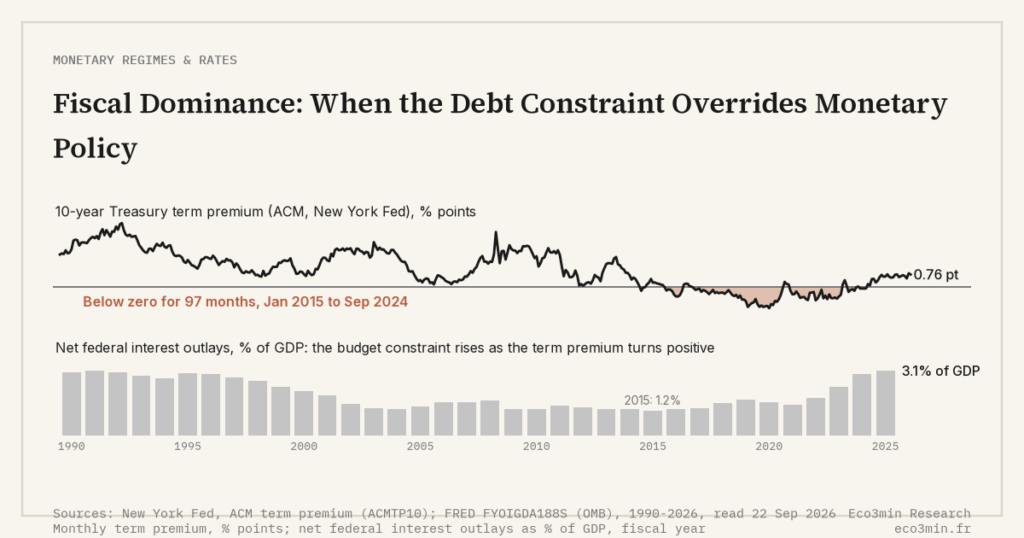
The most operational contemporary mechanism: when public debt is high and its maturity short, every policy-rate hike feeds quickly into the interest bill. Beyond a threshold, the tightening required to control inflation becomes politically and financially untenable — the central bank faces implicit pressure to cap rates. The term premium (ACMTP10, NY Fed) is where this tension shows first: it embeds a rising fiscal risk premium. For the raw figures, see the interest payments series back to 1947.
Financial repression as a soft form
Rather than open monetization, fiscal dominance often works through real rates held negative, slowly eroding the real value of the debt at the expense of the government’s creditors. This is the junction with financial repression (Reinhart & Sbrancia, 2011): the line between a binding constraint (fiscal dominance) and a deliberate policy (repression) blurs. A persistently negative 10Y real rate (DFII10, FRED) is the observable marker.
These mechanisms are not mutually exclusive. The post-2020 inflation debate illustrates their entanglement: a massive fiscal stimulus (American Rescue Plan, USD 1.9 trillion, March 2021), gross federal debt above 120% of GDP (BEA/Treasury data), and an open discussion of the fiscal share of inflation — without consensus on whether the United States entered fiscal dominance or simply experienced a transitory shock amplified by the budget.
How fiscal dominance propagates to markets and monetary policy
Fiscal dominance manifests through five observable channels:
Term-premium channel
The term premium is the compensation investors require for holding long bonds rather than rolling short bills. The Federal Reserve Bank of New York’s ACM decomposition (ACMTP10) isolates it from the rate level. A sustained rise in the term premium not explained by rate expectations signals a rising fiscal risk premium: the market demands more to fund a government whose budget path is seen as less sustainable.
Long-rate / policy-rate gap channel
Under fiscal dominance, long rates can stay high or rise even as the central bank eases — a sign that the market is pricing a sovereign-funding risk independent of monetary policy. Watching the policy rate (FEDFUNDS) alongside the 10Y–2Y slope (T10Y2Y) distinguishes a market slope (cyclical expectations) from a slope under fiscal stress (sovereign risk premium).
Debt-holder base channel
The composition of Treasury holders is a leading signal. A retreat by official foreign holders (central banks) offset by the domestic central bank or captive funds shifts risk toward less price-sensitive buyers — a pattern characteristic of the transition toward fiscal dominance. The US Treasury’s TIC (Treasury International Capital) data document this monthly.
Government cash-management channel
The Treasury General Account (TGA, WTREGEN on FRED) becomes a fiscal-stress signal during debt-ceiling episodes. The debt-ceiling episodes (2011, 2013, 2023) forced cash-management trade-offs that reveal the government’s dependence on the issuance calendar — an indirect symptom of fiscal pressure, documented in Eco3min’s study of TGA drawdown. Setting those three years against the cyclical state that surrounded them is a matter of a date-by-date reading of the macro regime.
Real-rate and debt-erosion channel
The “soft” resolution channel: real rates (DFII10) held negative mechanically reduce the debt-to-GDP ratio by eroding the real value of the debt stock. Reinhart and Sbrancia (2011) estimate that this mechanism cut advanced-economy public debt by several points of GDP per year in the post-war decades. It is the bridge to the financial-repression regime.
The measurement instruments for fiscal dominance
Fiscal dominance has no single threshold: it is a bundle of converging signals. Primary indicator first, then cross-indicators.
10Y ACM term premium — Federal Reserve Bank of New York
Primary indicator. The Adrian-Crump-Moench decomposition isolates the 10-year Treasury term premium from the rate-expectations component. A sustained rise in the term premium, uncorrelated with a rise in monetary-policy expectations, is the most direct marker of a growing fiscal risk premium. Series published directly by the NY Fed (monthly updates).
Long-rate / policy-rate gap — Federal Reserve
Watching the 10Y–2Y slope alongside the policy rate distinguishes a cyclical-expectation slope from a slope under fiscal stress. Long rates rising while the policy rate eases is atypical and points toward a sovereign risk-premium reading. Available since 1976 (T10Y2Y) and 1954 (FEDFUNDS) on FRED.
Treasury General Account — Federal Reserve (H.4.1)
The US government’s cash account at the Fed. During debt-ceiling stress, its volatility reveals dependence on the issuance calendar and extraordinary measures — an indirect symptom of budget constraint. Weekly FRED series, available since 2015 at high resolution.
10Y real rate (TIPS) — Federal Reserve
The marker of the “soft” form of fiscal dominance. A 10-year real rate held persistently negative erodes the real value of public debt at the expense of creditors — the financial-repression mechanism. Over 2021–2022, DFII10 reached −1.1% at its low (FRED), a substantial real transfer from Treasury holders to the sovereign issuer. Available since 2003.
Gross federal debt / GDP — BEA / Treasury via FRED
The sovereign-leverage ratio. A context variable, not a trigger: a high ratio does not establish fiscal dominance, but conditions its probability when combined with short debt maturity and a rising term premium. Quarterly data, complemented by the primary deficit (CBO/BEA sources).
What looks like fiscal dominance without being it
- High deficit without a constraint on rate policy. A large budget deficit is not fiscal dominance as long as the central bank retains the capacity and credibility to set rates independently. The United States ran high deficits in 2009–2012 without fiscal dominance: the Fed steered policy without an effective budget constraint, and inflation expectations (T5YIFR) stayed anchored.
- Apparent monetization (QE) without a rate constraint. Quantitative easing expands the central bank’s balance sheet and coincides with buying public debt, which looks like monetization. But as long as the central bank retains the ability to stop or reverse QE and raise rates — as the Fed did in 2022 — it is not fiscal dominance. The test is the freedom to tighten, not balance-sheet size.
- Long-rate rise attributed to fiscal dominance. A rise in long rates may reflect growth or inflation expectations, or a term premium tied to bond supply, without any sovereign-sustainability tension. Attributing every term-premium rise to a “fiscal risk premium” without isolating other factors (net Treasury supply, foreign demand, rate expectations) is a frequent attribution error.
- High debt in a reserve-currency economy. An issuer of an international reserve currency enjoys structural demand for its debt that pushes back the fiscal-constraint threshold. The Japanese case (gross debt > 230% of GDP, IMF data, with no funding crisis) shows that a debt level that would trigger a crisis elsewhere can remain sustainable depending on the holding structure and institutional credibility.
Observed behavior of major asset classes under fiscal dominance
AMF note — required reading before this table
The data below are historical descriptive statistics, drawn from identified past episodes. They are not forecasts, allocation recommendations, or trading signals. Fiscal dominance is a rare and contested regime: episodes are few and their monetary contexts heterogeneous. These observations cannot be mechanically extrapolated to future situations.
| Asset class | Trend observed over reference episodes | Nuances and conditions |
|---|---|---|
| Long sovereign bonds US Treasury 10Y+ | Unfavorable in real terms | Fiscal dominance typically resolves through inflation and negative real rates, unfavorable to holders of long fixed-rate bonds. During the 1942–1951 rate peg (the Fed capping long-bond yields at 2.5%), inflation exceeded 14% in 1947 (BLS), inflicting a heavy real loss on holders of war debt. Source: Federal Reserve History, BLS. |
| Real assets — Gold Spot LBMA USD/oz | Positive correlation with negative real rates | Gold has historically risen during prolonged negative real-rate phases, the typical setting of the “soft” resolution of fiscal dominance. Per the World Gold Council, gold shows a negative correlation with the US 10Y real rate — but this relationship is context-conditional and has no mechanical predictive value. |
| Inflation-linked bonds US TIPS (DFII10) | Mixed | Built-in inflation protection, but exposure to duration risk if real rates rise. Under fiscal dominance, TIPS protect against the inflation channel but stay exposed if the central bank manages to raise real rates — which is precisely what fiscal dominance makes difficult. |
| Sovereign currency Broad dollar (DTWEXBGS) | Depends on reserve-currency status | Fiscal dominance in a reserve-currency economy does not mechanically produce a currency fall: structural demand for the reserve currency cushions the pressure. In an economy without that status, fiscal dominance has historically coincided with marked currency depreciation (emerging-market episodes). |
| Equities S&P 500 | Ambiguous | Equities are real assets (claims on nominal profit streams) that can partly hedge against repression inflation, but the multiple compression tied to higher nominal rates works the other way. The net effect depends on the speed of inflation relative to that of rates — an ambiguity intrinsic to this regime. |
Sources: Federal Reserve (1942–1951 peg history, ACMTP10, DFII10), BLS (historical CPI), World Gold Council, FRED (DTWEXBGS, FEDFUNDS). All performance figures cited are factual and dated — they describe identified past episodes, not extrapolable trends. These data do not constitute an investment recommendation.
The most frequent interpretive pitfalls in analyzing fiscal dominance
- Confusing debt level with fiscal dominance. A high debt-to-GDP ratio is a context condition, not a trigger. Fiscal dominance is defined by the effective constraint on monetary policy, not by a debt threshold. Japan is the clearest counterexample.
- Attributing every term-premium rise to fiscal risk. The term premium moves for many reasons — net supply of securities, foreign demand, rate-volatility expectations. Isolating the “fiscal” component requires controlling for these factors; direct attribution is a frequent inference error.
- Reading QE as systematic monetization. As long as the central bank retains the freedom to stop and reverse its purchases and raise rates, QE does not establish fiscal dominance. The operational test is the freedom to tighten, demonstrated by the Fed in 2022, not the size of the balance sheet.
- Treating fiscal dominance as a binary event. It is a continuum, not a switch. The boundary with financial repression (a deliberate policy) and with mere budget constraint is gradual. Announcing “entry into fiscal dominance” on a precise date is most often interpretation, not established fact.
- Ignoring the role of institutional credibility. Two countries with the same debt ratio can follow opposite paths depending on the credibility of their central bank and the holding structure of their debt. Fiscal dominance is as much a matter of expectations and institutions as of accounting arithmetic.
Documented episodes and their status in the Eco3min classification
Classification windows — reminder
Full formal resolution: since January 2003. All indicators available; classifications verifiable and reproducible.
Degraded retroactive extension: since 1977. Subset of indicators (CFNAI, NFCI, T10Y2Y, Sahm, Trimmed Mean PCE). T5YIFR and net liquidity absent. Labeled data_quality: "degraded" in all exports.
Conceptual references (out of window): episodes before 1977. Used as analytical comparison points, not as validations of the method.
| Period | Episode | Description and key indicators |
|---|---|---|
| 1942–1951 | Fed rate peg Prototype | The textbook case of fiscal dominance in the United States. To finance the war effort, the Fed agreed to cap Treasury yields (around 0.375% on short bills, 2.5% on long bonds), subordinating its policy to the Treasury’s financing needs. CPI inflation exceeded 14% in 1947 (BLS) without the Fed being able to respond. The episode ended with the March 1951 Fed-Treasury Accord, which restored monetary independence. Conceptual precedent — out of the formal classification window. Source: Federal Reserve History, BLS. |
| 1973–1981 | Partial deficit monetization Conceptual | The Great Inflation period combined oil supply shocks with partial monetary accommodation of deficits, in a context where Fed independence was politically contested. The academic debate remains open on the share of fiscal dominance in the decade’s inflation persistence. CPI inflation peaked at 14.8% in March 1980 (BLS) before the Volcker shock. Conceptual precedent — out of the formal window. Source: BLS, Federal Reserve History. |
| 2013–2023 | Abenomics and YCC (Japan) Outside US core | The Yield Curve Control introduced by the Bank of Japan in 2016, capping the 10Y JGB yield, is a contemporary form of “soft” fiscal dominance: the central bank supports the sustainability of gross public debt above 230% of GDP (IMF data). Analytical reference outside the US core — the Eco3min classification covers the US economy. Source: Bank of Japan, IMF. |
| 2020–2022 | Post-COVID fiscal-inflation debate Disputed | The combination of a massive fiscal stimulus (American Rescue Plan, USD 1.9 trillion, March 2021), gross federal debt > 120% of GDP (BEA/Treasury), and persistent inflation revived the debate over the fiscal nature of inflation (FTPL). With the Fed able to tighten sharply in 2022 (+475 basis points) without a visible budget constraint, the episode is generally read as a transitory shock amplified by the budget rather than confirmed fiscal dominance. Formal episode but disputed interpretation. Source: FRED, BEA, ongoing academic debate. |
Data series used for this regime
Going further on fiscal-dominance mechanisms
The Eco3min classification applies this method in real time. Regime in effect as of the 1st of the current month:
Last updated — 22 September 2026
Disclaimer – Financial Information: The analyses, commentary, and content published on eco3min.fr are provided for informational and educational purposes only. They do not constitute investment advice or a solicitation to buy or sell financial instruments. Past performance is not indicative of future results. All investment decisions involve risk and are the sole responsibility of the reader.