
The Inflationary Regime: Mechanisms, Indicators, and Historical Episodes
eco3min · macro regime atlas
An inflationary regime is not simply a period of high prices. It is a macro configuration in which inflation persistently exceeds central bank targets, constrains their policy options, redistributes real incomes, and structurally alters the financing conditions of the economy.
Inflationary regime — Eco3min working definition
An inflationary regime describes a macroeconomic configuration in which persistent inflation — measured by underlying price indicators, not solely by volatile components — durably exceeds central bank targets and materially constrains their policy options.
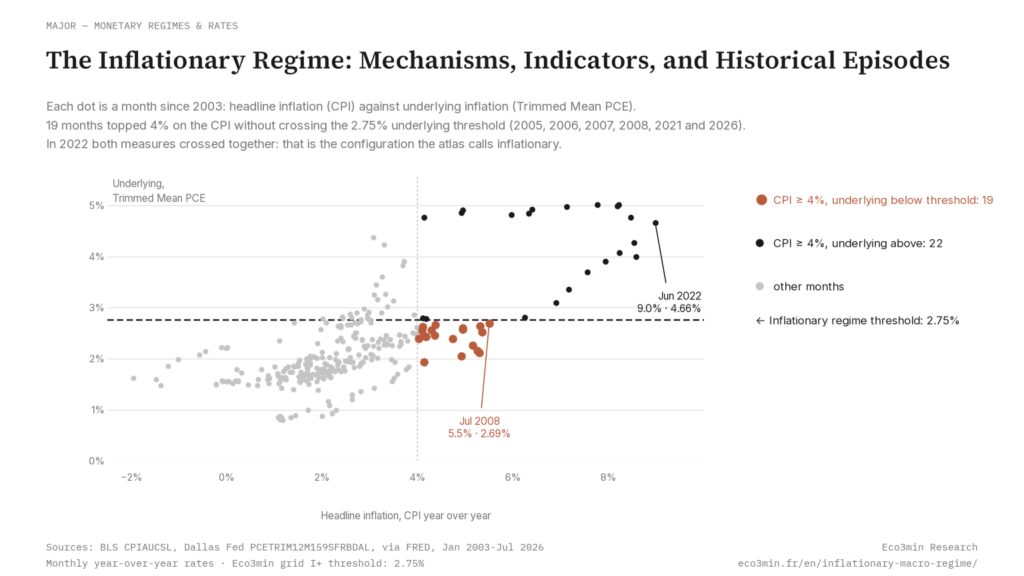
This definition excludes purely transitory inflationary spikes driven by energy that do not pass through to underlying components. A Brent oil spike that pushes headline CPI to 5% for two months, without the Dallas Fed’s Trimmed Mean PCE crossing 2.75%, does not constitute an inflationary regime under this classification — it produces a headline/underlying divergence signal documented separately.
Position in the Eco3min classification grid
The inflationary regime covers three distinct states of the growth × inflation grid, differentiated by real activity dynamics:
These three states share the I+ axis (Trimmed Mean PCE > 2.75%) but diverge radically on the growth axis — which determines what type of central bank response is possible. Overheating allows aggressive monetary tightening without immediate growth destruction; Stagflation confronts the central bank with a constitutive dilemma between fighting inflation and protecting output.
What this regime is not
An inflationary regime is not synonymous with elevated inflation at a given point in time. It requires measurable persistence: in the Eco3min classification, the I+ axis is confirmed only after two consecutive months with Trimmed Mean PCE above the threshold (hysteresis), unless the Sahm rule ≥ 0.50 short-circuits this delay on the growth axis.
It is also not a buy or sell signal. The historical asset observations in the Assets section are sourced descriptive statistics — not allocation recommendations.
How an inflationary regime takes hold and perpetuates itself
Three distinct generating mechanisms, often combined in empirical episodes:
Demand-pull inflation
Excess aggregate demand relative to available productive capacity generates price pressure. Typical of late-cycle expansion phases and episodes of un-sterilized fiscal stimulus. The Chicago Fed measures this excess via the CFNAI: a persistently positive CFNAI-MA3 signals above-trend activity, fertile ground for demand-pull inflation.
Cost-push inflation
A supply shock — energy, logistics, commodities — compresses margins and forces firms to pass cost increases on to output prices. This mechanism can produce persistent inflation even without excess demand, particularly when the shock is durable (1973–1975 oil shock; post-COVID supply chain disruptions 2021–2022). The Trimmed Mean PCE, by excluding the most volatile price components, allows separation of the persistent signal from transitory noise. Related framing: how futures, funds and equities carry commodity exposure.
Second-round effects and expectations de-anchoring
The mechanism central banks fear most: price increases replicate into wage negotiations, which feed further price increases (wage-price spiral). This process becomes self-sustaining and independent of the initial shock. The key indicator is the 5Y5Y forward breakeven (T5YIFR): as long as it remains anchored around 2.0–2.5%, the market expects central banks to bring inflation under control within five years. A drift above 2.7–3.0% signals long-term expectations de-anchoring, with qualitatively different implications for monetary policy.
Monetary and fiscal channel
A persistently accommodative monetary policy — durably negative real rates, excess money creation — can fuel inflation. Fiscal dominance (monetary financing of public deficits) represents an extreme case of this mechanism, historically associated with hyperinflation episodes and financial repression regimes (see Atlas — Financial Repression). In the post-2020 context of developed economies, net liquidity (WALCL − TGA − RRP) has proven a relevant real-time proxy for the generosity of monetary conditions, measurable directly via FRED.
In empirical episodes, these mechanisms rarely appear in pure form. The 2021–2022 period provides the clearest illustration: cost-push inflation first (supply disruptions, energy), then demand-pull (the $1.9 trillion American Rescue Plan, abundant liquidity), then expectations effects (FOMC too slow to tighten) — a three-phase episode that the Eco3min classification formally documents as the transition from Overheating to Inflationary Pressure through 2021–2022. Each month of that transition carries its own dated verdict, which is what the macro regime recorded for each month since 1978 returns.
How inflation propagates through markets and the real economy
Persistent inflation does not stay confined to the general price level. It propagates through five transmission channels whose combination determines the character of the adjustment:
Real rates channel
In the early stages of an inflationary regime, rising nominal rates do not always fully offset inflation: real rates (DFII10 on FRED) can remain negative or mildly positive for several quarters. This lag — particularly marked in 2021 when the Fed maintained zero rates against a Trimmed Mean PCE that had already crossed 2.5% — constitutes an involuntary accommodation window that feeds the regime. When the central bank reacts, the rise in real rates is the primary mechanism for restraining aggregate demand.
Yield curve channel
An inflationary regime first produces a steepening of the curve (market anticipates short-term rate hikes, term premium rises), then often an inversion if the market anticipates that tightening will ultimately break growth. The 10Y–2Y spread (T10Y2Y) followed this pattern precisely in 2022: steepening in early year, then deep inversion (−1.08% in March 2023 per FRED) as the market priced a hard landing. A yield curve inversion in an inflationary regime is a signal of regime exit — or of a transition toward Stagflation if growth capitulates before inflation normalizes.
Credit and financial conditions channel
In the initial Overheating phase, financial conditions paradoxically remain accommodative (negative NFCI, tight HY OAS): growth supports borrower balance sheets. Monetary tightening progressively produces spread widening and a NFCI moving into positive (restrictive) territory. According to Chicago Fed data, the NFCI reached a peak of +0.88 in October 2022, compared to −0.82 in early 2021 — a 170 basis point swing reflecting the speed of the financial conditions tightening. A parallel read: the data behind buying at record levels.
Currency and global financial conditions channel
When the Fed tightens more rapidly than other major central banks, the dollar strengthens (broad dollar index DTWEXBGS), importing disinflation for trading partners and exporting inflation to dollar-indebted emerging economies. The 2022 episode provides a clean example: the broad dollar index rose +12.8% year-over-year at its 2022 peak (calculations on DTWEXBGS, FRED), pressuring emerging markets and forcing other central banks to tighten to defend their currencies, even without comparable domestic inflationary pressure.
Liquidity and central bank balance sheet channel
Monetary policy normalization in an inflationary regime typically involves quantitative tightening (QT) alongside rate hikes. Net liquidity (WALCL − TGA − RRP) is the real-time barometer of this balance sheet adjustment: its contraction reduces available reserves in the financial system, potentially accelerating credit conditions tightening with an estimated 6–12 month lag to the real economy per Fed research. This channel was partially neutralized between 2022 and 2024 by the RRP drawdown, which released approximately $2.37 trillion of offsetting liquidity while QT nominally removed $2.14 trillion in assets — a phenomenon documented in Eco3min’s Net Liquidity Index study (#26). Read alongside: The Eco3min framework on the institutions and rate cycles behind monetary policy.
The instruments for measuring the inflationary regime
The Eco3min classification relies on public institutional indicators to identify and track the inflationary regime. Each indicator links to its corresponding dataset page.
Primary indicators — inflation axis
Trimmed Mean PCE (12-month) — Dallas Fed
Primary indicator of the inflation axis in the Eco3min classification. Measures persistent inflation by excluding the most volatile price components in both tails of the distribution. I+ threshold in the classification: > 2.75%. Two consecutive months above the threshold (hysteresis) confirms the I+ state. Available since 1977.
5Y5Y forward breakeven — Federal Reserve
Long-run inflation expectations indicator (5-year rate, 5 years forward). The Fed’s preferred gauge for measuring expectations anchoring. A 5Y5Y above 2.5–2.7% signals de-anchoring risk. Confirms I+ when elevated; corroborates I− when below 1.75%. Available since 2003 — the boundary of the full-resolution window.
Cross-indicators — context and severity
Chicago Fed National Activity Index — growth axis
Determines the sub-variant of the inflationary regime: Overheating if CFNAI-MA3 > +0.10 (G+), Inflationary Pressure in the neutral band (G=), Stagflation if < −0.50 (G−). The Overheating/Stagflation distinction is critical for monetary policy: the former allows tightening without painful trade-offs; the latter imposes a constitutive dilemma.
National Financial Conditions Index — Chicago Fed
Composite of 105 variables (money markets, debt, equities, banking system). Measures the restrictiveness of financial conditions. Positive = tighter than the historical average since 1971. In an inflationary regime, the NFCI tracks the monetary policy response: it moves from negative (accommodative) to positive (restrictive) as the central bank tightens. The timing of this shift determines the speed of regime exit.
10Y – 2Y yield spread — Federal Reserve
Yield curve dynamics signal the phase within the inflationary regime. Steepening = market pricing in hikes (early phase). Inversion = market pricing a hard landing or recession (late phase). An inversion followed by disinflation typically marks the regime exit. According to FRED data, every confirmed Overheating episode since 1970 was followed by a yield curve inversion with a median lag of 14 months.
Broad dollar index — Federal Reserve
Global context signal. In a US inflationary regime accompanied by Fed tightening, the dollar tends to strengthen — signaling tighter global financial conditions, particularly damaging for emerging markets and net energy importers. A 3-month change exceeding +3% constitutes the signal threshold in the Eco3min classification.
What looks like an inflationary regime without being one
- Energy spike without transmission to underlying components. A Brent or gas surge produces a visibly elevated headline CPI without the Trimmed Mean PCE crossing its threshold. This case generates a
headline_underlying_divergenceflag in the Eco3min classification but does not confirm the I+ state. Recent examples: Brent spike in 2022 Q2 without durable transmission to underlying PCE after June 2022; the Iran/Hormuz episode of May 2026 (Brent ~$108, underlying PCE pending). Conflating this signal with a structural inflationary regime has produced documented monetary policy errors — notably in 2008, when the ECB raised rates in July on the back of an oil spike while a recession was already underway per CFNAI data. - Optical base effects. Elevated year-over-year inflation can result from a very low base period (the same month of the prior year at depressed prices) without any acceleration in current prices. This bias is particularly strong at the exit from a recession. The 12-month Trimmed Mean PCE partially smooths the effect, but the 3-month annualized monthly dynamic remains the most reactive and least base-biased signal.
- Transitory vs. persistent inflation. The distinction between a transitory shock (resolved in 2–4 quarters) and a persistent regime is the most debated in the literature and the most difficult to make in real time. The Fed misjudged it in 2021 by maintaining the “transitory” label through November 2021, while the Dallas Fed’s Trimmed Mean PCE had already been above 3% since May of that year. The two-month hysteresis protocol in the Eco3min classification is designed precisely to avoid signaling a regime on the basis of a single month’s data.
- Apparent short-term expectations de-anchoring without a 5Y5Y drift. 1- and 2-year breakevens are highly sensitive to current energy prices and can spike without long-term inflation expectations (5Y5Y forward) moving. The 5Y5Y showed remarkable stability around 2.2–2.4% throughout 2021–2026 per FRED data, despite 1-year breakevens reaching over 6% at the 2022 peak — signaling that the market anticipated normalization, not structural de-anchoring.
Observed behavior of major asset classes during inflationary episodes
AMF notice — required reading before this table
The data below are historical descriptive statistics drawn from identified past episodes. They do not constitute forecasts, allocation recommendations, or trading signals. No two inflationary regimes are identical in their causes, duration, or monetary context. These observations cannot be mechanically extrapolated to future situations.
| Asset class | Observed trend across formal episodes (2003–2026) | Nuances and conditions |
|---|---|---|
| Long-duration nominal bonds US Treasury 10Y+ | Unfavorable | According to FRED data (series DGS10), the 10-year rate rose +315 basis points between January and October 2022, implying significant capital losses on long-duration fixed-rate holdings. The relationship is direct: persistent inflation raises rate expectations and depreciates the nominal value of fixed-rate bonds. |
| Inflation-linked bonds US TIPS (10Y real, DFII10) | Mixed | Inflation protection built into the coupon, but exposure to duration risk if real rates rise simultaneously. Over 2021–2022, the 10-year real rate (DFII10, FRED) moved from −1.1% to +1.7%, compressing TIPS prices despite the inflation protection. A TIPS buyer at the start of an inflationary regime remains exposed if Fed tightening is rapid. |
| Commodities Energy, industrial metals | Positive correlation observed | During Overheating and Inflationary Pressure episodes, commodities are often simultaneously a cause and a symptom of the regime. Over 2021–2022, Brent moved from $43 to $139 in March 2022 (ICE data). This correlation is more robust during Overheating than during Stagflation, where demand contraction can restrain industrial commodity prices. |
| Real assets — Gold Spot LBMA USD/oz | Mixed, conditional on real rates | According to World Gold Council data, gold has exhibited a negative correlation with US real rates over 2008–2024: it advances when real rates are negative or falling, and retreats when DFII10 rises. In 2022, despite the inflationary context, gold fell −2% in dollar terms over the year (peak of $2,069/oz in March, back to $1,824/oz in December), precisely because real rates were rising rapidly. |
| Equities S&P 500 | Depends on phase within the regime | In the early Overheating phase (NFCI still accommodative, negative real rates, solid growth), equities benefit from expanding nominal earnings. In the late phase, when the central bank tightens, the valuation multiple compresses. Over the 12 months of the Fed tightening cycle from March 2022 to March 2023, the S&P 500 posted a drawdown of −25.4% at the October 2022 trough (CBOE/Bloomberg data). The break occurs precisely when the NFCI moves persistently into positive territory. |
| High-yield credit HY OAS (BAMLH0A0HYM2) | Initial compression, late widening | A typical Overheating paradox: HY OAS initially compresses (growth supports high-yield issuer balance sheets), before widening as monetary tightening bites and upcoming refinancings become more expensive. Over 2021–2022, HY OAS moved from 360 bps at its trough (June 2021) to 588 bps at the stress peak (July 2022) per ICE data available before the FRED April 2026 truncation. |
Sources: FRED (DFII10, DGS10, T5YIFR, NFCI, BAMLH0A0HYM2, DTWEXBGS), ICE Futures Europe (Brent), London Bullion Market Association, World Gold Council, CBOE. All performance figures cited are factual and dated — they describe identified past episodes, not extrapolable trends. These data do not constitute an investment recommendation. A companion piece: our reading of the gold exposure paths.
The most frequent interpretive pitfalls in analyzing an inflationary regime
- Treating elevated inflation as a uniform regime. Conflating Overheating (G+ I+), Inflationary Pressure (G= I+), and Stagflation (G− I+) leads to diametrically opposite analytical errors. Overheating allows aggressive monetary tightening without immediate growth destruction; Stagflation places the central bank before a trade-off between inflation and recession. The category error carries real analytical cost.
- Assuming monetary tightening quickly ends the regime. The 1970–1982 period provides the most documented counter-example: the Fed conducted several incomplete tightening cycles between 1971 and 1979, each followed by an inflationary rebound. Only the Volcker shock (Fed funds at 20% in June 1981) broke inflation expectations. The persistence of an inflationary regime is tied to the anchoring or de-anchoring of expectations, not solely to the current level of rates.
- Ignoring fiscal dynamics. Monetary tightening can be partially or fully offset by simultaneous fiscal stimulus. Recent literature on the fiscal theory of the price level (Cochrane, Sims) shows that a fiscally unsustainable policy can sustain inflation even in the face of elevated policy rates, by shifting expectations about debt repudiation via inflation.
- Applying asset correlations from one sub-regime to another. Behaviors observed during Overheating (NFCI still accommodative, positive growth) do not mechanically replicate in Stagflation. Gold, for example, has historically outperformed in Stagflation and underperformed in Overheating accompanied by rising real rates.
- Conflating yield curve inversion with the end of the inflationary regime. Yield curve inversion signals that the market anticipates a slowdown or recession, which could end the regime. But several inversions (2000, 2006, 2019) preceded disinflationary recessions, not exits from inflationary regimes. The inversion itself indicates neither the speed of disinflation nor the price trajectory.
Episodes documented by the Eco3min classification and their characteristics
Classification windows — reminder
Full formal resolution: from January 2003. All indicators available; classifications verifiable and reproducible.
Retroactive degraded extension: from 1977. Reduced input set (CFNAI, NFCI, T10Y2Y, Sahm, Trimmed Mean PCE). T5YIFR and net liquidity absent. All exports labeled data_quality: "degraded".
Conceptual references (outside formal window): episodes predating 1977. Used as analytical reference points, not method validations.
| Period | Episode | Description and key indicators |
|---|---|---|
| 2021 Q1–2022 Q1 | Post-COVID Overheating G+ I+ | The combination of fiscal stimulus ($1.9 trillion American Rescue Plan, March 2021) + ultra-accommodative monetary policy (NFCI at −0.82, rates at zero) + demand reopening produced a textbook Overheating. The Dallas Fed’s Trimmed Mean PCE crossed 2.75% in May 2021, with a durably positive CFNAI-MA3. The 5Y5Y forward (T5YIFR) remained relatively anchored at 2.1–2.3% through early 2022, suggesting the market was not yet pricing structural de-anchoring. Formally classified. Source: FRED (PCETRIM12M159SFRBDAL, NFCI, CFNAI, T5YIFR). |
| 2022 Q1–Q3 | Transition to Inflationary Pressure G= I+ | In H1 2022, Trimmed Mean PCE reached a peak of ~4.9% (January 2023, Dallas Fed series), while CFNAI-MA3 decelerated toward the neutral zone. The FOMC triggered the fastest tightening cycle since 1981 (+475 basis points in 12 months). The NFCI moved from negative to +0.88 (peak October 2022, Chicago Fed). The Eco3min classification documents a transition from Overheating to Inflationary Pressure as growth slowed, without a durable crossing of the G− threshold (Sahm Rule remained below 0.50 throughout). Formally classified. |
| 1979–1982 | Stagflation — Volcker shock G− I+ | The reference Stagflation episode in the economic literature. US headline CPI inflation reached 14.8% in March 1980 (BLS). CFNAI data indicates activity contraction across virtually all of 1980–1982. The Volcker shock (Fed Funds raised to 20% in June 1981) produced a deep recession (unemployment at 10.8% in November 1982, BLS) before permanently anchoring inflation expectations lower. Outside the formal window (Trimmed Mean PCE from 1977, T5YIFR from 2003) — retroactive degraded classification. Source: BLS, FRED (FEDFUNDS, T10Y2Y, CFNAI vintage). |
| 1973–1975 | Stagflation — first oil shock G− I+ | The quadrupling of oil prices decided by OPEC in October 1973 (from $3 to $12/barrel) produced the first modern stagflation episode in developed economies. US headline inflation reached 12.3% in 1974 (BLS). The 1973–1975 recession was one of the deepest of the post-war period (GDP contraction of 3.2%, BEA). Conceptual historical reference — outside the formal classification window. Source: BLS, BEA, OPEC historical data. |
| 2007–2008 H1 | Persistent inflation + financial stress G= I+ + stress | An atypical episode: Trimmed Mean PCE remained above 2.5% throughout H1 2008 while the financial crisis was developing. The ECB made the documented error of raising rates by 25 bps in July 2008 to respond to the inflationary signal, while a recession was already underway per CFNAI data. This illustrates the danger of treating an inflationary regime without simultaneously qualifying the growth dynamic and the financial stress context. Retroactive degraded classification. Source: ECB, BLS, FRED. |
Data series used for this regime
Further reading on inflationary regime mechanisms
The Eco3min classification applies this methodology in real time. Current regime as of the 1st of the current month:
Last updated — 22 September 2026
Disclaimer – Financial Information: The analyses, commentary, and content published on eco3min.fr are provided for informational and educational purposes only. They do not constitute investment advice or a solicitation to buy or sell financial instruments. Past performance is not indicative of future results. All investment decisions involve risk and are the sole responsibility of the reader.