
The Dollar Shortage Regime: Mechanisms, Indicators, and Historical Episodes
eco3min · atlas of macro regimes
The dollar is the funding currency of the global financial system. When it becomes scarce, global credit contracts — regardless of U.S. domestic conditions.
Dollar shortage — Eco3min operational definition
A dollar shortage designates a state in which the demand for dollar-denominated funding exceeds the supply available in the global financial system. It is not a measure of U.S. monetary policy: the Fed can hold rates low during a dollar shortage (2020). It is a measure of stress on offshore dollar liquidity — the eurodollar market, cross-border repos, interbank swap lines.
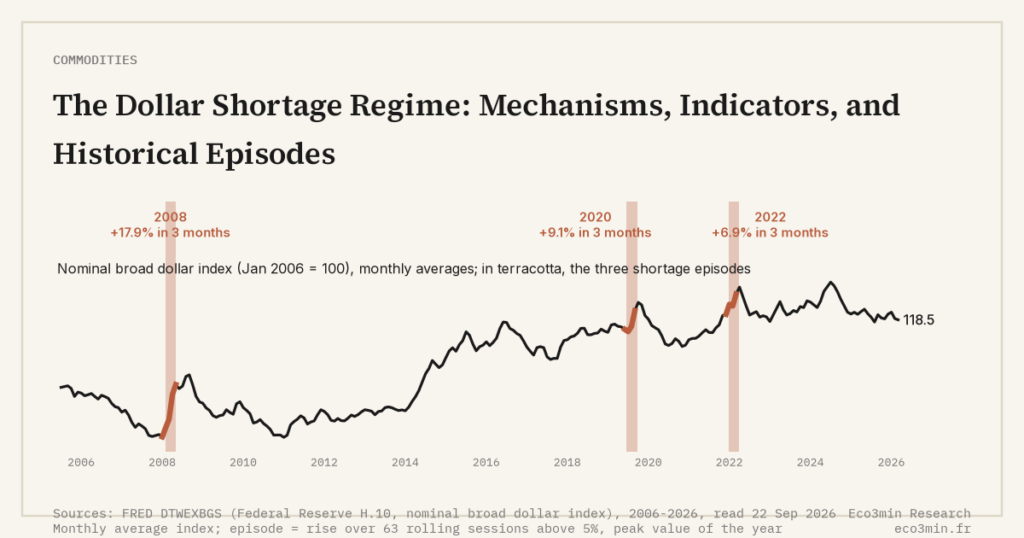
The regime is characterized by a brutal and non-linear appreciation of the broad dollar, a simultaneous widening of offshore credit spreads, a contraction of flows to emerging markets, and — in acute episodes — Fed intervention through its swap lines. It can last from a few weeks (March 2020: resolved in six weeks) to several months (GFC 2008: September to December 2008).
Position in the Eco3min classification
A global-context layer regime — not positionable on the G × I grid. The G (growth) × I (inflation) grid classifies U.S. domestic regimes. The dollar shortage is a qualifier of the global financial conditions layer. It overlays any U.S. cyclical state: a dollar shortage episode can occur in an inflationary regime (2022), in a disinflationary contraction (2008, 2020), or in expansion (1998 post-LTCM).
On the Eco3min dashboard, it appears as a “restrictive stress → acute stress” overlay activated by three simultaneous signals: broad dollar DTWEXBGS > +5% on a rolling 3-month basis, NFCI in tightening territory, and EM spreads widening by more than 100 bps.
What this regime is not
Not simply a strong dollar. Cyclical appreciation in risk-on does not create a funding shortage.
Not a U.S. solvency crisis. It is a liquidity crisis in offshore dollars — a structural feature of the international monetary system, where 60% of global FX reserves and more than 50% of international debt contracts are denominated in dollars (BIS, September 2023).
Not a necessary signal of imminent U.S. recession. H2 2022: partial dollar shortage without U.S. recession. It is a phenomenon distinct from fiscal dominance, which is a matter of budget policy.
How a dollar shortage is triggered and propagated
The dollar shortage rests on a unique structure of the international financial system: the dollar’s dominant position as a funding currency confers on the system a dependency on offshore dollar credit that no other currency would sustain. Five stages structure the episode:
Trigger — risk-aversion shock or sharp U.S. monetary tightening
A market shock (bank failure, major geopolitical crisis) or accelerated Fed funds tightening causes a simultaneous retreat of offshore dollar credit. Non-U.S. banks, whose dollar liabilities depend heavily on wholesale markets (FX swap deposits, cross-border repos), see their access to dollar funding contract.
Propagation via the eurodollar market and FX swaps
The eurodollar market — deposits and loans in dollars outside the United States — represented about USD 13 trillion of offshore bank liabilities at end-2023 (BIS, locational banking statistics). The most visible stress point is the dollar basis swap: the gap between the cost of dollar liquidity at spot and on a forward basis. In March 2020, the 3-month EUR/USD basis swap reached −150 basis points, signaling extreme dollar scarcity for European borrowers.
Non-linear appreciation of the broad dollar
The scarcity of funding fuels forced dollar demand (unwinding of short positions, dollar-debt repayment, margin calls). The DTWEXBGS index (Fed broad dollar) rose +7.6% in three weeks between March 9 and March 20, 2020. The pace of appreciation — more than its absolute level — is the signature signal of a dollar shortage.
Transmission to emerging markets via sudden stop
Emerging economies with current-account deficits or with dollar-denominated sovereign or corporate debt face a double shock: a more expensive dollar raises debt-service costs in local currency, while capital flows reverse (sudden stop). EM currencies depreciate, EMBI spreads widen. In March 2020, the JPMorgan EMBI Global Diversified saw its spreads rise by 290 bps in two weeks (Bloomberg data).
Circuit-breaker — Fed swap lines
The Fed maintains permanent currency swap agreements with five central banks (ECB, BoJ, BoE, SNB, Bank of Canada) and can activate temporary lines. In March–May 2020, total drawings reached USD 448 billion (Fed H.4.1, week of May 27, 2020). These lines allow foreign central banks to provide dollar funding to banks in their jurisdiction, breaking the feedback loop. Their activation is the strongest signal of an acute dollar shortage phase.
How dollar stress propagates to the real economy and markets
Five channels carry the dollar shortage into foreign economies and markets:
Cross-border bank credit channel
Non-U.S. banks hold dollar liabilities (deposits, CDs, commercial paper) to finance dollar assets (loans to multinationals, bonds, trade credit). When dollar refinancing dries up, they shrink their dollar balance sheets first — raising the cost of credit for non-U.S. borrowers. The direct measure is cross-border dollar bank credit (BIS, locational statistics, series Q-N-A-USD).
Commodities channel
Commodities are quasi-universally invoiced in dollars. A dollar shortage compresses the purchasing power of importers who must convert local currency into more expensive dollars. It simultaneously reduces commodity traders’ access to funding (documentary credit lines). In March 2020, WTI lost 55% between March 6 and March 18 (FRED data: DCOILWTICO), a combination of a dollar shock and a demand shock.
Emerging markets channel — debt and currency
Emerging countries with dollar-denominated sovereign or corporate debt face a mechanical deterioration in their debt-to-GDP ratio in local currency when the dollar appreciates. This channel is asymmetric: countries with large FX reserves or Fed swap lines have absorption capacity that others do not. In 2020, South Korea (Fed swap line: USD 60 billion) absorbed the shock far better than Turkey (no swap line).
Global financial conditions channel
The Chicago Fed’s NFCI synthesizes U.S. financial conditions: money markets, bond markets, equities, leverage. A dollar shortage widens credit spreads and reduces bond-market liquidity, transmitting stress to the financial-conditions indices of all major economies. The correlation between NFCI and euro-area financial conditions (ECB CISS) is particularly elevated during dollar stress phases.
FX swap channel — pressure on the basis
Non-U.S. firms that need forward dollars obtain them via FX swaps: they sell euros (or yen) spot against dollars, committing to repurchase euros forward. In stress periods, the premium paid to obtain forward dollars (cross-currency basis) becomes very negative — meaning the forward dollar costs far more than covered interest-rate parity would predict. This basis dislocation is a precise thermometer of dollar-shortage intensity. Adjacent reading: Gold’s real performance seen from outside the United States.
The instruments for measuring a dollar shortage
Three primary signals define the dollar-shortage overlay, complemented by crossover indicators of contagion.
Broad dollar — DTWEXBGS
Trade-weighted dollar index, broad version (26 partners). Dollar shortage signal: variation greater than +5% on a rolling 3-month basis. Available since January 2006. Weekly frequency (Wednesday).
National Financial Conditions Index — NFCI
Composite of 105 series of U.S. financial conditions (Chicago Fed). Positive value = conditions tighter than the historical norm. Stress overlay active if NFCI > +0.30. Available since January 1973. Weekly frequency.
US HY OAS — BAMLH0A0HYM2
US High Yield option-adjusted spread (ICE BofA). Domestic credit stress indicator that reflects global spillover. Signal: widening greater than 150 bps in under 4 weeks. Available since December 1996. Daily frequency.
CISS — Composite Indicator of Systemic Stress (ECB)
Euro-area systemic stress indicator built from 15 market series (ECB). Reflects the international contagion of dollar stress into Europe. Available since January 1999. Source: ECB Statistical Data Warehouse, series CISS.
Fed swap lines — weekly drawings
Weekly outstandings of Fed swap lines with foreign central banks. Available in the Federal Reserve H.4.1 release (Factors Affecting Reserve Balances). A significant drawing (greater than USD 50 billion) is the most direct signal of an acute dollar-shortage phase. Available since 2007. Weekly frequency (Thursday).
What looks like a dollar shortage without being one
- Strong dollar in a risk-on environment. A dollar appreciation accompanied by rising risk assets and stable credit spreads does not signal a dollar shortage. The dollar can rise for interest-rate-differential reasons (2021–2022 pre-stress) without offshore liquidity being constrained.
- Elevated VIX without widening EM and HY spreads. Equity volatility can rise without dollar funding stress. A VIX at 30 without BAMLH0A0HYM2 widening or pressure on EM currencies is a risk signal, not a dollar shortage.
- Isolated depreciation of an emerging-market currency. An EM currency weakness can result from a domestic political shock, a current-account imbalance or local inflation — without a global dollar shortage. The signal is systemic: several EM currencies depreciate simultaneously.
- Year-end seasonal dollar tension. End-of-quarter regulatory requirements (balance-sheet), especially in December, create technical tensions on dollar funding that are not structural dollar-shortage episodes.
Observed behavior of major asset classes during dollar-shortage episodes
AMF note — read before the table
The observations below describe the recorded behavior of asset categories during dollar-shortage episodes identified since 2006 (the formal DTWEXBGS window). They are a statistical description, not a forecast or a recommendation. Past performance is not indicative of future results. This content is produced for information and analysis purposes; it does not constitute investment advice within the meaning of the MiFID II directive or French AMF regulation.
| Asset category | Historical observation | Source · Reference episode |
|---|---|---|
| Short-dated US Treasuries UST 2Y | During the two formal acute dollar-shortage episodes (March 2020, fall 2008), 2Y yields posted a sharp contraction. The DGS2 yield went from 1.25% to 0.25% between March 9 and 27, 2020 (a 100 bps decline in 18 days), reflecting a flight-to-quality movement combined with expectations of Fed easing. | FRED · DGS2 · daily · 2008 and 2020 |
| EM dollar-denominated sovereigns EMBI Global Diversified | In March 2020, the JPMorgan EMBI Global Diversified Spread rose by about 290 bps in two weeks (from ~310 bps in early March to ~600 bps on March 23, 2020), before a partial rebound after swap-line activation. In October 2008, EMBI spreads had reached ~900 bps. These observations reflect the structural vulnerability of dollar-denominated EM funding. | JPMorgan EMBI Global Diversified · Bloomberg · 2008 and 2020 |
| US dollar DTWEXBGS broad | The broad dollar index (DTWEXBGS) rose by +7.6% between March 9 and March 20, 2020. In H2 2022, the progression was +12% over 9 months (from 116 to 130 between January and September 2022, weekly Fed data). These appreciations occurred in very different macroeconomic contexts (acute contraction in 2020, monetary tightening in 2022). | FRED · DTWEXBGS · weekly frequency |
| Gold LBMA Gold Price (XAU/USD) | Mixed behavior. In March 2020, gold initially fell about 12% (from ~1,700 $/oz to ~1,490 $/oz between March 9 and 16), under the impact of forced sales to cover margin calls, before rebounding sharply after swap-line activation. During the 2008 GFC, gold also experienced an initial correction before a rebound. The gold / dollar-shortage correlation is not stable in the short term. | London Bullion Market Association (LBMA) · Eco3min non-FRED pipeline |
| Commodities WTI crude | In March 2020, WTI lost 55% between March 6 and 18 (from 41 $/b to 20 $/b), a combination of a dollar-shortage shock and a COVID demand shock. In H2 2022, the partial dollar shortage coexisted with elevated oil prices (a dominant supply shock, geopolitical). The dollar’s effect on commodities is isolable only in the absence of a simultaneous supply shock. | FRED · DCOILWTICO · daily · 2020 and 2022 |
Sources: FRED (DGS2, DTWEXBGS, DCOILWTICO), JPMorgan EMBI Global Diversified via Bloomberg, London Bullion Market Association (LBMA). All performances cited are factual and dated — they describe identified past episodes, not extrapolable trends. This data does not constitute an investment recommendation.
The most frequent interpretive pitfalls in analyzing a dollar shortage
- Confusing strong dollar with dollar shortage. The dollar can appreciate for years in the complete absence of a dollar shortage (2014–2015: +25% on the DXY, stable global financial conditions, contained EM spreads). The dollar shortage is distinguished by the speed of appreciation, the simultaneous widening of offshore funding spreads, and pressure on multiple EM currencies simultaneously.
- Underestimating the heterogeneity of EM exposure. Emerging markets do not react uniformly to a dollar shortage. Countries with large FX reserves, Fed swap lines or a current-account surplus absorb the shock differently. In 2020, South Korea (reserves: USD 408 billion, Fed swap line: USD 60 billion) and Turkey (negative net reserves, no swap line) experienced very different trajectories.
- Believing that activating swap lines resolves a dollar shortage instantly. Swap lines reduce pressure but their effect goes through operational delays: foreign central banks must auction the liquidity to their commercial banks. Between line activation (March 19, 2020) and the normalization of dollar funding spreads, three to four weeks elapsed.
- Reading a dollar shortage as a signal of U.S. economic strength. Offshore dollar scarcity does not imply that the U.S. economy is expanding or in a favorable phase. In March 2020, the most intense dollar shortage since 2008 coincided with the most brutal U.S. recession since the Great Depression. It is a financial-mechanics phenomenon, not a domestic macroeconomic signal.
- Ignoring the cross-currency basis as an early signal. The EUR/USD and JPY/USD basis swap typically deteriorates before the DTWEXBGS shows visible appreciation. In March 2020, the 3-month EUR/USD basis had reached −150 bps by March 11–12, while the broad dollar index continued to accelerate until March 20. Excluding this indicator from monitoring means observing the dollar shortage with a multi-day lag.
Episodes documented by the Eco3min classification
Classification windows — reminder
Full formal resolution (since 2006): DTWEXBGS available, NFCI since 1973, BAMLH0A0HYM2 since 1996. All inputs of the dollar-shortage overlay are available.
Degraded extension (1996–2005): DTWEXBGS absent. Classification possible with the DXY (ICE) as a proxy and BAMLH0A0HYM2 available since 1996, but less precise.
Conceptual references (before 1996 or outside the offshore-dollar core): without BAMLH0A0HYM2, without a direct measure of eurodollar funding. Analytical classification only, based on contemporary proxies. Inside the window where every input exists, the exercise stops being analytical and becomes our regime lookup for a specific date. These episodes do not validate the method — they illustrate the mechanism in a different context. Related reading: our reference page on the physical markets for oil, gas, copper and critical minerals.
| Period | Episode | Description and key indicators |
|---|---|---|
| March–May 2020 | COVID dollar shortage Formal | The most documented episode since 2006. DTWEXBGS: +7.6% in 11 days (March 9–20). 3M EUR/USD basis: −150 bps (March 12). Fed swap-line drawings: USD 448 billion at peak (May 27, Fed H.4.1). Resolution in six weeks after line activation and PDCF, CPFF interventions. Short duration but record intensity. |
| Sept.–Dec. 2008 | GFC — Global dollar shortage Formal | Lehman Brothers bankruptcy (September 15, 2008) trigger. 3M USD LIBOR-OIS spread: +364 bps at peak (October 10, 2008, BBA). Fed swap-line drawings: USD 582 billion (week of December 10, 2008, Fed H.4.1). BAMLH0A0HYM2: ~1,100 bps in December 2008. Prolonged episode (4 months) of extreme intensity. |
| Jan.–Sept. 2022 | Dollar shock post-Fed tightening Formal* | DTWEXBGS: +12% between January and September 2022 (116 → 130). BAMLH0A0HYM2: peak at ~600 bps in July 2022. Pressure on several EM currencies (Indian rupee, Turkish lira, Argentine peso). The episode is partially contested: dollar appreciation was driven mainly by the rate differential, with offshore funding stress less acute than in 2008 or 2020. No swap-line activation. Classified “formal” with reservation on intensity. |
| 1997–1998 | Asian crisis + LTCM Degraded | Classic EM dollar shortage. Russia default (August 1998) and LTCM collapse (September 1998) triggered the acute phase. DXY appreciated. EM spreads widened massively. DTWEXBGS absent (series available only since 2006). Classification based on the ICE DXY and the behavior of contemporary EM spreads (Bloomberg). A precursor episode of the contemporary model. |
| 1979–1982 | Volcker shock — extreme dollar Conceptual | Fed funds rate at 20% in June 1981 (Fed H.15). Trade-weighted DXY (Fed nominal broad, TWEXMMTH) roughly doubled between 1979 and 1985. Trigger of the Latin American debt crisis. The dollar-shortage mechanism applies analytically but the measurement instruments (eurodollar, basis swap) do not exist in their current form. A conceptual reference: illustrates the transmission mechanism to emerging economies carrying dollar-denominated debt. |
Data series used for this regime
Going deeper into the dollar-shortage mechanisms
The dashboard below displays the current positioning in the Eco3min classification, including the dollar-shortage overlay when the three signals are active (DTWEXBGS, NFCI, credit spreads). The data are updated automatically via the GitHub Actions pipeline.
Last updated — 22 September 2026
Disclaimer – Financial Information: The analyses, commentary, and content published on eco3min.fr are provided for informational and educational purposes only. They do not constitute investment advice or a solicitation to buy or sell financial instruments. Past performance is not indicative of future results. All investment decisions involve risk and are the sole responsibility of the reader.