
Fed vs ECB: two mandates compared
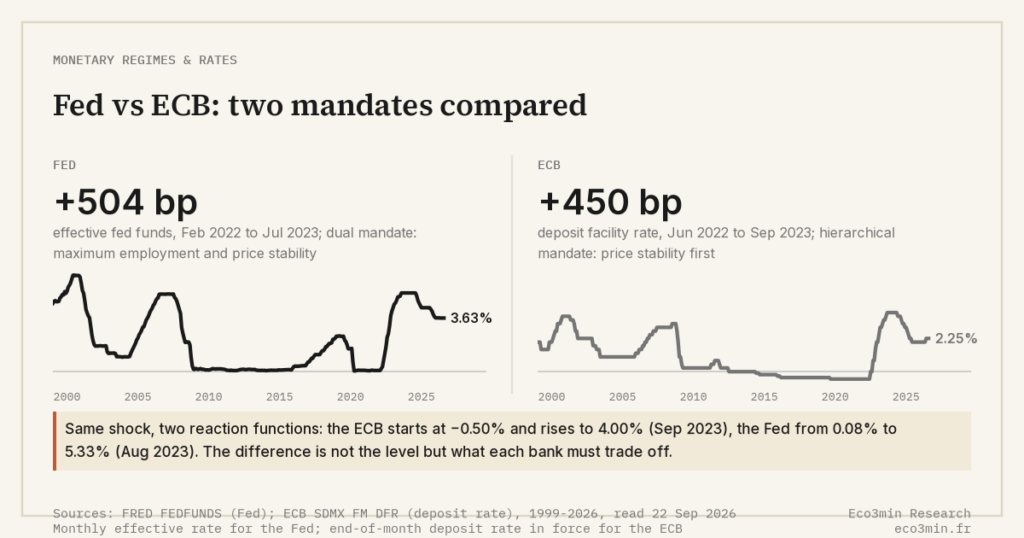
The Federal Reserve operates under a dual mandate — maximum employment and stable prices — set by the US Congress. The European Central Bank operates under a single, hierarchical mandate that gives price stability overriding priority, set by Article 127 of the EU Treaty. The decisive difference is not the level of rates but the reaction function: facing the same energy shock in 2026, the ECB hiked while the FOMC split 8-4, because it must weigh inflation against employment.
In this comparison
Why this comparison matters
The Fed and the ECB are routinely described as if they did the same job on opposite sides of the Atlantic. They do not. Their objectives are written into different legal texts, ranked differently, and translated into policy through different reaction functions. That distinction stays invisible when the two banks move in lockstep, as they did after 2008 and during the pandemic, and becomes decisive the moment a shock pushes inflation and employment in opposite directions — which is precisely what happened in 2026. Directly related: our calendar of European Central Bank meetings.
What the Fed is
The Federal Reserve is the central bank of the United States, governed by the Federal Reserve Act. Congress assigns it a dual mandate: maximum employment and stable prices, with the relative weight between the two left to the Committee’s discretion (BIS, comparative central banking review). It steers the federal funds target range, which the FOMC held at 3.50%–3.75% on 29 April 2026 by an 8-4 vote, with several members dissenting in both directions (Federal Reserve, FOMC statement, April 2026). Its 2% longer-run inflation goal was reaffirmed effective January 2026.
→ Full explanation: What is the Fed’s dual mandate and how is it balanced?
What the ECB is
The European Central Bank conducts monetary policy for the 21 countries of the euro area. Article 127 of the Treaty on the Functioning of the European Union assigns it a primary objective of price stability; only “without prejudice” to that objective may it support the Union’s general economic policies (Banque de France; Bundesbank). This is a hierarchical mandate, not a dual one: employment is a subordinate, secondary objective. Since July 2021 the ECB has defined price stability as a symmetric 2% inflation target over the medium term, measured by the Harmonised Index of Consumer Prices, and steers the deposit facility rate, raised to 2.25% on 11 June 2026 (ECB).
→ Related explanation: Why is the euro-dollar rate watched globally?
The key differences
Mandate structure. The Fed’s two objectives are pursued simultaneously, with no legal ranking; the FOMC chooses how much weight to give jobs versus prices at any moment. The ECB’s mandate is hierarchical: price stability comes first, and the secondary objective may be pursued only where it does not conflict with it (Banque de France, monetary strategy review). This is the structural source of every behavioural difference that follows.
Reaction function under a supply shock. Here the angle becomes concrete. In spring 2026, an energy shock tied to the Hormuz disruption pushed euro-area HICP to 3.2% in May (Eurostat) and US CPI to 3.8% year-on-year in April (BLS). The ECB, bound to price stability, raised rates — its first hike since 2023. The Fed, weighing the same inflation against a 4.3% unemployment rate, held and divided internally. Same shock, opposite moves, because the mandates rank the trade-off differently. How the Fed has resolved that trade-off across seventy years of decisions is what a quantitative audit of the Fed’s track record puts to the test.
Timing and the lead-lag pattern. Historically the ECB has tended to follow the Fed with a lag, and the two policy rates have been highly correlated since 2007 (FRED series FEDFUNDS and ECBDFR). That pattern broke after June 2024, when the ECB cut eight times into mid-2025 while the Fed moved more cautiously, leaving the deposit rate at 2.00% against a US range that had fallen to 3.50%–3.75% by April 2026.
How they behave across regimes
Across the 2021–2026 inflation cycle, the divergence tracks the mandate. In the 2022 tightening, both banks raised aggressively, but euro-area inflation peaked higher and later — HICP at 10.6% in October 2022 versus US CPI at 9.1% in June 2022 (ECB, Eurostat, BLS) — because energy supplied over half the euro-area peak. In the 2024–2025 disinflation, the ECB eased first and faster as euro-area growth weakened, an outcome a single price-stability mandate accommodates more readily once inflation is falling. In the 2026 energy re-acceleration, the banks split outright: the pivot parameter is whether a shock raises inflation and unemployment together, forcing the dual-mandate central bank into a trade-off the single-mandate one does not face.
Two banks, one 2% target, but only one is allowed to look away from prices.
→ Interpretive framework: Monetary regimes, interest rates & liquidity
The common confusion
The frequent error is to read the two banks’ rate levels as a measure of how hawkish each one is. In June 2026 the Fed’s range sat above the ECB’s deposit rate, which is sometimes taken to mean the Fed was “tighter.” The levels reflect different starting points, different inflation paths, and different growth conditions, not a difference in resolve. A cleaner reading compares each bank against its own target and its own mandate: the ECB hiking from 2.00% and the Fed holding at 3.50%–3.75% can both be consistent with a 2% goal pursued under different legal constraints.
Practical observation
What the data suggests for framing your own analysis:
- Question to ask yourself: when the Fed and the ECB diverge, is the shock symmetric across the two economies, or is it hitting inflation and employment in opposite directions in one of them?
- Data to monitor: the spread between the federal funds effective rate and the ECB deposit facility rate (FRED series FEDFUNDS and ECBDFR), read alongside the inflation gap between US CPI and euro-area HICP.
- Historical parallel: the 2022 episode, when HICP peaked at 10.6% in October against US CPI at 9.1% in June, with energy driving over half the euro-area gap.
- What the literature documents: Benjamin Friedman’s case for the dual mandate, and the Treaty hierarchy analysed by the Banque de France, frame the trade-off each bank is legally allowed to make.
This is descriptive information to help you frame your own analysis. Eco3min does not provide investment advice.
Go deeper
📊 Central banks: Central banks, monetary policy & rate cycles
📁 Datasets: Federal Funds Rate History · Euro Area HICP Inflation
Related guides
Frequently asked questions
How is the Fed’s mandate different from the ECB’s?
The Fed has a dual mandate: maximum employment and stable prices, pursued at the same time, with the relative weight set by the Committee. The ECB has a hierarchical mandate under Article 127 of the EU Treaty: price stability comes first, and supporting employment or growth is permitted only where it does not conflict with that primary objective. Both target 2% inflation over the medium term — the ECB symmetrically since July 2021 — but the legal ranking of objectives differs, which is why the two banks can read the same data and reach different decisions.
Why did the ECB and the Fed diverge in 2026?
In spring 2026 an energy shock raised inflation in both economies, but the policy response split. The ECB, bound to price stability, raised the deposit rate to 2.25% on 11 June 2026 — its first hike since 2023 (ECB). The Fed held its range at 3.50%–3.75% on 29 April, by an 8-4 vote, because it was weighing the same inflation against a 4.3% unemployment rate (Federal Reserve). The divergence is mechanical: a supply shock that lifts inflation while threatening jobs forces a dual-mandate central bank into a trade-off that a single-mandate one is not required to make. That 8-4 split is one line among 316 in the register of every FOMC rate decision since 1990, where every dissenter is named.
Do the Fed and the ECB use the same inflation target?
Both aim for 2% inflation over the medium term, but they measure and frame it differently. The ECB references the Harmonised Index of Consumer Prices and adopted an explicitly symmetric 2% target in its July 2021 strategy review, treating overshoots and undershoots as equally undesirable. The Fed references PCE inflation and reaffirmed its 2% longer-run goal effective January 2026. The HICP also excludes owner-occupied housing, which US CPI includes, so identical headline numbers do not describe identical price baskets. The broader collection of comparisons is where the rest of these pages are kept.
Last updated — 22 September 2026
Disclaimer – Financial Information: The analyses, commentary, and content published on eco3min.fr are provided for informational and educational purposes only. They do not constitute investment advice or a solicitation to buy or sell financial instruments. Past performance is not indicative of future results. All investment decisions involve risk and are the sole responsibility of the reader.
Read next
Full pillar →Proof-of-work vs proof-of-stake: the economics
Proof-of-work secures a blockchain by burning external energy; proof-of-stake secures it by locking internal capital. The real difference…
Bitcoin vs Ethereum: two different macro assets
Bitcoin is a fixed-supply asset whose issuance falls on a pre-set, immutable schedule; Ethereum is a productive network…
Bitcoin ETF vs self-custody: structure compared
A spot Bitcoin ETF and self-custody give exposure to the same underlying asset, so they do not differ…