
Compare: markets, assets & macro side by side
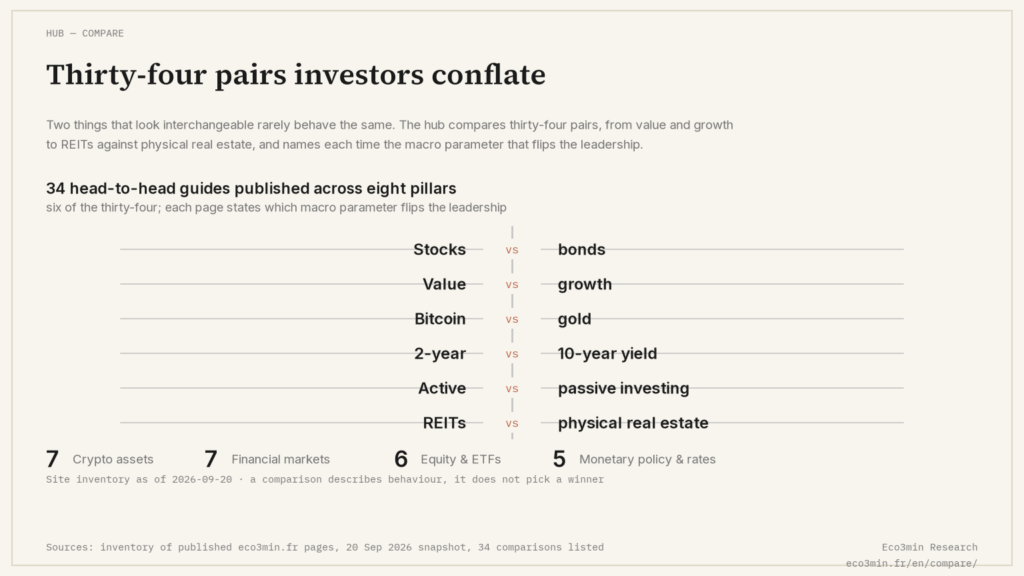
Two things that look interchangeable rarely behave the same. These guides compare the pairs investors most often conflate — and show, with dated data, how each side performs across inflation, rate and liquidity regimes. A comparison here is a description of behavior, not a verdict.
Most “X versus Y” questions are really regime questions: the answer that holds in a disinflationary, low-rate world inverts when real rates climb. Each guide below states what each side is, where the real difference lies, and which macro parameter flips the leadership — then links to the detailed Q&A for both sides so you can build your own view rather than borrow a conclusion.
Prefer direct answers, or the common errors?
Stocks, factors & equity styles
How equity styles and shareholder-return mechanics diverge once you look past the headline.
- Value vs growth — how leadership trades hands as real rates move
- Momentum vs quality — two factors that fail in opposite conditions
- Buybacks vs dividends — the same cash, two different signals
- Active vs passive investing — what the evidence actually documents
- US vs international equities — a statistical valuation comparison
Asset classes head to head
Long-run returns, drawdowns and the regimes where each cushions or fails.
- Stocks vs bonds — real returns and drawdowns over 125 years
- Bitcoin vs gold — two “stores of value”, very different behavior
- Dollar vs gold — the reserve-asset tension
- REITs vs physical real estate — liquidity versus control
Rates, the curve & bonds
Why short and long rates move apart, and the second-order risks bonds carry.
- Policy rates vs long-term rates — why the Fed doesn’t set the 10-year
- 2-year vs 10-year yield — reading the curve and its signal
- TIPS vs nominal Treasuries — what breakevens reveal
- Duration vs convexity — two layers of rate sensitivity
Inflation & wages
The distinctions behind the headlines people most often get wrong.
- Inflation vs rising prices — why they are not the same thing
- Nominal vs real wages — why a raise can still leave you poorer
Monetary policy & the cycle
Different tools, different mandates, and the line that decides crises.
- Fed vs ECB — two mandates compared
- QE vs rate cuts — two different easing tools
- Soft landing vs hard landing — the historical record
- LEI vs PMI — comparing leading indicators
- Solvency vs liquidity — the distinction that decides crises
Dollar & the global system
Who wins and loses from the dollar’s level, and the slow reshuffle of reserves.
- Strong dollar vs weak dollar — who wins, who loses
- Dollarization vs de-dollarization — the slow reshuffle
- Developed vs emerging markets — the risk-return profile
Crypto
Where the assets, the rails and the custody choices actually differ.
- Bitcoin vs Ethereum — two different macro assets
- Bitcoin vs Nasdaq — a correlation that keeps tightening
- Bitcoin ETF vs self-custody — structure compared
- Proof-of-work vs proof-of-stake — the economics of each model
- Stablecoins vs CBDCs — private versus public digital money
- DeFi vs traditional finance — two sets of rails
Real estate, portfolios & vehicles
The practical trade-offs behind common decisions, described through the data.
- Buying vs renting — what price-to-rent and affordability data show
- Fixed vs adjustable mortgages — the rate-cycle trade-off
- 60/40 vs all-weather — how the portfolios behave
- Dollar cost averaging vs lump sum — what history shows
- Physical vs synthetic ETFs — replication compared
Last updated — 22 September 2026
Disclaimer – Financial Information: The analyses, commentary, and content published on eco3min.fr are provided for informational and educational purposes only. They do not constitute investment advice or a solicitation to buy or sell financial instruments. Past performance is not indicative of future results. All investment decisions involve risk and are the sole responsibility of the reader.
Read next
Bitcoin ETF vs self-custody: structure compared
A spot Bitcoin ETF and self-custody give exposure to the same underlying asset, so they do not differ…
Bitcoin vs Ethereum: two different macro assets
Bitcoin is a fixed-supply asset whose issuance falls on a pre-set, immutable schedule; Ethereum is a productive network…
Bitcoin vs gold: store of value compared
Bitcoin and gold are both framed as scarce "hard money," but they have not behaved the same way.…