
Bitcoin ETF vs self-custody: structure compared
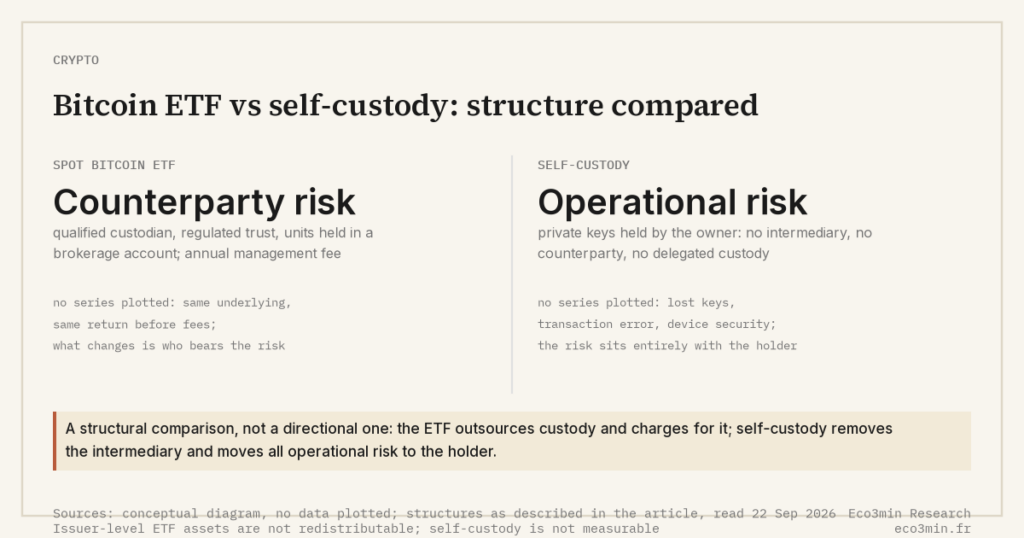
A spot Bitcoin ETF and self-custody give exposure to the same underlying asset, so they do not differ on return. They differ on who carries the risk: an ETF outsources custody to a qualified custodian and wraps Bitcoin in a regulated trust, while self-custody removes counterparty and intermediary risk but transfers every operational risk to the holder. The real comparison is structural, not directional.
In this comparison
Why this comparison matters
Since spot Bitcoin ETFs began trading in the United States in January 2024, the question of how to hold Bitcoin has split into two routes that look interchangeable and are not. One wraps Bitcoin inside a regulated fund; the other holds the asset directly on the blockchain. The confusion is to treat the choice as a return question. It is not: both track the same price. The distinction lives entirely in the plumbing (custody, counterparty exposure, accessibility and operational burden) and that plumbing decides what can actually go wrong. For the broader picture: how custody choices shape a bitcoin position.
What a Bitcoin ETF is
A spot Bitcoin ETF is a regulated grantor trust that holds physical Bitcoin and issues shares representing a fractional claim on it. The SEC approved the first US spot Bitcoin ETFs on 10 January 2024, with trading from 11 January. Each share tracks the Bitcoin price net of a sponsor fee, and the underlying coins are held by a qualified custodian rather than the investor. By March 2026, combined assets across the listed funds stood near 91 billion dollars. Companion analysis: comparisons on adjacent questions.
→ The complete explanation: How did spot Bitcoin ETFs change market microstructure?
What self-custody is
Self-custody means holding Bitcoin directly through a wallet whose private keys the holder controls, with no intermediary between owner and asset. There is no custodian, no fund wrapper and no counterparty: the keys are the ownership. That control is also the entire vulnerability: Chainalysis estimates that roughly 3.7 million BTC, a sizeable share of the supply issued so far, are permanently lost to forgotten or destroyed keys. The asset itself behaves the same way regardless of how it is held.
→ Full account: Bitcoin as a monetary asset: liquidity cycles and real rates
The key differences
Custody structure. An ETF does not eliminate custody risk; it relocates it. The investor no longer risks losing a private key, but the fund’s Bitcoin sits with a qualified custodian, and as of early 2026, Coinbase Custody held the coins for eight to nine of the eleven to twelve listed funds, a notable concentration. Self-custody removes that concentration entirely but places the full operational burden on one person.
Counterparty and cost. Here lies the real axis. The ETF wrapper adds layers (sponsor, custodian, exchange, broker) each a potential point of failure, and a recurring sponsor fee ranging across funds from 0.15% to 1.50% annually. Self-custody carries no ongoing fee and no counterparty, but no recovery mechanism either: a lost seed phrase is final. ETF shares, by contrast, are legally segregated from the issuer’s balance sheet and sit inside brokerage and retirement accounts. Sitting in those accounts is what turns a spot ETF into a channel of institutional integration, one of the forces reshaping how crypto assets sit within monetary regimes.
Access and control. The ETF trades only during market hours and cannot be moved on-chain or spent; it is exposure, not possession. Self-custody is available continuously, transferable globally and usable on the network, at the cost of the holder bearing security, backup and inheritance entirely alone.
Rights and the trading clock. The wrapper changes more than custody. An ETF shareholder has no say if the network splits in a fork, and the tax treatment of the shares differs from that of coins held directly. The fund also runs on a session clock that the underlying asset does not keep. Its net asset value is struck once a day and its flows concentrate in US trading hours. That concentration has reshaped Bitcoin’s own rhythm, with sharper moves around the US opening bell and quieter weekend trading. Wrapping the asset does not appear to have flattened its volatility, which stayed substantial through both the rallies and the drawdowns that followed the launch.
How they behave across regimes
Because both hold the same asset, price behaves identically across regimes; what diverges is which risk dominates. In calm, liquidity-abundant conditions the ETF’s frictions look trivial and its convenience dominates. In an acute risk-off or counterparty-stress episode (the kind that exposed exchange fragility in 2022) the ETF’s reliance on a concentrated custodian and a multi-layer intermediary chain becomes the binding constraint, while self-custody’s appeal is precisely the absence of that chain. The switching parameter is not the macro cycle but the source of the risk you are most exposed to: intermediary failure versus individual operational failure. Related coverage: how index, cost and liquidity shape an ETF.
The ETF route also carries a dependency that self-custody does not: the flow mechanics of the wrapper. Subscriptions and redemptions are handled in blocks by a handful of specialised desks that arbitrage in real time across spot, futures and derivatives markets. The price the fund transmits therefore reflects balance-sheet optimisation, fund regulatory constraints and allocation rotations more than the direct appetite of crypto-native buyers. Those flows cut both ways. November 2025 brought heavy net outflows. A change in accounting or prudential treatment can force mechanical selling through the issuer–custodian–regulator chain. The growing use of ETF shares as collateral with banks or in corporate cash management adds a quieter channel, one that can feed forced-selling loops in a sharp correction.
Unlike a return question, this one never resolves to a better asset, only to a different risk you agree to carry.
→ Framework: Crypto assets: liquidity, cycles and real rates
The common confusion
The frequent error is to read the ETF as a strictly safer version of the same thing. It is safer against one failure mode (the lost key) and more exposed to another: intermediary and custodian concentration. The maxim “not your keys, not your coins” captures one side; the symmetric truth is that keys you cannot reliably secure are also coins you can lose. Neither route is universally safer; each trades one well-defined risk for another, which is why framing it as a ranking misreads the structure.
Practical observation
What the data suggests for framing your own analysis:
- Question to ask yourself: which failure mode am I better equipped to absorb (an intermediary or custodian failing, or my own key-management failing)?
- Data to monitor: custodian concentration across listed funds, sponsor-fee dispersion (0.15%–1.50%), and the share of supply estimated as lost.
- Historical parallel: the 2022 exchange failures, when intermediary risk crystallised even as the underlying network kept settling.
- What the literature documents: Chainalysis on irrecoverable supply; SEC filings on trust segregation and custody arrangements.
This is descriptive information to help you frame your own analysis. Eco3min does not provide investment advice.
Go deeper
📊 Related question: Why has Bitcoin behaved as a liquidity play rather than digital gold?
Related guides
Frequently asked questions
How is a Bitcoin ETF different from holding Bitcoin directly?
Both give exposure to the same asset and the same price, so they do not differ on return. The difference is structural. An ETF is a regulated trust holding Bitcoin through a qualified custodian, with shares that trade in brokerage accounts during market hours and carry a sponsor fee. Direct holding, or self-custody, means controlling the private keys yourself, with no fund, no custodian and no fee, but no recovery if those keys are lost. One outsources custody; the other internalises it.
Does a Bitcoin ETF actually remove custody risk?
No: it relocates it rather than removing it. The investor stops bearing the risk of losing a private key, but the fund’s Bitcoin sits with a qualified custodian, and as of early 2026 a single custodian held the coins for most listed US funds, creating concentration risk. ETF shares are legally segregated from the issuer’s balance sheet, which limits issuer-bankruptcy exposure, but the custodian and the broader intermediary chain remain genuine points of failure that self-custody does not have.
Why can self-custody be both safer and riskier?
Self-custody removes counterparty and intermediary risk entirely: no exchange, custodian or fund can fail and take the asset with it. That is the safer side. The riskier side is that there is no safety net: Chainalysis estimates roughly 3.7 million BTC are permanently lost to mishandled keys. The holder absorbs every operational risk: security, backup, inheritance. Whether that trade is favourable depends on which failure mode the holder is better placed to manage.
Last updated — 20 October 2026
Disclaimer – Financial and Legal Information: The analyses, commentary, and content published on eco3min.fr are provided for informational and educational purposes only. They do not constitute investment advice or a solicitation to buy or sell financial instruments. Past performance is not indicative of future results. All investment decisions involve risk and are the sole responsibility of the reader. Data, charts and calculated series are provided as is and may contain errors or lag behind their source: check any figure against the primary source cited before relying on it. Content describing laws, regulations or contracts reflects the law as of its publication date and does not constitute legal or tax advice; applying it to a specific situation requires a qualified legal or tax professional.
Read next
Full pillar →Policy rates vs long-term rates: why they move differently
Policy rates are the overnight rate the Federal Reserve sets by decision; long-term rates are the yield the…
Active vs passive investing: what the evidence documents
Active management selects and weights securities to beat a benchmark; passive management replicates an index at minimal cost.…
Fixed vs adjustable mortgages: the rate-cycle tradeoff
A fixed-rate mortgage locks the borrowing cost for the life of the loan; an adjustable-rate mortgage (ARM) resets…