
The Costliest Investment Mistakes for Beginners
The costliest investment mistakes are not technical errors of timing or diversification — they are misreadings of the economic context. Sound rules applied in a regime where they no longer hold. This page maps the structural errors that compound the most over decades.
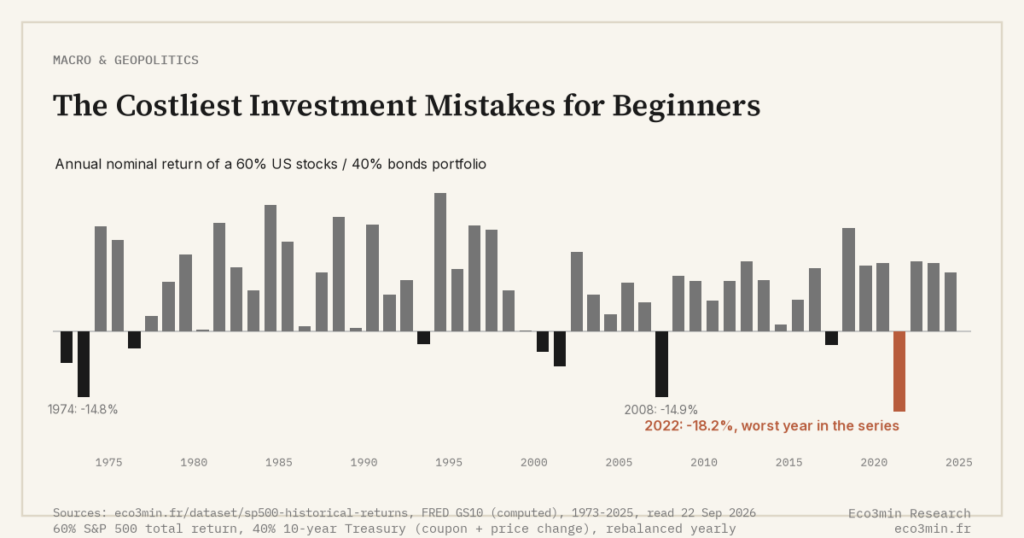
The costliest mistakes are not technical. They are not errors of “timing” or “diversification”. They are errors of context — sound rules applied in a regime where they no longer hold.
Standard guides always list the same mistakes: panicking when the market falls, trying to time the market, failing to diversify, investing without understanding. These warnings are useful. But they are superficial — they describe symptoms without tracing the cause.
The cause, in most cases, is a misreading of the economic context. The investor applies a rule that worked in the recent past — and discovers it no longer works once the regime shifts. This disconnect stems in part from the fact that financial markets and the real economy never move in lockstep. This page identifies the most frequent and most costly structural errors.
Mistake #1: confusing displayed return with real return
This is the most widespread and the most silent of the mistakes. It affects millions of savers without their knowledge. The dynamic is analyzed in inflation and savings: the real cost of inertia.
A euro-denominated insurance fund showing 2% in 2022 looks positive — the statement displays a gain. But with inflation at 5.2% (INSEE), purchasing power fell by 3.2%. On the €1.9 trillion of life insurance held by French households (France Assureurs, 2024), the collective loss of purchasing power in 2022 runs into tens of billions — invisible on each individual statement.
The same mechanism applies to real estate: a property bought for €300,000 and sold for €315,000 four years later shows a “gain” of 5%. But if cumulative inflation reaches 15%, the real gain is −10% — before notary fees, maintenance, and taxation.
The distinction between real and nominal returns is the first filter to apply to any financial decision. Until it is internalized, every comparison between investments is distorted.
Mistake #2: applying the rules of a regime that has changed
Between 2009 and 2021, an exceptional environment prevailed: rates near zero, low inflation, abundant liquidity. In that regime, almost everything worked. Equities rose. Real estate rose. Bonds rose. Credit was nearly free. The 60/40 split (60% equities, 40% bonds) delivered steady returns with contained volatility.
In 2022, the regime flipped. Inflation hit 5.2% in France and 9.1% in the United States. Central banks moved policy rates from 0% to 4-5%. The consequences were brutal for those still applying the previous regime’s rules:
The 60/40 portfolio lost 16% — its worst year since the 1970s. Equities fell 19% (S&P 500) and long-dated bonds fell 31% (ICE BofA). The correlation between the two, normally negative, turned positive. The diversification that “always worked” stopped working — because it had worked in a specific regime, not universally.
Real estate corrected by 5 to 15% depending on the area (Notaires de France, 2022-2024). “Property never falls” is a recency bias calibrated on the 1998-2021 cycle — the longest housing bull cycle in history, driven by the secular decline in rates from 6% to 1%. That cycle reversed once rates rose again.
Flows into tech/growth funds and crypto-assets peaked exactly at the top. Inflows into equity tech funds hit records in 2021 (ICI) — just as the Nasdaq was about to lose 33% in 2022. Bitcoin flows peaked at $69,000 in November 2021, before a fall to $16,000 (−77%, CoinGecko). Investors entered when enthusiasm was at its peak and exited when fear was at its peak — the exact opposite of any allocation logic. A related read: our overview of inflation regimes and their structural drivers.
The common thread across these three examples: rules that worked perfectly in one regime were extrapolated into a different regime. The error does not lie in the rule — it lies in the absence of conditionality. The sub-pillar Reading the cycle, adjusting exposure develops the method to identify regime shifts without making predictions.
Mistake #3: assuming “diversifying” is enough to protect
“Diversify” is the most repeated piece of advice in finance. It is well-founded — but it is incomplete, because it carries an implicit bet that is rarely spelled out.
Diversification rests on the assumption that assets do not all fall at the same time. In a regime of low inflation and stable rates, this is historically verified: when equities fall, bonds rise (negative correlation), and the portfolio is cushioned. But when inflation becomes the dominant problem, this correlation reverses — equities and bonds fall together, and “diversification” no longer cushions anything.
That is exactly what happened in 2022: the usual correlations broke. An investor who thought they were “protected” because they held bonds alongside equities suffered a double loss. “Diversify” is not advice — it is an implicit bet on a correlation regime. The sub-pillar Foundations of asset allocation deconstructs the implicit assumptions behind each diversification approach.
Mistake #4: underestimating the impact of fees and taxation
Fees are the only return parameter the investor controls entirely. And their impact is systematically underestimated, because it is invisible day to day and only reveals itself over decades.
An investor who picks a standard bank fund at 1.5% annual fees instead of an index ETF at 0.25% loses 1.25 percentage points of return every year. On €200/month over 25 years, that difference represents around €30,000 in lost capital — the equivalent of 12 years of monthly savings, erased not by the market but by fees. About 90% of active funds underperform their benchmark over 15 years in Europe (SPIVA, S&P Global) — primarily because of these fees.
Taxation works the same way, but at the back end. A PEA taxed at 17.2% retains significantly more than a CTO taxed at 30% — the difference runs into thousands of euros over a 20-year horizon. And taxation hits nominal gains, including the share that merely offsets inflation.
Mistake #5: letting emotions drive decisions
The average investor earns 1.5 percentage points less than the index every year (Dalbar QAIB, 2024). Not because of fees — because of their own decisions: buying when optimism is at its highest, selling when fear is at its peak, switching strategy after a bad year.
Over 30 years, 1.5 points less per year turns €200/month at 7% (€243,000) into €200/month at 5.5% (€194,000). The difference — €49,000 — is the cost of behavioral biases. It exceeds the impact of fees and taxation combined.
The most expensive biases are well documented: loss aversion (a 10% loss hurts twice as much as a 10% gain feels good, which pushes investors to sell too early on the way down), recency bias (believing that the recent past predicts the future, which pushes investors to buy at the top and sell at the trough), and overconfidence (believing one can beat the market, which leads to multiplying costly transactions).
The most effective antidote is not willpower — it is automation. An automated DCA on a diversified ETF held in a PEA removes almost all emotional decisions. The sub-pillar Mind traps and behavioral biases analyzes these psychological mechanisms in depth and the strategies for neutralizing them.
Mistake #6: confusing volume of information with quality of understanding
Beginner investors today have access to more information than ever: continuous financial news feeds, YouTube recommendations, Reddit forums, Substack newsletters, technical signals. The problem is not the lack of information — it is the excess, and the absence of an analytical lens to separate signal from noise.
Following markets daily does not produce a better investor. Almost all daily moves are noise — they have no predictive value and change nothing about a long-term strategy. By contrast, understanding the regime in which one finds oneself — high or low inflation, rising or falling rates, expansion or contraction — fundamentally changes how every decision is read.
That is the difference between reading the news and understanding the context. The first activity consumes time and generates anxiety. The second takes a few hours and structures decades. The major article Financial education: structuring decisions over time develops this approach.
The common denominator across these mistakes
Each mistake described above has the same root: applying a rule without understanding the conditions under which it works. “Diversify” works — except when correlations break. “Invest regularly” works — except when real returns are zero for 13 years. “Property never falls” — except when rates rise after 23 years of decline.
The solution is not to abandon these rules — it is to understand their conditionality. That is precisely what the Eco3min framework allows: the 5 questions that test whether a decision is consistent with the prevailing regime.
What this path has taught you
Across seven pages, you have covered the foundations of an investor’s path — but with an angle you will not find elsewhere:
| Concept | What everyone says | What Eco3min adds |
|---|---|---|
| Method | DCA + long horizon | DCA compounds on real returns, not nominal — and that return depends on the regime |
| ETF | Diversification + low fees | An ETF protects neither against market risk, nor inflation, nor index concentration |
| Account wrapper | PEA = lower taxes | Taxation hits the nominal — including the share that merely offsets inflation |
| Amount | Invest what you can | Duration (exponential) beats amount (linear). Fees are the most powerful free lever |
| Real return | — | The concept missing from 95% of guides. The only one that measures what your money can buy |
| Inflation | It erodes savings | The urgency to invest depends on the real return on cash — which changes with the regime |
What now?
You have the foundations. The natural follow-up question is: how do you know which regime you are in? That is the subject of the rest of Eco3min.
Three entry points depending on your interest:
Last updated — 22 September 2026
Disclaimer – Financial Information: The analyses, commentary, and content published on eco3min.fr are provided for informational and educational purposes only. They do not constitute investment advice or a solicitation to buy or sell financial instruments. Past performance is not indicative of future results. All investment decisions involve risk and are the sole responsibility of the reader.