
Inflation and Investing: What Inaction Really Costs
The phrase 'not investing means losing money' is true in some regimes — in others, cash earns a positive real return. The answer hinges on a single number: the gap between the yield on savings and inflation. This page builds the framework to read both regimes.
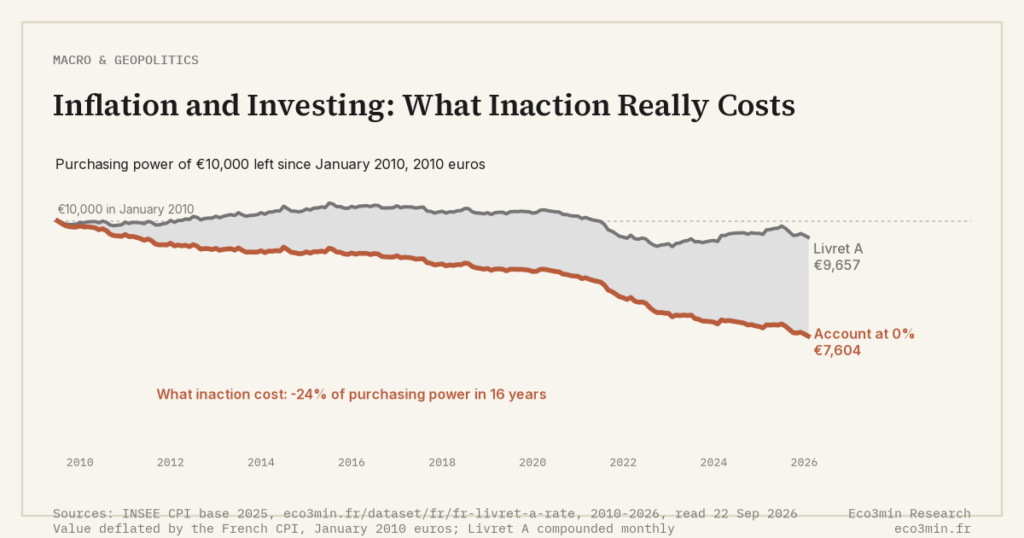
A common phrase says that “not investing means losing money.” That is true — in some regimes. In others, cash earns a positive real return. The answer depends on a single number: the gap between the return on your savings and inflation.
What inflation actually does to your money
Inflation is the general rise in prices. When it runs at 5%, a basket that cost €100 in January costs €105 in December. Your €100 note has not changed — but what it can buy has fallen by 5%. That is the difference between nominal value (the number) and real value (purchasing power).
The same mechanism applies to savings. A Livret A at 3% turns €10,000 into €10,300 after one year. But if inflation runs at 5%, it takes €10,500 to buy what €10,000 bought a year earlier. The statement shows +€300. Purchasing power has fallen by €200. The apparent gain masks a real loss.
This mechanism — explained in detail on the page real returns vs nominal returns — is why inflation is sometimes called an “invisible tax.” It takes nothing from your account. It reduces what your account can buy.
The cost of inaction: leaving money in a checking account
Money sitting in a checking account earns 0%. Its real cost equals inflation exactly — a guaranteed loss of purchasing power.
| Initial amount | Annual inflation | Purchasing power after 10 years | Real loss |
|---|---|---|---|
| €10,000 | 2% | ~€8,200 | −€1,800 |
| €10,000 | 3% | ~€7,400 | −€2,600 |
| €10,000 | 5% | ~€6,100 | −€3,900 |
At 5% inflation, €10,000 left for 10 years in a checking account loses nearly 40% of its purchasing power. The statement still shows €10,000. But those €10,000 buy only the equivalent of €6,100 in today’s money. That is the cost of inaction — and it scales with inflation. In depth: where US households park their cash.
But inaction is not always the worst choice
Here is what most guides do not say — and it may be the most important point on this page.
“Not investing means losing money” holds when inflation exceeds the return on risk-free savings (Livret A, euro-denominated insurance funds). In that regime — France in 2022-2023, everywhere from 2009 to 2021 — every day of uninvested cash is a day of real loss. The urgency to invest holds.
But when real rates turn positive — when cash or short-dated bonds yield more than inflation — inaction carries a low or even zero cost. That is the configuration that prevailed in the United States in 2023-2024: T-bills (short-term Treasury bills) yielded 5.25% with inflation below 3%, a positive real return of more than 2%. Holding cash in that regime is not inaction — it is a rational, remunerated choice.
Inflation is not a number — it is a regime
The inflation figure that INSEE publishes each month is a national average computed on a basket of goods. It is useful as a macroeconomic indicator. But it does not necessarily match your inflation.
A renter household whose housing represents 35% of the budget and whose rent rises 7% experiences a personal inflation well above the official 5.2% of 2022. A homeowner without a mortgage, whose spending is concentrated on food and energy, may face yet a different inflation. “Average” inflation does not exist at the individual level — it is structurally higher for lower-income households, whose budgets are more concentrated on the categories that rise fastest (food, energy, housing).
More fundamentally, inflation is not a one-off event — it is a regime. France experienced a regime of low inflation between 1995 and 2021 (~1-2% per year), preceded by a regime of high inflation between 1970 and 1985 (up to 14% in 1974). These regimes last years, sometimes decades. They shape the environment in which every financial decision produces its effects — savings, investing, credit, real estate. For the full reading framework, see the Eco3min framework on inflation.
But these regimes are not random. They are largely shaped by structural factors such as commodities, energy and the physical constraints of the real economy. When resource prices rise persistently, they propagate through the entire economy — from production costs to final prices. The article Commodities, inflation and monetary policy shows how these deep dynamics shape inflation cycles over the long run.
The sub-pillar Inflation: beyond the monthly numbers develops this analysis in depth.
Is your return really positive?
Enter your investment’s displayed return and the estimated inflation.
Simplified calculation. For educational purposes only.
How inflation reshapes every financial decision
Precautionary savings. The Livret A is essential as a safety cushion — but its real cost varies with inflation. At 2% inflation, it yields +1% real. At 5%, it costs −2% real. That cost is the price of liquidity insurance — acceptable, but worth knowing. This point is developed in the guaranteed-fund versus unit-linked split.
Equity investing. Equities are historically the asset class that protects best against inflation over the long run — because companies adjust their prices and margins. But this protection is imperfect and takes time: over horizons of 1 to 3 years, equities can fall sharply during periods of high inflation (S&P 500: −19% in 2022, exactly when inflation was at its peak). The major article Equity markets and the real economy analyzes this temporary disconnect.
Mortgage credit. Inflation is the friend of the fixed-rate borrower — it reduces the real value of the debt. A loan at 1% taken in 2021, with inflation at 5% in 2022-2023, was repaid in depreciated currency: a real gain for the borrower. Conversely, a loan at 4% taken when inflation falls back to 2% costs 2% in real terms — a growing burden. The sub-pillar Rates and purchasing capacity develops this central mechanism.
Life insurance (euro-denominated funds). Euro-denominated funds display a “positive return” each year — but in 2022 and 2023, their real return was negative. The €1.9 trillion in life insurance savings (France Assureurs, 2024) collectively lost purchasing power for two consecutive years. The sub-pillar Anatomy of investments deconstructs the real returns of each vehicle.
Inflation is a gateway into macroeconomics
If you have read this page and grasped that inflation rewrites the financial rules, you have understood the central idea of Eco3min: individual financial decisions are conditioned by the macroeconomic environment. Inflation is the first force in that environment. The others — interest rates, credit cycles, liquidity, monetary policy — all interact with it.
The pillar page Financial education structures this understanding. The pillar Macroeconomics explores the underlying forces. The pillar Monetary policy analyzes the tools central banks use to respond to inflation — and the effects of those tools on portfolios.
It is a path, not an obligation. But if the question “why is my saving not making progress despite my efforts?” speaks to you, the answer lies in these pillars.
The final step of the path
You now master the foundations: method, vehicle, account wrapper, amount, real return, inflation. The last page of this path gathers the structural mistakes that this knowledge helps avoid — not the “classic” mistakes (panicking, failing to diversify), but the errors of context.
The mistakes that cost the most →Last updated — 22 September 2026
Disclaimer – Financial Information: The analyses, commentary, and content published on eco3min.fr are provided for informational and educational purposes only. They do not constitute investment advice or a solicitation to buy or sell financial instruments. Past performance is not indicative of future results. All investment decisions involve risk and are the sole responsibility of the reader.