
Every US Government Shutdown Since 1976: All 23 Funding Gaps, Dates, Duration, Cost
Fiscal year 2026 alone accounts for 120 of the 281 full days of federal funding gaps since 1977, and for the two longest on record. This register lists all 23, with dates, duration, scope, furloughs, cost estimates and the dispute behind each one, from the Congressional Research Service and the House Historian.
Above the table: the current funding deadline with its countdown in Washington and Paris time, and the state of the debt limit. Below it: what the register does and does not show, a component to place a hypothetical shutdown among the 23, and the CSV.
Twenty-three funding gaps since fiscal year 1977, 281 full days in total; the three longest, 75, 42 and 34 days, all began after December 2018.
- Fifteen gaps happened between 1976 and 1990 and lasted 83 days combined; most were weekends that closed almost nothing. Eight gaps since 1995 lasted 198 days, and shutdown procedures were followed in every one of them.
- The 75-day lapse of February to April 2026 affected one department, Homeland Security, and ended without funding for ICE and the Border Patrol, later provided by a reconciliation law: a first in the appropriations process, per CRS.
- The next deadline is 11 December 2026, when the continuing resolution signed on 2 September expires. The debt limit is a separate clock: $1,201 billion of room on 17 September 2026, with no official X-date.
US federal funding: current deadline
81 days · 9 h 04 min
Funding expires at the end of 11 December 2026, Washington time, which is 12 December 2026 at 06:00 Paris time.
Status as of 3 Sep 2026: Continuing resolution H.R. 6500 signed on 2 September 2026; 3 of the 12 FY2027 appropriations bills passed by the House, 0 by the Senate (CRFB, Appropriations Watch, 3 September 2026).
Private estimates: Bipartisan Policy Center (17 Jun 2026), limit reached between late winter and mid-summer 2027, then 6 to 9 months of extraordinary measures; CRFB (7 May 2026), increase needed in mid-to-late 2027.
Sources: White House, CRFB (Appropriations Watch), US Treasury Fiscal Data (table IIIC, read today). The countdown is recomputed in the browser.
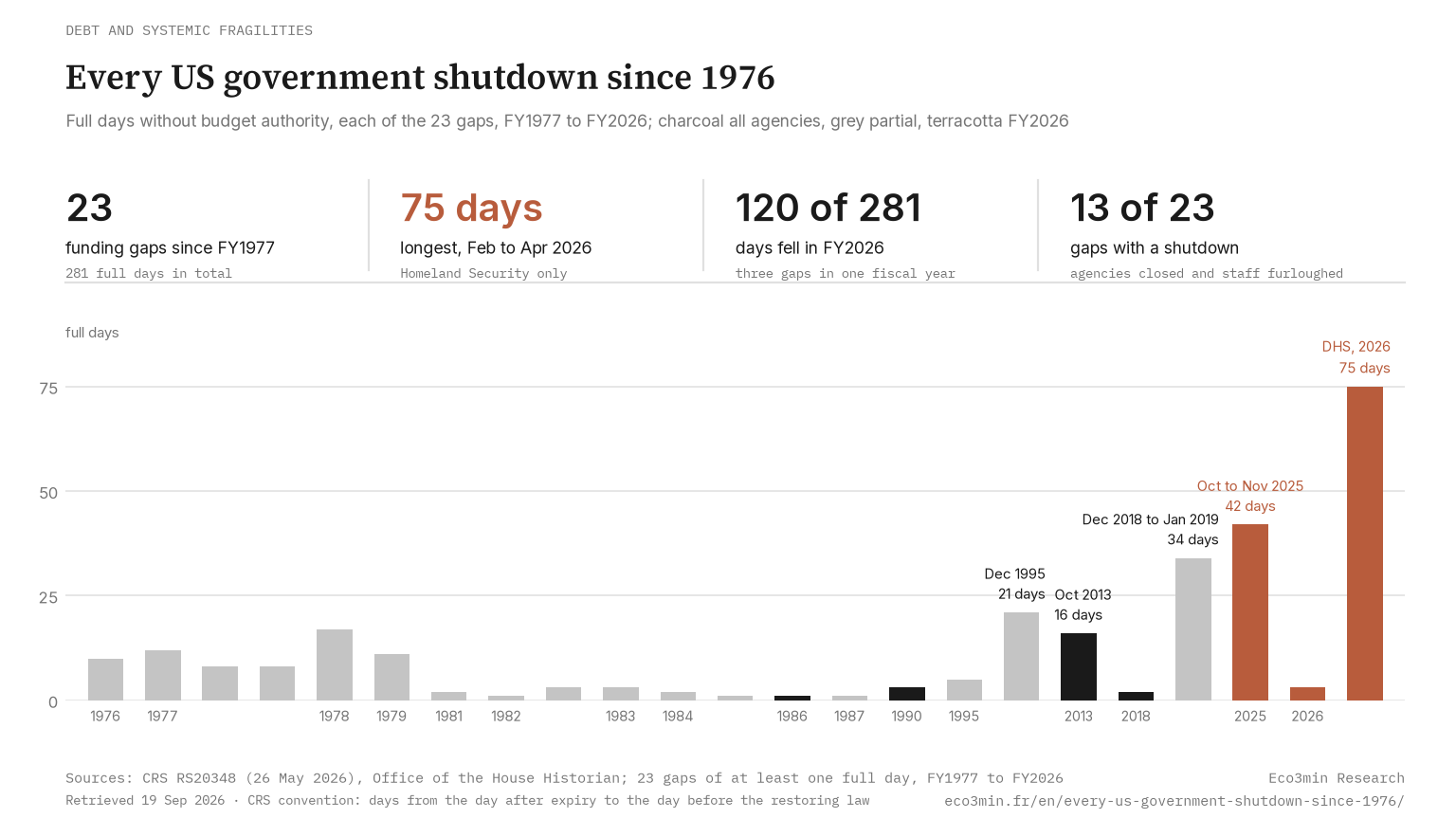
The register: 23 funding gaps, FY1977 to FY2026
| FY | First full day | Funding restored | Days | Scope | Shutdown | Furloughed (est.) | Cost (est.) | Dispute | |
|---|---|---|---|---|---|---|---|---|---|
| FY2026 | 14 Feb 2026 | 30 Apr 2026 | 75 | partial | yes | 22,862 planned (DHS) | n.a. | Immigration-enforcement conditions on ICE and Border Patrol funding; DHS bill enacted without ICE and Border Patrol, funded later by reconciliation (P.L. 119-98, 10 June 2026) | |
| FY2026 | 31 Jan 2026 | 3 Feb 2026 | 3 | partial | yes | n.a. | n.a. | Senate Democrats withdrew from the year-end funding package after the killing of Alex Pretti by federal agents in Minneapolis (24 Jan.); DHS split from the package | |
| FY2026 | 1 Oct 2025 | 12 Nov 2025 | 42 | full | yes | at least 670,000 | $11 bn GDP lost (CBO) | Extension of the enhanced Affordable Care Act premium tax credits demanded by Senate Democrats; clean continuing resolution rejected 14 times | |
| FY2019 | 22 Dec 2018 | 25 Jan 2019 | 34 | partial | yes | 380,000 + 420,000 unpaid | $11 bn GDP, $3 bn lost (CBO) | Funding for a wall on the border with Mexico (USD 5.7 bn requested) | |
| FY2018 | 20 Jan 2018 | 22 Jan 2018 | 2 | full | yes | n.a. | n.a. | Immigration: status of DACA recipients tied to the continuing resolution | |
| FY2014 | 1 Oct 2013 | 17 Oct 2013 | 16 | full | yes | about 850,000 per day | $2.0 bn payroll (OMB) | House Republican demand to defund or delay the Affordable Care Act as a condition of funding | |
| FY1996 | 16 Dec 1995 | 6 Jan 1996 | 21 | partial | yes | about 280,000 | $630 m payroll (OMB) | Seven-year balanced-budget plan: no agreement on the six remaining bills | |
| FY1996 | 14 Nov 1995 | 19 Nov 1995 | 5 | partial | yes | about 800,000 | $430 m payroll (OMB) | President Clinton vetoed a continuing resolution carrying Medicare premium increases; balanced-budget timetable | |
| FY1991 | 6 Oct 1990 | 9 Oct 1990 | 3 | full | yes | n.a. | n.a. | President Bush vetoed a continuing resolution after the House rejected the budget-summit deficit-reduction package; Columbus Day weekend | |
| FY1988 | 19 Dec 1987 | 20 Dec 1987 | 1 | partial | no | n.a. | n.a. | Aid to the Nicaraguan Contras and the FCC fairness doctrine in the year-end spending bill | |
| FY1987 | 17 Oct 1986 | 18 Oct 1986 | 1 | full | yes | n.a. | n.a. | Omnibus continuing resolution cleared late; non-essential offices closed at noon on 17 Oct. | |
| FY1985 | 4 Oct 1984 | 5 Oct 1984 | 1 | partial | yes | 500,000 (part of a day) | n.a. | Same dispute; non-excepted staff sent home for part of 4 Oct. | |
| FY1985 | 1 Oct 1984 | 3 Oct 1984 | 2 | partial | no | n.a. | n.a. | Crime package, water projects and civil-rights provisions attached to the continuing resolution | |
| FY1984 | 11 Nov 1983 | 14 Nov 1983 | 3 | partial | no | n.a. | n.a. | Education funding and foreign aid levels in the continuing resolution; holiday weekend, no disruption reported | |
| FY1983 | 18 Dec 1982 | 21 Dec 1982 | 3 | partial | no | n.a. | n.a. | Dispute over a public-works jobs programme and MX missile funding in the continuing resolution | |
| FY1983 | 1 Oct 1982 | 2 Oct 1982 | 1 | partial | yes | n.a. | n.a. | Continuing resolution cleared after the deadline; offices told to run essential operations only | |
| FY1982 | 21 Nov 1981 | 23 Nov 1981 | 2 | partial | yes | n.a. | n.a. | President Reagan vetoed a continuing resolution that did not carry the spending cuts he demanded | |
| FY1980 | 1 Oct 1979 | 12 Oct 1979 | 11 | partial | no | n.a. | n.a. | Congressional and senior-official pay raise and abortion funding | |
| FY1979 | 1 Oct 1978 | 18 Oct 1978 | 17 | partial | no | n.a. | n.a. | President Carter vetoed the defense bill (nuclear carrier) and the public works bill (water projects) | |
| FY1978 | 1 Dec 1977 | 9 Dec 1977 | 8 | partial | no | n.a. | n.a. | Same abortion-funding dispute; agreement reached 7 Dec. | |
| FY1978 | 1 Nov 1977 | 9 Nov 1977 | 8 | partial | no | n.a. | n.a. | Same abortion-funding dispute; second stopgap | |
| FY1978 | 1 Oct 1977 | 13 Oct 1977 | 12 | partial | no | n.a. | n.a. | Medicaid funding of abortion (Hyde amendment language) in the Labor-HEW bill | |
| FY1977 | 1 Oct 1976 | 11 Oct 1976 | 10 | partial | no | n.a. | n.a. | Labor-HEW bill vetoed by President Ford on 29 Sept.; veto overridden, continuing resolution enacted 11 Oct. |
Scope: full means none of the regular appropriations acts had been enacted; partial means at least one had. Shutdown: yes when agencies closed and furloughed staff, per the House Historian. The House Historian counts 43 and 76 days for the October 2025 and February 2026 gaps, one more than CRS in each case. Regime column and sources are in the CSV.
What changed after 2018
The register splits in two at the Civiletti opinions. Before 1981, agencies kept working through a lapse and Congress ratified the spending afterwards: the six gaps of 8 to 17 days between 1976 and 1979 closed nothing, as the CRS notes. From 1981 the Antideficiency Act was read strictly, and the gaps became short, usually a weekend, because the cost of a real closure was now visible. Fifteen gaps in the fifteen fiscal years from 1977 to 1991, then a five-year silence.
The second half of the register is a different object. Since 1995 there have been eight gaps, every one of them with shutdown procedures followed, and the three longest all came in the last three cycles: 34 days in 2018-19, 42 in 2025 and 75 in 2026, after 21 in 1995-96 and 16 in 2013. The mechanism is visible in the coverage column. When most agencies are already funded, the lapse costs the negotiators less, and it lasts longer: the 34-day gap of 2018-19 covered 7 of 12 bills, the 75-day gap of 2026 covered one department. The register of every US bank failure since 1934 shows the same concentration pattern in another series: rare events, but larger when they come.
Fiscal year 2026 is the outlier on every column. Three gaps, 120 full days, a government-wide shutdown that cancelled the October 2025 unemployment rate and the October CPI, and a departmental shutdown resolved by a reconciliation law rather than an appropriations act. The CRS report on DHS lapses records two other firsts: salaries of 70,000 law-enforcement staff paid from multi-year reconciliation funds during the lapse, and a department funded in April without two of its largest components, which received their money in June through P.L. 119-98.
The length of a funding gap is a function of what is already funded, not of how far apart the two sides are. Government-wide lapses end within weeks because every constituency is affected at once; partial lapses can run for months because the pressure is confined to the agencies left out. Read the coverage column before the days column.
A shutdown of how many days? Place it among the 23
The register cannot say how long a gap starting on 12 December 2026 would last. The component takes a duration you choose, ranks it among the 23 gaps since 1976, lists the episodes of comparable length with what is documented about their furloughs and costs, and gives the corresponding end date with the scheduled US releases and Fed meetings that would fall inside the window. It is a hypothesis in your hands, not a forecast.
The current deadline and the debt limit
Fiscal year 2027 began on 1 October 2026 with none of the twelve regular appropriations acts enacted. The Continuing Appropriations and Extensions Act, 2027 (H.R. 6500) passed the Senate on 8 August by 90 votes to 6 and the House on 1 September by 370 to 48, and was signed on 2 September. It funds the government through 11 December 2026. As of 3 September, the House had passed three of the twelve bills and the Senate none, per the Committee for a Responsible Federal Budget. Between fiscal years 2000 and 2023, CRS counts 22 cases where the next CR was enacted the day after the previous one expired, with no full day lost: a deadline is not a gap. The calendar of US data releases and the period each number covers lists what a December lapse would delay; the next US CPI release page flags the October 2025 index that was never published.
The debt limit is the second clock and it is not running out. The One Big Beautiful Bill Act of 4 July 2025 raised it by $5,000 billion to $41,104 billion. On 17 September 2026 debt subject to the limit was $39,903 billion according to the Daily Treasury Statement, leaving $1,201 billion. No extraordinary measures are in use and neither Treasury nor CBO has published an X-date. The Bipartisan Policy Center, in a note of 4 June 2026 updated on 17 June, expects the limit to be reached between late winter and mid-summer 2027, followed by six to nine months of extraordinary measures; the Committee for a Responsible Federal Budget wrote on 7 May 2026 that an increase would be needed in mid-to-late 2027. How Treasury General Account drawdowns inject liquidity during a debt-ceiling episode covers the plumbing that starts once the limit binds; the federal debt to GDP dataset gives the stock behind the flow.
What the register does not show
Three limits. First, duration is a convention. CRS counts full days without budget authority; the House Historian counts through the last day of the shutdown; press counts often include both the expiry day and the reopening day. The same 2025 episode is 42, 43 or 44 days depending on the rule. This register uses CRS throughout and prints the House count where it differs.
Second, furlough numbers are estimates and not comparable across rows. No official count exists for any lapse, CRS notes, because furloughed workers who are paid retroactively are recorded as employed. The 1995 figure is a contemporaneous estimate, the 2013 figure is OMB’s peak daily count, the 2018-19 figure is a Senate committee projection, the 2025 figure is a Bipartisan Policy Center estimate cited by CRS, and the 2026 DHS figure is the planned number in the department’s contingency plan, which was not updated during the lapse.
Third, the dispute column is a label, not a cause. Before 1996 it rests on the press accounts cited by CRS and the House Historian; from 1996 it follows the CRS narrative. My criterion is explicit: one gap per CRS row, one dispute per gap, the issue named in the source that ended it. If a later CRS revision changes a row, the register follows it.
Method and sources
The register reproduces Table 1 of CRS report RS20348, Federal Funding Gaps: A Brief Overview, updated 26 May 2026, row for row, and adds five fields. Scope, shutdown procedures and the restoring law come from the House Historian’s page Funding Gaps and Shutdowns in the Federal Government, read on 19 September 2026. Furloughs and costs come from CRS RS20348, CRS R48832 on the economic effects of the 2025 shutdown, CRS R49105 on DHS lapses, OMB’s November 2013 report on the costs of the October 2013 shutdown, CBO’s report of 28 January 2019 and its letter of 29 October 2025, and the DHS lapse plan of 29 September 2025. The macro regime of the month in which each gap began comes from the Eco3min regime classifier, monthly since 1978, flagged degraded before 2003; the four gaps of 1976 and 1977 have no regime. The deadline, the CR votes and the debt-limit figures come from the White House statement of 2 September 2026, CRFB’s Appropriations Watch and the Daily Treasury Statement (Fiscal Data API, table IIIC).
Questions about the register
How many US government shutdowns have there been since 1976?
Twenty-three funding gaps of at least one full day between fiscal year 1977, the first under the current 1 October fiscal year, and fiscal year 2026, according to the Congressional Research Service. Not all of them produced a shutdown: the House Historian records shutdown procedures being followed in 13 of the 23, mostly those after the Civiletti opinions of 1980 and 1981.
What is the longest government shutdown in US history?
By the CRS convention of full days without budget authority, the lapse affecting the Department of Homeland Security from 14 February to 30 April 2026 is the longest at 75 days. The longest government-wide lapse ran from 1 October to 12 November 2025, 42 full days. The House Historian counts 76 and 43 days for the same two episodes because it includes the final day.
When is the next US government shutdown deadline?
Federal funding under the continuing resolution H.R. 6500, signed on 2 September 2026, expires at the end of 11 December 2026, Washington time. Unless appropriations acts or another continuing resolution are enacted by then, a funding gap begins on 12 December. The status panel on this page shows the countdown and the last dated state of the process.
What did the shutdowns cost?
Estimates exist for four episodes. OMB put the payroll cost of furloughed employees at $430 million for November 1995, $630 million for December 1995 to January 1996 and $2.0 billion for October 2013. CBO estimated that the 2018-2019 lapse reduced real GDP by $11 billion across two quarters, of which about $3 billion was never recovered, and that the six-week 2025 lapse would leave $11 billion of real GDP unrecovered.
Is a shutdown the same as hitting the debt ceiling?
No. A shutdown follows a lapse in annual appropriations: agencies stop discretionary activity, but Treasury keeps borrowing and keeps paying interest. The debt limit caps what Treasury can borrow; once reached, extraordinary measures postpone the X-date by several months. On 17 September 2026 debt subject to the limit stood at $39,903 billion against a limit of $41,104 billion, with no X-date published by Treasury or CBO.
Last updated — 19 September 2026
Disclaimer – Financial Information: The analyses, commentary, and content published on eco3min.fr are provided for informational and educational purposes only. They do not constitute investment advice or a solicitation to buy or sell financial instruments. Past performance is not indicative of future results. All investment decisions involve risk and are the sole responsibility of the reader.