
How to Buy Bitcoin: Exchanges, Spot ETFs, Self-Custody and the Tax Trail
The purchase takes two minutes. What actually shapes the outcome and the risk is the custody route, its true cost, and its tax trail.
- Three routes: an exchange (buy and hold on a platform), a spot ETF (buy in a brokerage account), and self-custody (hold your own keys). Each shifts who controls the asset and who bears the counterparty risk.
- US tax treats crypto as property, so every disposal is a taxable event, including a crypto-to-crypto trade; gains held a year or less are ordinary income, longer are taxed at 0/15/20% (IRS).
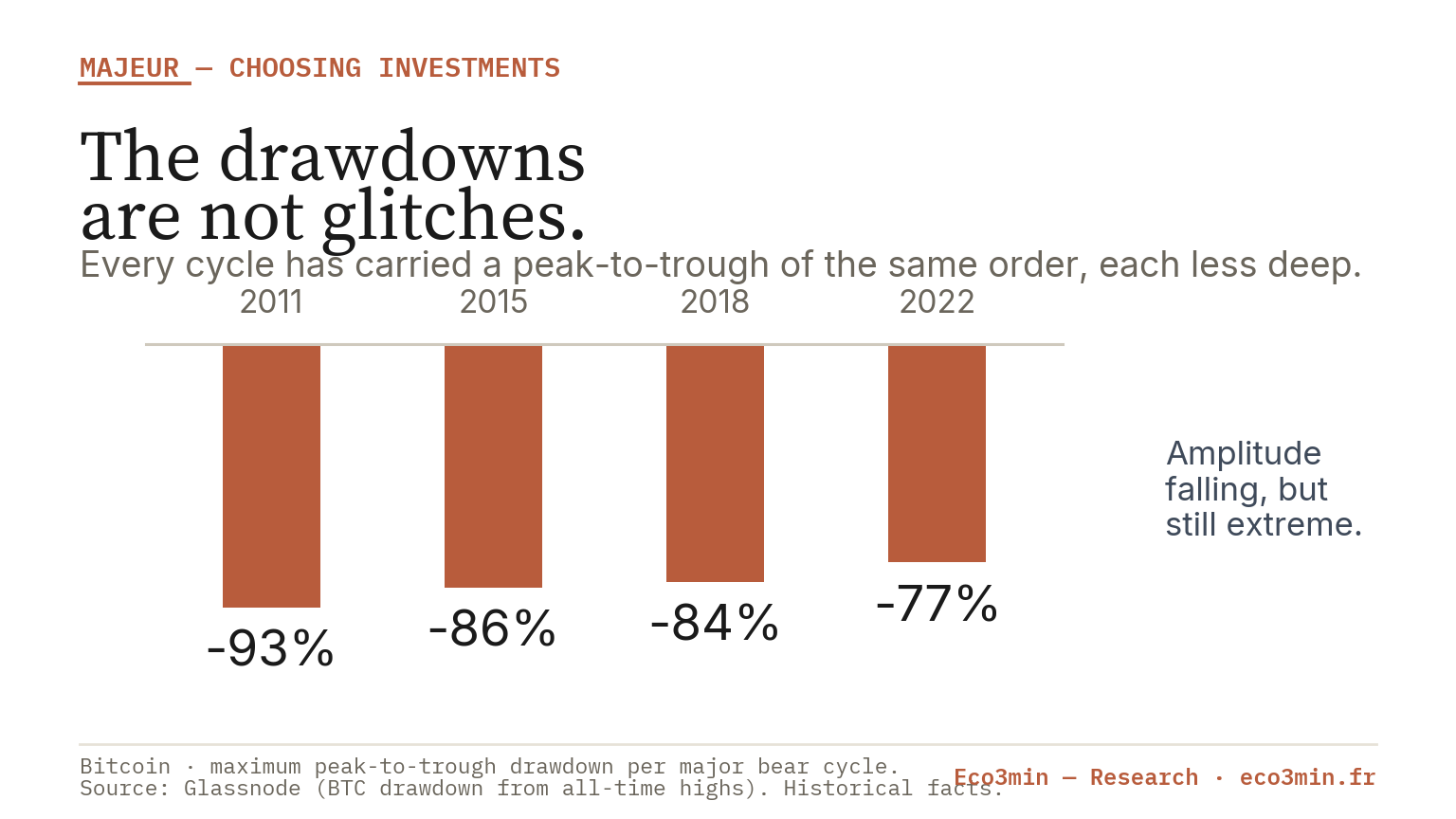
- Bitcoin’s documented peak-to-trough drawdowns run deep and recur: about 93% (2011), 86% (2015), 84% (2018) and 77% (2022).
There are three real ways to hold bitcoin: on an exchange, through a spot ETF, or in self-custody with your own keys. Pressing “buy” is trivial on any of them. The choice that matters is what happens after.
Platforms advertise a two-minute purchase. That framing hides the three things that decide the result: the true cost including the spread, who holds the asset, and how every disposal is taxed. This page maps the routes, not the price.
Buying is the easy part; custody is the decision
Buying bitcoin is the easy part; custody is the decision. The purchase is a button. What that button does not show is that you have just chosen a custody model, a cost structure and a tax profile in a single click. The three routes differ on one axis above all: who controls the private keys, and therefore who can lose the asset. On an exchange, the platform holds the keys and you hold a claim; in a spot ETF, a custodian holds the bitcoin and you hold a share; in self-custody, you hold the keys and no one else can move the coins, or recover them if you lose access. Everything else, cost, tax, counterparty risk, follows from that choice. For where a volatile, non-yielding asset sits inside a portfolio, the sub-pillar on placing bitcoin in a regime framework is the reference; this page stays on how you buy and hold.
Exchanges: a grid of verifiable facts
An exchange is the default entry point, and the useful way to compare exchanges is by verifiable facts, not by reputation. In the United States, that means checking registration and licensing: exchanges typically operate as money services businesses registered with FinCEN and hold state money transmitter licences, and their tokens and products may fall under the overlapping remits of the SEC and the CFTC. These are facts you can look up, and they matter, but they are not a quality or safety guarantee: a registered platform can still fail, and being on a regulator’s list is a compliance status, not a promise about your funds.
Two operational facts separate a serious exchange from a costly one. The first is cost transparency. The headline trading fee is rarely the true cost, because the platform also earns a spread, the gap between the price you pay and the mid-market price, which is invisible on the confirmation screen. A “zero-fee” purchase can carry a wide spread that costs more than an honest commission would. The second is whether you can withdraw on-chain: an exchange that lets you move coins to your own wallet gives you an exit to self-custody, while one that locks the asset inside its walled garden leaves you fully dependent on the platform. These two facts, the real cost and the on-chain exit, tell you more than any brand.
Three more facts round out the exchange grid. Liquidity depth determines how much a large order moves the price against you, so a thin market can add a slippage cost on top of the spread. Know-your-customer requirements mean a regulated exchange will verify identity, which is a feature for tax reporting and a friction for those who value privacy. And the distinction between a custodial and a non-custodial service matters at the level of who can freeze your access: a custodial exchange can suspend withdrawals in a stress event, as several have, while a non-custodial interface never holds your coins in the first place. None of these is visible in an advertisement, and all of them are checkable before a first deposit, which is the practical meaning of comparing exchanges by fact rather than by reputation.
Spot ETFs
A spot bitcoin ETF lets you hold bitcoin exposure inside an ordinary brokerage or retirement account, with no wallet to manage and no exchange to trust with withdrawals. A regulated custodian holds the underlying bitcoin, and you hold a share that tracks its price, for a small annual expense ratio. The structural trade-off against holding the coin yourself, custody convenience against direct ownership, is the dedicated subject of bitcoin ETF versus self-custody, and the plumbing of how these products create and redeem shares is set out in spot bitcoin ETF microstructure. This page cites those rather than re-running them. What the ETF changes at the level of access is simple: it removes the key-management burden and the exchange-withdrawal question, and replaces them with a fund wrapper, an annual fee, and the fact that you never hold the coins, which is a feature for some buyers and a deal-breaker for others.
Two practical points sit inside the ETF wrapper. First, it fits where a wallet cannot: a spot ETF can be held in an ordinary brokerage account and, in some cases, a retirement account, bringing bitcoin exposure inside the tax-advantaged and reporting infrastructure investors already use. Second, the wrapper introduces its own quieter risks. Large ETF flows now move a meaningful share of spot demand, and a shift in that flow can change the liquidity picture beneath the market in ways individual investors rarely see, a dynamic examined in the quiet liquidity shift in bitcoin ETFs. The ETF removes the custody headache, but it does not remove structure: you are trusting a fund, a custodian and a creation-redemption mechanism instead of a wallet, which is a different set of dependencies rather than none.
Self-custody
Self-custody means holding your own private keys, usually on a hardware wallet, so that no platform stands between you and the coins. It is the route that most fully delivers on bitcoin’s original promise of an asset no intermediary can freeze, and it carries a matching responsibility: lose the keys or the recovery phrase and the coins are gone, with no support line to call. The operational risks are real and well documented, from phishing to physical loss to sending funds to a wrong address, and they replace counterparty risk with personal-security risk. That shift, from trusting a platform to trusting yourself, is the quiet reframing that self-custody forces, and it is why it suits holders who value control and unnerves those who do not.
Self-custody itself comes in degrees. A hot wallet, connected to the internet, is convenient for small amounts and spending but more exposed to malware and phishing; a cold wallet, kept offline on a hardware device, is the standard for holding larger amounts, trading convenience for security. The single point of failure in either case is the recovery phrase, the sequence of words that can regenerate the keys: whoever holds it controls the coins, and whoever loses it loses them. That is why the practical discipline of self-custody is really the discipline of backing up and protecting a phrase, offline and in more than one place, rather than anything to do with the coins themselves. The route delivers the strongest form of ownership bitcoin offers, and it makes the owner the last line of defence, with no institution to absorb a mistake.
Counterparty risk, documented
The case for taking custody seriously is not theoretical; it is written in dated failures. Mt. Gox, once the largest bitcoin exchange, went offline and filed for bankruptcy in 2014, freezing customer coins for years. FTX, a large and heavily marketed exchange, collapsed in November 2022, and its bankruptcy trapped client funds even where local subsidiaries appeared compliant. The recurring lesson is the phrase the industry coined after the first collapse: not your keys, not your coins. Crucially, crypto held on an exchange is not covered by deposit insurance the way bank deposits are, so a platform failure is not backstopped by a guarantee fund. Registration status does not change this: a platform can be registered and still fail, and its clients can still wait years to recover assets. This is the single strongest argument for understanding, before you buy, exactly who is holding your coins.
Treating a platform’s registration as a safety guarantee is the costly error. Registration is a verifiable compliance fact, not deposit insurance and not a promise about your funds. Mt. Gox (2014) and FTX (2022) both failed with client coins inside; crypto held on an exchange has no deposit-guarantee backstop.
US taxes: property treatment
The tax trail is where the “two-minute purchase” framing does the most damage, because it hides a reporting obligation that begins the moment you dispose of anything. The IRS treats crypto as property, not currency, so every disposal is a taxable event: selling for dollars, spending it on goods, and, critically, trading one crypto for another all trigger a capital gain or loss (IRS, Notice 2014-21). That crypto-to-crypto rule catches many buyers off guard, because swapping bitcoin for another token feels like moving money, not selling, yet the IRS treats it as a sale of the bitcoin at its market value. Gains on assets held a year or less are taxed as ordinary income, up to 37%; gains held longer than a year are long-term, taxed at 0%, 15% or 20% depending on income. There is no wash-sale rule for crypto, so a loss can be harvested and the asset rebought immediately.
Reporting has tightened sharply. Starting with 2025 transactions, US exchanges must report gross proceeds to the IRS on the new Form 1099-DA, with cost-basis reporting phasing in for assets acquired from 2026, so the era of crypto as a reporting grey area is closing. Transfers between your own wallets are not disposals and are not taxable, but they can distort an exchange’s records, which is why keeping your own transaction history matters: without it, a later sale can be taxed as if your cost basis were zero. The practical takeaway for a buyer is that the custody route and the tax trail are linked: the more you move and trade across platforms, the more taxable events and reconciliation work you create.
Two details close the loop. Every Form 1040 now carries a digital-asset question on its first page, a disclosure made under penalty of perjury, so the reporting decision is not optional even for a buyer who only held. And the one-year line that separates ordinary-income treatment from the lower long-term rates is a genuine lever a holder controls: selling at eleven months versus thirteen can change the rate materially on the same gain. Spending bitcoin is also a disposal, so using it to buy something is a taxable event on the appreciation since acquisition, a fact that quietly undercuts its use as everyday money in the United States. None of this is a reason to prefer one route; it is the reporting reality that the buy button never shows, and it rewards the buyer who keeps clean records from the first purchase.
See the true cost
Because the headline fee hides the spread, the real cost of a route is worth making visible. The tool below compares the cumulative cost of a generic exchange profile, a one-time transaction fee plus the spread you set, against a generic ETF profile, a small entry cost plus an annual expense ratio. It shows how a one-time spread and a recurring fee cross over as the horizon lengthens. It uses generic cost structures, names no platform or product, tracks costs rather than any projected performance, and picks no winner.
[eco3min_crypto_cost_sim lang=”en”]The routes, side by side
The grid reduces the choice to its moving parts. Read it by column: the deciding question is who you want to hold the asset, and what cost and tax that implies.
| Route | Visible cost | Hidden cost | Counterparty risk | The trap |
|---|---|---|---|---|
| Exchange (custodial) | Trading fee | Spread; withdrawal fee | Platform failure; no deposit insurance | Reading registration as a safety guarantee |
| Spot ETF | Annual expense ratio | Bid-ask spread | Fund and custodian structure | Assuming a wrapper removes all counterparty risk |
| Self-custody | Hardware wallet cost | On-chain network fees | None external; personal-security risk | Losing the keys or recovery phrase |
No route dominates. The exchange is convenient and carries platform risk; the ETF removes key management and adds a fee and a wrapper; self-custody removes external counterparty risk and hands you the full burden of protecting the keys. The binding question, who holds the asset, is what should decide, and it depends on how much control and how much responsibility you want. The wider placement of bitcoin against other assets is the sub-pillar on bitcoin among investments, read inside digital assets within allocation.
Bitcoin read through the macro regime
Access explains the cost and the custody; the macro regime is where the price behaviour lives, and that analysis belongs to a dedicated home rather than this page. Bitcoin has historically moved with global liquidity and the direction of real rates, behaving like a high-beta liquidity asset that rallies when dollars are plentiful and falls when they are scarce, the thesis developed in the sub-pillar on bitcoin, liquidity and real rates. This page does not re-run that argument; it points to it. Where the current setting sits is shown on the dashboard for the current liquidity regime, and the specific case of a dollar-shortage environment is mapped in the Atlas on bitcoin in a dollar shortage.
Two further threads sit alongside the regime. The real return matters because bitcoin pays no income, so its entire return is price, read against inflation in reading real returns against bitcoin. And the supply schedule, the four-year halving that cuts new issuance, is a recurring talking point whose actual relevance is examined in the relevance of the halving cycle. To place bitcoin against equities, bonds and gold rather than in isolation, the tool comparing bitcoin compared across regimes is the way to do it.
The purchase is a button; the decision is custody, and it sets your true cost, your counterparty risk and your tax trail in a single click.
Documented volatility
One number belongs on any access decision, and it is not a price target: the depth of the drawdowns. Bitcoin’s history is a sequence of deep, recurring falls from each cycle’s high to its low, about 93% in 2011, 86% in 2015, 84% in 2018 and 77% in 2022, a series whose magnitude has shrunk cycle by cycle as the market has grown but has never been small. Its volatility has run several times that of the S&P 500 and of gold, and its correlation with equities has been inconsistent, so it has not reliably diversified a portfolio. This page makes no forecast and names no target; the record simply establishes that the asset behind the two-minute purchase moves in double digits routinely and can fall by three-quarters or more, which is context every buyer deserves before the button, not after. The links above carry the analysis of why; the discipline here is to size a position that survives a drawdown of that order.
That discipline is the one genuinely actionable conclusion of an access decision. Because a fall of seventy to ninety percent is not an edge case in bitcoin’s record but a repeated feature of it, the size of a position matters more than the entry route: a holding small enough to endure such a decline without forcing a sale is what lets any of the three routes work as intended, and a holding too large turns a normal drawdown into a permanent loss when nerves break at the bottom. The volatility also cuts against using an exchange’s leverage or margin products, which convert a survivable drawdown into a liquidation. The record does not say whether bitcoin will rise or fall next; it says only that whatever route you choose must be paired with a position you can hold through a decline of that magnitude, which is a sizing question, not a timing one.
Frequently asked questions
What are the ways to buy and hold bitcoin?
Three main routes: an exchange, where the platform holds the keys and you hold a claim; a spot ETF, where a custodian holds the bitcoin and you hold a share in a brokerage account; and self-custody, where you hold your own keys on a wallet and no one else can move or recover the coins. Buying is trivial on all three; they differ on who controls the asset, what it costs, and how it is taxed.
How is the true cost of buying bitcoin measured beyond headline fees?
The advertised trading fee is only part of the cost. Exchanges also earn a spread, the gap between your price and the mid-market price, which is invisible on the confirmation screen and can exceed an honest commission. An ETF’s cost is instead an annual expense ratio that accrues each year. The true comparison therefore depends on the spread, the fee and the holding horizon: a one-time spread and a recurring fee cross over as the horizon lengthens.
How are bitcoin disposals taxed for US investors?
The IRS treats crypto as property, so every disposal is a taxable event, including trading one crypto for another. Gains held a year or less are taxed as ordinary income; gains held longer are long-term at 0%, 15% or 20%. There is no wash-sale rule. From 2025 transactions, US exchanges report proceeds on Form 1099-DA, so keeping your own records of cost basis and wallet transfers is essential to avoid being taxed as if your basis were zero.
What is exchange counterparty risk, and what does the record show?
Counterparty risk is the risk that the platform holding your coins fails. The record is concrete: Mt. Gox went bankrupt in 2014 and FTX collapsed in 2022, both freezing customer funds, in FTX’s case even where local units looked compliant. Crypto on an exchange has no deposit-insurance backstop, and registration is a compliance status, not a guarantee. This is the reasoning behind the phrase “not your keys, not your coins”.
How does a spot bitcoin ETF differ from self-custody?
A spot ETF holds bitcoin through a custodian and gives you a share in a brokerage account, removing key management and exchange-withdrawal questions in exchange for an annual fee and the fact that you never hold the coins. Self-custody hands you the keys and full control, removing external counterparty risk but adding personal-security responsibility: lose the keys and the coins are gone. The trade-off is convenience and a fee against ownership and responsibility.
This content is published for information only. It is not investment or tax advice, recommends no platform, product or allocation, and makes no price projection. Crypto-assets are highly volatile and can lose most of their value. Tax rules reflect IRS guidance available in 2026 and can change. Sources: IRS (digital asset guidance, Form 1099-DA); documented exchange failures (Mt. Gox 2014, FTX 2022); drawdown data (Glassnode).
Last updated — 8 July 2026
Disclaimer – Financial Information: The analyses, commentary, and content published on eco3min.fr are provided for informational and educational purposes only. They do not constitute investment advice or a solicitation to buy or sell financial instruments. Past performance is not indicative of future results. All investment decisions involve risk and are the sole responsibility of the reader.