
Choosing investments in the light of the macro cycle
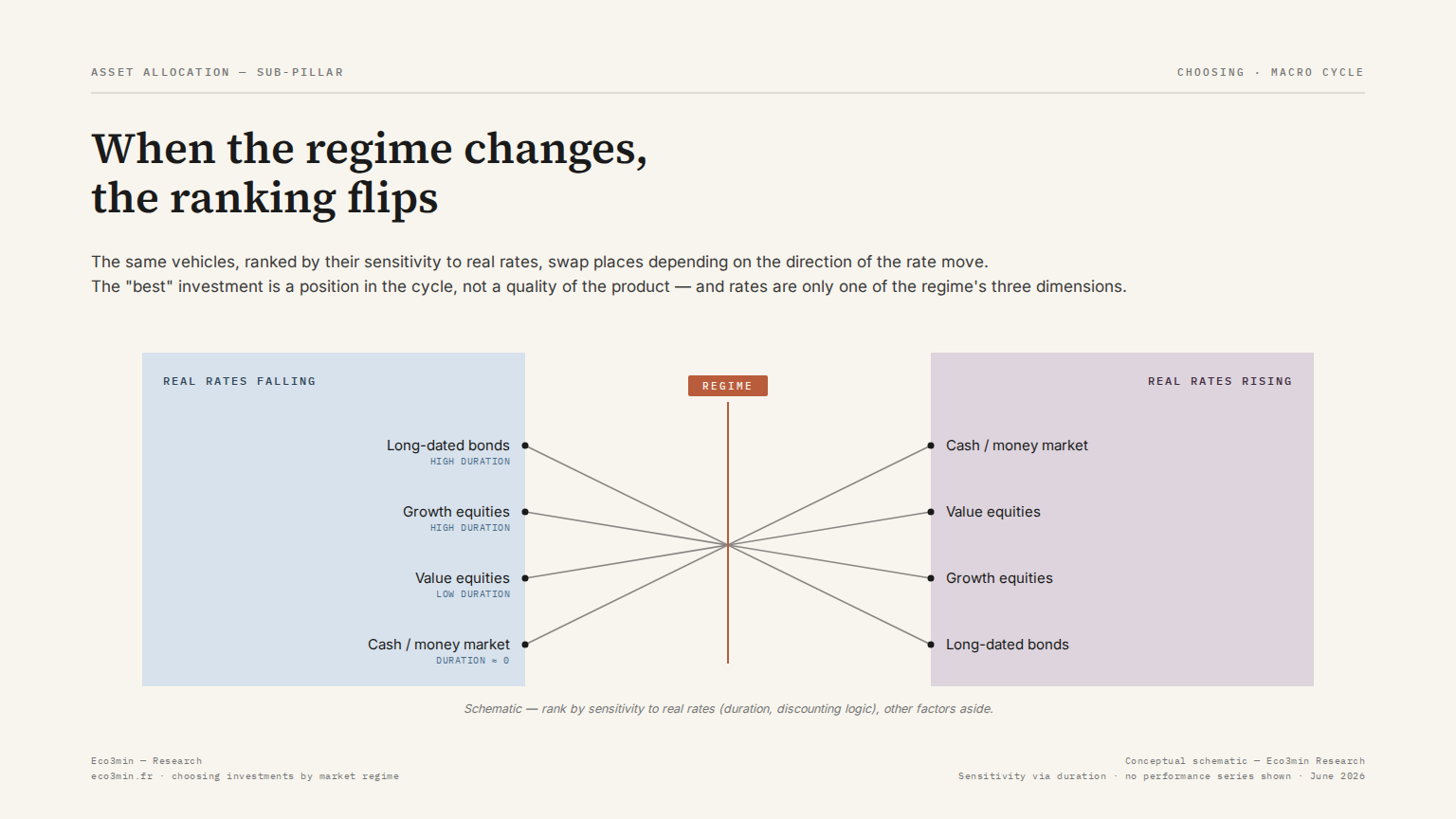
An investment’s performance owes less to its own features than to its interaction with the prevailing macro regime: the same vehicle shifts risk-return profile depending on the level of rates, inflation and liquidity.
“Which is the best ETF?”, “the best investment to get started?”: these questions assume a stable answer exists, valid regardless of context. It is the assumption most rankings adopt, ordering vehicles by their fees, their structure or their recent past performance. It is also the assumption that the asset allocation strategies pillar sets out to replace with a regime-based one.
That grid sets aside the variable that moves the ranking most: the macroeconomic regime. An asset that leads in a phase of disinflation and abundant liquidity can fall to the back of the field when real rates climb. The “best” investment is not an intrinsic property of the product; it is a position relative to an environment of rates, inflation and financial conditions. Worth reading alongside: gold’s role across the real-rate regime.
The trap of the single ranking
A comparison presented as valid “in all circumstances” makes a promise the cycle never keeps. The criteria it ranks do not vanish, but they stop being decisive the moment the regime shifts. This dynamic is examined in detail in guaranteed funds versus unit-linked across the rate regime.
The fixed ranking
Vehicles are ordered on internal criteria, assumed to hold at all times:
- management fees and replication quality
- assets under management
- performance over the past three years
The resulting ranking is presented as a single answer, independent of context.
The conditional ranking
The same vehicles are placed back within the macro regime:
- sensitivity to the level and direction of real rates
- behaviour in an inflationary versus disinflationary regime
- dependence on liquidity and financing conditions
The ranking is no longer single: it reads regime by regime.
The three dimensions that rewrite the ranking
The rate regime, first. The level and direction of policy rates, transmitted to real rates through inflation expectations, alter the relative value of future cash flows. What lifts long-duration assets — growth equities, long-dated bonds — in an easing phase weighs on them in a tightening phase: precisely what the behaviour of the main bond ETF categories across the rate regime documents. The transmission is not instantaneous: it plays out over roughly a year to eighteen months between the monetary decision and its full effect on the real economy, a regularity long documented in central-bank research — a lag that resurfaces in how guaranteed funds and unit-linked savings behave across the rate regime.
The inflation regime, next. High and volatile inflation erodes returns differently across vehicles: an asset such as gold, whose role turns on the real-rate regime, protects in some regimes and not in others. The gap between nominal and real return becomes the decisive variable: it widens or narrows with the regime, and it is that gap, not the headline return, that determines what remains once monetary erosion is netted out — the very question of what has actually protected savings, and in which inflation regime.
Liquidity conditions, finally. The abundance or scarcity of liquidity, steered by central-bank balance sheets and bank financing conditions, moves risk appetite and market depth. In periods of stress it reaches the effective liquidity of certain vehicles — as with listed property repricing through the rate cycle — at the very moment the holder needs it most.
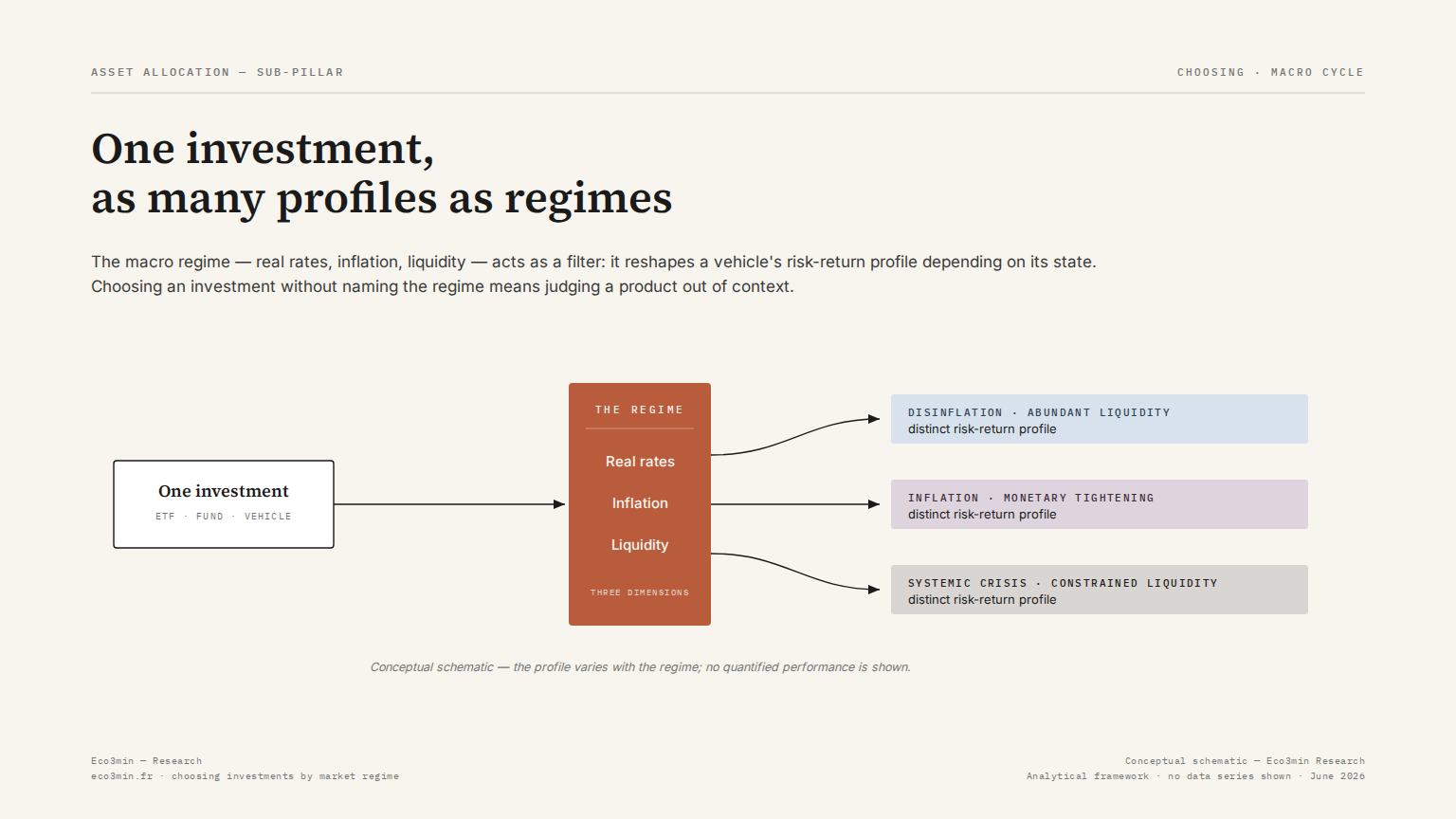
The best investment is not a quality of the product but a position in the cycle: the ranking is rewritten at every change of regime. A related read: our study on the two-sided bet behind tax-deferred retirement accounts.
The comparisons in this series do not point to an investment to buy. They describe how each vehicle has behaved, with data, depending on the macro regime — rate level, inflation regime, liquidity conditions — and leave the reader to weigh those observations against their own situation. The grid is descriptive and historical, never prescriptive. In depth: our study on why investment wrappers are mechanics, not rankings.
“Which is the best ETF?”, “the best investment to get started?” have no context-free answer — but they do have one, regime by regime. Each comparison in the series applies the reading set out above to a specific vehicle, with data, without pointing to an investment to buy:
- the full investment landscape read through the macro regime
- what an ETF ranking leaves unsaid
- the reading grid for an ETF, from index to wrapper
- the access routes to bonds across the rate regime
- gold as a vehicle, seen through the real-rate lens
- what 150 years of data say about entering at highs
- what $10,000 actually changes in the choice of vehicles
- the access routes to commodities and their structural costs
- the mechanisms that reduce taxable income, and their clocks
- how much retirement requires: the income gap and the math
- the routes to bitcoin, from exchanges and spot ETFs to self-custody
- the exposure routes to AI, from chips to indices
- a screening grid for dividend stocks, not a stock list
- what separates near-identical S&P 500 ETFs
- reading a 401(k) fund menu
- REITs: vehicles, metrics and the rate cycle
- every route into real estate, compared
- choosing a brokerage account: fees, execution, protection, cash
- short-term investments by horizon, net of taxes and inflation
What these comparisons examine
Every vehicle is run through the same axes — the ones that move its place in the ranking when the regime shifts.
Sensitivity to the rate regime
How the level and direction of real rates alter the vehicle’s relative value, according to its implied duration.
reading the cycle to position a portfolio →Inflation and real return
The gap between nominal and real return across inflation regimes, and what remains once monetary erosion is netted out.
Liquidity and financing conditions
The vehicle’s dependence on abundant liquidity, and the market depth that remains — or recedes — under stress.
Structure and costs of the vehicle
Fees, replication quality, wrapper taxation: the internal criteria, placed behind the regime rather than ahead of it.
the foundations of asset allocation →Reading the vehicles, reading the cycle
One difficulty these comparisons do not resolve on their own: identifying the prevailing regime in real time, when transitions are slow and the signals often contradictory. The episode that defined the exercise is reconstructed in the Volcker shock of 1979-1982 and forced disinflation. This is where reading the vehicles meets reading the cycle. The first only makes sense anchored to the second: knowing an asset’s sensitivity to rising real rates is useless if one misreads the regime one is in. Also relevant: how listed property reprices across the rate cycle.
That is why each comparison in this series refers back to the macro framework it relies on, rather than delivering a context-free ranking. To locate that framework, Eco3min’s regime reading provides a continuous update, vehicle by vehicle — the common starting point for all the analyses that follow. Directly related: what has protected savings across inflation regimes.
Last updated — 18 September 2026
Disclaimer – Financial Information: The analyses, commentary, and content published on eco3min.fr are provided for informational and educational purposes only. They do not constitute investment advice or a solicitation to buy or sell financial instruments. Past performance is not indicative of future results. All investment decisions involve risk and are the sole responsibility of the reader.
Read next
Full pillar →The Fee Stack in Variable Annuities: M&E Charges, Riders, and Subaccount Costs
A variable annuity does not carry one fee, but a stack of them. Mortality and expense charges, subaccount…
The Conventional 401(k)-Match-First Funding Order: Where It Comes From, How It Works
The question of what order to fund accounts in usually draws a fixed list, presented as a rule…
Roth IRA vs Traditional 401(k): Two Shelters, Two Clocks, Two Tax Treatments
A Roth IRA and a traditional 401(k) are both tax-sheltered, but they are not two flavors of one…