Bitcoin ETFs: The Quiet Shift Reshaping the Crypto Market
Bitcoin ETFs: how the rapid arrival of listed vehicles is reshaping liquidity, flows and risk management for investors. A look at the structural shift moving market governance toward Wall Street.

Bitcoin ETFs: how the rapid arrival of listed vehicles is reshaping liquidity, flows and risk management for investors.
TL;DR
Spot bitcoin ETFs now serve as the main bridge between Wall Street and crypto, and they make bitcoin's risk increasingly financial: priced by asset-manager flows, rates and global liquidity.
- Global spot bitcoin ETF assets rose from roughly $40 billion to about $110 billion between February and November 2025, with bitcoin near $85,000 after its spring peak.
- Across several November 2025 sessions, spot ETFs made up roughly 20–25% of daily net bitcoin purchases, so price increasingly tracks asset-management arbitrage.
- Since mid-2024 the 90-day bitcoin–Nasdaq correlation has often sat between 0.5 and 0.7, while the ETF-held share of market cap rose from about 5% at end-2023 toward 12–15% at end-2025.
In a few months, spot bitcoin ETFs have become the main bridge between traditional finance and crypto. Between February and November 2025, global bitcoin ETF assets under management rose from roughly $40 billion to roughly $110 billion, while bitcoin trades around $85,000 after its spring peak. Behind these figures, a gradual but structural shift is underway: effective market governance is moving toward Wall Street. For an investor, ignoring this dynamic means watching the price without watching the liquidity tap that feeds it. On this point: how exchanges, spot ETFs and self-custody compare.
This analysis approaches bitcoin ETFs not as a financial innovation in the technological or institutional sense, but as a change in the channel through which crypto-asset holdings and flows are intermediated.
To frame this shift in a coherent reading, it helps to place it within the broader scope of the economic, financial and monetary stakes of crypto-assets, where bitcoin ETFs appear less as a simple access product than as a new transmission channel for flows and risk.
Key point: what prices do not yet fully express is the changing nature of bitcoin risk — increasingly financial, less and less purely technological.
Three things worth keeping in mind
- ETFs dominate marginal flows: across several November 2025 sessions, spot ETFs accounted for roughly 20–25% of daily net bitcoin purchases — the price becomes more sensitive to asset-management arbitrage.
- Counterparty risk is shifting: fewer unregulated exchanges, more dependence on a handful of large custodians and ETF issuers — operational risk concentration.
- Macro correlation is strengthening: since mid-2024, the 90-day correlation between bitcoin and the Nasdaq has frequently sat between 0.5 and 0.7, driven by ETF flows sensitive to rates and global liquidity.
Decoding the development
Since the chain of spot bitcoin ETF approvals in the United States, then in Europe and Asia between 2024 and 2025, the market has shifted from a universe dominated by crypto exchanges to a more conventional structure: issuers, market makers, custodian banks, clearing houses. In practice, a growing share of demand comes from investors who have never opened a wallet but allocate 1–3% of a portfolio through a simple ticker. On the same question: how spot Bitcoin ETFs changed market microstructure.
Most of the dominant narratives present this dynamic as merely a “new access door” to the same asset class. That reading is incomplete. What is changing in depth is the mechanics of flows: ETF subscriptions and redemptions are managed in blocks by a handful of specialised desks that arbitrage in real time across spot, futures and derivatives markets. The bitcoin price therefore reflects balance-sheet optimisation, fund regulatory constraints and global allocation rotations — far more than the direct appetite of crypto-native retail investors. The detail is worked through in the false assumptions investors make about Bitcoin and crypto.
Notable observation: the more bitcoin is integrated into mixed portfolios via ETFs, the more it reacts to the same variables as growth equities or AI tech names — US real rates (Fed, 2023–2025 data), the dollar index, equity implied volatility. The “uncorrelated asset” narrative holds up less and less in the data.
This shift fits within a broader dynamic analysed in our framework on crypto-asset liquidity cycles, rates and institutional integration, which explains why bitcoin increasingly behaves as a macro-financial asset subject to the same constraints as other risk asset classes. Our analysis of Bitcoin and liquidity cycles frames this against the historical record.
Concrete impact: what changes now
For an investor, the real question is no longer “is bitcoin warranted?” but through which vehicle and with what type of risk. Three immediate implications:
- More structured allocation: through bitcoin ETFs, investors can integrate crypto within a global allocation framework such as a 60/30/10 portfolio. Industry allocation surveys (Fidelity Digital Assets, BlackRock 2024–2025) report that retail balanced portfolios with bitcoin ETF exposure typically range 1–3%, with more risk-tolerant profiles up to 5%, alongside equities and bonds.
- Operational risk reduced… but reconcentrated: the ETF removes the failure-of-exchange risk seen in 2022, but concentrates risk on the issuer–custodian–regulator chain. A change in accounting or prudential framework can force mechanical selling, as observed in other asset classes during the 2025 bond stress episodes.
- Less “outsider” premium: if bitcoin behaves more like a cyclical macro asset, its pure diversification capacity declines. Hedging a shock historically required combining it with other assets (cash, short-duration bonds, gold or commodities, depending on the macro reading detailed in our analysis of the soft-stagflation scenario).
The implicit question for most readers is straightforward: is it already too late to enter through a bitcoin ETF? Probably not, but the nature of the bet has changed. It is no longer purely a technology-adoption play; it is also a play on the asset-management flow dynamics shaped by rates and global macro.
Weak signals worth tracking
- ETF assets / bitcoin market cap ratio: roughly 5% at end-2023, approaching 12–15% at end-2025. Beyond 20%, subscription/redemption moves could dominate the spot market.
- Premium / discount on imperfectly backed ETFs: 0.5–1% spreads versus spot persisting over several days signal liquidity or collateral constraints.
- Growing use of ETFs as collateral with banks or in corporate cash management: a quiet shift that can amplify forced-selling loops during sharp corrections.
- Rolling 90-day correlation with major equity indices (S&P 500, Nasdaq 100): a sustained drop below 0.3 would indicate renewed crypto specificity; above 0.6, bitcoin via ETF remains essentially a “tech turbo”.
- Regulatory response: tighter rules on custody or accounting treatment of bitcoin ETFs for institutions, in the wake of the financial stability debate, could cut part of the inflows.
Plausible mid-term scenarios
Part of the consensus anticipates a linear path: gradual rise in bitcoin ETF assets, falling volatility, semi-institutional asset status by 2026. This scenario assumes monetary policy normalises without shock (policy rates stable or modestly lower around 3–3.5% in developed economies, per central bank projections) and that regulators do not revisit their stance. For more detail: How bitcoin ETFs and self-custody compare.
An alternative reading is worth considering: if real rates remained sustainably elevated (above 2% in the United States through 2026, per current macro estimates) and growth slowed, bitcoin ETF flows could turn far more cyclical, with episodes of mass redemptions during “risk-off” phases. In that case, the ETF would no longer be a stabiliser but a volatility amplifier — much as some bond strategies were before 2020. Eco3min’s reading of crypto cycles treats that stabiliser-to-amplifier flip as the core risk.
Conversely, a third — less discussed — scenario combines regulated adoption with renewed emerging-market interest: use of bitcoin ETFs as a reserve diversification or currency-hedging tool in countries under monetary pressure. This is not the central scenario today, but it would illustrate how the boundary between crypto and macro, already at the heart of several pieces on the global monetary crisis, is dissolving.
What could invalidate these three trajectories? Targeted regulatory tightening on digital-asset custody, a major operational scandal at a large custodian, or conversely a prolonged phase of real rates near zero redirecting flows toward even riskier assets (small-cap equities, private equity) at bitcoin’s expense.
Common reading errors
- Confusing a bitcoin ETF with a “risk-free” bank deposit: an ETF remains exposed to the extreme volatility of the underlying asset; being listed and regulated does not guarantee price stability.
- Assuming the ETF wrapper cancels crypto risk: it shifts the risk (custody, counterparty, prudential framework) but does not eliminate technology risk or narrative risk (sudden shift in perception).
- Overstating the diversification: adding 3% bitcoin via ETF to a portfolio already heavily tech-tilted does not really diversify; it increases exposure to the same “liquidity / rates” factor.
What readers actually want to know
At the core, most readers seek to arbitrate three questions: “Is it too late to enter?”, “Will bitcoin ETFs stabilise the market or make it more dangerous?”, “What position size is reasonable without putting personal or corporate wealth at risk?”. The point is not so much to predict the next high as to understand whether ETF exposure improves, or not, the overall risk/return trade-off of the allocation.
Key points for investors and corporates
- Allocation observed in surveys: industry surveys report that diversified retail portfolios with bitcoin ETF exposure typically hold 1–3%, within a 60% equities / 30% bonds / 10% satellites (crypto, gold, commodities) framework. Going further has historically been associated with potential annual volatility above 50%.
- Entry timing: empirically, monthly fractional entries (dollar-cost averaging over 6–12 months) have shown lower entry-volatility outcomes than single-shot purchases, particularly in environments where macro volatility cycles remain short and sharp.
- KPIs to track: monitor monthly the bitcoin ETF assets / total market cap ratio, and weekly net flows (inflows vs. outflows). A sustained reversal (3–4 weeks of negative flows) near price highs has historically been a caution signal.
- For corporates: bitcoin ETFs may serve as an opportunistic treasury asset, ring-fenced in accounting and capped at a modest fraction of total cash (industry practice typically below 2–3%), so as not to mix operational management with speculative exposure.
Frequently asked questions on bitcoin ETFs
- How do bitcoin ETFs interact with bitcoin price volatility?
Not always in a smoothing direction. Short term, they can dampen retail-driven swings. But once institutional flows dominate, ETFs can amplify forced-selling phases, particularly in macro stress and rising real-rate regimes. - How does direct bitcoin custody compare to ETF holdings in terms of risk profile?
Direct holding preserves key sovereignty but carries operational risk (security, user error). The ETF route simplifies custody and portfolio integration, at the cost of counterparty risk and regulatory dependence. The trade-off depends on horizon and technological appetite. - Can bitcoin ETFs be banned or restricted by regulators?
Unlikely in major jurisdictions in the near term, but not impossible if an extreme volatility episode were deemed systemic. Regulators have already shown, on other products, that they can adjust short-selling or leverage rules. - To what extent do bitcoin ETFs mitigate exchange fraud risk?
They reduce it, since custody is entrusted to supervised and audited actors, but do not eliminate it. Custodian default or asset-segregation issues remain risks, even if less frequent than the unregulated-exchange failures observed in 2022. - How have bitcoin ETFs behaved relative to inflation over time?
Over the long run, bitcoin has at times performed better in environments of abundant liquidity than during pure phases of high inflation. A bitcoin ETF tends to behave as a play on global liquidity rather than as a pure hedge against rising prices, in contrast to certain commodities.
Several trajectories remain open: bitcoin ETFs as institutional stabiliser, as volatility amplifier, or as a hybrid instrument tied to large monetary tensions. The market does not yet fully price this diversity of scenarios, focusing mainly on rising assets under management. For an investor, the value-add lies less in guessing which trajectory dominates than in adjusting position size, horizon and asset combinations around this new market building block. We will revisit with a flow landscape that may already look different.
- 3 takeaways
- Bitcoin ETFs shift the risk: fewer exchanges, more dependence on flows and on the constraints of asset managers.
- Above 20% of market cap held in ETFs, subscriptions/redemptions can become the real driver of bitcoin prices.
- For most diversified portfolios, surveys report a 1–3% bitcoin ETF allocation as enough to capture the theme without transforming the global risk profile.
Last updated — 4 August 2026
Disclaimer – Financial Information: The analyses, commentary, and content published on eco3min.fr are provided for informational and educational purposes only. They do not constitute investment advice or a solicitation to buy or sell financial instruments. Past performance is not indicative of future results. All investment decisions involve risk and are the sole responsibility of the reader.
Read next
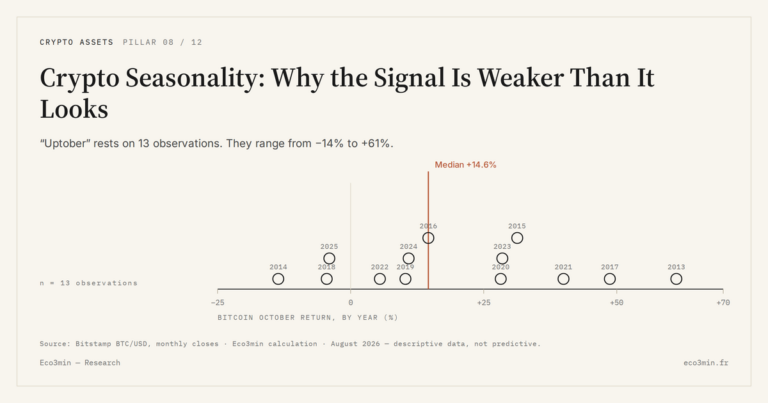
Full pillar →Crypto Seasonality: Why the Signal Is Weaker Than It Looks
Crypto’s cyclical regularities, monthly seasonality or the four-year cycle, rest on a very small number of observations. That…
Bitcoin Halving: How the Programmed Supply Cut Works
The halving writes bitcoin’s scarcity into an immutable rule, applied without exception since 2012. It shapes the pace…
Crypto Cycles: Why Their Amplitude Dwarfs Equity Swings
Crypto cycles post drawdowns two to four times deeper than equity markets. The asymmetry stems from market microstructure,…