
Guaranteed funds vs unit-linked: behaviour across the rate regime

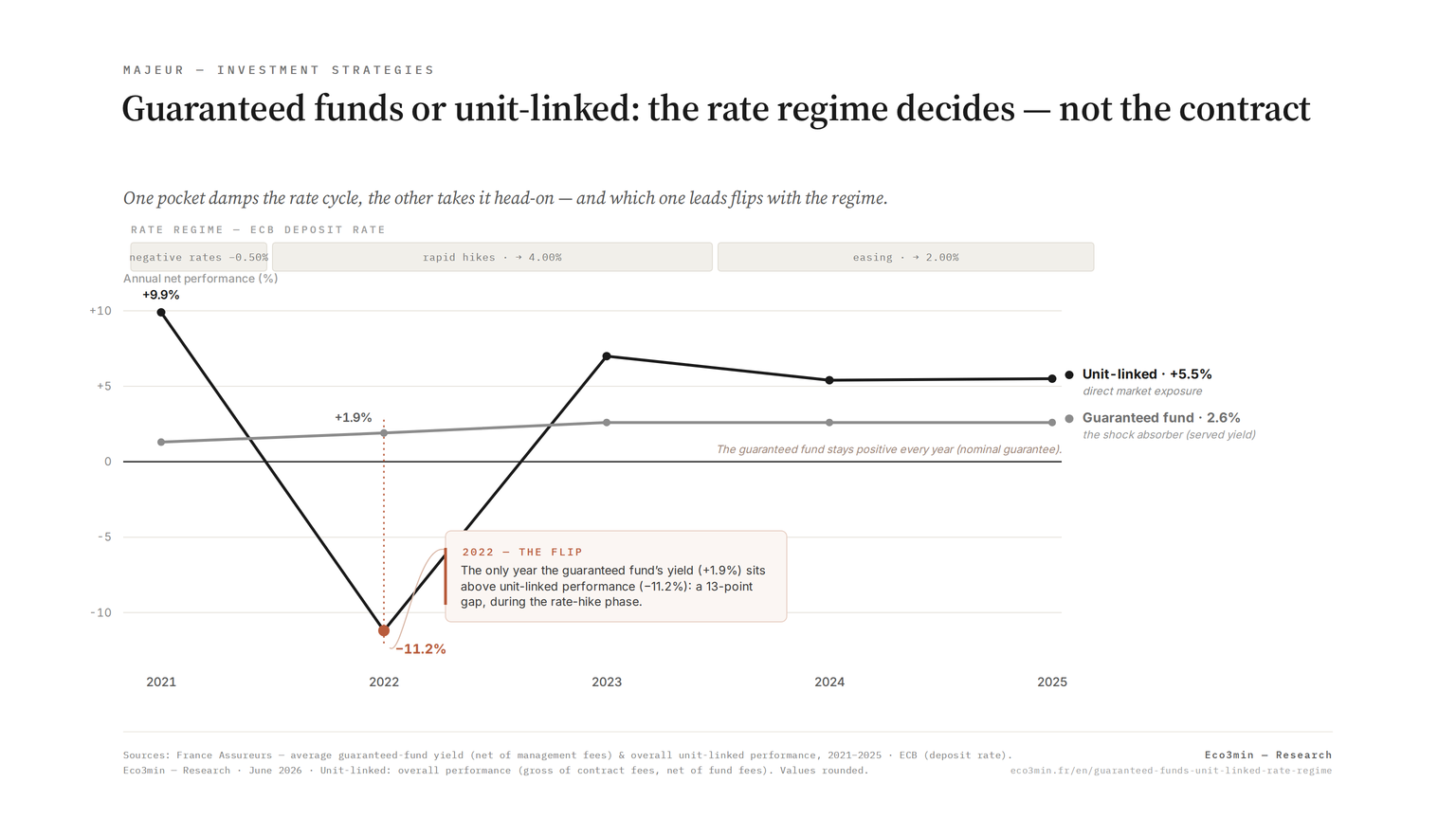
In a life-insurance-style contract, the guaranteed pocket and unit-linked holdings absorb the rate cycle at different speeds: one smooths the move through the insurer’s bond portfolio and reserves, the other takes the market in directly. The rate regime, not the contract, governs the gap.
TL;DR
Inside one life-insurance contract, the guaranteed pocket and unit-linked holdings absorb the same rate cycle at two speeds: one smoothed through bonds and reserves, the other marked to market daily.
- The wrapper sets only the tax and inheritance frame and the menu of supports; the risk and responsiveness come from the chosen mix of pockets, not the contract's name or fee schedule.
- The guaranteed pocket still concentrates roughly 70% of euro life-insurance assets and credits a yield that can no longer fall in nominal terms once attributed (the ratchet effect).
- For 2025, France Assureurs put unit-linked overall performance at about 5.5% on average (4.7% net of contract fees) against 2.6% for guaranteed funds; in 2022, those same unit-linked supports fell while guaranteed funds stayed positive.
- Insurers drew on smoothing reserves through the transition: the industry's profit-sharing buffer fell from about 4.5% of assets at end-2023 to around 3.7% at end-2025.
Comparisons of savings contracts tend to turn on cost: the best contract is framed as the cheapest. That reading misses the more important point. Inside a single life-insurance-style contract, two engines sit side by side and respond on different clocks. The guaranteed pocket rests on the insurer’s bond portfolio and its reserves: the credited yield is smoothed, and it tracks the rate cycle with a lag measured in years. Unit-linked holdings, by contrast, contain funds or ETFs whose value absorbs the market directly, with no buffer. What separates these two behaviours is not the contract itself but the rate regime. This article describes how each pocket behaves as rates rise, plateau or fall — without designating which one would suit any particular saver. Companion analysis: how tax-deferred accounts trade taxes over time.
The wrapper is not the investment
Euro-denominated life-insurance savings remain one of the largest single pools of household financial wealth in the euro area, and that sheer scale sustains a stubborn confusion. People speak of the “return on the savings contract” as though it were an asset with a performance of its own. It is not. A life-insurance contract is a wrapper — a legal and tax envelope — inside which supports of radically different nature coexist. Judging two contracts on their headline fee level, or on the rate posted by a guaranteed fund, is like rating a house on the colour of its façade while ignoring what it shelters. Related coverage: the tax envelope around a contract.
Inside that wrapper, savings split into two families of support. First the guaranteed fund, on which the insurer guarantees the capital paid in: the so-called secure pocket, which still concentrates roughly 70% of euro life-insurance assets. Then unit-linked holdings, which house fund units, ETFs, equities, listed or unlisted property, with no capital guarantee at all: the value of this pocket follows that of the underlying markets. A single contract can hold both, in freely chosen proportions, and it is precisely this coexistence that makes the object hard to read. The wider context: what a guarantee in euros is worth in purchasing power.
The consequence is that any reasoning conducted at the level of the wrapper is almost always ill-posed. The useful question is not “is life insurance a good investment?”, but “how does each of the two pockets behave, and on what logic?”. That is the subject of this cluster, of which this article is the entry point. To situate the contract among other savings vehicles, the broader treatment of allocation strategies read through the macro regime sets the wider frame; here we stay inside the contract.
The stakes go beyond documentation. As long as the two pockets are conflated, the saver attributes to the contract properties that in fact belong to its supports — and draws faulty conclusions about the risk being carried or the responsiveness of the savings. Telling the two engines apart, and grasping what makes them diverge, is the precondition for reading correctly what one holds. And the variable that drives them apart, as we shall see, is neither the contract nor the fees: it is the level and direction of interest rates. A complementary angle: The Fee Stack in Variable Annuities: M&E Charges, Riders, and Subaccount Costs.
Consider what the conflation conceals. A saver who holds, say, two-thirds of a contract in the guaranteed pocket and one-third in equity unit-linked supports carries a blended risk that lives entirely in that split, not in the contract’s name or its fee schedule. Move the same money to a contract with a different mix and the risk changes, though the wrapper is unchanged; keep the mix and switch wrappers and the risk is identical, though the brand differs. The wrapper sets the tax and inheritance frame and the menu of available supports; the risk and the responsiveness come from the chosen mix of pockets. Reading the contract at the wrapper level loses exactly the information that matters most.
Why, then, does the public debate fixate on cost? Because fees are visible, comparable and quantifiable: a management-fee rate can be displayed, ranked and put into competition. The transmission mechanics of rates, by contrast, are invisible and deferred, and so absent from comparison tables. Fees deserve attention — they erode the net return on every support, and a heavily loaded contract can wipe out a substantial share of performance — but they belong to the wrapper and the distributor, not to the behaviour of the pockets. Reducing the choice of a contract to its fee schedule optimises the margin while ignoring the engine. The order of questions matters: understand the two pockets first, weigh the fees second. Further detail: Target-Date Funds vs Self-Directed Portfolios: The Mechanics of a Delegated Glide Path.
The guaranteed fund: a constructed yield, not a passive one
The first reflex is to picture the guaranteed fund as an enhanced savings account whose rate would mirror the year’s bond market. That image is misleading. The yield credited by a guaranteed fund is not the immediate reflection of a market: it is constructed by the insurer, out of a bond portfolio assembled over many years and a set of reserves designed to dampen the swings. Related work: What Guaranteed Savings Products Have Paid: Fixed Annuity and Stable Value Yields Through the Rate Cycle.
The portfolio first. An insurer holds a mass of bonds bought at different dates, at different rates. Each year, only a fraction of that stock matures and is replaced with securities at prevailing conditions. The average yield of the whole therefore moves slowly, by inertia, in step with the pace of renewal. This is the stock effect, and it is the first source of the smoothing through insurer reserves that this cluster details in its foundation article.
The reserves next. In good years, the insurer is not obliged to redistribute the entire income earned. It can set part of it aside, in a regulated provision, and release it later, when the portfolio’s income softens. This device lets it flatten the path of credited rates: the posted yield varies little from one year to the next, where a bond ETF held directly would pass each market move straight through. The counterpart of that stability is that the income distributed is decoupled, at least in part, from the actual performance of the year just ended.
This mechanism produces a characteristic behaviour: the credited yield reprices with a lag. When rates rise sharply, the guaranteed fund barely moves, because most of its portfolio stays invested in older low-coupon bonds; it takes several years for gradual renewal to lift the average yield. The logic of that temporal lag — distinct from the smoothing through reserves, even if related to it — is treated separately in the analysis of a credited yield that reprices with a lag.
Recent figures illustrate this double effect. After a low of around 1.3% in 2021, the average credited yield on euro guaranteed funds climbed back to about 1.9% in 2022, then 2.6% in 2023 and 2024, and 2.6% again for 2025 — a third consecutive year at that level, according to the France Assureurs report published in March 2026. This recovery is the deferred translation of the rise in bond yields that began in 2022: the insurer invested its inflows and maturing proceeds into better-paid securities, and the portfolio’s average yield converged slowly towards those new levels. Slowly: market rates rose mostly in 2022 and 2023, yet the guaranteed fund only reaped the benefit in 2024 and 2025.
That recovery carried a hidden cost. To support their credited rates through the transition, many insurers drew on their smoothing reserves. The industry’s profit-sharing buffer, which holds this deferred income, fell from roughly 4.5% of assets at the end of 2023 to about 4% at the end of 2024 and around 3.7% at the end of 2025. In other words, part of the rate posted in recent years came from reserves accumulated in fat years, not from current income alone. The buffer worked — at the price of a drawdown in the ammunition available for the next shocks.
There is a quiet redistribution embedded in this mechanism. Reserves released to a current saver were, in part, income withheld from earlier savers; reserves rebuilt today set aside income that current savers will not see this year. Smoothing therefore transfers return across time and, implicitly, across cohorts of policyholders. None of this is hidden in any deceptive sense — it is the regulated logic of a mutualised buffer — but it means the credited rate of a given year is a managed distribution decision as much as a measurement of that year’s earnings. The number that lands on the statement is the output of a policy, not a thermometer reading.
The slowness of this pocket is not a fixable flaw: it is written into its structure. To guarantee capital at all times and meet its prudential requirements, the insurer holds long-duration bond portfolios whose average maturity runs into years and only a fraction of which turns over each financial year. That duration sets the tempo: a portfolio that renews slowly cannot, by construction, track market rates quickly. As for the reserves, they are not bottomless. Their steady decline since 2023 is a reminder: a buffer that is repeatedly tapped eventually thins, and an insurer that had exhausted its provision would be forced to credit close to the current income of its portfolio, with no further room to smooth. Damping has a limit, which forbids treating it as unconditional protection.
One last trait completes the picture: the ratchet effect. Once a yield is attributed and the interest credited, it is definitively acquired; the accumulated capital can no longer fall in nominal terms. That irreversibility, combined with smoothing, explains why the guaranteed fund resembles no market support. It is not the gross performance of a given year that defines it, but the damping mechanism that sets it apart from a unit-linked holding.
Unit-linked: direct exposure, no buffer
At the other end of the contract, the logic inverts completely. Choosing a unit-linked holding means accepting that the value of this pocket moves with the market, with no cushion, no reserve, no ratchet. Behind the label sit very different supports — equity funds, index ETFs, bond funds, listed property or unlisted real estate — united by a single common feature: the absence of a capital guarantee.
The implication is direct and often underestimated: what drives a unit-linked holding’s return and risk is not the wrapper but its contents. Life insurance adds only a tax and inheritance layer here; it changes neither the risk nor the behaviour of the underlying support. A bond ETF held as a unit-linked support will pass a rate rise through exactly as the same ETF held in a brokerage account: its value falls when rates rise, climbs when they ease, and does so within the day. An equity fund will follow the cycle of earnings and multiples. The wrapper smooths nothing. That is the whole point of the article devoted to the direct exposure of unit-linked holdings, which details the behaviour of the main families of support.
Performance figures make the point bluntly. For 2025, France Assureurs put the overall performance of unit-linked holdings at about 5.5% on average (gross of contract fees, net of fund fees), or 4.7% net of contract fees, against 2.6% for guaranteed funds. The gap appears to argue for unit-linked — but that reading is precisely the one to distrust. This performance depends entirely on the composition of the pocket and the year considered. In 2022, when rates jumped and both bond and equity markets fell, these same supports recorded marked declines, where the guaranteed fund still posted a positive rate. The superiority of one pocket over the other is not a stable attribute: it changes with the regime. Related material: the regime sensitivity of investment vehicles.
This dependence on contents breaks down into as many behaviours as there are families of unit-linked support. A bond support reacts to rates mechanically and immediately, in the opposite direction to their move. An equity support responds more to the earnings cycle and to the compression or expansion of valuation multiples, which themselves depend partly on the level of rates. A listed-property support takes in rate-driven repricing quickly, while unlisted real estate passes it through with a lag specific to its appraisal methods. Detailing these reactions lies beyond this article, which keeps to the common principle: in a unit-linked holding, the risk and the responsiveness come from the support, and the wrapper changes nothing.
The 2022 episode supplies the mirror image of 2025. That year, the simultaneous rise in rates and retreat in equity markets pushed almost every unit-linked support lower, bond and equity alike, while guaranteed funds still showed a positive, if modest, yield. A saver judging the two pockets on that single year would have drawn exactly the opposite conclusion to the one 2025 would suggest. It is the clearest demonstration that comparing raw performance, with no mention of the regime, teaches nothing transferable: it describes a snapshot, not a property.
Here lies the founding asymmetry of the contract. The guaranteed fund defers and damps the rate shock; the unit-linked holding takes it in immediately and in full. One turns an abrupt move into an adjustment spread over several years; the other passes it through as is, up and down alike. Neither damping nor direct exposure is “better” in the abstract. They describe two opposite ways of undergoing the same rate environment — and it is that environment, precisely, that decides which of the two mechanics proves favourable or punishing at any given moment.
We can now state the central thesis of this cluster. The difference in behaviour between guaranteed funds and unit-linked holdings owes nothing to the contract chosen, the fee level, or the quality of the insurer. It owes everything to a single variable: the interest-rate regime. Depending on whether rates rise, plateau or fall, the two pockets diverge predictably, and the nature of that divergence changes with the phase of the cycle.
The mid-2026 backdrop offers a textbook case, because it compresses the cycle’s three phases into a few years. The European Central Bank raised its deposit rate to 4.00% by autumn 2023, after a tightening begun in summer 2022. It then opened an easing cycle from June 2024, lowering that rate through eight successive decisions to 2.00% by June 2025. Then, on 11 June 2026, it raised its three key rates by 25 basis points — taking the deposit rate to 2.25% with effect from 17 June — its first hike since 2023, prompted by a re-acceleration of inflation (euro-area HICP at 3.2% in May 2026, the highest since September 2023) tied to an energy shock. Rise, plateau-and-fall, then a turn back up: the full sequence fits inside a single holding horizon. A second 25-basis-point hike followed, taking the deposit rate to 2.50% with effect from 16 September 2026 (ECB). A related perspective: Beneficiary Designations, the Step-Up in Basis and the 10-Year Rule.
Take each phase in turn. In a regime of rapidly rising rates — the 2022-2023 situation — the guaranteed fund shows great inertia. Its portfolio remains mostly composed of older low-coupon bonds; the credited yield barely moves. Meanwhile, unit-linked bond supports absorb the fall in market prices triggered by the rate rise, and equity supports suffer the compression of valuations. The guaranteed pocket then looks protective — not because it anticipated anything, but because its buffer turns an instantaneous shock into an apparent non-event.
In a regime of plateau then decline — the 2024-2025 situation — the mechanics continue but partly invert. The guaranteed fund finally benefits, with a lag, from the earlier rise in rates: its average yield converges towards the higher coupons of securities bought since 2022, which explains the move to 2.6%. But just as it harvests the fruit of the rise, market rates are already easing. Unit-linked bond supports, for their part, rebounded as soon as the easing began, immediately pricing the rate fall into their securities. The buffer that had protected in the rising phase now penalises: it also delays the capture of the benefit and keeps the credited yield below what a portfolio rebuilt at current rates could offer.
In a regime of upward turn — the phase opened in June 2026 — the gap replays. The ECB’s new hike will first weigh on the value of unit-linked bond supports, which pass it through within the day, while the guaranteed fund stays almost still, still digesting the previous cycle. The lag is not a one-off delay to be caught up: it reconstitutes itself at every inflection, because the renewal speed of the insurer’s portfolio is structurally slow. That is why the guaranteed fund never durably “catches” market rates: it chases them permanently, a few years behind.
This asymmetry of timing is the heart of the matter. With a unit-linked holding, the saver feels the rate move the instant it happens, in full; with a guaranteed fund, the same move is felt spread over several years and at reduced amplitude. The total taken in over a complete cycle may be close — income exists in both cases — but its timing differs radically, and it is that timing that decides the lived experience. Someone checking the value of their contract in the thick of a rate rise will see a unit-linked bond support down and a guaranteed fund steady; someone checking two years later, in the easing phase, will see the opposite. The same rate reality produces two opposite narratives depending on the moment of observation and the pocket observed.
The magnitude of the gap, not only its sign, is worth holding in mind. A market rate that moves two percentage points in a year passes almost entirely and at once into the value of a unit-linked bond support; the same move reaches a guaranteed fund’s average yield only as fast as its portfolio renews, often a fraction of that move per year. The guaranteed pocket thus behaves like a heavily filtered version of the rate signal — most of the amplitude removed, most of the timing delayed. A unit-linked support is the raw signal. Describing one as calm and the other as volatile mistakes the filtering for a property of the asset, when it is a property of the structure that holds it.
One point is worth underlining to avoid a misreading: this lag is not a signal of direction. The guaranteed fund predicts nothing and positions itself for nothing; it passively records, with inertia, the history of past rates as inscribed in its portfolio. Likewise, the unit-linked holding does not bet on the future; it reflects the present state of the market. Neither pocket carries predictive information about the rest of the cycle. Their divergence describes different transmission speeds of the same past, not competing anticipations of the same future — an essential distinction, lest one read into the behavioural gap some supposed foresight of one pocket or the other.
This dependence on the regime is not specific to life insurance: it structures the behaviour of most asset classes, as documented across the contents attached to the sub-pillar on choosing investments across market regimes and rate cycles. What is distinctive about the life-insurance contract is that it houses, side by side within a single wrapper, a support that damps the regime and a support that mirrors it.
Two clocks, an illusion of stability
The smoothing of the guaranteed fund does more than damp rates: it shapes the saver’s perception of them. Because the credited yield varies little from one year to the next, the guaranteed pocket inspires a feeling of stability — partly founded, since the nominal does not fall, but partly deceptive, since that nominal stability can coexist with a silent real erosion. The stability one sees is not the same as the stability one owns.
The rate posted each January by insurers is, in this respect, an administered signal rather than a market truth. It results from internal trade-offs — how much to draw from reserves, how much to rebuild, how to stand against competitors — as much as from the portfolio’s actual income. That constructed character is in no way improper: it is the very definition of smoothing. But it means the posted rate does not directly report on the health of the underlying portfolio or on its capacity to hold that level in the following years. The same 2.6% can cover a portfolio in full recovery or reserves run down to keep up appearances one more year.
This is why two contracts posting the same headline rate can be in opposite underlying conditions. One insurer may reach 2.6% with a portfolio steadily reloading at higher coupons and reserves intact; another may reach the same figure by drawing down reserves to stay competitive, with a portfolio that has not yet reloaded. The posted rate alone cannot tell them apart. Over a few years the difference surfaces — the second insurer runs short of buffer and the gap opens — but in any single year the two look identical on the only number most savers ever see. The smoothing that delivers comfort also delivers opacity.
The unit-linked holding, conversely, offers no comfort of signal. Its value fluctuates, visibly, at each statement. That displayed volatility is often experienced as risk, when it is merely the transparent translation of the underlying market. The result is a cognitive asymmetry: the volatility of the unit-linked holding is felt because it is visible, whereas the real erosion of the guaranteed fund passes unnoticed because it is masked by the nominal guarantee. The saver therefore spontaneously overrates the risk of the exposed pocket and underrates the real risk of the guaranteed pocket — not through a failure of judgement, but because the two pockets do not render their risks equally visible.
This asymmetry of visibility explains much of the misunderstanding around life insurance. The near-zero real return on guaranteed funds in 2024 — about 0.19% after social levies and inflation, according to Facts & Figures — stirred little reaction, because it showed in positive nominal terms; an equivalent fall in a unit-linked holding would have been perceived as a loss. Yet from the standpoint of purchasing power, it is the silent erosion that eats into capital, not the visible fluctuation that ends up recovering over a cycle. Reading the contract honestly means correcting that illusion: judging each pocket by its real risks, whether displayed or concealed, and not by the comfort of reading it provides.
This inequality of visibility carries a practical implication for anyone reading an annual statement. The credited rate of a guaranteed fund gains from being set against two markers the bare figure conceals: the inflation of the period, which determines the real return, and the state of the insurer’s reserves, which conditions the sustainability of the posted level. A flattering rate propped up by a depleting provision does not carry the same weight as an identical rate backed by a portfolio that is rebuilding. Neither piece of information appears in the posted yield; both matter in assessing its real meaning.
The point is not to flip the prejudice the other way — to brand the guaranteed fund “dangerous” and the unit-linked holding “clear-eyed”. The two pockets carry risks of different nature: real-return risk and reinvestment risk for one, market and volatility risk for the other. The aim is to see them as they are, at equal visibility. The role of a media outlet is not to prescribe the trade-off, but to make legible risks that the very structure of the contract tends to present unequally.
Believing that a guaranteed fund “protects against rates” and a unit-linked holding “benefits from rates” is a frozen reading. In reality, the buffer of the guaranteed fund protects in a rising phase but deprives in a falling one, while the direct exposure of a unit-linked holding penalises when rates rise and benefits when they ease. The sign of the advantage depends on the regime — and that regime changes, as the June 2026 turn showed. What the guarantee costs precisely, and the confusion between nominal capital and purchasing power, are treated in the analysis devoted to the cost of the capital guarantee.
What the guarantee actually protects
The capital guarantee is the guaranteed fund’s central selling point, and the source of the “safe versus risky” reading that pervades the debate. It is real: capital paid in cannot, in principle, fall in nominal terms, and the ratchet effect makes gains definitively acquired. But that protection carries a cost and a limit that commercial comparisons rarely spell out, and that this cluster examines in detail.
The cost first. To guarantee the nominal at all times and meet its prudential constraints, the insurer invests cautiously, weighted towards high-quality bonds. That caution mechanically bounds the yield: one cannot simultaneously guarantee capital each year and capture the full risk premium of volatile assets. The capped yield is the counterpart of the guarantee, not a shortfall in management.
The limit next, subtler. The guarantee covers nominal capital, not purchasing power. In an inflationary regime, capital preserved in nominal terms can lose ground in real terms, year after year. The arithmetic is telling: according to Facts & Figures, the average return on guaranteed funds, net of social levies and inflation, settled at only about 0.19% in 2024 — close to zero — and it was clearly negative during the high-inflation episodes of 2022-2023, when credited rates of 1.3% to 1.9% faced markedly higher inflation. The protection sought then worked in reverse: capital, guaranteed in nominal terms, eroded in real ones.
This nuance does not disqualify the guaranteed fund; it places its guarantee in its exact frame. Protecting the nominal is one thing, preserving purchasing power another, and only the rate-and-inflation regime determines whether the two coincide. For the same reason, the allocation role a guaranteed fund can play once it pays a positive real rate belongs to a distinct discussion, developed separately in the analysis of the guaranteed fund compared with a bond ETF and, from a portfolio standpoint, in the reference content on the guaranteed fund as a savings base. The present article confines itself to the point that “guaranteed” does not mean “free of real loss”.
Three layers stack within any life-insurance contract, and confusing them produces misleading comparisons. The first layer is the wrapper: its tax treatment, its liquidity, its inheritance terms. The second is the contents: guaranteed fund, unit-linked holdings, and the nature of the supports housed in the latter. The third is the rate-and-inflation regime, which determines the actual behaviour of each support. A rigorous comparison proceeds layer by layer, attributing to the wrapper nothing that belongs to the contents, and to the contents nothing that belongs to the regime.
Wrapper versus contents, and the moving boundary of supports
The three-layer frame invites widening the lens beyond the single life-insurance contract. For the same question — what determines the result, the wrapper or the contents? — arises as soon as one compares savings vehicles. The same ETF held in a life-insurance contract, an equity savings plan or an ordinary brokerage account will not produce the same after-tax result, nor the same liquidity, even though the underlying support is identical. The wrapper does not change the nature of the asset; it changes the tax and inheritance treatment of what the asset earns. This interaction between wrapper, contents and regime is the subject of the article showing when the wrapper matters as much as its contents.
The boundary internal to the guaranteed fund itself is, too, less sharp than it appears. The classic guaranteed fund is no longer the only format. Insurers have built so-called dynamic euro funds, blending in a share of riskier assets to aim at a higher yield, and term-guarantee vehicles, which guarantee capital only at the end of a holding period rather than at every instant. These variants redistribute the basic trade-off between guarantee and yield, and their sensitivity to the rate cycle differs from that of the standard guaranteed fund. What these structures change is treated in the article on new-generation euro funds.
The existence of these hybrid formats confirms the thesis rather than complicating it: the guaranteed-versus-unit-linked opposition is not a wall but a gradient. Between permanent guarantee and bare exposure, intermediate structures arbitrate the guarantee-yield couple and responsiveness to the rate regime differently. That this range broadened precisely as rates climbed is no accident: a higher-rate environment makes it possible again to fund a share of risk while keeping partial protection, which the years of zero rates made difficult.
This shift in supply also reflects a flow reality. France Assureurs data show net inflows into euro life insurance running well into the tens of billions in 2025, with inflows into the guaranteed pocket turning positive again for the first time in several years, after net outflows in 2024, while unit-linked supports drew record amounts. This twin dynamic — savings returning towards the guaranteed fund as it pays again, and persistent appetite for unit-linked exposure — shows that the two pockets do not compete head-on: they answer different functions within the same contract.
A structural choice, felt through a global cycle
The guaranteed fund is something of an oddity. The idea that a majority share of households’ financial savings can sit on a capital-guaranteed support, managed by an insurer that smooths its yield, is far more common in some euro-area systems than in Anglo-Saxon ones, where long-term household savings tend to be invested more directly in market supports — equities, funds, often through retirement schemes — with greater acceptance of volatility and no equivalent institutional buffer. The fact that close to 70% of euro life-insurance assets still sit in guaranteed funds has no direct counterpart in those market-led systems.
This difference in architecture carries an often-overlooked consequence: the same global rate cycle does not transmit to households the same way across systems. When the ECB raises or lowers its rates, a saver exposed to a guaranteed fund feels that move only in deferred and damped form, through the intermediation of the insurer’s portfolio. A saver exposed directly to markets takes it in at once, in the value of their supports. The rate regime is the same; its translation into household wealth depends on the layer of intermediation interposed between the monetary decision and the savings.
The guaranteed fund thus acts as a discreet macroeconomic buffer. By smoothing the transmission of rates to millions of contracts, it dampens the immediate sensitivity of household savings to central-bank decisions. That effect is the mirror, at the collective scale, of the one observed at the individual level: it protects against an abrupt reaction in shocks, but it also delays adjustment to new conditions. When rates rise durably, as since 2022, savings held in guaranteed funds take years to benefit; when they ease, they take as long to feel it. The buffer works in both directions, and always with a lag.
For the wider economy this damping cuts both ways. A large stock of smoothed savings makes household balance sheets less reactive to monetary policy in the short run, which can blunt one channel through which rate decisions are meant to transmit. It also means that when policy turns, as it did in June 2026, the savings tied up in guaranteed funds neither amplify the shock nor adjust quickly to it. The buffer that steadies individual statements steadies, in aggregate, a slice of the transmission mechanism itself — a feature with no equivalent in systems where household savings sit directly in markets.
This structural feature also lights up the recurring debate on redirecting savings. Policymakers regularly note that the abundant savings held in guaranteed funds largely finance debt, and wonder how to channel a share towards equity financing of firms — that is, towards unit-linked or comparable supports. That debate is not the subject of this article, and it cannot translate into an instruction for an individual saver; it simply recalls that the boundary between the two pockets has a dimension reaching beyond the contract, all the way to the financing of the economy.
For the saver, the useful takeaway from this detour is more modest but more operational. The very nature of the guaranteed fund — a collective buffer smoothing a global cycle across millions of contracts — explains why it can, by construction, neither protect instantly nor benefit instantly from rates. That property is neither good nor bad in the abstract; it is structural. Grasping it means ceasing to expect from the guaranteed fund a responsiveness it will never have, and from the unit-linked holding a stability it cannot offer. Each does what its structure allows, and the rate regime decides the rest.
Guaranteed funds and unit-linked holdings are not opposed as caution to daring, but as two clocks set to the same rate cycle running at different speeds.
Reading the contract by regime, not by fees
At the end of this path, the reading grid flips. The public debate on life insurance favours fees and contract rankings; it is the easiest angle to quantify, but the least explanatory. Fees matter — they cut the net return, and a loaded contract can erase a substantial share of a support’s performance. But they do not explain why the two pockets of one contract diverge, nor why that divergence changes sign across the cycle. Only the rate regime does.
The present moment makes that reading especially tangible. In mid-2026, the guaranteed fund is still harvesting, with a lag, the fruit of the 2022-2023 rate rise: its average yield, settled near 2.6%, has turned positive again in real terms for the best-managed contracts, for the first time in years. At the very same instant, the ECB has reopened a hiking cycle (June, then September 2026), which will first weigh on unit-linked bond supports before, perhaps, feeding a fresh round of deferred revaluation in the guaranteed fund. The contract has not changed; the regime is turning.
None of this points to an answer about which pocket to hold; it points to a better question. The right object of attention is not a ranking but the match between how a pocket transmits the cycle and the cycle one is actually living through — knowing that the cycle does not stand still. A reading anchored to today’s regime, treated as permanent, will mislead precisely because regimes turn, often more than once within a single contract’s life. The discipline this cluster argues for is to read the structure, not the snapshot.
The holding horizon adds a final layer to this reading. The average life of a life-insurance contract runs to well over a decade. Over such a horizon, a saver necessarily crosses several rate regimes — the 2021-2026 sequence, from the low to the two successive turns, is a compressed illustration. The deferral of the guaranteed fund and the immediacy of the unit-linked holding replay at every inflection, and what looks like an advantage at one moment can invert a few years later. Reasoning on a single phase of the cycle — the one lived at the moment of subscription — freezes a snapshot where the subject is a film. The regime reading only makes sense as a dynamic one.
This is where the saver gains from reasoning. Not by seeking the “best” contract in the abstract, but by understanding that each pocket encodes a specific way of crossing the cycle, and that the relative relevance of those two ways shifts with the regime. The satellites in this cluster each detail one cog: the smoothing through reserves, the lag in the credited yield, the direct exposure of unit-linked holdings, the cost of the guarantee, the interaction of wrappers, the new-generation formats. Taken together, they make a life-insurance contract legible for what it is — not an investment, but a wrapper housing two engines set to the same rate cycle at different speeds — without deciding for the reader which of those engines would serve their situation.
- Life insurance is not a homogeneous investment but a wrapper housing two pockets with opposite behaviour: the guaranteed fund, which damps the rate cycle, and unit-linked holdings, which take it in directly.
- A guaranteed fund’s yield is constructed, not passive: an old bond stock and smoothing reserves delay the reaction to rates by years — hence an average credited yield back to about 2.6% in 2025, echoing the 2022-2023 rise.
- The variable separating the two pockets is neither the contract nor the fees, but the rate regime: the buffer protects in a rising phase and deprives in a falling one, while direct exposure does the reverse.
- The capital guarantee covers the nominal, not purchasing power: in an inflationary regime, guaranteed capital can erode in real terms, as the near-zero real return of 2024 showed.
- The ECB’s upward turn in June 2026 (deposit rate to 2.25%, then 2.50% in September) reopens a cycle in which these behavioural gaps will replay between the two pockets.
Last updated — 7 October 2026
Disclaimer – Financial and Legal Information: The analyses, commentary, and content published on eco3min.fr are provided for informational and educational purposes only. They do not constitute investment advice or a solicitation to buy or sell financial instruments. Past performance is not indicative of future results. All investment decisions involve risk and are the sole responsibility of the reader. Data, charts and calculated series are provided as is and may contain errors or lag behind their source: check any figure against the primary source cited before relying on it. Content describing laws, regulations or contracts reflects the law as of its publication date and does not constitute legal or tax advice; applying it to a specific situation requires a qualified legal or tax professional.
Read next
Full pillar →Target-Date Funds vs Self-Directed Portfolios: The Mechanics of a Delegated Glide Path
A target-date fund is sold as a simple, set-and-forget win. It is first something narrower: a delegated glide…
What Guaranteed Savings Products Have Paid: Fixed Annuity and Stable Value Yields Through the Rate Cycle
US guaranteed savings products credit a rate that trails the bond market rather than tracking it. Through the…
Beneficiary Designations, the Step-Up in Basis, and the 10-Year Rule: How US Accounts Transfer at Death
At death, most US financial accounts pass outside the will, straight to a named beneficiary, under tax rules…