Equity Momentum Strategy: Reading the Signal in 2025
Equity momentum strategy: reading the signal, limiting false starts and integrating it into an allocation framework against a backdrop of higher rates.

Equity momentum strategy: reading the signal, limiting false starts and integrating it into an allocation framework in 2025.
TL;DR
Equity momentum trends are shorter and more concentrated: the Nasdaq 100 logged over twenty daily ±2% moves from January to November 2025 while the VIX often stayed below 18.
- A narrow group of technology and AI names drives much of 2025's US index performance, so flows concentrate and trend breadth narrows.
- Higher policy rates tighten selection between firms: those earning a return on capital above its cost draw flows, while leveraged, capital-intensive models grow more rate-sensitive.
Equity momentum: why this topic is back in focus
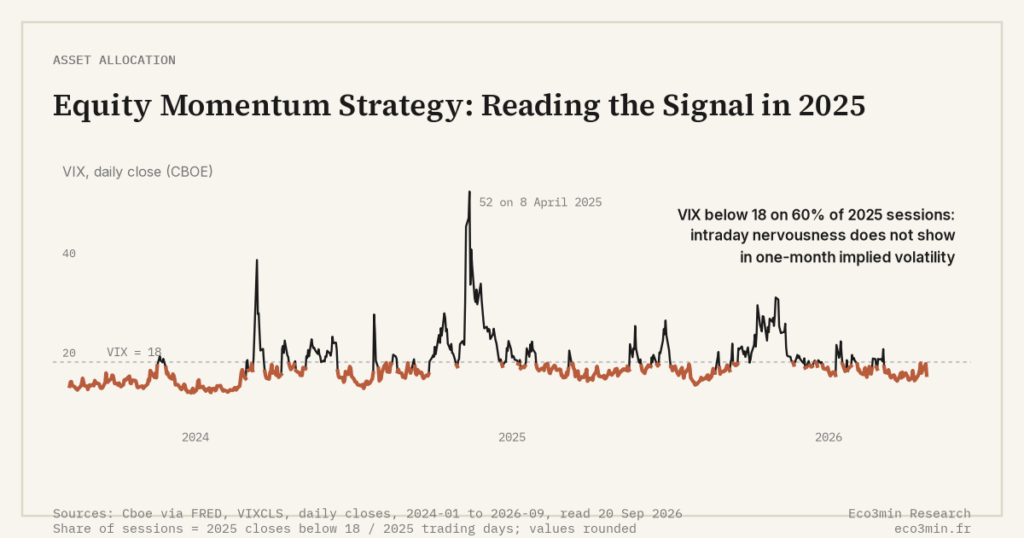
Since early 2025, global equity indices have alternated between rapid rallies and sharp corrections within a few sessions. Between January and November 2025, the Nasdaq 100 recorded more than twenty daily moves above ±2%, a pace close to that seen in 2020–2022, even as implied volatility (VIX) often stayed below 18. In other words, trends still exist, but they are shorter, more nervous and harder to exploit. Underlying data: The VIX data series.
In this context, the equity momentum strategy regularly returns to the debate. Its general principle consists in observing price dynamics, favouring assets already in trend, without relying exclusively on detailed fundamental analysis. The known risk: applied mechanically or in isolation, momentum can lead to acting too late in the price cycle. Related deep-dive: our study on aligning portfolio exposure with the economic cycle.
To place this topic in a broader analytical frame, it is useful to link it to the general portfolio construction logic presented on the reference page dedicated to investment strategies and their economic foundations. The aim here is not to promote a method, but to analyse how price dynamics interact with a higher-rate environment and more selective liquidity.
The focus is in particular on a frequently underestimated point: the actual duration of trends when the cost of capital is no longer neutral.
Exploiting momentum does not depend solely on the quality of the signal, but above all on the ability to maintain a stable decision framework when trends fragment and false signals multiply.
This dimension is analysed in depth in the reference study on investment discipline, which forms the common foundation of the strategies covered on Eco3min.
The trigger: a market that rewards winners faster and more sharply
Two recently observed developments explain the renewed interest in momentum:
- Greater concentration of performance: in 2025, a significant share of the major US indices’ performance comes from a narrow group of names, mainly tied to technology and AI. This dynamic extends a trend visible for several years, but with reinforced intensity.
- More frequent sector rotations: over the past twelve months, several sectors have alternated rapid rises and sharp corrections. The maintenance of high policy rates exerts stricter selection on growth promises.
This phenomenon fits within a broader macro frame, where the cycle’s structure is already weakened by the signals sent by the inverted yield curve, a key indicator of economic transition phases and risk reallocation.
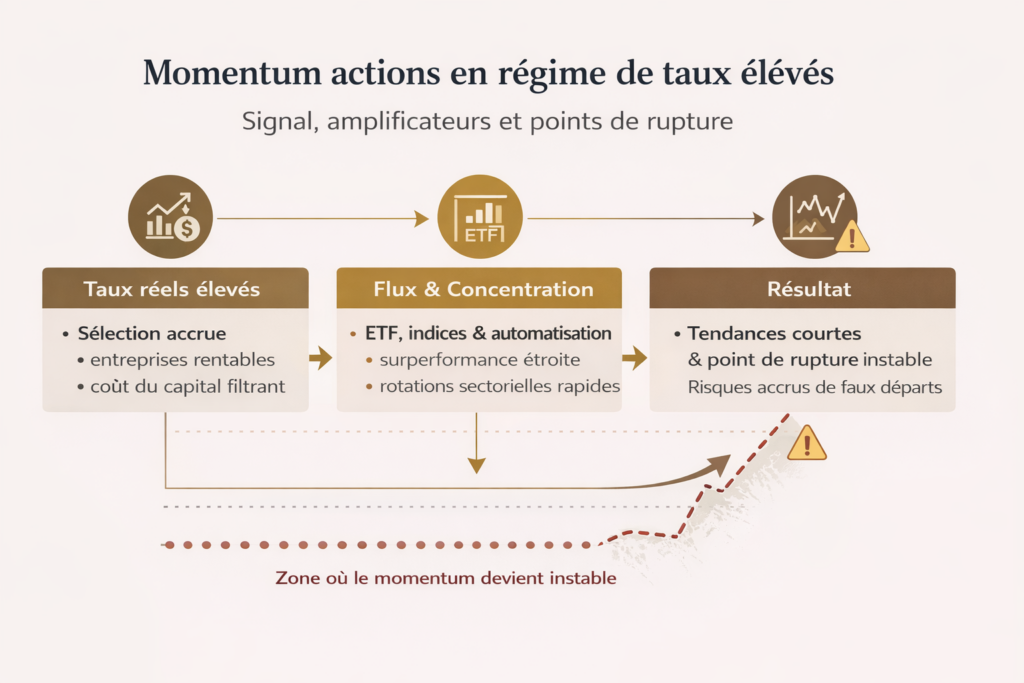
In this context, uniform exposure to the entire market becomes less readable in terms of contribution to performance. Conversely, following each short-term move increases the risk of overreaction. Momentum then appears as a tool for analysing relative dynamics, provided it is placed within a risk management framework.
How equity momentum works in theory
In its simplest reading, momentum rests on the observation that assets that have recently outperformed tend, statistically, to extend their trajectory over certain periods. Over long horizons, numerous academic studies have documented the existence of this factor across the major equity zones since the 1990s.
Three parameters, however, condition the reading of the signal:
- The observation period: too short a horizon mainly captures market noise, while too long a horizon reacts late to cycle breaks.
- The adjustment frequency: frequent revisions accentuate rotation costs and the risk of false signals.
- Exit modalities: how a relative deterioration is interpreted strongly influences overall volatility.
In a durably low-rate environment, synchronisation errors carried a limited cost. In 2025, with a higher cost of capital, flow reversals are faster and penalise poorly calibrated strategies more.
What consensus assumes and what the new regime reveals
A widespread reading considers momentum as a factor mainly effective in bull market phases fuelled by abundant liquidity. According to this approach, bond yields back to attractive levels would mechanically weaken price dynamics on equities.
This interpretation overlooks a central element: a higher-rate environment strengthens selection. Companies able to maintain profitability and growth despite a more constraining cost of financing become rarer, concentrating flows further. Momentum does not disappear but evolves into narrower and more unstable trends.
Underlying economic mechanisms: rates, flows and financial structure
1. The cost of capital as a structural filter
With policy rates stabilised at historically higher levels, the hierarchy between firms tightens. Heavily leveraged or capital-intensive models become more sensitive, while companies generating a return on capital above its cost concentrate attention.
2. The amplifying role of index flows
The rise of factor and thematic ETFs mechanically reinforces certain trends. When an asset enters statistically dominant segments, automatic flows can amplify the dynamic, before reversing during rebalancing phases.
3. A more uneven volatility regime
Since 2020, a sequence of macroeconomic and geopolitical shocks has installed a more irregular volatility environment. Trends persist, but their trajectory is less linear, complicating their reading without a structured analytical framework.
Frequent interpretation errors
- Equating momentum with emotional price-chasing, confusing an established trend with a simple technical rebound.
- Underestimating concentration, exposing an excessive share of risk to a narrow set of assets.
- Isolating past performance, without confronting it with liquidity or financing constraints.
In this context, momentum should be understood not as a standalone strategy, but as an analytical tool integrated into a broader decision architecture, where process consistency takes precedence over isolated optimisation.
Conclusion
The equity momentum strategy is neither a universal solution nor an obsolete factor. In the 2025 market regime, it retains analytical relevance provided it is integrated as one signal among others, within a coherent allocation framework oriented towards risk management rather than the search for episodic performance.
Key points:
- The return of durably positive rates strengthens equity market selectivity.
- Momentum evolves towards more concentrated and more unstable trends.
- Performance dispersion and macro cycle structure largely condition its effectiveness.
This content is provided for economic and financial analysis purposes. It does not constitute investment advice or a personalised recommendation.
Last updated — 20 September 2026
Disclaimer – Financial Information: The analyses, commentary, and content published on eco3min.fr are provided for informational and educational purposes only. They do not constitute investment advice or a solicitation to buy or sell financial instruments. Past performance is not indicative of future results. All investment decisions involve risk and are the sole responsibility of the reader.
Read next
Full pillar →Beneficiary Designations, the Step-Up in Basis, and the 10-Year Rule: How US Accounts Transfer at Death
At death, most US financial accounts pass outside the will, straight to a named beneficiary, under tax rules…
The Fee Stack in Variable Annuities: M&E Charges, Riders, and Subaccount Costs
A variable annuity does not carry one fee, but a stack of them. Mortality and expense charges, subaccount…
The Conventional 401(k)-Match-First Funding Order: Where It Comes From, How It Works
The question of what order to fund accounts in usually draws a fixed list, presented as a rule…