Beneficiary Designations, the Step-Up in Basis, and the 10-Year Rule: How US Accounts Transfer at Death

At death, most US financial accounts pass outside the will, straight to a named beneficiary, under tax rules that depend on the account, not the estate plan. The tax fate of an inherited account turns less on the will than on which kind of account it is.
The beneficiary designation is the quiet instruction that overrides a will. And the tax treatment of what passes splits sharply, in ways that surprise many heirs, between a taxable account and a tax-deferred one.
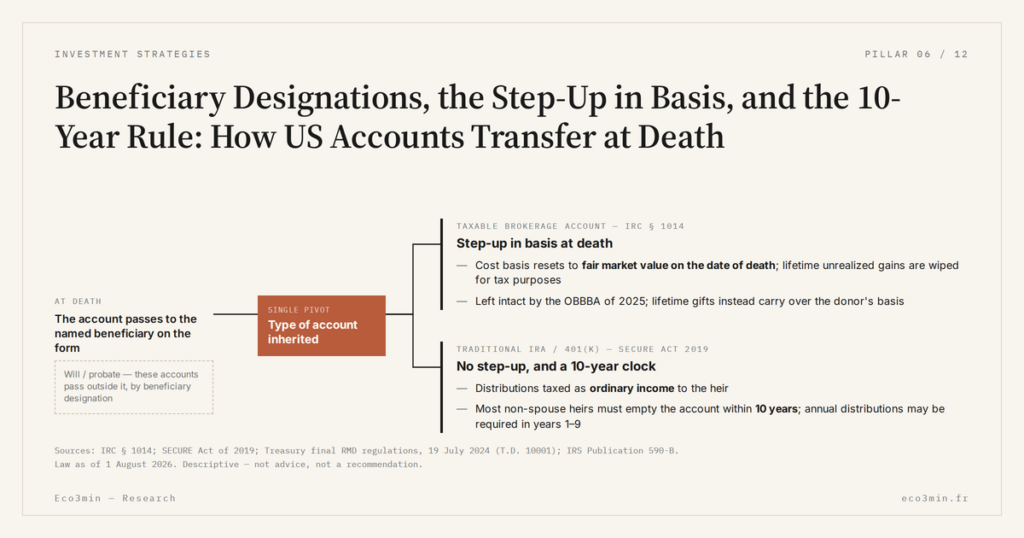
A beneficiary designation overrides the will and passes an account outside probate. What the heir owes then depends on the account type, not the estate.
- Taxable accounts get a step-up in basis at death: unrealized gains during the owner’s life are wiped, and the heir inherits at fair market value. OBBBA left this intact.
- Inherited traditional IRAs and 401(k)s get no step-up; distributions are ordinary income, and most non-spouse heirs must empty the account within 10 years (SECURE Act).
- The federal estate tax exemption is 15 million dollars per individual in 2026, made permanent by OBBBA and indexed for inflation; only estates above it owe the 40% tax.
The designation overrides the will
The starting point catches many families off guard: a will does not control a retirement account, an IRA, an annuity, or a transfer-on-death brokerage account. These assets pass by beneficiary designation, the form the owner filled out with the custodian, and they move outside probate directly to whoever that form names. A will can be meticulously drafted and entirely beside the point if the beneficiary form says something else. The form wins.
This separation is the heart of the mechanism. The account’s life, made of contributions and withdrawals, and its transfer at death, made of a beneficiary payout, follow different tracks. When the owner dies, the custodian does not read the will; it reads the designation on file and pays the named beneficiary. That autonomy is what lets an account pass to someone who is not an heir under the will, or split unevenly among heirs, subject to other legal limits. It is not the will that governs the transfer of these accounts, but the beneficiary form and the account’s tax character.
The reach of this rule is broad. Employer retirement plans, IRAs, annuities, and transfer-on-death or payable-on-death bank and brokerage accounts all move by designation, bypassing probate entirely. That is often an advantage: the beneficiary gains access quickly, without the delay and public record of a probate court. But the same speed removes a safety net, because there is no executor to catch an outdated form. A contingent beneficiary, named to inherit if the first has died, is the simplest protection against an account falling back into the estate, and it is the one families most often omit.
Because the designation operates outside probate, a stale form is one of the costliest oversights in estate planning. An ex-spouse still named on a 401(k), a predeceased beneficiary with no contingent named, an account opened decades ago and never updated: each can send money exactly where the owner no longer intended, and the will cannot fix it. The quiet form, not the signed will, is the document that actually moves the money, a point taken up in the short entry on why a beneficiary form overrides a will.
Two very different tax fates, by account type
What the heir owes depends almost entirely on whether the inherited account is taxable or tax-deferred, and the gap between the two is wide. The distinction, not the size of the account, is what sets the bill.
A taxable account, an ordinary brokerage account holding stocks or funds, receives a step-up in basis at death. The cost basis resets to the asset’s fair market value on the date of death, and every unrealized gain the owner accumulated over a lifetime simply disappears for tax purposes. An heir who sells the inherited shares shortly after death owes little or no capital gains tax, because the gain is measured from the stepped-up basis, not from what the owner originally paid. The OBBBA of 2025 left this treatment intact; lifetime gifts, by contrast, carry over the donor’s original basis and get no step-up. In the same vein: evaluating an online broker on the details.
A tax-deferred account, a traditional IRA or 401(k), works the opposite way. It receives no step-up. Distributions are taxed as ordinary income to the heir, exactly as they would have been to the owner, and the SECURE Act of 2019 compressed the timetable: most non-spouse designated beneficiaries who inherit after 2019 must empty the account by December 31 of the tenth year following the owner’s death. The stretch IRA, which once let a young heir draw the account down slowly over a lifetime, is gone for them. Under Treasury’s final regulations of July 2024, if the owner had already reached their required beginning date, the heir must also take annual required distributions in years one through nine, with enforcement beginning in 2025 and a missed-distribution penalty of 25%. A narrow group of eligible designated beneficiaries, chiefly surviving spouses, minor children, the disabled and the chronically ill, keep the lifetime stretch. It is here that the wrapper cannot be judged on its balance alone, a point that connects to how account types differ.
A single comparison shows how far the two fates diverge. Suppose an heir inherits 500,000 dollars in appreciated stock and, separately, a 500,000 dollar traditional IRA. The stock arrives with a stepped-up basis: sold the next day, it generates almost no taxable gain, and the full sum is available. The IRA arrives with no step-up and a countdown: every withdrawal is ordinary income, the balance must be gone within ten years, and annual distributions may be required along the way. Two accounts of identical face value, inherited on the same day, can leave the heir with materially different amounts after tax, purely because of how each is treated at death. That reset of the acquisition value is the piece doing most of the work here, and its scope after the 2026 reform belongs to the step-up in basis and its place in estate planning.
Spouses stand apart from all of this. A surviving spouse who inherits a retirement account can roll it into their own IRA and defer distributions on their own timetable, escaping the 10-year drain entirely, and can inherit taxable assets with the same step-up as any other heir. The sharp rules described here fall hardest on non-spouse heirs, typically adult children, for whom the compressed window and the ordinary-income treatment of a large inherited IRA can push taxable income into higher brackets during their own peak earning years.
The estate tax, and where it bites
Above these account-level rules sits the federal estate tax, and for 2026 its reach narrowed rather than widened. The One Big Beautiful Bill Act, signed in July 2025, set the exemption at 15 million dollars per individual, up from 13.99 million in 2025, made it permanent by removing the scheduled sunset, and indexed it for inflation from 2027. A married couple can shield 30 million dollars through portability. Only the value above the exemption is taxed, at a top rate of 40%. On the same theme: our mapping “Choosing investments in the light of the macro cycle”.
The exemption is unified across gifts and estates: lifetime gifts above the annual exclusion, 19,000 dollars per recipient in 2026, draw down the same 15 million dollar pool that shelters the estate at death. The generation-skipping transfer tax exemption is matched to the same figure. The word permanent deserves a caveat: it means only that no automatic sunset is written into the law, not that a future Congress cannot revisit it. The 2025 statute removed the scheduled drop to roughly 7 million dollars that had loomed over planning for years, replacing a cliff with a stable, indexed baseline.
The practical consequence is that the estate tax touches very few estates, while the account-level rules touch nearly every inheritance. For the large majority of families whose total estate sits below 15 million dollars, the federal estate tax is a non-event; what actually shapes the heir’s outcome is the step-up on taxable accounts and the 10-year drain on inherited retirement accounts. The estate tax is the ceiling few reach; the account rules are the floor everyone stands on. A handful of states levy their own estate or inheritance taxes at far lower thresholds, so a family untouched by the federal tax can still face a state one. The step-up in basis, notably, survived the 2025 law unchanged, preserving the single most valuable feature of inheriting a taxable account. A closer look: our decoding of the brokerage question.
Assuming an inherited IRA works like an inherited brokerage account is a costly error. A taxable account gets a step-up in basis, wiping out a lifetime of gains; a traditional IRA gets none, and every dollar withdrawn is ordinary income. And the 10-year rule does not always mean “wait until year 10”: when the owner died on or after their required beginning date, annual distributions are required in the intervening years, with a 25% penalty for missing them.
The account type, not the will, decides
The US mechanics of transfer at death combine three features that, together, make the account form the decisive document: assets pass outside the will by beneficiary designation, their tax treatment splits sharply between stepped-up taxable accounts and ordinary-income retirement accounts, and the estate tax bites only above a 15 million dollar exemption most families never approach. None of this is governed by the will. It is governed by which account holds the asset and by whose name sits on the beneficiary form. An estate plan that perfects the will while ignoring the designations and the account mix optimizes the document that matters least, and leaves the ones that decide the outcome to chance. This structural reading of the transfer sits alongside the broader reading of the life-insurance contract as a whole.
Last updated — 29 August 2026
Disclaimer – Financial Information: The analyses, commentary, and content published on eco3min.fr are provided for informational and educational purposes only. They do not constitute investment advice or a solicitation to buy or sell financial instruments. Past performance is not indicative of future results. All investment decisions involve risk and are the sole responsibility of the reader.
Read next
Full pillar →The Fee Stack in Variable Annuities: M&E Charges, Riders, and Subaccount Costs
A variable annuity does not carry one fee, but a stack of them. Mortality and expense charges, subaccount…
The Conventional 401(k)-Match-First Funding Order: Where It Comes From, How It Works
The question of what order to fund accounts in usually draws a fixed list, presented as a rule…
Roth IRA vs Traditional 401(k): Two Shelters, Two Clocks, Two Tax Treatments
A Roth IRA and a traditional 401(k) are both tax-sheltered, but they are not two flavors of one…