Investment Discipline and Long-Term Portfolio Performance

Long-term portfolio performance is not driven by stock selection or market timing. It is driven by decision discipline — the willingness to follow a framework when narratives become noisy. The mechanism is statistically documented, and yet it remains underapplied.
TL;DR
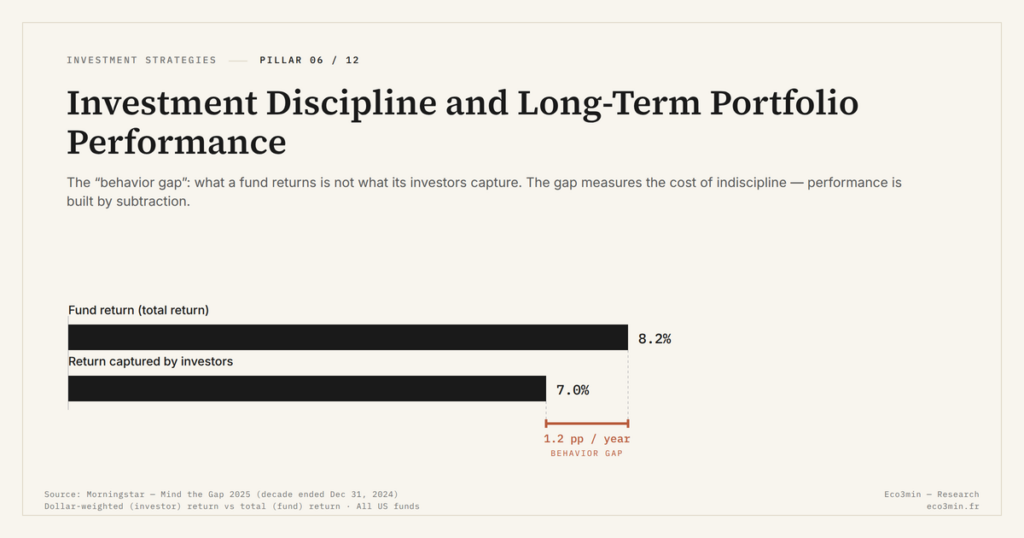
Morningstar's 'behavior gap', the yearly shortfall between fund returns and what fund investors actually earn, ran 1.5–3 points over 2014–2024 and compounds to 30–60% of final value over twenty years.
- DALBAR's 2024 QAIB puts the average US equity-fund investor about 4 points a year below the S&P 500 over 30 years, the gap traced mainly to ill-timed buying and selling.
- Three mechanisms drive the drag: behavioral biases (loss aversion weighs losses roughly twice as much as equivalent gains, after Tversky & Kahneman 1979), narrative pressure, and a decision horizon — often quarterly — misaligned with a multi-year holding horizon.
- Vanguard's Advisor's Alpha (2024) estimates rule-based rebalancing contributes 0.4–0.7 points a year, an effect it likens to a reduction in management fees.
Why discipline matters more than information in long-term performance
What separates long-term-resilient portfolios from those that drift is not the quality of the information they have. It is the discipline with which they apply a stable analytical framework.
Investment-decision discipline is a structurally underestimated source of long-term performance. While financial analysis focuses on identifying signals, predicting cycles, or optimizing allocations, the empirical evidence converges on one finding: the difference between resilient portfolios and those that drift lies less in the quality of information than in the rigor with which decisions are framed and executed across market regimes.
Behavioral biases, narrative pressure, and the temptation of reactive adjustment regularly erode the value of even the most sophisticated allocations. For a deeper dive: Investment Strategy vs Performance: Why Results Mislead Decisions. Investment discipline — defined as the ability to maintain a stable analytical framework, react only to material signals, and avoid emotional reallocations — is a multiplier on the long-term return of any strategy, regardless of underlying philosophy. This case study unpacks the structural mechanisms through which decision discipline determines long-term portfolio performance, the empirical evidence supporting them, and their implications for the framework an investor should apply across cycles.
Academic research and industry data converge: the gap between average mutual fund return (geometric mean) and average investor return in those same funds — the so-called “behavior gap” — has stood at roughly 1.5 to 3 percentage points per year over 2014–2024, depending on category (Morningstar Mind the Gap 2024 study). Over twenty years, the gap compounds into 30–60% of cumulative final value — solely from frequent, ill-timed reallocations. The differential does not capture stock-picking skill or asset-class choice: it isolates the destructive impact of indiscipline on otherwise sound strategies. The framework sits inside the broader analysis of economic-cycle analysis applied to portfolio positioning and intersects with the question of portfolio allocation architectures across regime assumptions.
- Discipline is a structural performance lever — the behavior gap (1.5–3 pp/year) measures the cost of indiscipline directly
- Three mechanisms drive it: stability of the analytical framework, avoidance of behavioral biases, alignment between decision horizon and investment horizon
- Discipline does not mean inertia — it means the deliberate choice not to react to signals that fail to justify reframing
What separates long-term-resilient portfolios from those that drift is not the quality of the information they have. It is the discipline with which they apply a stable analytical framework. The behavior gap of 1.5–3 percentage points per year identified by Morningstar (2024) measures the structural cost of indiscipline in real portfolios. Over 20 years, that drag compounds into 30–60% of cumulative final value — pure performance loss from poor decision sequencing. Three mechanisms account for it: behavioral biases (loss aversion, recency, herd behavior) that distort decisions, fragmented information environments that amplify narrative pressure, and misalignment between decision horizon (often quarterly) and investment horizon (often multi-year). The asymmetric outcomes of disciplined and indisciplined investors are documented across academic and industry research; what remains debated is the optimal calibration of discipline by investor profile and market regime — the question this case study explores. In the same vein: The sequencing risk over the holding period.
The core mechanism: how discipline becomes a performance lever
The path through which investment discipline translates into superior long-term performance follows a clearly identifiable causal chain whose central mechanism is reducing the volatility of decisions, not the volatility of markets.
Stable analytical framework → Reactions only to material signals (filtering noise) → Reduced decision frequency → Lower transaction costs + lower bias risk + horizon alignment → Performance gap accumulated over the cycle
Decision discipline is a structural lever, comparable in impact to asset allocation itself.
Trigger: stability of the analytical framework. The foundation of discipline is a stable, explicit, ex ante analytical framework — set out before the heat of decision-making. This framework defines material signals (those that justify reassessment), filters tactical noise (price moves, daily news, contradictory commentary), and clarifies decision criteria (when to rebalance, when to hold, when to revise the framework itself). Without this explicit anchor, investors fall back on heuristics shaped by recent emotions or dominant narratives — and decisions become a function of available attention, not analysis. The literature on robust investment processes (institutional consensus from CFA Institute, EDHEC research) converges: documented investment policies (Investment Policy Statements) that explicitly define cycles and rebalancing rules statistically outperform discretionary processes — even when the latter rely on more sophisticated information.
Transmission channel: filtering biases and noise. A stable framework operates by lowering exposure to behavioral biases documented for decades in financial behavioral research. Eco3min lays this out in this analysis of rebalancing discipline returns. The most distortive: loss aversion (Tversky & Kahneman, 1979 — losses weigh roughly twice as much as equivalent gains), which pushes investors to liquidate at the bottom; recency bias, which extrapolates near-term trends into long-term decisions; herd behavior, which amplifies sector flows and concentrations at cycle peaks. Discipline does not eliminate these biases — it builds procedural buffers (rebalancing rules, decision waiting periods, weighted criteria) that limit their direct impact. The behavior gap measured by Morningstar (Mind the Gap 2024) — 1.5 to 3 percentage points per year on average across mutual fund categories — captures precisely the cumulative cost of these biases on real portfolios. This filtering channel intersects with the analysis of indicators that look reassuring while masking real risks, which often trigger ill-timed reallocations.
Amplifier: decision-horizon / investment-horizon alignment. A structural source of underperformance is the misalignment between decision frequency and investment horizon. Long-term investors (retirement, generational transmission, long-cycle institutional asset management) often make decisions on quarterly or even monthly frequency — driven by reporting cycles, recent performance reviews, or anxiety in front of volatility. The misalignment systematically generates suboptimal decisions: short-term volatility (sometimes 15–25% drawdown peak-to-trough on equities over a few months) drives reallocations that, viewed on the full cycle, are pure transaction costs. Disciplined investors align their decision frequency with the natural cycle of the strategy: typically a year (annual rebalancing) for diversified portfolios, or even cycle-based (rebalancing triggered by predefined deviation thresholds rather than the calendar). The mechanism interacts with the role of real rates and global financial conditions — variables that move slowly and on cyclical horizons, structurally misaligned with reactive trading.
Consequence: accumulation of statistical advantage across cycles. Combined, these mechanisms generate a long-term statistical advantage rather than a single performance edge. Disciplined investors do not necessarily beat the market in any given year — they avoid the catastrophic decisions (selling at the bottom, buying at the top, abandoning a strategy after two years of underperformance) that destroy long-term performance. DALBAR’s annual Quantitative Analysis of Investor Behavior (QAIB 2024) shows that the average individual investor in US equity funds earned an annualized return roughly 4 percentage points below the S&P 500 over 30 years — a gap mainly explained by ill-timed buying and selling decisions. Disciplined investors capture most of the benchmark return — which, compounded over decades, is a structural performance lever. A closer look: 60/30/10 Portfolio Grid: Reading Allocation After Zero Rates.
- Behavior gap: 1.5 to 3 percentage points per year on average across mutual fund categories (2014–2024). Source: Morningstar Mind the Gap 2024.
- Individual equity-investor gap vs benchmark: ~4 pp/year annualized over 30 years vs the S&P 500. Source: DALBAR QAIB 2024.
- Cumulative impact at 20 years: 30–60% of cumulative final value depending on bias intensity. Source: Eco3min calculations based on Morningstar / DALBAR data.
- Loss aversion: losses are perceived ~2× more strongly than equivalent gains. Source: Tversky & Kahneman, 1979 (prospect theory).
- Institutional vs individual: documented Investment Policy Statements correlate with statistically superior performance vs discretionary processes. Sources: CFA Institute, EDHEC.
Stable explicit framework + decision frequency aligned with investment horizon + rule-based rebalancing rather than reactive trading → progressive accumulation of statistical advantage over the cycle. The performance lever is not the quality of any single decision but the elimination of catastrophic decisions over a 10–20 year horizon.
What the consensus reads correctly — and the discipline dimension it overlooks
The dominant view in financial services and conventional advisory frameworks centers on the quality of information and the sophistication of analysis: better data, more granular models, more refined macroeconomic forecasts. The premise is that performance comes from informational edge. The argument carries weight at the margin — for hedge funds and arbitrage desks operating on high-frequency horizons, information clearly matters. That kind of installed belief is reviewed in our inventory of economic misconceptions.
Its weakness, for the vast majority of long-term investors (individual or institutional), lies in confusing the source of edge with the source of long-term performance. The empirical evidence converges: it is not the absence of information that destroys long-term performance, but indiscipline applied to existing information. An investor with access to mediocre data but a stable framework will systematically outperform an investor with privileged information but a reactive process — once the horizon stretches beyond a few years. The performance race is not won by those who know more, but by those who systematically apply what they know. The framework sits inside the broader analysis of the strategic foundations of resilient portfolio architecture.
The most costly consensus mistake is interpreting disciplined inaction as analytical weakness. A separate analysis is devoted to it: Why Strategic Consistency Matters More Than Performance. In the financial industry — fueled by media noise, frequent reporting, and constant product distribution — the default attitude is reaction, not stability. An advisor who recommends maintaining an allocation through volatility appears less “active” than one who proposes constant repositioning, even though the data suggest stability creates more value. This bias structurally rewards over-reactive processes — to the detriment of investor performance — and explains why the behavior gap remains so persistent across cycles.
Interpreting discipline as inertia or as an admission of analytical weakness. Decision discipline is not the absence of decisions — it is the deliberate choice not to react to signals that do not justify reframing. In fragmented market environments (conflicting signals, narrative reversals), the temptation for constant adjustment peaks — and it is precisely during these phases that discipline creates the most value. A second mistake: treating discipline as a generic recipe rather than a calibration. Discipline does not mean rigidity; it means a robust framework with explicit revision criteria — distinct from a stable framework that simply ignores material new information.
| “Active investor” approach | Disciplined approach | |
|---|---|---|
| Source of edge | Quality of information, market timing | Decision-process discipline |
| Decision frequency | High (monthly/quarterly) | Low (annual/threshold-triggered) |
| Bias exposure | High (frequent reactions) | Limited (procedural filters) |
| Time horizon | Short / medium | Long / cyclical |
| Performance vs benchmark | Variable, often subtracted by costs and biases | Tracks benchmark, accumulates advantage over the cycle |
| Key variable | Tactical signal, market timing | Stable framework, rebalancing rules |
The three dimensions of investment discipline
Investment discipline is not a generic concept — it splits into three distinct operational dimensions, each addressing a specific failure mode in decision processes. The thread is picked up in Strategy, Tactics, Timing: Three Distinct Decision Levels.
Framework discipline: the stable analytical structure. The first level is framework discipline — the ability to maintain a coherent analytical structure across cycles, even when narratives shift. A robust framework defines causal mechanisms (how monetary policy transmits to assets, how the economic cycle interacts with valuations, how regional dynamics interact), material variables (real rates, credit conditions, structural inflation), and explicit review criteria (which observations would justify reassessing assumptions). Without this explicit structure, every market shock becomes an invitation to reframe the analysis — pure indiscipline disguised as adaptability. The framework draws on documented mechanisms such as the lagged transmission of restrictive monetary policy, the impact of inflation on real returns (inflation regimes complete guide), and the structural dynamics of liquidity cycles.
Process discipline: rule-based execution. The second level is process discipline — explicit operating rules that govern execution: rebalancing thresholds (e.g., realign once an asset class deviates by more than 5 percentage points from its strategic target), decision waiting periods (don’t change a major position in less than 24 hours, to filter emotional decisions), and review frequency (semiannual portfolio review, exceptional only in regime change). These rules act as procedural buffers between volatile market signals and operational decisions. Robust academic research (Vanguard, Advisor’s Alpha 2024) estimates the cumulative impact of disciplined rebalancing at 0.4 to 0.7 percentage points per year — a structural contribution comparable to a basis-point reduction in management fees. The dimension intersects with the analysis of risk management as a survival imperative.
Emotional discipline: managing decision biases. The third level — the most demanding — is emotional discipline: the ability to recognize the conditions under which biases are most likely to take over (sharp drawdown periods, persistent underperformance, dominant narratives) and to apply procedural countermeasures during those windows. The dimension cannot be reduced to a rigid framework or rules — it requires meta-cognition. Concrete mechanisms include: pre-committing to long-term targets in writing (Ulysses contracts), keeping a decision journal to identify recurring bias patterns, and segregating reflection time from execution time. The framework intersects with the analysis of market expectation dynamics, which shape the narrative context in which biases activate.
Discipline calibrated to investor profile
Investment discipline is not a generic recipe — it requires calibration to investor profile, investment horizon, and the macro regime. A few key configurations stand out.
Long-horizon investors (retirement, generational transmission). For investors with 15–40 year horizons, discipline is the dominant performance lever — the cumulative impact of 1.5–3 pp/year of behavior gap reaches 30–60% of final cumulative value, far ahead of any conceivable tactical edge. Calibration tilts toward maximum discipline: rare reviews (annual or biennial), wide rebalancing thresholds (5–10 percentage points of deviation), minimal exposure to financial media. The major risk is over-attention to short-term volatility, which destroys value asymmetrically. The framework sits within the broader analysis of the cost of inaction relative to inflation — over very long horizons, real inflation erosion outweighs the price volatility savers most often fear.
Medium-horizon investors (5–15 years, active accumulation phase). For investors in the accumulation phase, discipline must be balanced with adaptability to major regime shifts. Calibration involves semiannual reviews, narrower rebalancing thresholds (3–5 pp), and explicit attention to slow structural variables (productivity, demographics, structural inflation). Discipline here means filtering tactical noise while remaining open to genuine paradigm shifts (typically every 10–15 years). Not every long horizon is voluntary, though, and when the lock-up is contractual the question becomes the compensation an investor receives for capital that cannot be recalled.
Short-horizon investors (specific projects, <5 years). For investors with short, specific objectives, discipline shifts to risk management: capital preservation outweighs return optimization. Calibration involves automated risk-control mechanisms (stop-losses, capital guarantees) and the readiness to dramatically reduce equity exposure in advance of the horizon — a structural decision, not a tactical one. The framework intersects with the analysis of the real economic cycle: a short horizon coinciding with a late-cycle phase calls for a particularly defensive positioning.
Institutional investors (pension funds, foundations). Institutional structures have a major advantage in implementing discipline: formalized governance processes (investment committees, written policies, periodic review) impose external constraints that reduce the risk of impulsive decisions. The empirical evidence (Mercer 2024, Russell Investments 2025) shows that pension funds with documented Investment Policy Statements underperform their less-disciplined peers significantly less during stress periods. The institutional advantage is structural — not informational.
Implications for the framework an investor should apply
Macro-financial framework. A robust analytical framework draws on documented variables: structural macro cycles (typically 7–10 years between expansion peaks), the real-rate regime (the dominant variable affecting risky-asset valuations), and the structural inflation environment (decisive for nominal real returns). The framework integrates the monitoring of slow indicators (productivity, demographics, debt trajectories, geopolitical fragmentation) rather than high-frequency signals (weekly inflation prints, monetary-policy statements, intraday volatility). Stability comes from anchoring on slow variables, not tactical reactions to fast variables.
Strategic allocation. A disciplined allocation rests on diversified portfolio architectures — by asset class (equities, bonds, real assets), geography (developed markets, emerging markets), and economic regime (assets that perform across deflationary, inflationary, growth, recession scenarios). The architecture aims for resilience across regimes rather than optimization for a specific scenario. Rebalancing is mechanical (threshold or calendar-based) rather than tactical, eliminating both the temptation to time markets and reactive emotional reallocations.
Decision process. An effective decision process explicitly separates the framework-revision phase (rare, structured) from the execution phase (frequent, rule-based). A documented Investment Policy Statement records analytical assumptions, decision criteria, and the conditions that would justify a framework revision. The document acts as a procedural anchor that limits the impact of emotions in stress periods — a Ulysses contract for one’s investment self.
Cycle monitoring. A disciplined investor monitors structural variables that genuinely move long-term valuations: real interest rates, structural inflation expectations, real productivity, demographics, financial conditions. The weekly macroeconomic dashboard structures this monitoring around variables that matter for cyclical positioning rather than around short-term fluctuations that generate decisional noise.
Invalidation conditions. The discipline-as-performance-lever framework loses relevance in specific situations: investors operating on truly short horizons (high-frequency trading, market making) where tactical edge matters; markets in extreme structural breakdown (such as a hyperinflation regime, where stability of nominal frameworks becomes destructive); or radical paradigm shifts requiring full framework revision (technological revolution affecting whole sectors, geopolitical reconfiguration altering global cycles). In these contexts, disciplined inaction can amplify rather than reduce risk — which is precisely why the framework must include explicit revision criteria.
Three time horizons to operationalize discipline
Short term (0–6 months): the discipline test is the ability to ignore high-frequency tactical signals — weekly inflation prints, monetary-policy statements, narrative reversals — that do not justify reframing. Priority indicators: a stable mental model of the macro regime, an explicit list of variables justifying reassessment, the discipline of separating reflection time from execution time. The short-term risk is reacting to narrative noise that crystallizes during fragmented periods.
Cycle horizon (1–3 years): discipline operates through mechanical rebalancing — semiannual or threshold-triggered — and through explicit revision of structural assumptions. The key question is detecting genuine regime shifts (changes in real-rate regime, structural inflation trajectories, large geopolitical reconfiguration) without confusing them with cyclical fluctuations. The expanded analytical framework (Eco3min approach) prioritizes slow variables on this horizon.
Structural horizon (5+ years): long-term discipline produces its full effect. The cumulative impact of 1.5–3 pp/year of behavior gap compounds into 30–60% of final value — the structural advantage that justifies investing in process and framework infrastructure. The horizon raises questions of generational transmission, retirement preparation, and capital preservation through monetary and political regimes that may evolve significantly.
Investment discipline is a structural performance lever — empirically documented (1.5 to 3 percentage points per year of behavior gap), historically robust (DALBAR data over 30 years), and applicable across all investor profiles. It rests on three complementary dimensions: framework discipline (stable analytical structure), process discipline (explicit operating rules), and emotional discipline (managing decision biases). It is not synonymous with inertia or with rejecting analysis — it is the rigorous application of a robust framework to material signals, while filtering tactical noise that destroys long-term performance. In fragmented market environments, where information saturation amplifies behavioral biases, discipline becomes the dominant edge — far more determinative than incremental gains in analytical sophistication or informational edge.
Robust: The existence of a structural behavior gap of 1.5 to 3 pp/year is documented by Morningstar, DALBAR, and academic literature over decades. The fundamental behavioral biases (loss aversion, recency, herd behavior) are formalized in behavioral finance (Tversky, Kahneman, Thaler) and confirmed by experimental data. The positive impact of documented Investment Policy Statements on long-term performance is measured (Vanguard, Mercer, EDHEC). The performance asymmetry between disciplined and indisciplined investors increases with horizon. It is the pull of the immediate over the distant that opens that asymmetry, a preference reversal formalised as hyperbolic discounting and present bias.
Uncertain: The optimal calibration of discipline by investor profile and market regime remains a debated empirical question — a level of discipline appropriate in a stable regime may be inadequate in regime-shift periods. The ability of investors to maintain emotional discipline through extreme stress (deep prolonged crisis) is structurally unpredictable — even sophisticated institutional investors abandon their framework in episodes of acute stress. The trade-off between absolute discipline and necessary adaptability to major paradigm shifts has no universal solution and depends on judgment.
Reading long-term performance through discipline — rather than through information or sophistication — provides a more empirically rigorous framework for understanding the dynamics of successful portfolios, calibrating decision processes, and isolating structural value drivers from tactical noise that systematically destroys long-term portfolio value.
- Investment discipline is a structural performance lever — the behavior gap of 1.5 to 3 pp/year measures its direct cost in real portfolios.
- Over 20 years, the gap compounds into 30 to 60% of cumulative final value — pure performance loss from poor decision discipline.
- Three complementary dimensions: framework discipline (stable analytical structure), process discipline (explicit operating rules), emotional discipline (managing biases).
- Calibration to investor profile is essential — maximum discipline for long horizons, balance for medium horizons, defensive risk-management for short horizons.
- The framework is invalidated for high-frequency trading or in extreme breakdown regimes — situations where disciplined inaction amplifies rather than reduces risk.
Frequently asked questions on investment discipline and long-term performance
Why does investment discipline matter more than analytical sophistication?
Because the cumulative cost of indiscipline (1.5 to 3 pp/year of behavior gap) far exceeds the gains achievable from incremental analytical sophistication. Empirical data converge: even sophisticated investors lose more from poor decision sequencing than from any informational disadvantage. Once the horizon extends beyond a few years, decision discipline becomes the dominant performance lever, well ahead of stock selection or market timing.
How does discipline differ from inertia?
Inertia is the absence of decision; discipline is the deliberate choice not to react to signals that do not justify reframing. A disciplined investor maintains a stable framework but acts decisively when material signals require it — a major regime shift, a verified structural variable change, a documented invalidation of an analytical assumption. The distinction rests on explicit revision criteria, set ex ante.
How do you build investment discipline?
Through three complementary tools: a documented Investment Policy Statement (analytical framework, decision criteria, revision conditions), explicit operating rules (rebalancing thresholds, waiting periods, review frequency), and meta-cognition practices (decision journal, time separation between reflection and execution). The institutional architecture (formal investment committees, documented processes) is replicable at individual scale through written discipline.
How does the macro environment affect discipline?
The current fragmented environment (conflicting narratives, asynchronous regional dynamics, monetary regime shifts) maximizes the temptation to make reactive adjustments. It is precisely in these phases that discipline creates the most value — but also where it is hardest to maintain. The right response is a more explicit framework, not a more reactive one: clarify in advance which observations would justify reassessment, and which would be noise. The building blocks of this framework are developed individually in the companion pieces below.
In this series
Building a strategy
Holding the course
The series completes the discipline framework developed above.
Last updated — 28 July 2026
Disclaimer – Financial Information: The analyses, commentary, and content published on eco3min.fr are provided for informational and educational purposes only. They do not constitute investment advice or a solicitation to buy or sell financial instruments. Past performance is not indicative of future results. All investment decisions involve risk and are the sole responsibility of the reader.
Read next
Full pillar →The Fee Stack in Variable Annuities: M&E Charges, Riders, and Subaccount Costs
A variable annuity does not carry one fee, but a stack of them. Mortality and expense charges, subaccount…
The Conventional 401(k)-Match-First Funding Order: Where It Comes From, How It Works
The question of what order to fund accounts in usually draws a fixed list, presented as a rule…
Roth IRA vs Traditional 401(k): Two Shelters, Two Clocks, Two Tax Treatments
A Roth IRA and a traditional 401(k) are both tax-sheltered, but they are not two flavors of one…