The Fee Stack in Variable Annuities: M&E Charges, Riders, and Subaccount Costs

A variable annuity does not carry one fee, but a stack of them. Mortality and expense charges, subaccount expense ratios, optional rider fees, administrative charges and surrender penalties each sit on top of the others, and most are deducted every year from a growing balance.
Buyers compare headline features and guarantees, rarely the fee structure that erodes them. Yet that structure is why two contracts with the same subaccount returns can leave very different amounts behind.
A variable annuity’s cost is a stack of layers, not a single number. The mortality and expense charge and the subaccount expense ratio combine before any rider is added.
- M&E charges typically run 0.60% to 1.40% a year; subaccount expense ratios add another 0.50% to 1.50% on top (FINRA, SEC).
- Base cost commonly lands near 2.0% to 2.3%; a living-benefit rider can push the total above 3.5%.
- The same product category spans from under 0.50% to over 3.50%, a spread of more than three percentage points driven by distribution model, subaccounts and rider elections.
The layers of a variable annuity’s cost
What sets the variable annuity apart is less the size of any single fee than the number of fees. A contract can superimpose four or five distinct charges, each with its own rationale and beneficiary. The first is the mortality and expense charge, the M&E, deducted annually from contract value to compensate the insurer for the mortality risk it accepts and to cover general operating expenses. It typically runs from 0.60% to 1.40% a year; on a 300,000 dollar contract at 1.25%, that is 3,750 dollars a year before any fund-level cost, as FINRA and the SEC set out in their investor guidance. Related analysis: the timeline “Choosing investments in the light of the macro cycle”.
The second layer sits inside the investments. A variable annuity allocates to subaccounts that function much like mutual funds, and each carries its own expense ratio, typically 0.50% to 1.50% a year, deducted before the subaccount’s value is struck. These expenses are entirely separate from the M&E and add to it. A third layer, administrative charges, covers recordkeeping and is often modest. The fourth and most consequential is optional: rider fees, paid for guarantees such as a guaranteed lifetime withdrawal benefit or an enhanced death benefit.
A fifth charge does not recur but shapes liquidity. Surrender charges, or contingent deferred sales charges, apply to withdrawals beyond a free allowance, usually around 10% of contract value per year, during a surrender period. They commonly start between 5% and 8% and decline by roughly one percentage point a year before expiring after five to eight years. Fee-based and low-cost direct contracts, by contrast, generally carry no surrender charge at all, offering full liquidity from the outset.
These distribution differences explain much of the spread. Most commission-based contracts impose no upfront sales charge; instead, the insurer recovers the broker’s commission through the surrender schedule, which is why those contracts lock the investor in for several years. Fee-based, advisory and low-cost direct contracts eliminate the commission and, with it, the surrender charge, trading a sales-driven structure for full liquidity. On the same theme: how cash and protection shape a broker choice. The gap in cost between two variable annuities therefore reflects, in part, a difference in how the contract is sold, not only a difference in what it invests in. Reading the fee stack means reading the distribution model behind it. Further reading: the documents and traps behind a broker choice.
The stack: M&E plus subaccounts, before any rider
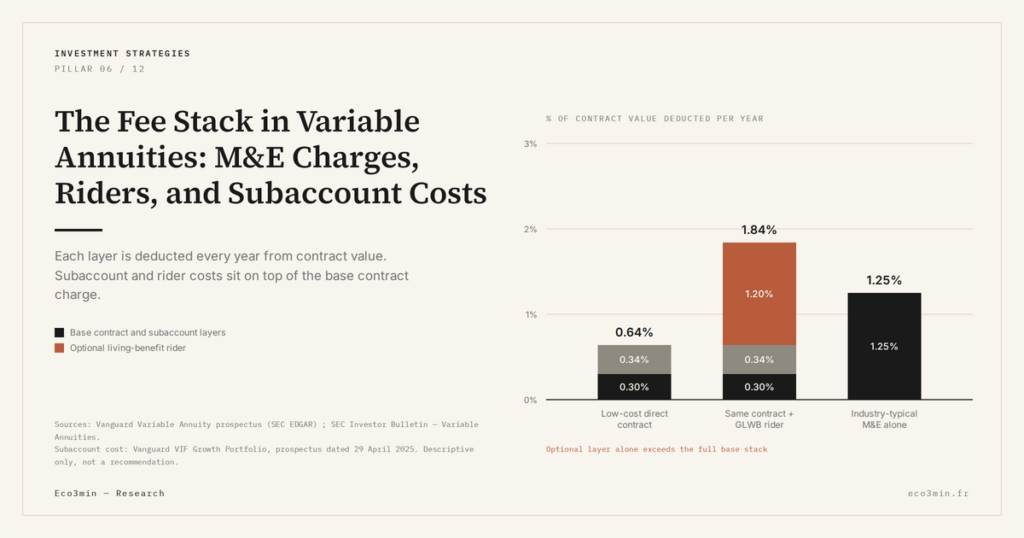
The base cost of a variable annuity is the sum of the M&E and the subaccount expenses, and it is already substantial before a single guarantee is added. A contract with a 1.25% M&E and subaccounts averaging 0.90% carries a base cost of about 2.15% a year, which industry commentary places within a 2.0% to 2.3% range for 2025. That is the starting point, not the total.
The subaccount layer is the one buyers most often overlook, because it is deducted inside the fund rather than billed on the statement. Its size depends entirely on what the contract holds. Active subaccounts sit toward the upper end of the 0.50% to 1.50% band; index subaccounts sit near the bottom. The same structural point that governs a French life-insurance contract governs the variable annuity: the investor pays two managers, the insurer for the wrapper and the fund company for the subaccount, and the headline M&E reveals only the first. This is why the wrapper cannot be judged on one number, a theme developed in the reading of how the wrapper shapes the outcome.
Because the base cost is a sum, comparing contracts on the M&E alone is comparing the visible top of a stack whose base is hidden. A contract advertising a low M&E but offering only active subaccounts can cost more than one with a higher M&E paired with index subaccounts. The relevant figure is the effective expense ratio, the sum of every recurring percentage charge, and it is the only quantity comparable from one contract to the next.
A concrete comparison shows how much the subaccount layer matters. Two contracts can advertise an identical 1.25% M&E, yet one paired with active subaccounts averaging 1.10% carries a base cost of 2.35%, while the other paired with index subaccounts at 0.20% carries 1.45%, almost a full percentage point apart on the same headline charge. Nothing in the M&E signals that difference; it lives entirely in the layer deducted inside the funds. A buyer comparing on the quoted M&E alone would rate the two contracts identical, and would be wrong by nearly a point a year, compounded for the life of the contract.
Riders, the ceiling, and the drag over time
Optional living-benefit riders are the most consequential fee decision, because they can nearly double the base annual cost. A guaranteed lifetime withdrawal benefit or a stepped-up death benefit commonly costs around 1.0% a year each, so that a contract at a 2.15% base can reach 3.3% or more once a rider is elected. This is why the question of what a variable annuity costs has no single answer: the same product category runs from under 0.50%, for a low-cost direct contract with index subaccounts and no riders, to over 3.50%, for a commission-based contract with active subaccounts and a living-benefit rider.
The surrender schedule interacts with all of this. Because it penalizes early exit, it discourages leaving a high-cost contract even once its cost is understood, and it resets whenever the contract is exchanged for another. FINRA’s oversight of annuity exchanges exists precisely because a new contract can restart a surrender period and layer on fresh M&E and rider fees while offering little the investor did not already have. The cost of a variable annuity is therefore not only its annual drag but the friction of leaving it, a friction the surrender schedule is designed to create.
Put in dollars, the arithmetic is stark. On a 100,000 dollar contract growing at a gross 5% a year, a 1.0% all-in cost and a 3.0% all-in cost diverge by tens of thousands of dollars over two decades, with none of that gap attributable to the performance of the underlying subaccounts. The difference comes solely from the stack. As with any wrapper, the gross return advertised does not determine the outcome; the layered cost, compounding year after year, does much of the work, and its weight grows with the holding period.
None of this makes the variable annuity uniformly expensive. A low-cost, no-rider, index-subaccount contract can sit under half a percent a year, competitive with many alternatives once its tax deferral is counted. The point is not that the wrapper costs too much, but that its cost is dispersed across layers a single quoted figure conceals. Two contracts sold under the same name can differ by three points a year, and only a full reconstruction of the stack reveals which is which.
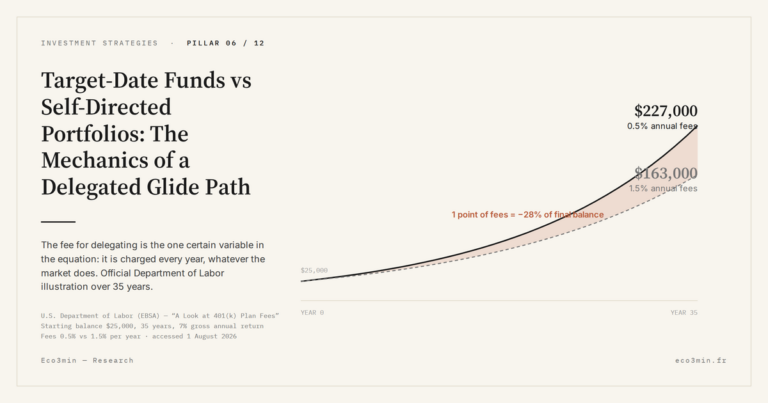
Each recurring layer is charged every year, on a balance that compounds. A contract carrying 2.55% in combined annual cost can, over twenty years, consume a substantial share of what the balance would have been fee-free, on the order of a third or more by common estimates. The drag is not a one-time deduction but a compounding gap that widens with the holding period. Whether the contract’s tax deferral and its guarantees offset that drag is a genuinely contested question, and it turns on the investor’s tax situation and on how much the insurance features are actually used. The account-level version of that comparison is set out in the account-versus-account comparison.
- A variable annuity’s cost is a stack of layers (M&E, subaccount expenses, administrative charges, optional riders, surrender charges), not a single fee.
- Base cost, the M&E plus subaccount expenses, commonly lands near 2.0% to 2.3% a year before any rider; the subaccount layer is deducted inside the fund and does not appear on the statement.
- A living-benefit rider can nearly double the base cost, pushing the total above 3.5%; the same product category spans more than three percentage points.
- Whether tax deferral and guarantees offset the compounding fee drag is contested and depends on the investor’s tax position and use of the insurance features.
A stack to total, not a number to read
Reading a variable annuity’s cost correctly means reconstructing the whole stack, layer by layer, rather than reading the figure placed in front of you. The effective expense ratio, the sum of the M&E, the subaccount expenses and any rider fees, is the comparable quantity; the surrender schedule sits alongside it as a liquidity constraint rather than a recurring cost. FINRA’s rules on annuity suitability and exchanges exist precisely because these layers are easy to misread and their cumulative weight easy to understate. Understanding the stack is the prerequisite to any judgment of a contract’s net return, and it precedes the underlying question of the choice between guaranteed and unit-linked funds itself.
Last updated — 1 August 2026
Disclaimer – Financial Information: The analyses, commentary, and content published on eco3min.fr are provided for informational and educational purposes only. They do not constitute investment advice or a solicitation to buy or sell financial instruments. Past performance is not indicative of future results. All investment decisions involve risk and are the sole responsibility of the reader.
Read next
Full pillar →Beneficiary Designations, the Step-Up in Basis, and the 10-Year Rule: How US Accounts Transfer at Death
At death, most US financial accounts pass outside the will, straight to a named beneficiary, under tax rules…
The Conventional 401(k)-Match-First Funding Order: Where It Comes From, How It Works
The question of what order to fund accounts in usually draws a fixed list, presented as a rule…
Roth IRA vs Traditional 401(k): Two Shelters, Two Clocks, Two Tax Treatments
A Roth IRA and a traditional 401(k) are both tax-sheltered, but they are not two flavors of one…