Target-Date Funds vs Self-Directed Portfolios: The Mechanics of a Delegated Glide Path

A target-date fund is sold as a simple, set-and-forget win. It is first something narrower: a delegated glide path with a fee. The manager decides the allocation, the fund selection, the rebalancing and the de-risking, and charges for it, whatever the market then does.
The pitch frames the target-date fund as a solved problem. Its mechanics frame it as a delegation with a price. The two descriptions are not the same thing.
A target-date fund delegates a lifetime glide path to a manager for a fee. That fee is low but certain; the glide path is a template that may or may not fit.
- Target-date assets reached 4.8 trillion dollars in 2025, with an asset-weighted average expense ratio of 0.27%, down from 0.55% in 2015 (Morningstar).
- They are the default 401(k) investment under the Department of Labor’s 2007 QDIA rule, so most holders never actively chose them.
- The value is discipline and simplicity, because investors tend to stay put, not a guarantee of outperformance.
What a target-date fund really is: a delegated glide path
Before judging its results, it helps to name what a target-date fund does. It hands four decisions to an asset manager at once: the mix of stocks and bonds, the specific underlying funds, the rebalancing, and the gradual shift to safety as retirement nears, the path Morningstar and the Department of Labor both call the glide path. In exchange, it charges an expense ratio. That fee has fallen sharply, to an asset-weighted average of 0.27% in 2025 from 0.55% a decade earlier, but it is still a charge levied every year, whatever the market does. A target-date fund sells a glide path, not a result.
Most holders never made that sale knowingly. Since the Department of Labor’s 2007 rules blessed target-date funds as a qualified default investment alternative, plans have swept the savings of employees who make no election straight into them. That safe harbor is why the category grew to 4.8 trillion dollars and why, for tens of millions of savers, the target-date fund is not a choice but a destination reached by not choosing. The delegation, in these cases, was accepted by default rather than decided. That is not a knock on the funds, which are mostly sound, but a reason to look under a label most savers treat as settled. Background: our take “Choosing investments in the light of the macro cycle”.
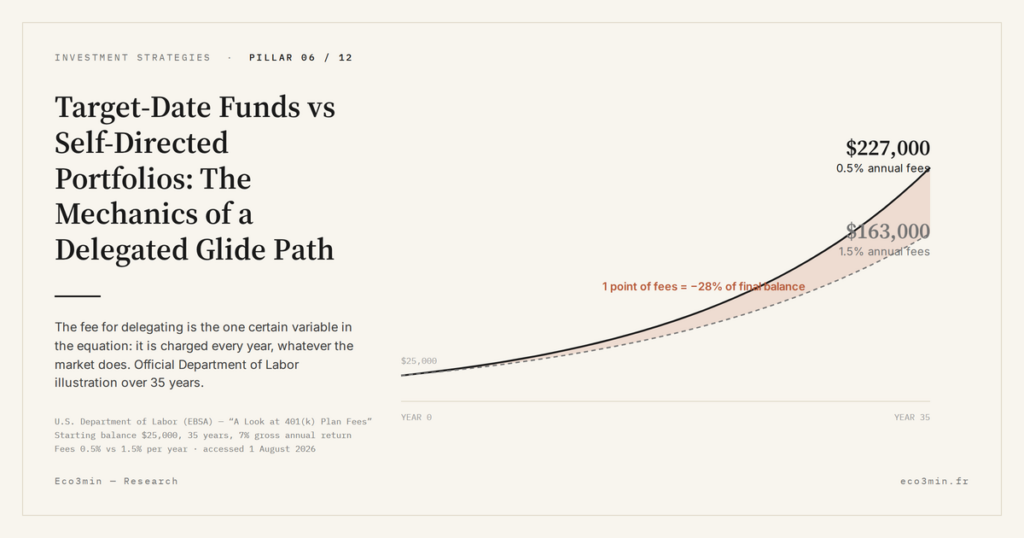
The fee is low by fund standards, yet its arithmetic is the same as any other layer of cost. Index-based target-date funds run near 0.27%, while all-active ones sit closer to 0.82%, and the cheapest, such as Vanguard’s, reach 0.08% against an industry average of 0.41% for comparable funds. At an identical glide path, the cheaper option nets more, mechanically, for no other reason than cost. The Department of Labor’s own illustration makes the point starkly: over 35 years, a one-point fee difference turns a 25,000 dollar balance into 227,000 dollars at half a percent, or 163,000 dollars at one and a half. The delegation is worth examining precisely because its price compounds.
Naming the product this way reframes the question. As long as a saver treats a target-date fund as a finished answer, they stop asking what it holds and what it costs. Treated as a delegation, the question sharpens: does handing over these four decisions add value beyond the fee, given what the saver would otherwise do? That is a question about the saver as much as the fund, and it connects to the wider matter of the account that defaults into it.
The glide path is a template, and it may not fit
The delegation’s hidden cost is fit. A target-date fund applies one glide path to everyone retiring near a given year, regardless of their other assets, their risk tolerance, or their income needs. Two people planning to retire in 2045 receive the same allocation, though one may have a pension and the other none. The fund cannot know, so it defaults to an average, and an average fits no one exactly. An average applied by default remains a powerful lever, because the default setting is precisely where nudges in retirement plan design operate.
Consider two savers both aimed at 2045. One has a defined-benefit pension covering most of their retirement income and could take more equity risk; the other has only their 401(k) and needs more caution. The same target-date fund gives them the same allocation, too conservative for the first and too aggressive for the second. Neither is served badly enough to notice in a rising market, but the mismatch surfaces in a downturn near retirement, exactly when it hurts most. The template’s convenience is real, and so is the cost of its one-size design.
The to-versus-through distinction deserves its own attention, because it is invisible on the label. A 2045 fund that glides to retirement may hold roughly a third in equities at the target date; one that glides through it may still hold half, and keep de-risking for a decade after. Same name, different risk at the worst possible moment. A saver relying on the year alone cannot see which bet they hold.
The template hides real choices. A crucial one is whether the glide path runs to retirement, reaching its most conservative point at the target date, or through it, continuing to de-risk for years afterward. Two funds bearing the same year can hold materially different equity stakes at retirement, the moment a saver is most exposed to a market fall. Starting allocations diverge too: the median target-date fund now holds 93% equities for a saver 45 years out, up from 89% a decade ago, as managers have grown more aggressive. A saver who never looks under the label inherits whichever bet their plan’s default made for them, and the choice of provider, not the saver, sets the risk. For context: the questions behind a 401(k) choice.
None of this makes the template wrong; it makes it a default rather than a fit. Morningstar’s research shows glide paths converging across providers, which narrows the differences but does not erase them, especially in the mid-career years where they remain pronounced. The wrapper around these funds shapes the outcome as much as the glide path itself, a point developed in the layered cost of delegation.
What the target-date fund actually changes
Recentered on what it is, the target-date fund changes three concrete things, none of them a promise of return. It removes work, handing rebalancing and de-risking to a manager for savers who will not do it themselves. It imposes discipline, holding an allocation steady through the market swings that tempt hand-managed accounts into selling low. And, as the 401(k) default, it puts tens of millions of savers into a diversified portfolio who would otherwise have sat in cash or chased last year’s winner. Default enrolment and automated allocation are the same idea applied at two different layers, the second being the way robo-advisers actually run a portfolio.
That third effect is the strongest argument for the product, and it is behavioral, not selective. Morningstar finds that investors tend to stay put in target-date funds rather than trading in and out, so their realized returns often beat the returns of investors in funds they manage themselves. The value, in other words, sits in the staying, not in the picking. A target-date fund that a saver holds through a crash may serve them better than a cheaper portfolio they would have abandoned at the bottom, which is a real benefit, and a different one from outperformance.
The delegation carries a quieter cost: the loss of the wheel. Accepting a glide path means accepting the manager’s calls, including the ones a saver would not have made, and giving up the ability to tilt exposure to their own convictions or circumstances. For someone with no view and no time, that surrender is a relief; for an informed, engaged investor, it is a cost, like any fee. The steady migration of these funds into collective investment trusts, now 54% of target-date assets, has lowered their price but not changed this basic trade: control exchanged for simplicity. Exchanging control for simplicity is the opening move of the principal-agent problem as it appears in finance.
Reading a target-date fund as a finished, best-possible answer misses what it is. At an identical glide path, its fee is a certain drag, and its one-size template may not fit a saver’s other assets or risk needs, especially at the to-versus-through decision that sets equity exposure at retirement. The fund does not buy outperformance; it buys delegation and the discipline to stay invested, whose worth depends on what the saver would otherwise have done.
A service to price, not a result to expect
Judging a target-date fund well means treating it as a service whose cost and fit are measured, not a product from which outperformance is expected. Its fee is certain and immediate; its value is probable and conditional, lodged in the discipline of staying invested more than in any edge in selection. The honest test is not whether target-date funds have performed well, which they largely have through a long bull market, but whether the delegation earns its keep for a given saver. For the disengaged majority it plainly does: a held default beats an abandoned optimum. For the investor who will genuinely build and rebalance a low-cost index allocation, the same glide path is available for less. The natural benchmark is not last year’s return but a plain index portfolio at a matching glide path, rebalanced once or twice a year, which is the same service without the manager’s layer. A saver who clears that bar with a default they will actually hold has made a sound trade; a saver who could build and keep the same allocation for less is paying for delegation they do not need. The product is neither a shortcut to returns nor a fee trap; it is a service, worth its price to some and not to others. Placed in the frame of which vehicle holds the money and how it is run, this sits alongside the choice a wrapper frames.
Last updated — 1 August 2026
Disclaimer – Financial Information: The analyses, commentary, and content published on eco3min.fr are provided for informational and educational purposes only. They do not constitute investment advice or a solicitation to buy or sell financial instruments. Past performance is not indicative of future results. All investment decisions involve risk and are the sole responsibility of the reader.
Read next
Full pillar →The Fee Stack in Variable Annuities: M&E Charges, Riders, and Subaccount Costs
A variable annuity does not carry one fee, but a stack of them. Mortality and expense charges, subaccount…
The Conventional 401(k)-Match-First Funding Order: Where It Comes From, How It Works
The question of what order to fund accounts in usually draws a fixed list, presented as a rule…
Roth IRA vs Traditional 401(k): Two Shelters, Two Clocks, Two Tax Treatments
A Roth IRA and a traditional 401(k) are both tax-sheltered, but they are not two flavors of one…