
How to Reduce Taxable Income in 2026: Mechanisms and Their Clocks
Reducing taxable income is not a single move. It is a family of separate mechanisms, each governed by its own rule, its own cap, and above all its own clock, so the useful question is not which one is best but what each one actually does and when it pays off.
This page covers the tax mechanisms tied to saving and investing. It sets aside the unrelated niches, business deductions, property schemes, service credits, which follow different logic and belong elsewhere.
Lowering taxable income is not one lever but a set of clocks, each on its own rule, and knowing the clock matters more than ranking the accounts.
- A pretax 401(k) or traditional IRA defers tax rather than cancelling it: the 2026 caps are $24,500 and $7,500 (IRS), and the bill arrives at withdrawal.
- A Roth account is taxed on the way in, then its qualified growth is tax-free, gated by a five-year clock plus age 59 and a half.
- Tax-loss harvesting turns a paper loss into a deduction, but the wash-sale rule voids it if a substantially identical security is bought within 30 days either side.
- An HSA is the one account taxed at none of the three stages, deductible in, tax-free growth, tax-free medical withdrawals, capped at $4,400 self-only or $8,750 family in 2026 (IRS).
What the promise leaves out
The phrase “reduce taxable income” suggests a switch. Pull it and the tax bill falls. The reality is a set of mechanisms that each move tax through time or across categories, and none simply erases it. Lowering taxable income is not one lever but a set of clocks, each on its own rule. A deduction today can be a taxable withdrawal in thirty years; a tax-free gain can require a five-year wait; a harvested loss can be voided by a purchase made a week later. The mechanisms are real and substantial, but they are conditional, and the condition is usually a clock.
Naming that structure is the whole point, because the mechanisms do not stack into a single ranked list. Which one matters depends on income, horizon, account access, and the shape of a given year, so this page documents each mechanism and its clock rather than ordering them. What follows is a map of the levers, not a route through them.
Pretax contributions: the 401(k) and traditional IRA
The most direct way to lower this year’s taxable income is to route money into a pretax retirement account. A traditional 401(k) contribution comes out of income before tax, so it reduces adjusted gross income dollar for dollar, up to $24,500 in 2026, with an extra $8,000 catch-up from age 50 and a larger $11,250 catch-up for ages 60 to 63 (IRS, Notice 2025-67). A traditional IRA works the same way up to $7,500 in 2026, though its deductibility phases out at higher incomes for those covered by a workplace plan, starting around $81,000 for a single filer.
Two features shape how far the pretax lever reaches. An employer match, where offered, is additional money that also lands pretax, and the combined employee-and-employer cap is $72,000 in 2026, well above the $24,500 an individual can defer alone. A change taking effect in 2026 also narrows the catch-up for higher earners: those whose prior-year wages with the plan sponsor exceeded $150,000 make their age-based catch-up as Roth, after-tax, rather than pretax (IRS, under SECURE 2.0). The pretax deduction remains the largest single in-year reduction available to most savers, but its edges are defined by these caps and by the income at which the IRA deduction phases out.
The mechanism is deferral, not cancellation, and the distinction is the clock. The deduction is real now, but the money and its growth are taxed as ordinary income when withdrawn in retirement, and required minimum distributions eventually force the timing. The bet embedded in a pretax contribution is that the tax rate at withdrawal is lower than the rate today, which is a fact about a future that has not happened yet. The mechanics of that trade-off are set out in our page on how pretax contributions interact with tax brackets, part of the wider picture of tax-advantaged accounts versus a taxable brokerage.
The Roth clock
A Roth contribution inverts the timing. It is made with after-tax dollars, so it does nothing for this year’s taxable income, but the account’s growth and qualified withdrawals come out entirely tax-free. The catch is a clock of its own: a distribution is qualified only after the account has been open five years and the holder has reached age 59 and a half, and conversions carry their own separate five-year clocks. The Roth trade is the mirror of the pretax one, paying tax now to remove it later, and the choice between them turns on the same unknowable comparison of present and future rates. The two clocks are compared directly in our page on the Roth and traditional clocks side by side.
Two mechanical details matter within the Roth. Contributions can be withdrawn at any time without tax or penalty, because they were already taxed, so the five-year and age gates apply to earnings, not to the original contributions. And a Roth conversion, moving money from a traditional account into a Roth by paying tax on it now, starts its own five-year clock separate from the contribution clock, which is why conversions are timed rather than made reflexively. The Roth is often cast as the account for a saver who expects higher rates later, but the mechanism itself is neutral: it fixes the tax rate at today’s, and whether that proves favourable is a fact about a future rate no one can observe in advance.
Tax-loss harvesting, and the wash-sale trap
Not every mechanism runs on a retirement clock. Inside a taxable account, a position sold at a loss generates a capital loss that offsets capital gains, and up to $3,000 of net loss offsets ordinary income in a year, with the remainder carried forward. Realising that loss deliberately, to lower a tax bill while staying broadly invested, is tax-loss harvesting.
The wash-sale window
The mechanism has a strict guardrail. The wash-sale rule disallows the loss if a substantially identical security is purchased within 30 days before or after the sale, a 61-day window in total, which prevents booking a loss while effectively holding the same position. The loss is not lost forever; it is added to the cost basis of the replacement, deferring rather than denying it. Working within that window, without tripping the substantially-identical test, is the whole craft, and it is documented in our guide to implementing tax-loss harvesting.
The deduction has a hierarchy worth knowing. A realised loss first offsets realised gains of the same type, long-term against long-term and short-term against short-term, then across types, and only the net remainder, up to $3,000 a year, reduces ordinary income, with anything beyond that carried forward indefinitely. The craft lies in the replacement: selling one fund at a loss and buying a different fund that tracks a different index keeps the exposure broadly intact without breaching the substantially-identical test, whereas rebuying the very same fund inside the window forfeits the loss for the year. Harvesting does not create value from nothing; it accelerates a deduction the holder would otherwise take later, and its worth depends on having gains or income for the loss to offset. Losses are not the only deduction with a clock, since a basis reset at death removes the gain outright, the mechanism at the centre of the step-up basis in estate planning.
Asset location
A quieter mechanism concerns where an asset sits rather than what is bought. Income-heavy holdings, taxable bonds, REITs, actively traded funds that throw off short-term gains, are taxed most heavily when held in a taxable account, and least when held inside a tax-advantaged one. Placing them by tax character, the tax-inefficient assets inside the shelter and the tax-efficient ones outside, changes the after-tax return without changing the portfolio itself. The reasoning, using REITs as the clearest case, is set out in our page on REITs and asset location. Asset location is a mechanism with no cap and no clock, only a condition: it requires holding the same assets across more than one account type.
The size of the effect tracks the tax character of the asset. A taxable bond fund distributing interest taxed as ordinary income, or a REIT whose dividends are largely non-qualified, loses more to tax each year in a taxable account than a broad equity index fund that defers most of its gain until sale. Shifting the tax-heavy holdings into a shelter and leaving the tax-light ones outside raises the after-tax return of the whole without altering the mix. A further refinement places the highest-growth assets in a Roth, where the growth is never taxed, and the steadier income assets in a traditional account, though the gain from that finer sorting is smaller and depends on the accounts a saver actually holds.
Holding periods and the capital-gains clock
The tax on an investment gain depends on a clock measured in a single year. A gain on an asset held one year or less is a short-term gain, taxed as ordinary income at rates up to 37%. Hold the same asset more than a year and the gain becomes long-term, taxed at 0%, 15%, or 20% depending on total taxable income. The 0% band is wider than most expect: for 2026 it reaches taxable income of roughly $49,450 for a single filer and $98,900 for a married couple filing jointly (IRS, Revenue Procedure 2025-32), so gains realised inside that band carry no federal tax at all. Above the top thresholds, a further 3.8% net investment income tax applies once modified adjusted gross income passes $200,000 single or $250,000 jointly. On the same theme: our study “Choosing investments in the light of the macro cycle”.
The width of the 0% band creates a mechanism of its own. A holder whose taxable income sits below the threshold can realise a long-term gain, pay no federal tax on it, and immediately repurchase the same asset, resetting the cost basis upward at no cost, the mirror image of harvesting a loss. The wash-sale rule applies only to losses, not gains, so the repurchase is unrestricted. The catch is that the gain itself stacks on top of ordinary income when the band is measured, so a large enough gain pushes part of itself out of the 0% band and into the 15%, which is why the mechanism works at the margin rather than without limit.
The clock here is the one-year line, and it can quietly move an identical gain between two very different rates. That single threshold, and the way it interacts with when a position is sold, is examined in our pages on the holding-period clock and on how dividends and capital gains are taxed differently.
Municipal bonds and the HSA, mentioned in full
Two further mechanisms sit at the edges of a saver’s toolkit and are worth stating plainly rather than skipping. Municipal bond interest is generally exempt from federal income tax, and often from state tax for in-state holders, which is why a municipal bond’s lower headline yield can leave more after tax than a higher-yielding taxable bond for a high-bracket holder. It is a category shift, not a deferral: the income simply sits outside the federal tax base.
The comparison a municipal bond invites is therefore an after-tax one. A 4% municipal yield and a 5% taxable yield are not what they appear: for a holder in a high federal bracket, the tax-free 4% can leave more in hand than the taxable 5% once the tax on the latter is subtracted, which is why municipals are read through a taxable-equivalent yield rather than their headline rate. The exemption is worth more the higher the rate it avoids, so the mechanism favours high-bracket holders by construction.
The health savings account is the rare mechanism that is taxed at none of its three stages. Contributions are deductible or made pretax, the balance grows tax-free, and withdrawals for qualified medical expenses are tax-free, a combination no other account offers at once. The 2026 caps are $4,400 for self-only coverage and $8,750 for family coverage, with a $1,000 catch-up from age 55 (IRS, Revenue Procedure 2025-19), and eligibility requires enrolment in a qualifying high-deductible health plan. After age 65, non-medical withdrawals are taxed as ordinary income, which turns the account into a traditional-IRA equivalent with a tax-free medical layer on top. The HSA’s clock is not a date but a condition: qualifying health coverage while contributing. Residence is a clock of the same kind, since the state that taxes an income depends on where the taxpayer lives, a link tested in what high-tax states actually do to migration patterns.
That structure is what lets the HSA double as a long-horizon savings account. A holder who pays current medical costs out of pocket and leaves the account invested lets the balance compound untaxed for decades, then draws it tax-free against a lifetime of accumulated medical expenses, or, after 65, against anything at ordinary rates. A payroll-deducted HSA contribution also escapes the 7.65% payroll tax that applies to wages, an advantage neither a 401(k) nor an IRA shares. The account is small by design, but per dollar it is the most tax-favoured of the set, which is why its eligibility condition, the high-deductible plan, is the binding constraint rather than the contribution cap.
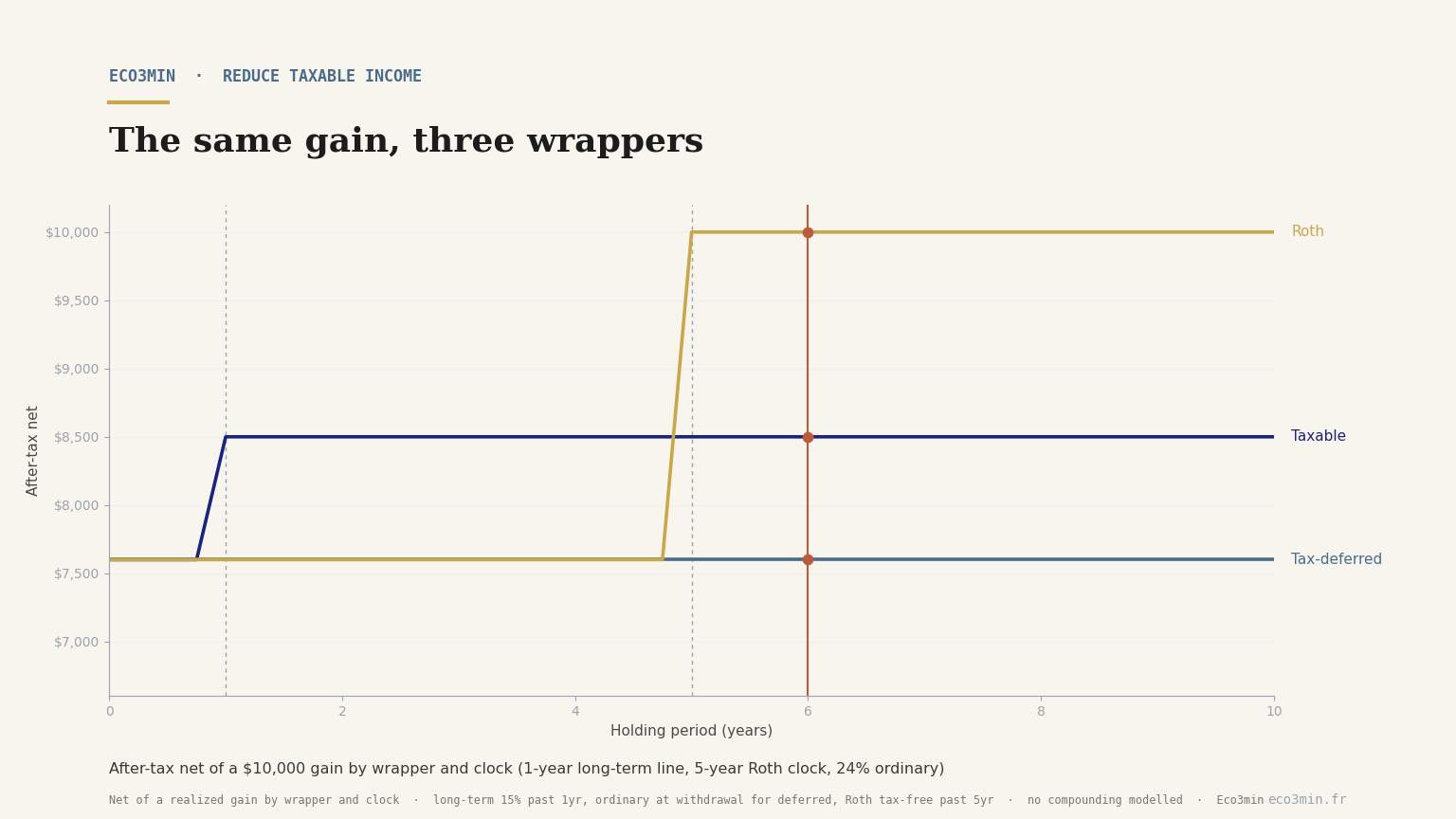
The same gain, three wrappers
The mechanisms are easiest to see side by side. The tool below takes one hypothetical pretax gain and follows it through three wrappers, a taxable account, a tax-deferred account, and a Roth, across a chosen holding period, showing the after-tax result of each. The clocks appear as descriptive markers, not as instructions. The point is not to crown a wrapper but to make visible how the same gain lands differently depending only on where it was held and for how long.
The same gain, three wrappers
After-tax net of one gain by wrapper and clock
Taxable
Tax-deferred
Roth
The observable criteria grid
Read as a set of mechanisms rather than a ranking, the toolkit sorts cleanly. Each mechanism has a defining action, a clock, a cap, and a condition, and the grid sets them next to one another so the structure, rather than a verdict, is what shows.
| Mechanism | What it does | Clock | 2026 cap or threshold |
|---|---|---|---|
| Pretax 401(k) / IRA | Defers tax on income and growth | Ordinary tax at withdrawal; RMDs later | $24,500 / $7,500 |
| Roth | Taxes now, tax-free qualified growth | Five years plus age 59 and a half | Same contribution caps |
| Tax-loss harvesting | Turns a loss into a deduction | 30-day wash-sale window each side | $3,000 ordinary offset per year |
| Asset location | Places assets by tax character | None; needs two account types | No cap |
| Holding period (LTCG) | Cuts the rate on a gain | One-year line | 0% band to about $49,450 / $98,900 |
| HSA | Untaxed at all three stages | Qualifying HDHP while contributing | $4,400 / $8,750 |
Read through the macro regime
The value of every mechanism is measured after inflation, and the rate regime sets the backdrop. When inflation runs above the underlying trend, as it has under the 2026 energy shock, the after-tax real return is what a saver actually keeps, and tax paid on a nominal gain that merely tracks inflation is a real loss even when the headline number is positive. A deferral that pushes tax into a lower future rate is worth more when rates are high today; a Roth’s tax-free growth is worth more when future rates are expected to rise. None of this changes the mechanisms, but it changes what each is worth, a point developed in our primer on real versus nominal returns and tracked on the macro regime dashboard, alongside our work on inflation’s bite on savings. The regime does not pick a mechanism; it reprices all of them.
Frequently asked questions
Does a pretax 401(k) contribution eliminate the tax on that money?
No, it defers it. The contribution reduces this year’s taxable income, but the money and its growth are taxed as ordinary income when withdrawn in retirement, and required minimum distributions eventually force withdrawals. The mechanism moves the tax through time rather than removing it, which is why the comparison of today’s rate with the expected retirement rate is central to how the deferral works.
What is the wash-sale rule?
It is the guardrail on tax-loss harvesting. If a substantially identical security is bought within 30 days before or after selling one at a loss, the loss is disallowed for that year and instead added to the cost basis of the replacement. The window spans 61 days in total. The rule prevents claiming a loss while effectively keeping the same position, and it defers rather than destroys the loss.
How does the long-term capital-gains clock work?
An asset held more than one year qualifies for long-term rates of 0%, 15%, or 20%, versus ordinary income rates for a shorter hold. For 2026 the 0% band reaches taxable income of about $49,450 single and $98,900 married filing jointly, so a gain realised within that band is untaxed federally. A 3.8% net investment income tax can apply above higher income thresholds. The single one-year line is what separates the two rate systems.
Why is a health savings account described as triple tax-advantaged?
Because it escapes tax at all three points where money is usually taxed. Contributions are deductible or pretax, the invested balance grows without tax, and withdrawals for qualified medical expenses are tax-free. No other account combines all three. The 2026 caps are $4,400 self-only and $8,750 family, and eligibility depends on enrolment in a qualifying high-deductible health plan. After age 65 non-medical withdrawals are simply taxed as ordinary income.
Which tax mechanism lowers a bill the most?
There is no single answer, because the mechanisms do different things on different clocks. A pretax contribution cuts this year’s income but defers tax; a Roth does nothing now but removes tax later; harvesting depends on having losses; asset location depends on holding multiple account types; the capital-gains clock depends on the holding period and income band. Which one matters most depends on income, horizon, and the shape of the year, which is what the grid and the tool make visible rather than resolve. Horizon, in particular, is the variable these clocks share with the building of resilient portfolios across market regimes.
- Reducing taxable income is a set of separate mechanisms, each defined by its own clock, cap, and condition rather than a single lever.
- Pretax accounts defer tax to withdrawal; Roth accounts pay it now for tax-free qualified growth after a five-year clock.
- Harvesting, asset location, and the one-year capital-gains line each lower tax through a different mechanism, with their own guardrails.
- The HSA is the one account untaxed at all three stages; municipal interest sits outside the federal base entirely.
What “reducing taxable income” actually means
The useful reframing is to stop looking for the lever and start reading the clocks. Every mechanism here moves tax through time or across categories on a rule of its own, and the saver’s task is to know which clock applies before acting, not to rank the mechanisms in the abstract. Named that way, the toolkit is neither a trick nor a hierarchy; it is a set of conditional trades, each worth understanding on its own terms. For where these accounts sit among the broader options, our overview of what different vehicles deliver maps the wider ground. Tax treatment depends on individual circumstances and the rules change from year to year, so the figures here are dated and sourced and worth checking against current guidance.
This article is general information, not tax, investment, or legal advice, and does not account for any individual situation. Figures are dated and sourced in the text and may change. Consider your own circumstances, and where relevant a qualified professional, before acting.
Last updated — 15 September 2026
Disclaimer – Financial Information: The analyses, commentary, and content published on eco3min.fr are provided for informational and educational purposes only. They do not constitute investment advice or a solicitation to buy or sell financial instruments. Past performance is not indicative of future results. All investment decisions involve risk and are the sole responsibility of the reader.