REITs in Tax-Advantaged Accounts: Why Ordinary-Income Dividends Raise the Asset-Location Question

Because most REIT dividends are ordinary income rather than qualified dividends, the account a REIT is held in changes its after-tax return more than the fund itself does. That is why asset location, taxable versus tax-advantaged, is the first question a REIT investor faces.
The wrapper is not neutral. What a tax-advantaged account saves in annual tax, it can cost in a lost deduction. This article describes that trade-off, as an observation, not advice.
Most REIT dividends are taxed as ordinary income, so where you hold a REIT drives its after-tax return. The account choice is a trade-off, not a free win.
- REIT distributions are largely non-qualified: historically around 70 percent is ordinary income taxed at marginal rates up to 37 percent, per Nareit data.
- A tax-advantaged account defers or eliminates that annual tax, but forfeits the Section 199A deduction, which is now permanent as of 2025 legislation.
- A taxable account keeps the 199A deduction and return-of-capital deferral, but taxes the ordinary portion every year at the marginal rate.
Holding a REIT is not only choosing a fund; it is also choosing the account that holds it. The same shares behave differently in a taxable brokerage account and in a tax-advantaged retirement account, because REIT dividends are taxed unlike ordinary stock dividends. For REITs, the account decides the tax more than the fund does. This is the asset-location question, and it is discreet because it never shows up in the headline yield. This article describes it as the container-level extension of the rate-cycle reading of paper property. It is distinct from, and complementary to, the mechanics of how each distribution is taxed, covered in the satellite on how each REIT payout is taxed: that page decomposes the tax of a distribution, this one weighs where to hold it. Further detail: how to choose an online broker.
Why REIT dividends raise the location question
A REIT is required to distribute at least 90 percent of its taxable income to shareholders, and it avoids entity-level tax by doing so, which pushes the whole tax burden onto the holder. The nature of that burden is what matters here: most REIT dividends are non-qualified, meaning they do not receive the lower long-term capital-gains rate that applies to qualified dividends from ordinary corporations. Instead they are taxed as ordinary income at the holder’s marginal rate, which reaches up to 37 percent for top earners. An asset taxed at that rate reprices when the rate itself moves, a link at the centre of how tax reforms move asset valuations.
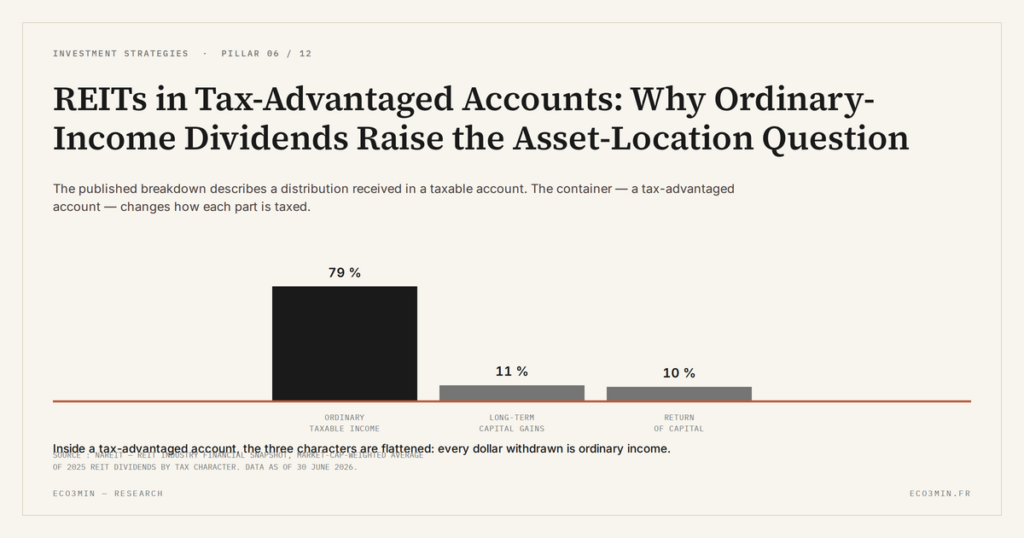
The magnitude is not marginal. Looking across hundreds of REITs over decades, Nareit data show that ordinary income frequently accounts for around 70 percent of distributions, with the remainder split between long-term capital gains and return of capital. A qualified dividend from a blue-chip corporation might be taxed at 15 or 20 percent; the ordinary portion of a REIT dividend at the same investor’s full marginal rate. That gap, applied every year to a high-yielding asset, is exactly what makes the choice of account consequential. Two investors holding the same REIT can keep very different fractions of its yield, depending only on where they hold it. Related work: the trade-offs behind chasing yield.
The distribution itself is not uniform, which is what makes the calculation subtle rather than mechanical. A REIT payout is split across three tax categories, ordinary income, capital gain, and return of capital, each taxed differently, and the split varies by REIT and by year. The account choice interacts with that split: a tax-advantaged account flattens all three into ordinary income on withdrawal, while a taxable account preserves the distinct treatment of each. The composition therefore matters as much as the yield, and it is set by the REIT, not the investor. Related material: the piece “Choosing investments in the light of the macro cycle”.
The tax-advantaged account: deferral, and the 199A trade-off
The intuitive move follows directly: because REIT dividends are taxed as ordinary income, holding REITs in a Traditional IRA, Roth IRA, or 401(k) is often recommended, since those accounts defer or eliminate the annual tax. In a Traditional IRA or 401(k), the distributions compound untaxed and are taxed as ordinary income only on withdrawal in retirement. In a Roth account, qualified withdrawals are tax-free entirely, which suits a high-yielding, ordinary-income asset particularly well.
But the tax-advantaged route has a discreet cost that the intuitive rule omits: it forfeits the Section 199A deduction. Since 2018, and now permanent as of 2025 legislation, individuals may deduct 20 percent of qualified REIT dividends, which lowers the top effective federal rate on that portion from 37 to roughly 29.6 percent. Inside a tax-advantaged account, that deduction is unavailable, because every dollar withdrawn is treated as ordinary income regardless of its original character, and no 199A applies. So the account that shelters the dividend from annual tax also strips the 20 percent deduction from it. The naive rule, always hold REITs in an IRA, therefore hides a genuine trade-off rather than a free win. A related perspective: the rate-cycle view of REITs.
The taxable account: 199A and return of capital
The taxable account is the mirror image. It taxes the ordinary portion of the distribution every year at the marginal rate, which is the cost. But it preserves two features the tax-advantaged account destroys. The first is the 199A deduction, worth up to a fifth off the ordinary portion. The second is the treatment of return of capital: a slice of REIT distributions is often classified as return of capital, which is not taxed when received but instead reduces the cost basis, deferring tax until the shares are sold. A tax-advantaged account renders both irrelevant, since all withdrawals are ordinary income anyway. More context: our guide to the tax-reduction mechanisms.
A simple illustration fixes the stakes, without describing any real security or future path. Take a distribution that is 70 percent ordinary income for an investor in a high marginal bracket. In a taxable account, that ordinary slice is taxed each year, but the 199A deduction trims roughly a fifth off its rate, and any return-of-capital portion is deferred against the cost basis. In a Traditional IRA, nothing is taxed until withdrawal, but the entire distribution is then taxed as ordinary income with no 199A relief. The same dollars, taxed on two different schedules and at two different effective rates. A broader view: what actually separates brokerage accounts.
The result is a genuine two-sided calculation rather than a rule of thumb. A taxable account pays annual tax but keeps the deduction and the deferral; a tax-advantaged account skips the annual tax but loses both. Which comes out ahead depends on the investor’s marginal rate, time horizon, and the mix of ordinary income, capital gain, and return of capital in the specific REIT’s distributions, none of which this article assesses. The decomposition of that mix, box by box on the Form 1099-DIV, is the subject of the satellite on the taxation of REIT distributions.
The container is not free
Two further wrinkles are routinely underestimated. The first is that high earners may owe the 3.8 percent net investment income tax on REIT dividends held in a taxable account, and state taxes may apply on top, widening the annual drag the tax-advantaged account avoids. The second is that a tax-advantaged account is not costless in flexibility: contributions are capped, early withdrawals can be penalized, and the money is committed to a retirement horizon. Choosing the container is therefore not only a tax calculation but a liquidity and horizon decision, in which the deferral value of the account is itself a function of the rate and tax regime. A further dimension applies to non-US holders: US REIT dividends generally face a 30 percent withholding tax at source, which a tax treaty between the holder’s country and the United States can reduce or remove, so that for a cross-border investor the account and the treaty together set the effective rate. That deferral value is taken up in the cluster on the value of tax deferral through the regime.
In practice, many holders gain REIT exposure not through individual REITs but through REIT-focused funds or ETFs held inside a 401(k), which is often the only account where real-estate exposure is available to them. That packaging does not change the underlying tax logic: the fund still passes through ordinary-income dividends, and the wrapping account still determines whether the 199A deduction survives. The vehicle can be a single REIT or a diversified fund; the location question is the same.
The parallel with the guaranteed and unit-linked wrappers of a savings contract is close: in each case the container reshapes the after-tax, after-fee outcome of the same underlying asset, and the choice turns on what the holder values. That broader wrapper question is developed in the cluster on guaranteed funds and unit-linked exposure through the rate regime.
- Because most REIT dividends are ordinary income, taxed up to 37 percent, the account a REIT sits in drives its after-tax return more than the fund itself.
- A tax-advantaged account defers or eliminates the annual tax, but forfeits the Section 199A deduction, made permanent in 2025, that lowers the ordinary rate by up to a fifth.
- A taxable account keeps the 199A deduction and the return-of-capital deferral, at the cost of annual ordinary-income tax on the bulk of the distribution.
- Neither container is free: the taxable route adds the 3.8 percent net investment income tax and state tax, while the tax-advantaged route caps contributions and locks the horizon.
In the end, the account does not make a REIT a better or worse investment; it reshapes what the investor keeps. The tax-advantaged wrapper trades the 199A deduction and return-of-capital deferral for freedom from annual tax and a locked horizon; the taxable account makes the opposite trade. For an ordinary-income asset held for the long run, the choice is consequential, but it is a choice of container, not of content, and it is decided by the investor’s own rate, horizon, and priorities, not by a single number.
Last updated — 29 August 2026
Disclaimer – Financial Information: The analyses, commentary, and content published on eco3min.fr are provided for informational and educational purposes only. They do not constitute investment advice or a solicitation to buy or sell financial instruments. Past performance is not indicative of future results. All investment decisions involve risk and are the sole responsibility of the reader.
Read next
Full pillar →Beneficiary Designations, the Step-Up in Basis, and the 10-Year Rule: How US Accounts Transfer at Death
At death, most US financial accounts pass outside the will, straight to a named beneficiary, under tax rules…
The Fee Stack in Variable Annuities: M&E Charges, Riders, and Subaccount Costs
A variable annuity does not carry one fee, but a stack of them. Mortality and expense charges, subaccount…
The Conventional 401(k)-Match-First Funding Order: Where It Comes From, How It Works
The question of what order to fund accounts in usually draws a fixed list, presented as a rule…