The Pre-Tax Contribution: What 401(k) and IRA Deductions Actually Save, Bracket by Bracket

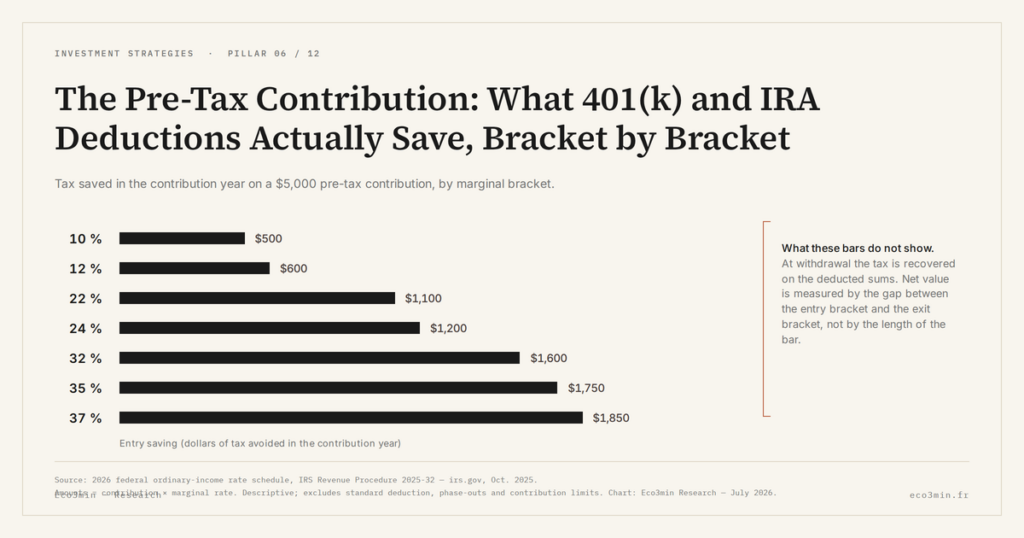
Contributing $5,000 pre-tax and “saving” $1,850 in tax at a 37% bracket is not money kept. It is a cash-flow advance the government recovers at withdrawal, at whatever ordinary-income bracket then applies to the pre-tax balance.
The upfront deduction is the headline pitch for a traditional 401(k) or IRA, and the most misread. Its real net gain shows up not in the contribution year but in the gap between two brackets.
The pre-tax deduction moves a tax bill through time instead of erasing it: it earns at the entry bracket and costs at the exit bracket.
- 2026 IRS limits: $24,500 into a 401(k) ($32,500 with the age-50 catch-up, $35,750 for ages 60 to 63), and $7,500 into an IRA ($8,600 after 50).
- The immediate saving equals the contribution times the marginal bracket (10 to 37%); a household with no tax liability saves nothing.
- Net value is measured only by the gap between the entry bracket and the exit bracket, since deferral is not exemption.
For 2026, the IRS set the elective-deferral limit for a 401(k) at $24,500, and the traditional-or-Roth IRA limit at $7,500. Those two numbers are not arbitrary caps; they mark the space in which the deduction does its work. Starting from them, rather than from the sales pitch, shows what the deduction actually does: it lowers the year’s taxable income, and therefore the tax owed, within a defined limit and for a deferred counterpart. This companion breaks down that entry mechanism. It does not cover the exit or the traditional-versus-Roth question, which belong to other articles in the cluster, and it sits within the full anatomy of the tax-deferred account set out by the hub.
The contribution limits, catch-ups and the ceiling
The deduction is capped by statute, and the 2026 figures set by the IRS in Notice 2025-67 define the ceiling. An employee can defer up to $24,500 of salary into a 401(k). Savers aged 50 and over add a catch-up of $8,000, lifting the limit to $32,500, and those aged 60 to 63 benefit from the SECURE 2.0 super catch-up of $11,250, for a total of $35,750. The IRA limit is $7,500, or $8,600 with the $1,100 catch-up after 50. Combined employee-and-employer contributions to a 401(k) are capped at $72,000. These limits stack by vehicle, so a saver with both a workplace plan and an IRA works within two separate ceilings. Related reading: the criteria behind a 401(k) fund choice.
One rule reshapes the catch-up for higher earners. Beginning in 2026, catch-up contributions must be made on a Roth, after-tax basis for anyone whose prior-year wages with the plan sponsor exceeded $150,000. For those savers, the incremental catch-up no longer reduces current taxable income; it buys tax-free withdrawals later instead. The change is a reminder that the rules keep shifting under the same architecture, and that a limit quoted without its year and its conditions can mislead. The ceilings that govern 2026 contributions are not the ones that will govern later years, as the IRS adjusts them for inflation.
The employer match adds a distinct layer that is easy to conflate with the deduction. A match is not a market return and not a tax effect; it is deferred compensation the employer contributes alongside the worker, up to a plan limit. Leaving it unclaimed forfeits pay, which is why the match is often the first dollar a saver captures before weighing the deduction itself. It changes the arithmetic of the account without changing the tax mechanics of the pre-tax contribution, and it belongs to the funding of the vehicle rather than to the deduction analyzed here.
The way the ceilings stack matters for higher savers. Because the 401(k) and IRA limits are separate, a worker with access to both can deduct against each within its own cap, subject to income rules that can phase out the IRA deduction when a workplace plan is present. The combined $72,000 limit, which folds in employer contributions, sits above the elective-deferral figure and is rarely reached by salary deferrals alone. For most savers the binding constraint is the $24,500 deferral limit, not the overall ceiling, so the practical question is how much of that room the household chooses to use, not how high the statutory maximum runs.
The immediate saving, bracket by bracket, from 10 to 37%
Within the limit, the tax saved in the contribution year is simple to compute: it equals the amount contributed times the household’s marginal bracket. The federal schedule runs through brackets of 10, 12, 22, 24, 32, 35 and 37%, and it is the top rate reached by the household’s income that applies to the pre-tax contribution. A $5,000 contribution therefore cuts the tax bill by $1,200 at a 24% bracket, by $1,600 at 32%, and by $1,850 at 37%. At 10%, the same contribution saves only $500, and a household with no tax liability saves nothing at all, because there is no tax to erase.
This dependence on the bracket has a direct consequence: the deduction earns more, the higher the marginal bracket. That is why the same account is pitched as highly advantageous to a high earner and as nearly neutral to a low earner. The mechanism is not linear in the contribution alone; it is proportional to the contribution times the bracket. But reading the advantage off this immediate saving leads to the central misconception about a traditional account, because the entry gain is not permanent.
A cash-flow advance, not a saving: what the deduction moves
The immediate saving hides the counterpart. At withdrawal, the government recovers the tax on the sums that were deducted, as ordinary income, at the bracket then in force. The deduction does not erase an expense; it moves a tax bill through time. The real gain is not the saving in the contribution year but the difference between the tax avoided on the way in and the tax paid on the way out. If the exit bracket equals the entry bracket, the advantage collapses to a pure cash-flow effect: having let a sum that would otherwise have funded a tax bill compound, sheltered, over the saving years.
That effect is not nothing, and its value grows with the horizon. A dollar not paid to the government in year zero and left sheltered compounds for years before part of it is returned. The longer the saving phase, the more the deferral effect weighs; the shorter it is, the more the advantage rests on the bracket gap alone. The deduction therefore does not mean the same thing at every stage of life. The bet it opens is settled only at how the exit is taxed, where the recovered tax is measured against the retiree’s bracket.
The mechanics are clearer when drawn out. Without a traditional account, the worker pays tax on the income earned, then invests the net remainder in a taxable account, where the fruits of saving are taxed in turn. With one, the worker invests the gross, pre-tax sum, which compounds in full during the saving phase, and returns part of its value to the government only at the end. The difference between the two paths is not an exemption, which does not exist, but the fact of putting a larger base to work for longer. It is a pure matter of tax timing, and its size grows with the holding period and the real return earned along the way. Further reading: our mapping of the taxable-income mechanisms.
Two separate levies round out the picture without contradicting it. Earnings inside the account face their own treatment, and flat versus progressive at exit does not carry the same consequences at every income level. Sheltered accounts also sit above the real tax floor on sheltered accounts, a floor that applies to gains rather than to contributions. Neither levy changes the nature of the deduction itself: a deferral, not an exemption.
It is this bracket gap that makes the deduction a bet, not a gift. A saver who deducted at 32% during working years and withdraws at 22% captures the gap on top of the deferral effect; one whose bracket stays flat captures only the deferral; one whose retirement income exceeds working-life income can see the deferral turn into an added cost. This gap is exactly what structures the traditional-versus-Roth bracket bet, where Roth’s tax-now, tax-free-later logic inverts the traditional deduction. Reading a long-horizon vehicle means holding this variable, as the frame on reading a vehicle through the rate regime sets out.
- 2026 limits ($24,500 for a 401(k), $7,500 for an IRA, plus catch-ups) stack by vehicle; the catch-up must be Roth for high earners.
- The immediate saving is proportional to the marginal bracket (10 to 37%); a household with no tax liability gains nothing.
- Net value is measured only by the gap between the entry and exit brackets, because deferral is not exemption.
The pre-tax deduction becomes clear once it stops being read as money kept. It is an advance: the government grants relief on the way in and recovers it on the way out, on the deducted sums alone. What the tax side moves is not an expense removed but a tax bill deferred, whose final cost will be read, years later, at the bracket of the retiree the saver has become.
Last updated — 25 July 2026
Disclaimer – Financial Information: The analyses, commentary, and content published on eco3min.fr are provided for informational and educational purposes only. They do not constitute investment advice or a solicitation to buy or sell financial instruments. Past performance is not indicative of future results. All investment decisions involve risk and are the sole responsibility of the reader.
Read next
Full pillar →Beneficiary Designations, the Step-Up in Basis, and the 10-Year Rule: How US Accounts Transfer at Death
At death, most US financial accounts pass outside the will, straight to a named beneficiary, under tax rules…
The Fee Stack in Variable Annuities: M&E Charges, Riders, and Subaccount Costs
A variable annuity does not carry one fee, but a stack of them. Mortality and expense charges, subaccount…
The Conventional 401(k)-Match-First Funding Order: Where It Comes From, How It Works
The question of what order to fund accounts in usually draws a fixed list, presented as a rule…