Roth IRA vs Traditional 401(k): Two Shelters, Two Clocks, Two Tax Treatments

A Roth IRA and a traditional 401(k) are both tax-sheltered, but they are not two flavors of one account. Tax is paid at opposite ends, the clocks differ, and the treatments diverge. Choosing between them is reading their asymmetries, not ranking them.
This piece is the frontal duel between two sheltered accounts. It is not the sheltered-versus-taxable comparison: it sets two shelters against each other, on tax timing, clocks and access.
A Roth IRA and a traditional 401(k) differ on when tax is paid, on their withdrawal clocks and on their contribution and income limits.
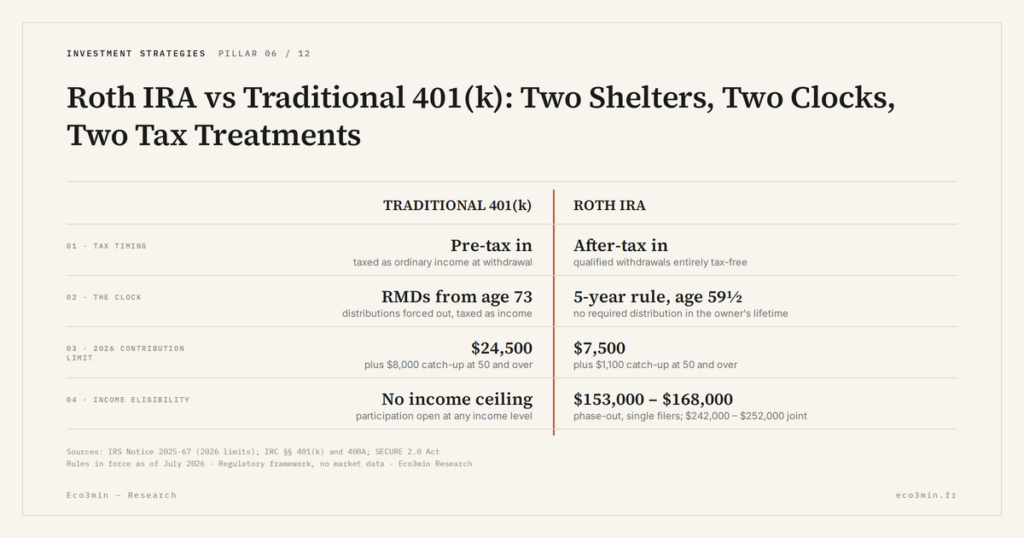
- A traditional 401(k) is funded pre-tax and taxed as ordinary income at withdrawal; a Roth IRA is funded after-tax and withdrawn tax-free once qualified.
- For 2026 the 401(k) elective deferral limit is $24,500 and the IRA limit is $7,500, with Roth IRA eligibility phasing out at $153,000 to $168,000 for single filers.
- A traditional account carries required minimum distributions from age 73; a Roth IRA carries none during the owner’s lifetime.
A Roth IRA and a traditional 401(k) share one label, tax-advantaged, and little else in their mechanics. Treating them as interchangeable, or ranking them in the abstract, ignores that the two accounts tax you at opposite ends of the timeline and answer to different clocks. This piece is the frontal duel between them. It is distinct from the broader question of the choice between a shelter and a taxable account, which sets any shelter against an ordinary brokerage account. Here the comparison is internal: two shelters against each other, read through the framework for reading wrappers.
1. Tax now versus tax later
The first and deepest asymmetry is timing. A traditional 401(k) is funded with pre-tax dollars: contributions reduce taxable income in the year they are made, the balance grows tax-deferred, and withdrawals in retirement are taxed as ordinary income. The tax is not avoided, only postponed to the withdrawal year, at whatever marginal rate applies then. This deferred ordinary-income charge is the account’s floor, examined in the reading of the real tax floor of sheltered accounts.
A Roth IRA reverses the sequence. Contributions are made with after-tax dollars, so there is no deduction in the contribution year, but qualified withdrawals of both principal and growth are entirely tax-free. The tax is paid up front, at today’s rate, and never again. The choice between the two is therefore a bet on rates: deferral favors a saver who expects a lower marginal rate in retirement than today, while paying now favors one who expects the reverse. A lower expected retirement bracket has historically favored deferral, but the comparison is of expected rates, not a rule. The mechanism by which deferral creates or fails to create value is set out in the value of tax deferral by rate regime.
2. Two clocks
Each account answers to a clock, and the two are not the same. The Roth IRA runs on a five-year rule: for the growth portion of a withdrawal to come out tax-free, the account must have been open at least five years and the owner must generally be 59½. This holding requirement echoes, in a different tax system, the five-year clock that governs France’s equity savings plan, and rewards the same behavior, leaving the account untouched until the clock has run. Roth contributions, as opposed to earnings, can be withdrawn at any time without tax or penalty, since the tax on them was already paid. Read alongside: the checklist for a brokerage account.
The traditional account runs on a different clock, this one imposed at the far end. From age 73, required minimum distributions force a portion of the balance out each year, taxed as ordinary income, whether or not the money is needed. A Roth IRA carries no required minimum distribution during the owner’s lifetime, so the balance can be left to compound untouched and, if unspent, passed to heirs. Tapping either account before 59½ generally triggers a 10% penalty on top of ordinary income, the cost detailed in the penalty on early withdrawals. One clock forces money out late; the other never does. The traditional 401(k) also permits, in many plans, a loan against the balance, repaid with interest to oneself, an access route the IRA does not offer.
3. Limits and access in 2026
The two accounts differ sharply in how much they admit. For 2026, the 401(k) elective deferral limit is $24,500, with a catch-up of $8,000 for those 50 and over and a higher catch-up of $11,250 for ages 60 to 63. The IRA limit, shared across traditional and Roth IRAs, is $7,500, with a $1,100 catch-up. The workplace plan therefore accepts more than three times what an IRA does, before any employer contribution. Contribution room is only one of the asymmetries, and the tax-timing one runs through the comparison between Roth and traditional retirement accounts.
The employer match is the 401(k)’s distinctive feature: many plans add 50 to 100 cents per dollar contributed, up to a percentage of salary, an immediate return no IRA offers. Historically the match itself landed in the pre-tax side of the plan regardless of how the employee contributed, though SECURE 2.0 now lets plans offer it as a Roth match where the employee elects it. Roth IRA eligibility, by contrast, phases out with income: for 2026, contributions taper between $153,000 and $168,000 of modified adjusted gross income for single filers, and between $242,000 and $252,000 for married couples filing jointly. Above those ranges, a direct Roth contribution is closed, though the backdoor Roth conversion remains available. A traditional 401(k) has no income ceiling on participation, which is part of why high earners often default to it. Access, not just tax treatment, separates the two. A companion piece: our decoding of the best-investment question.
A third option blurs the binary: the Roth 401(k). Offered by many employer plans, it combines the workplace plan’s high contribution limit with Roth tax treatment, after-tax in and tax-free out, and since 2024 it carries no required minimum distribution either. Crucially, it has no income ceiling, unlike the Roth IRA, so high earners locked out of a direct Roth IRA can still make Roth contributions through the plan. The clean two-account duel is, in practice, often a three-way choice inside a single plan. Related discussion: the anatomy of a 401(k) allocation.
A 2026 rule reshapes catch-up contributions for higher earners. Under the SECURE 2.0 Act, savers whose prior-year wages from the plan sponsor exceeded $150,000 must now make their catch-up contributions as Roth, after-tax, rather than pre-tax. For those workers, part of the 401(k) is pushed toward Roth treatment by statute, narrowing the pre-tax-versus-Roth choice at the margin rather than leaving it fully open.
- A traditional 401(k) is pre-tax in, ordinary-income out; a Roth IRA is after-tax in, tax-free out once qualified.
- For 2026 the 401(k) deferral limit is $24,500 and the IRA limit is $7,500; Roth IRA eligibility phases out at higher incomes.
- The Roth five-year rule rewards leaving the account untouched; the traditional account forces distributions from age 73.
- The 401(k) employer match is an immediate return no IRA offers; the Roth carries no lifetime required distribution.
4. Reading it by mechanics
These asymmetries are read through mechanics, never through a universal ranking. Three parameters orient the comparison. The rate gap first: the account that pays less tax overall is the one funded at the lower rate, which turns on whether today’s marginal bracket sits above or below the expected retirement bracket. Income eligibility next: above the Roth phase-out range, the direct Roth door is closed, and the traditional 401(k) or a backdoor conversion carries the contribution instead. Distribution needs last: a saver who wants to leave a balance compounding untouched is served by the Roth’s absence of required distributions, while one who will draw the account down anyway is less affected by them. On this point: our decoding of the retirement math.
Two further mechanics shape the choice at the edges. A Roth conversion moves money from a traditional account to a Roth in a chosen year, paying ordinary income on the converted sum, which lets a low-bracket year be used deliberately. And the backdoor route carries a pro-rata rule: where other pre-tax IRA balances exist, part of any conversion is taxed in proportion to them, which can blunt the strategy for a saver with a large traditional balance.
None of these parameters names a superior account. They describe situations where one mechanism fits a given need better than the other. A single saver commonly holds both, each doing a distinct job: the 401(k) captures the employer match and the higher contribution ceiling, the Roth IRA adds a tax-free, distribution-free pocket for later. The question is not which account is best but which does what a given situation requires, and the answer sits in the asymmetries, not in a league table.
There is also a hedge argument that neither rate bet fully captures. Future tax rates and future income are both uncertain, and holding pre-tax and Roth balances side by side spreads that uncertainty: whichever way rates move, part of the balance sits in the favorable treatment. For a saver who cannot forecast the retirement bracket with confidence, the split is itself a position rather than an indecision, and it explains why many portfolios end up holding both rather than resolving the bet one way.
One reading this duel makes visible without settling: for a given income and a given expected retirement bracket, which tax timing and which clock fit the need? The answer depends on the gap between today’s rate and the retirement rate, on income eligibility, and on whether required distributions matter. It is because it depends on all three that Roth versus traditional has no single answer, only as many answers as there are situations. For more detail: the page “Choosing investments in the light of the macro cycle”.
Last updated — 29 August 2026
Disclaimer – Financial Information: The analyses, commentary, and content published on eco3min.fr are provided for informational and educational purposes only. They do not constitute investment advice or a solicitation to buy or sell financial instruments. Past performance is not indicative of future results. All investment decisions involve risk and are the sole responsibility of the reader.
Read next
Full pillar →Beneficiary Designations, the Step-Up in Basis, and the 10-Year Rule: How US Accounts Transfer at Death
At death, most US financial accounts pass outside the will, straight to a named beneficiary, under tax rules…
The Fee Stack in Variable Annuities: M&E Charges, Riders, and Subaccount Costs
A variable annuity does not carry one fee, but a stack of them. Mortality and expense charges, subaccount…
The Conventional 401(k)-Match-First Funding Order: Where It Comes From, How It Works
The question of what order to fund accounts in usually draws a fixed list, presented as a rule…