
Wage-Price Spirals: Mechanism and Historical Lessons
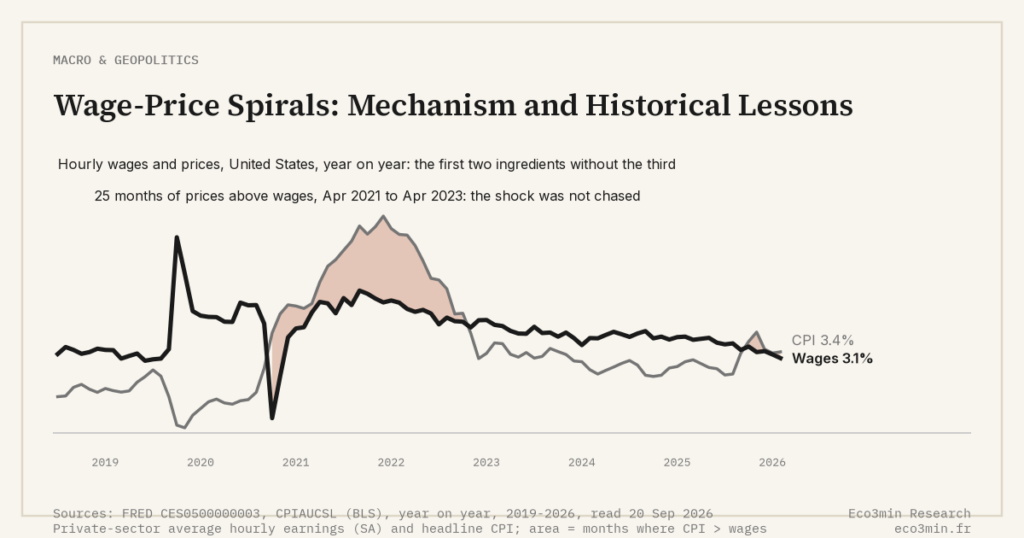
Wage-price spirals: the self-reinforcing loop that turns a one-off shock into persistent inflation — and why the 2022-2024 episode failed to ignite one despite checking many of the historical boxes.
A wage-price spiral requires three ingredients: a wage shock, margin pass-through, and de-anchored expectations. The recent inflation episode supplied the first two without the third — explaining why disinflation arrived faster than 1970s historical analogies suggested.
The IMF (Working Paper 22/207, 2022, Alvarez et al.) identified 22 episodes since 1960 in advanced economies that combined rising inflation, falling real wages and a tight labour market. The underlying detail is gathered in Eco3min’s mapping of structural inflation drivers. Only a handful triggered a self-sustaining spiral. The 2022-2024 episode, despite checking many boxes, joined the majority that did not. Absent the spiral, the gap between prices and pay closes slowly, and its width is legible in US prices set against the hourly wage that pays for them.
Anatomy of a wage-price spiral
A wage-price spiral describes a self-reinforcing dynamic in which an initial shock — typically a supply-driven price increase — triggers compensating wage demands; firms pass the higher labour costs through to prices; the resulting second-round price increase triggers further wage demands; and the loop repeats. The full picture is drawn in our mapping of inflationary regimes. The mechanism transforms what would otherwise be a one-off price level shift into persistent inflation. The diagnostic question is whether the loop is self-sustaining (inflation above expected, expectations rising, wages chasing) or self-correcting (inflation expectations stable, wage demands moderating once prices stabilise). Neither branch is visible from inside a single budget, where what changes is the position of a household income within a given year’s distribution.
The theoretical foundations were laid by A.W. Phillips’ 1958 estimation of the wage-inflation relationship on UK data 1861-1957, refined by Samuelson and Solow (1960) into a generalised Phillips curve, and reformulated by Friedman (1968) and Phelps (1967) with the introduction of expectations. The Friedman-Phelps insight was decisive: a Phillips trade-off only exists when expectations lag actual inflation. Once agents fully anticipate the inflation, the trade-off disappears — and a spiral becomes possible only if expectations themselves de-anchor. Our companion piece on the Phillips curve and its limits develops the theoretical apparatus.
The historical reference: 1970s United States and the Italian scala mobile
The classic empirical reference is the 1970s U.S. spiral. Following the 1973 oil shock that pushed CPI from 3.4% in 1972 to 11.0% in 1974 (BLS), nominal wages began chasing inflation: average hourly earnings growth accelerated from 6.6% in 1973 to 8.4% in 1974 and remained above 7% through 1981. Inflation expectations, measured by the Michigan Survey, rose from 4% in 1972 to over 8% by 1979 — clear evidence of de-anchoring. The spiral persisted until Volcker’s tightening campaign (Fed funds rate to 19% by 1981) broke both the wage trajectory and the expectations. The breadth of that episode against every other one is laid out in the assembled data on how high each wave since 1948 actually reached.
The institutional template that made the spiral mechanically self-sustaining was wage indexation. The Italian scala mobile, in operation from 1975 to 1992, automatically indexed wages to a national price index every quarter. France maintained the SMIC indexation throughout. Belgium and Luxembourg retained automatic wage indexation systems that survive to the present day. In each case, the indexation eliminated the lag between price increases and wage compensations, mechanically guaranteeing the second-round effect that constitutes a true spiral. The dataset on U.S. inflation history since 1913 shows the persistence of the 1970s episode that contemporary indexation produced.
What blocks a spiral: anchored expectations and the absence of indexation
The post-1985 disinflation taught central banks the operational lesson: anchored expectations break the spiral mechanism. If households and firms believe central-bank inflation targets are credible, wage demands moderate even after a price shock, and firms hesitate to pass through cost increases for fear of losing market share. The mechanism becomes self-correcting rather than self-reinforcing. Most advanced-economy central banks adopted explicit inflation targets between 1990 (New Zealand) and 2012 (the Fed) precisely to operationalise this anchoring effect. Because the institutional design here was borrowed from an earlier decade’s failure, the episode belongs to the case for financial history as the best teacher.
The institutional dimension matters as much as the expectational one. Three structural changes since the 1980s reduced the spiral risk: declining union density (U.S. private-sector unionisation fell from 24% in 1973 to 6% by 2023, BLS), elimination of automatic wage indexation in most countries, and the disinflationary pressure of globalised supply chains that limited firms’ pricing power. Together, these changes raised the threshold of expectational de-anchoring required to ignite a self-sustaining loop. Our work on how inflation expectations form and why they matter details the modern anchoring infrastructure.
The 2022-2024 stress test: a spiral that didn’t ignite
The post-pandemic episode provided a near-laboratory test of the spiral mechanism. The conditions looked propitious: U.S. CPI peaked at 9.1% in June 2022 (BLS), eurozone HICP at 10.6% in October 2022 (Eurostat), labour markets were exceptionally tight (U.S. vacancy-to-unemployment ratio above 1.9 throughout 2022, a postwar record per BLS JOLTS), and real wages had compressed sharply. By 1970s logic, this would have triggered a wage-chasing dynamic.
It did not — or at least not in the self-sustaining form. Eurozone negotiated wages grew 4.7% year-on-year in Q4 2023 (ECB), well below the 10.6% HICP peak. U.S. average hourly earnings growth peaked at 5.9% in March 2022 against 8.5% CPI — a real-wage compression of roughly three percentage points. Long-term inflation expectations stayed remarkably anchored: the ECB’s Consumer Expectations Survey three-year-ahead inflation expectations remained close to 2.5% throughout 2022-2023, the Michigan Survey five-year measure stayed in the 2.9-3.2% range. The spiral conditions were present but the spiral did not activate. The silent erosion of purchasing power even when nominal salaries rise documents the household experience of this asymmetric adjustment.
The fragility of the no-spiral conclusion
The 2022-2024 episode does not invalidate the spiral framework — it confirms the conditions under which the framework predicts a spiral does not occur. Three caveats matter for the forward-looking analyst. First, the disinflation arrived partly because of the absence of formal wage indexation in most major economies; if indexation were to return (a possibility floated in some European policy debates after the energy shock), the threshold would shift. Second, the expectations anchoring depended on central-bank credibility built over decades; that credibility could erode if central banks fail to deliver inflation back to target convincingly. Third, the labour-market tightness was partially absorbed by labour-supply recovery (U.S. participation rate climbed from 60.2% in April 2020 to 62.7% by mid-2024, BLS); the cyclical buffer may not be available next time.
The more durable lesson is that the spiral is not a mechanical inevitability following any inflation surge: it is a contingent outcome dependent on institutional structure and expectational anchoring. The rate-hike framework central banks deploy against inflation targets exactly the expectations channel: aggressive tightening signals commitment to the inflation target and prevents the de-anchoring that would activate the spiral. The 2022-2024 disinflation succeeded in this respect, validating the inflation-targeting framework even where the speed of the initial response was imperfect.
The wage-price spiral is not a default outcome of any inflation surge: it requires the simultaneous failure of expectations anchoring, the existence of indexation, and the absence of credible monetary tightening. The 2022-2024 episode passed all three tests.
Wage indexation: where the mechanism remains alive
The few advanced economies that retained automatic wage indexation produced visibly different outcomes during the 2022-2024 episode. Belgium’s automatic indexation lifted nominal wages by approximately 11% cumulatively over 2022-2023 (Belgian Federal Planning Bureau), against eurozone average negotiated wage growth of around 6% over the same period. Luxembourg’s similar mechanism produced comparable results. Both economies experienced longer and more persistent inflation spells than the eurozone average — illustrating in real time the spiral mechanism’s continued relevance where indexation survives. Related data: our Employment Cost Index dataset (2002–2026).
This contrast is analytically important: it isolates the institutional channel from the expectational one. Belgium’s inflation expectations were not significantly more de-anchored than Germany’s, but the institutional indexation alone was sufficient to produce a longer inflation persistence. Our framework on cost-push vs demand-pull inflation notes that even pure cost-push shocks become persistent under indexation: the supply shock is mechanically converted into wage growth, which converts into further price increases. The dataset on U.S. real wage growth documents the contemporary U.S. trajectory in which the absence of indexation produced a sharper but shorter real-wage compression.
Treating the absence of a 2022-2024 spiral as proof that spirals no longer occur. The mechanism remained empirically active in indexation economies, and the expectations anchoring that prevented the broader spiral is a contingent achievement, not a permanent state of affairs. A 1970s-style spiral could re-emerge if either pillar fails.
Implications for the next inflation episode
The diagnostic framework for spotting a spiral risk in a future inflation episode requires monitoring three variables in tandem. First, the trajectory of long-term inflation expectations (Michigan Survey 5-10 year measure, ECB CES three-year measure, market-implied breakevens at 5-year and 10-year horizons). A drift above 3% sustained over 12 months would be the early signal. Second, the formal or informal indexation infrastructure in the relevant economy (collective bargaining structures, public-sector wage indexation, automatic minimum-wage adjustments). Third, the response speed of the central bank: a measured but credible tightening prevents the expectational de-anchoring that activates the spiral mechanism.
The mechanism is dormant in most advanced economies but not extinct. Its return would require failure on at least one of the three fronts. The current 2024-2026 environment, with disinflation broadly delivered and expectations re-anchoring around target, suggests the immediate spiral risk has receded — but the structural disinflationary forces of the 1990-2020 period (globalisation, demographic dividend, technology-driven price compression) are themselves weakening. The next inflation surge may face a different baseline.
- A wage-price spiral requires three conditions: a wage shock, firm pass-through to prices, and de-anchored long-term inflation expectations. Missing any one breaks the loop.
- The 1970s U.S. spiral and the European indexation experiences (Italian scala mobile 1975-1992) provide the historical template; both featured automatic or quasi-automatic wage-price linkage.
- The 2022-2024 episode supplied the wage shock and partial pass-through but expectations remained anchored (ECB CES three-year measure stayed near 2.5%; Michigan Survey five-year measure stayed below 3.2%) — preventing a self-sustaining spiral.
- Wage indexation remains the single most powerful spiral-amplification mechanism: Belgium’s automatic indexation produced cumulative wage growth of approximately 11% over 2022-2023 versus a eurozone negotiated-wage average around 6%.
The diagnostic discipline
The framework yields no comfortable verdict. The post-2022 disinflation succeeded, and the absence of a spiral confirms the modern central-banking architecture (inflation targeting, anchored expectations) functions as designed. But the conditions for a future spiral remain present: indexation persists in pockets, expectations anchoring depends on continued central-bank credibility, and the structural disinflation tailwind of the 1990-2020 era is weakening. The honest analytical posture is to treat the absence of a recent spiral as a contingent victory, not as evidence that the mechanism has been definitively neutralised.
For the reader following the cluster, the spiral question is one of three diagnostics that determine the persistence of any inflation episode — alongside the cost-push/demand-pull mix and the formation of inflation expectations. Together, these three lenses constitute the operational toolkit for assessing whether a price shock will fade or compound. The pillar piece on the complete framework of inflation mechanisms, measurement, history and effects integrates these three axes into a unified grid.
Last updated — 22 September 2026
Disclaimer – Financial Information: The analyses, commentary, and content published on eco3min.fr are provided for informational and educational purposes only. They do not constitute investment advice or a solicitation to buy or sell financial instruments. Past performance is not indicative of future results. All investment decisions involve risk and are the sole responsibility of the reader.
Read next
Full pillar →Inflation: France vs Eurozone vs U.S. — Divergences Explained
Identical headline shocks produced very different inflation prints in France, the eurozone aggregate and the United States during…
TIPS, OATi and Inflation-Linked Bonds: Understanding the Protection Mechanics
Inflation-linked bonds do not protect against inflation — they protect against the gap between realised inflation and what…
Services vs Goods Inflation: The Great Post-2020 Divergence
The post-2020 services-versus-goods divergence: how a single inflation regime split into two sub-regimes operating on different timetables —…